
The Problem: Most Hotels Don’t Know How Travelers Search for Hotels
Do you actually know how travelers find your hotel online? 🤔
Some guests discover you through Google, others through AI tools like ChatGPT or Gemini, and many still come through platforms like Expedia or Booking.com. But here’s the real question:
Do you actually understand their search journey?
What exactly do they type when they look for a hotel like yours?
Which hotel search terms do they use?
What information are they looking for before they decide to book?
And just as important:
Why do some travelers book with you, while others end up booking somewhere else?
If you’ve never seriously thought about these questions, you’re not alone. Most hotels focus on running their property well, which is obviously important, but they rarely analyze how travelers actually search for hotels online.
Meanwhile, companies like Booking.com and Expedia obsess over this.
They analyze millions of searches and continuously optimize their websites to answer those questions.
And that’s one of the reasons why so many travelers end up booking through these platforms instead of directly on hotel websites.
Put simply:
They understand the traveler’s search journey better than most hotels do.
But here’s the good news. 😊
There are specific parts of the booking journey that platforms will never understand as well as you do.
No platform knows:
- your hotel
- your rooms
- your neighborhood
- your guests
as well as you.
And if you learn how to connect those strengths with the right hotel search terms, something powerful happens.
Your hotel becomes easier to find on Google, AI tools, and search platforms.
Travelers see that your hotel fits exactly what they are looking for.
And many of them decide to book directly with you.
In this article, I’ll show you a simple framework to understand how travelers search for hotels and how your hotel can take advantage of it.
You’ll learn:
- how to identify the hotel search terms travelers actually use
- how to check if your hotel can realistically rank for them
- how to position your website so Google and AI tools can recommend your hotel
- and how small improvements to your website can lead to more direct bookings and higher revenue
Or to say it in simpler words:
Once you understand how travelers search, you can position your hotel exactly where they are looking.
And that’s when your website stops being just a digital brochure—and starts becoming a real booking engine. 🚀
In this guide
Key Highlights in this article
Before we dive in, here’s why this topic matters for your hotel.
✔ Most hotels don’t actually know how travelers find them online.
Travelers rarely search for a specific hotel. They search for things like “hotel near a landmark,” “family hotel,” or “hotel with spa.” Understanding these searches can dramatically change how easily guests discover your hotel.
✔ Booking platforms win many bookings because they understand search intent.
Platforms like Booking.com and Expedia analyze millions of traveler searches. Many hotel websites, on the other hand, are built like brochures and don’t answer the questions travelers actually search for.
✔ In this article you’ll learn a simple framework to understand your guests’ search journey.
You’ll learn how to identify search terms, stress-test them in Google, match them with your hotel’s strengths, and turn them into clear pages on your website.
✔ You’ll also get a practical worksheet to identify your hotel’s best search opportunities.
Using the checklist and search-term list in this article, you can quickly discover 3–5 powerful search positions your hotel could own.
✔ Hotels that master this approach create a powerful direct booking engine.
Instead of relying only on platforms, they attract travelers earlier in the search journey — when people are still deciding where to stay.
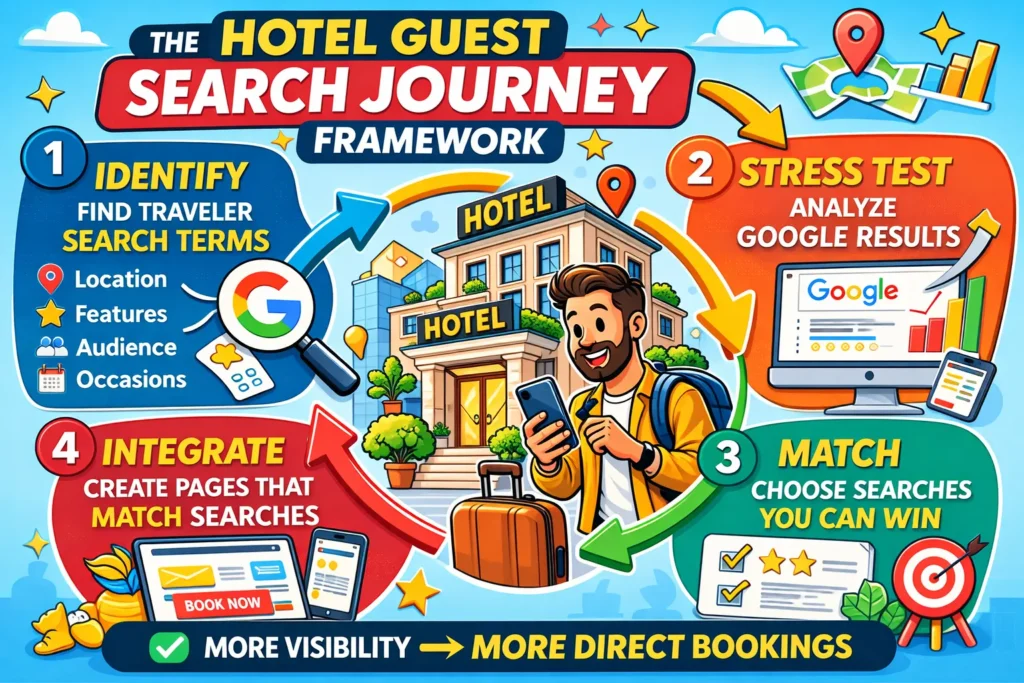
Why Many Hotels Struggle to Get Found Online
If travelers are constantly searching for hotels online, a logical question appears:
Why do so many hotel websites rarely show up in those searches?
In my experience working with SEO and online growth, the answer usually comes down to three structural reasons.
1. Platforms Invest Heavily in Understanding Search Behavior
Companies like Booking.com, Expedia, and Tripadvisor analyze millions of hotel searches every day. They study what travelers type, what they click, and what leads to a booking. Over time, this creates an enormous advantage.
Their websites are designed around traveler search intent.
If someone searches for:
- hotel near Hyde Park
- hotel with spa in London
- family hotel near Covent Garden
those platforms already have pages designed exactly for those searches.
Most hotels, on the other hand, simply launch a website and hope people will find it.
The difference is not technology, it’s understanding how travelers search.
2. Many Hotel Websites Are Built Like Brochures
When you look at many hotel websites, they often follow the same structure:
- Homepage
- Rooms
- Gallery
- Contact page
That might look nice visually, but it doesn’t necessarily answer how travelers search for hotels online.
Travelers usually search for something very specific, for example:
- hotel near Hyde Park
- hotel with parking in Covent Garden
- family hotel in London
- boutique hotel near Soho
If your website doesn’t clearly talk about those things, search engines have very little context to show your hotel in those searches.
In other words:
If a search intent doesn’t have a dedicated page or clear explanation, Google has no reason to rank your hotel for it.
3. Travelers Search for Solutions — Not for Hotel Websites
One of the biggest misconceptions in hotel marketing is this:
Hotels think travelers search for hotels.
In reality, travelers search for solutions to their travel needs.
Nobody opens Google and searches for:
“a nice hotel website.”
Instead, people search for things like:
- hotel near Hyde Park
- hotel with balcony in London
- spa hotel near Covent Garden
Each of these searches represents a specific need or expectation.
And this insight is incredibly powerful.
Because once you understand what travelers are actually looking for, you can position your hotel website to answer those questions directly.
That is exactly how hotels start appearing in more searches and attracting more direct bookings.
The Framework: How to Understand Your Guests’ Search Journey
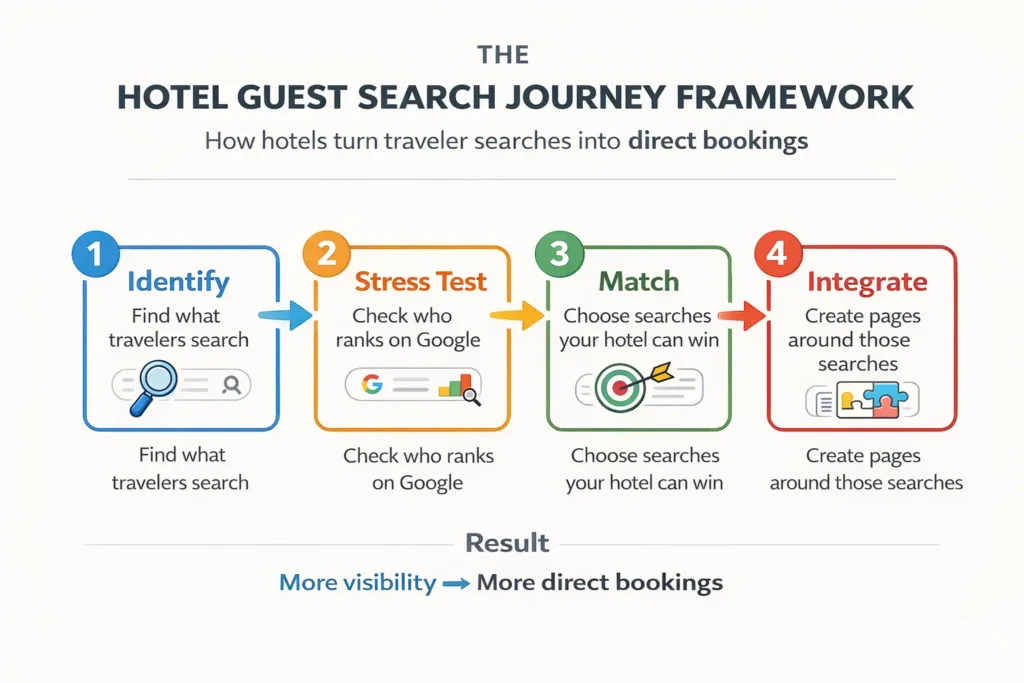
Understanding how travelers search for hotels online might sound complicated at first. But the good news is that you don’t need a huge marketing team or expensive software to figure it out. In fact, you can already learn a lot using a simple framework that helps you understand your guests’ search journey.
I like to call it:
The Hotel Guest Search Journey Framework 🧭
It consists of four simple steps:
1️⃣ Identify
Start by identifying the search terms travelers might use to find your hotel. Think about what people could type into Google, ChatGPT, or another search tool when they are looking for a place like yours.
These are often things like:
- hotel near Hyde Park
- family hotel in Soho, London
- hotel with balcony in Covent Garden
These hotel search terms are the starting point of the traveler’s journey. If there are a lot of hotels in your area, you can even try more specific search terms by using a combination (e.g. boutique hotel with view of Hyde Park).
2️⃣ Stress Test
Next, search those terms on Google. Look carefully at the results:
- Which websites appear?
- Are they mostly booking platforms?
- Are other hotel websites showing up?
This quick stress test shows whether a search term is realistic to compete for.
If other hotels appear in the results, that’s usually a good sign. It shows hotels actually made it work, which means you can also do it. But even if there are mostly platforms or editorials, if you do your job well, there might be potential to show up.
3️⃣ Match
Now compare the search terms you found with the actual strengths of your hotel.
Ask yourself:
- Which searches can my hotel truly fulfill well?
- Where do we have a clear advantage?
- What do our guests already love about our hotel?
Maybe your hotel is great for families, has a beautiful spa, or is located right next to a famous landmark. Those strengths should guide the search terms you focus on.
4️⃣ Integrate
Finally, look at the websites that already rank for those searches. Study what they do well:
- How do they describe their hotel?
- What pages do they have?
- What information do they provide?
Then use those insights to improve your own website and make it even clearer and more helpful.
Don’t worry, in the next sections I’ll walk you through each step in detail and show you practical examples from real hotel websites.
The goal of this framework is simple:
✅ Identify the hotel search terms travelers use
✅ Improve your website with clear, targeted content
✅ Get found more easily on Google and AI tools
✅ Turn more visitors into direct bookings
Or in short: Understand how travelers search → position your hotel accordingly → increase bookings and revenue. 🚀
Want to improve more than just this one page?
This guide focuses on one specific part of your hotel website. But direct booking growth usually comes from improving the full system: your positioning, homepage, room pages, feature pages, Google visibility, AI search readiness, and booking journey.
How to Apply the Framework to Get Found by Travelers Online
In the previous section we looked at the framework how to actually identify the search terms travelers use when they are looking for a hotel like yours. Now let’s put it into practice. I recommend you do the following steps for your hotel to increase the direct bookings of your website.
Step 1: Identify the Hotel Search Terms Travelers Use
Now let’s look at the first step of the framework in practice.
The goal here is simple:
Identify the search terms travelers might use when they are looking for a hotel like yours.
Once you understand those hotel search terms, you can start positioning your website to appear when people search for them.
A very good starting point is this simple formula:
Hotel + Location
Examples could be:
- hotel London
- hotel Covent Garden
- hotel near Hyde Park
If your hotel is located in a small town with only a few hotels, you might already show up for searches like “hotel + city.” But in larger destinations with many hotels, this becomes much harder. In that case, you usually need to focus on more specific searches, otherwise your hotel disappears in a sea of competitors.
Three Simple Ways to Discover Hotel Search Terms
Luckily, you don’t need expensive tools to find great keyword ideas. Here are three simple methods I use all the time when researching how travelers search for hotels.
1. Use Google Autocomplete
This is one of the easiest and most underrated research methods. 🔎 When you start typing something into Google, the search bar automatically suggests additional queries. Those suggestions are not random.
They are based on real searches from users.
For example, try typing:
hotel + your location
Google might suggest things like:
- hotel london near Hyde Park
- hotel london with parking in Soho
- hotel london with balcony Covent Garden
- hotel london near Heathrow Airport
You can discover even more ideas by adding small words like:
- near
- with
- in
- for
For example:
hotel LOCATION near + LANDMARK
hotel LOCATION with + FEATURE
hotel LOCATION for + AUDIENCE
Each suggestion represents a real search travelers are making. You noticed, that I’ve always used “hotel + location” as the starting point. This is usually the starting point for travelers. With autocomplete you can discover how travelers make the search more specific in your area and which search terms matter.
My recommendation:
Write all of them down in a list.
Later we’ll evaluate which ones are worth targeting
2. Use AI to Generate Search Ideas
AI tools like ChatGPT or Gemini can also help you identify potential hotel search queries. A simple trick is to give the AI some context about your hotel.
For example, you can paste:
- your website URL
- your homepage text
- a short description of your hotel
Then ask the AI to suggest likely search terms travelers might use.
Here is a prompt you can copy and use.

I run a hotel and want to understand how travelers might search for it online.
Here is my website: [INSERT WEBSITE]
Based on the location, features, and positioning of the hotel, please suggest at least 30 realistic search queries travelers might type into Google or AI tools when looking for a hotel like this.
Please group them into categories such as:
– location searches
– feature searches
– audience searches
– experience searches
This will usually generate many useful ideas within seconds. You should not blindly trust every suggestion, but it’s a great way to expand your list of possible hotel search terms.
3. Look at Your Hotel’s Real Strengths
And now comes a surprisingly powerful source of ideas:
Your own hotel.
Or more precisely, the features and strengths of your property.
Ask yourself questions like:
- Do we have a nice pool?
- Are we located near a famous landmark?
- Are we especially popular with families?
- Do we offer a wellness area? What is unique about it?
- Do some rooms have a beautiful view?
(we will discover more potential questions in the checklist chapter in this article)
Each of these features can become a potential search query.
For example:
- hotel Covent Garden with pool
- hotel near Hyde Park
- family hotel Soho, London
- hotel near King’s Cross with balcony
Write everything down.
At this stage, your goal is simply to collect as many relevant search ideas as possible.
FIVE Common Types of Hotel Searches
If you need inspiration, here are five common categories that explain how travelers typically search for hotels online.
A. Location/near Landmark Searches
Many travelers search based on where they want to stay.
Examples:
- hotel near Hyde Park
- hotel Covent Garden
- hotel near Heathrow Airport
- hotel near Times Square
Search engines give a lot of importance to location relevance, because travelers usually want a hotel close to something specific or in a specific area. If the area is too big (like hotel London), you will be competing with platforms, and it will be difficult to appear in searches.
B. Audience Searches
Some searches are based on who the hotel is for.
Examples:
- family hotel
- romantic hotel
- business hotel
- hotel for singles
Travelers want to know quickly whether a hotel fits their situation or travel style. That’s why it helps if your website clearly communicates who your hotel is best suited for.
C. Experience Searches
Sometimes people search for a specific type of experience.
Examples:
- spa hotel
- boutique hotel
- wellness retreat
These searches are very powerful because they often represent strong travel intentions and emotional motivations. When someone searches for a spa hotel, they are already imagining the experience they want.
D. Feature Searches
What is more, many searches focus on specific features or amenities.
Examples:
- hotel with pool
- hotel with balcony
- hotel with parking
- hotel with hot tub
These searches are usually very practical. Travelers simply want to know whether a hotel offers something important to them.
E. Occasion Searches
Finally, there might be an opportunity for you in people search for a hotel for a specific occasion:
- honeymoon hotel
- birthday hotel
- anniversary hotel
- girls trip hotel
These potentially convert extremely well and offer higher margins.
A Simple Tip That Works Very Well
In many cases, the most powerful search terms combine location + another element.
For example:
- family hotel near Hyde Park
- hotel with balcony Covent Garden
- spa hotel near Heathrow Airport
These combinations often represent very clear traveler intent. And clear intent usually means higher booking potential.
At this point, you should already have a solid list of possible hotel search terms travelers might use to find your hotel. In the next step, we’ll take those search terms and run a quick stress test on Google to see which ones are actually worth targeting.
Step 2: Stress Test Your Hotel Search Terms
Once you have a list of possible hotel search terms, the next step is very simple:
Google them.
This step is what I call the stress test. The goal is to quickly understand whether a search term is realistic to target or not. Simply type the search query into Google and carefully look at the results. Here are a few things I always check first.
Are the results mostly booking platforms or large websites?
If the results are dominated by platforms like Booking.com, Expedia, or Tripadvisor, it usually means the search is very competitive. These platforms have thousands of hotel listings and massive authority in search engines. That doesn’t mean it’s impossible to appear there, but it usually means it will be difficult to outrank them directly.
Are there many sponsored results?
If you see many paid advertisements at the top of the page, this is another sign that the search term is valuable and competitive. Hotels and platforms are paying money to appear there. That doesn’t mean you should give up, but it’s useful information when deciding which search terms to prioritize.
Do you see other hotel websites?
This is often the best sign. If Google shows individual hotel websites in the results, it means the search engine believes hotel websites can be relevant answers for this query. The next question then becomes: Can your hotel realistically compete with the ones that appear there?
Focus on the First Page
One important rule: Only the first page really matters. Very few travelers go to the second page of search results. So when you do your stress test, focus mainly on the top 10 results on the first page.
Example From a Quick London Test
To give you an example, I recently tested a few searches for hotels in London. When I searched for: “budget hotel Covent Garden London” the results were almost entirely dominated by large booking platforms.
That actually makes sense. Travelers searching for a budget hotel often want to compare many options and prices. Platforms are designed exactly for that. So even if your hotel claims to be the most budget-friendly option, many travelers will still prefer to compare multiple hotels on those platforms. This doesn’t mean you should ignore these searches completely. But it does mean they are often harder to win for individual hotel websites.
Now let’s look at a different example. When I searched for: “hotel Covent Garden London for singles” something interesting happened. Most of the results were individual hotel websites, not platforms.
Why? Because this search requires something platforms struggle with: Trust and positioning. A hotel website can clearly explain why it is a great choice for solo travelers, which is much harder for a generic platform to communicate. That makes this type of search a much better opportunity for individual hotels. Of course, this only works if your hotel actually provides something meaningful for solo travelers.
And that’s exactly what we’ll evaluate in the next step.
A Small Tip
When you run this test, don’t only check your exact neighborhood. Try a few nearby areas or districts as well. Sometimes you will discover patterns that help you better understand which types of searches Google prefers to show hotels for. Later in this article, I’ll also show a few examples from my small case study of hotels in London.
Step 3: Match Search Terms With Your Hotel’s Strengths
Now that you know which searches exist and how competitive they are, it’s time for the next step. Matching those searches with what your hotel actually offers.
At this point you probably have a list of many possible search queries. Now go through that list and ask yourself one simple question for each of them:
Can my hotel genuinely fulfill this search well?
If the answer is yes, put a checkmark next to it. Your goal is to identify the search terms where your hotel has a real advantage.
Study the Hotels That Already Rank
Next, take the search terms you marked and Google them again. Look carefully at the hotel websites that appear in the results.
Ask yourself two important questions:
What are they doing well?
Can my hotel realistically compete with them?
Sometimes you will notice clear patterns. Maybe the top results all emphasize wellness experiences, family-friendly rooms, or boutique design. This gives you valuable insight into what Google considers relevant for that search.
The Positioning Rule
One of the biggest mistakes hotels make is trying to target too many different search terms at once. Instead of trying to rank for everything, I recommend focusing on 3–5 strong search positions. Think of them as the areas where your hotel truly stands out.
For example, a hotel might aim to own searches like:
- family hotel Vienna
- hotel with kids play area Vienna
- family suites Vienna
Another hotel might focus on:
- boutique hotel Covent Garden
- romantic hotel Covent Garden
- boutique hotel near Soho
By focusing on a small number of clear search intents, your website becomes much more convincing for both travelers and search engines.
Examples of Strong Positioning
Here are a few examples of search positions hotels often successfully target.
For example:
Maybe 80% of your guests are families. That’s a strong signal that your hotel is already doing something well for that audience. In that case, searches related to family hotels could be a perfect fit.
Or maybe your hotel has the most beautiful wellness area in your area. Then positioning yourself as a wellness hotel could be a powerful strategy.
Another example could be a hotel with a very distinctive style and atmosphere. In that case, searches related to boutique hotels might be the best opportunity.
The key idea is simple:
Choose search positions that reflect what your hotel truly does best.
If you do this well, something interesting happens. Over time, travelers, search engines, and even AI tools start to associate your hotel with those strengths. And that makes it much easier for your hotel to appear in the right searches and attract the right guests.
Next we will look at the final step of the framework: How to integrate these search positions into your website. This is where your strategy turns into actual website pages that bring you more visibility and bookings. 🚀
Step 4: Integrate Your Search Positions Into Your Website
Now comes the interesting part. Up to this point you have:
- identified hotel search terms
- tested which ones are realistic
- selected the search positions that fit your hotel best
The next step is to use those insights to shape your website.
In other words:
The search terms you target should become visible elements of your website.
Your homepage, room pages, and feature pages should clearly communicate those strengths. And there is one very important rule to remember:
One Search Intent = One Page
Search engines and AI tools understand websites much better when each search intent has its own dedicated page.
For example:
- Family hotel → Family page
- Hotel with spa → Wellness page
- Hotel near landmark → Location page
- Hotel with balcony → Room page
This structure makes it easier for search engines to understand what your hotel is known for. And it also makes it easier for travelers to quickly find the information they need. Let’s look at a few examples.
Example 1: Positioning Your Hotel as a Family Hotel
If your hotel is particularly well suited for families, you should make that very clear on your website.
For example, you could:
- Mention the word “family” in your homepage title or introduction
- Explain why your hotel works well for families
For instance:
- family suites with extra bedrooms for children
- bathtubs suitable for kids
- a kids menu in the restaurant
- a play area for children
- babysitting or childcare services
The key is to give clear reasons why families choose your hotel.
You can strengthen this further by creating:
- a dedicated page about family rooms
- pages describing family-friendly features such as play areas or childcare services
Another powerful signal comes from reviews. If families mention your hotel in their reviews, respond and reinforce the positioning.
For example:
“We’re happy you and your family enjoyed your stay with us.”
This helps both travelers and search engines understand who your hotel is perfect for.
Example 2: Positioning Your Hotel Around Wellness
A beautiful wellness area can be a very strong selling point. Hotels that rank well for wellness-related searches usually make this feature very visible. Here are a few things that work well:
Create a dedicated wellness page that includes:
- high-quality photos
- videos
- detailed descriptions of the spa facilities
You should also mention wellness access when guests look at room booking options.
For example:
“All guests receive free access to the hotel’s wellness area.”
Or clearly explain if access is available for an additional charge. It can also make sense to mention wellness directly on the homepage or even position your hotel as a wellness hotel if it truly reflects your offer.
Example 3: Positioning Your Hotel as a Boutique Hotel
The term boutique hotel is often associated with a specific atmosphere and style. If this fits your hotel, it should be reflected clearly on your website.
For example:
- Use the term “Boutique Hotel” in your positioning
- Describe the style, atmosphere, and personal service in detail
- Highlight the intimate size of the hotel if applicable
Strong visual storytelling also helps here. Use stylish photos and design-focused images that reflect the personality of your hotel. You can even describe how your hotel reflects the culture and character of the surrounding neighborhood.
Another useful tactic is to connect with travel blogs or websites that feature boutique hotels. These mentions can further strengthen your positioning online.
Example 4: Positioning Your Hotel Around a View
A great view can be an incredibly powerful selling point. If your hotel offers rooms with beautiful views, you should highlight this as clearly as possible.
The most important element here is visual presentation.
For example:
- show the view on your homepage
- include the view in your room photos
- show the view from rooftop terraces, restaurants, or wellness areas
You can also name rooms based on the view.
For example:
- “Room with view over Soho”
- “Tower Bridge View Room”
- “Balcony Room with view of Westminster Abbey”
This creates a very strong connection between search queries and your room offerings. If multiple areas of your hotel have great views, you can even create dedicated pages such as:
- rooftop terrace with city view
- spa with skyline view
- restaurant with park view
Example 5: Highlight the Area Your Hotel Is Located In
This is one of the most important positioning elements of all. Travelers care deeply about where a hotel is located. That’s why you should always clearly highlight the area or neighborhood of your hotel.
For example:
- include the area in your homepage title
- mention it on room pages
- describe it in your hotel introduction
It can also be extremely helpful to create a dedicated page about the area. On that page you can:
- explain why the location is special
- recommend nearby restaurants or attractions
- highlight important landmarks
- mention walking distances
You can even describe a perfect day around your hotel. If you have many ideas, this can also become a series of blog articles about the neighborhood.
Another small but powerful trick:
Be specific with names.
- Instead of writing “beach view” write “view of Coogee Beach”
- Instead of “city view” write “view of Downtown Manhattan”
- Instead of: “walking distance to the railway station” write “5-minute walk to King’s Cross Railway Station”
These details give search engines and AI tools much more context to understand your location.
A Simple Rule to Remember
In general, the more clear, detailed, and structured information your website provides, the easier it becomes for search engines and AI tools to recommend your hotel. That’s why my main advice is simple:
Create a dedicated page for each important search position.
Don’t try to mix too many topics into one page. Clear pages help both travelers and search engines understand what makes your hotel special.
In the next section, we’ll look at real examples of hotels that apply this strategy successfully. This will give you inspiration for how other hotels turn their positioning into visible search results. 🚀
Want more hotel website ideas like this?
I regularly share practical thoughts on hotel SEO, AI search, direct bookings, website clarity, and how independent hotels can become easier to find and book directly.
Practical Examples: Hotels That Use Search Positioning Successfully
So far we talked about how travelers search for hotels and how you can identify the right search terms for your property. But theory is one thing. What really matters is how this looks in practice.
To illustrate this, I did a small case study of hotels in London. London is an interesting market because it is extremely competitive, with thousands of hotels competing for visibility in search results. Yet even in such a competitive environment, some hotels manage to appear very prominently in organic search results.
Why?
Because they structure their websites around specific traveler searches.
Below are a few examples that illustrate how hotels successfully do this.
Example 1: Spa Positioning Near Hyde Park
Search: hotel near Hyde Park with spa
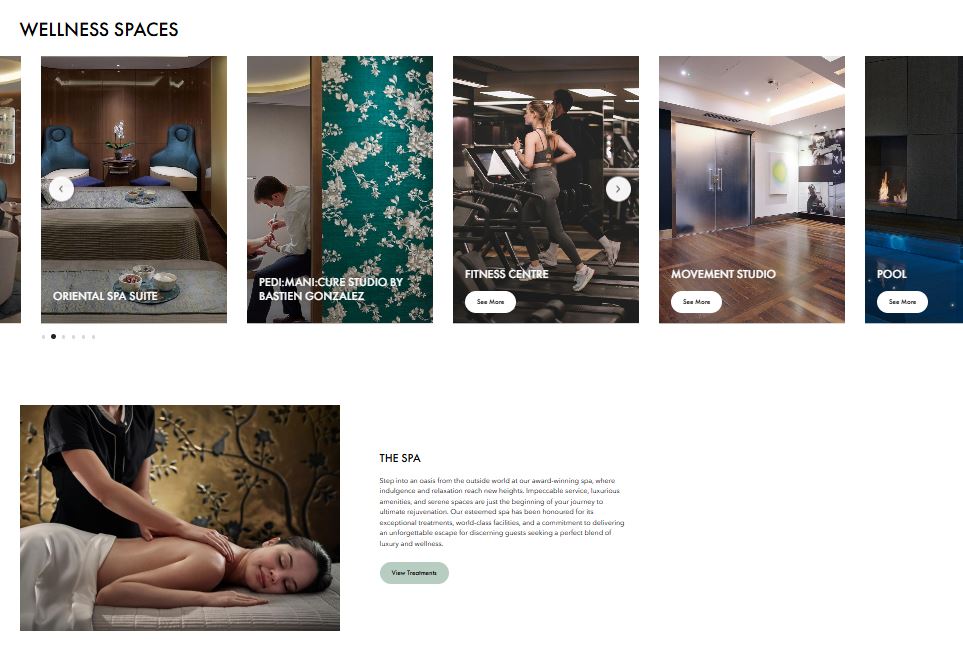
When searching for this query, one hotel that appears prominently is the Mandarin Oriental Hyde Park.
What they do exceptionally well is how they present their wellness offering. Instead of simply mentioning the spa somewhere on the website, they created a complete wellness section with dedicated pages.
You can see it here:
https://www.mandarinoriental.com/en/london/hyde-park/wellness
Their wellness section includes:
- a main spa page
- separate pages for treatments
- detailed descriptions of facilities
- high-quality images and videos
This creates a very strong signal to search engines that wellness is a core part of the hotel experience. And because the hotel is located directly next to Hyde Park, it becomes a very relevant result for searches combining location + spa.
SEO Lesson: If an amenity is important for travelers (like a spa), it deserves its own dedicated page.
Don’t hide it in a paragraph on the homepage. Make it a clear and detailed part of your website.
Example 2: Solving the Parking Problem in Covent Garden
Search: hotel Covent Garden with parking
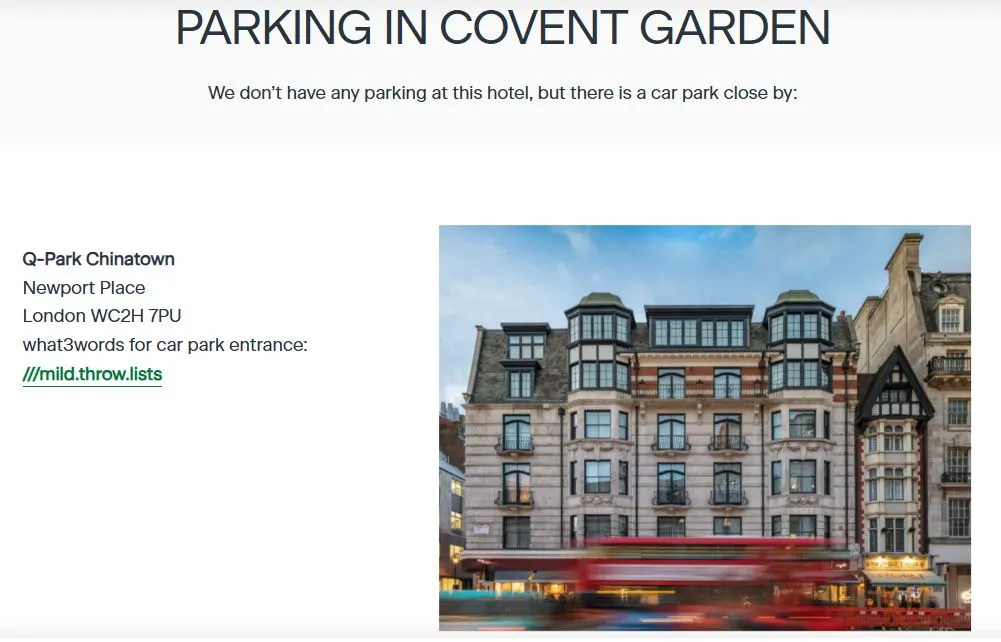
Parking in Covent Garden is notoriously difficult and expensive. Because of this, many travelers hesitate to book a hotel there if they arrive by car. The Resident Covent Garden hotel solved this problem in a very clever way.
They created a dedicated Car Parking page:
https://www.residenthotels.com/covent-garden/car-parking/
Interestingly, the hotel itself does not have its own parking.
Instead, the page explains:
- nearby parking garages
- walking distances
- discount partner options
Most hotels bury this information somewhere in an FAQ section. But by creating a dedicated page about parking, they can appear in searches like:
hotel Covent Garden with parking
What they are really doing here is solving a traveler’s logistical problem before the booking even happens.
SEO Lesson: Create pages that solve traveler problems even if the solution is outside your hotel.
Helping travelers plan their stay can make your website more relevant than competitors who provide less information.
Example 3: Ranking With a Jacuzzi Suite
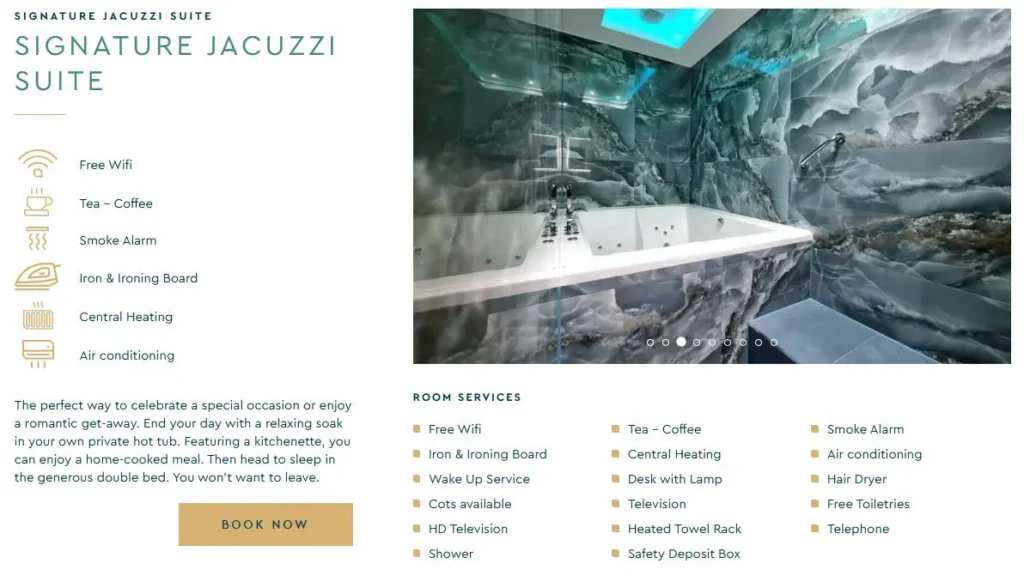
Search: hotel near Hyde Park with hot tub
Searches related to Jacuzzis or hot tubs are usually dominated by large booking platforms. These platforms offer filter options like:
- “hot tub”
- “spa bath”
- “Jacuzzi”
But the NOX Kensington Gardens Hotel managed to compete with them.
How?
By creating a dedicated room page for their Signature Jacuzzi Suite. You can see it here:
The page includes:
- the word Jacuzzi in the URL
- a clear H1 headline
- detailed room information
- strong visual content
This creates a very precise match for searches like:
hotel with jacuzzi near Hyde Park
Instead of showing a list of hotels, Google can show a specific hotel room that perfectly matches the search.
SEO Lesson: A single, highly relevant page can sometimes outrank large platforms.
If your hotel offers a unique feature, create a dedicated page that focuses entirely on that feature.
Example 4: Turning a View Into a Search Advantage
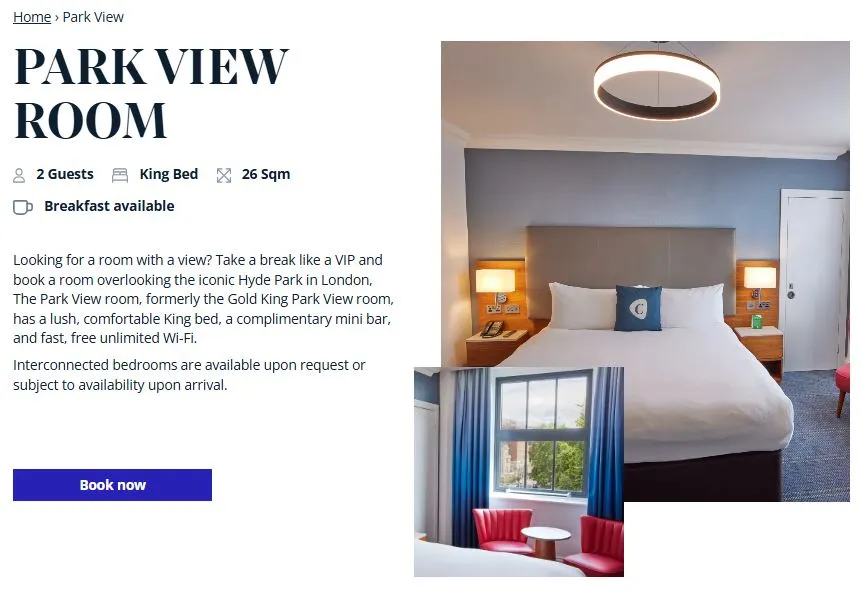
Search: hotel near Hyde Park with view
One hotel that uses this idea well is The Cumberland Hotel at Hyde Park. Their strategy is surprisingly simple. Instead of only mentioning the view in a description, they created a room category called:
Park View Room
You can see the page here:
https://www.thecumberland.com/room/park-view-room/
By naming the room after the view, they create a perfect match for searches related to Hyde Park views. Google’s algorithm now clearly understands that this room is specifically designed for travelers who want a park view experience. This is much stronger than a generic room description that only briefly mentions a view.
SEO Lesson: If a feature is important, make it part of the product name.
For example:
- Park View Room
- Balcony Suite
- City Skyline Room
This helps search engines connect your rooms directly with traveler search queries.
What These Examples Have in Common
Although the examples above are very different, they all follow the same principle. Each hotel created clear pages that match specific traveler searches. Instead of trying to rank for very broad terms like:
hotel London
they focus on specific search intents, such as:
- hotel with spa near Hyde Park
- hotel with parking Covent Garden
- hotel with jacuzzi suite
- hotel with park view
This approach makes their websites more relevant for specific searches, which increases their chances of appearing in search results.
In the next section, we’ll turn everything you’ve learned so far into a simple checklist you can use for your own hotel website. ✅
Get practical hotel website ideas in your inbox
In my newsletter, I share clear, actionable ideas for hotel owners and marketers who want more guests to find, trust, and book their hotel directly.
Hotel SEO Checklist: Identify the Search Terms Your Hotel Should Target
By now you understand an important principle: Travelers rarely search for a specific hotel. They search for a solution to their travel needs. Your job is to identify which of these searches your hotel should appear for.
To make this easier, here is a simple checklist you can follow.
Step-by-Step Hotel Search Term Checklist
Use the following process to identify the search opportunities for your hotel website.
✅ Step 1: Identify 20–50 potential hotel search terms
Start by writing down all possible ways travelers might search for a hotel like yours.
✅ Step 2: Google each search term
Check the search results and see what type of websites appear.
✅ Step 3: Look for searches where individual hotels rank
If you see hotel websites in the results, that’s usually a good sign.
✅ Step 4: Select your best 3–5 search positions
Focus on the searches where your hotel has a real advantage.
✅ Step 5: Create dedicated pages for those searches
Each important search intent should ideally have its own page on your website.
✅ Step 6: Use the search term in key elements
Include the search term in:
- the page title
- the headline (H1)
- the page description
- image descriptions
✅ Step 7: Add helpful details and visuals
Search engines and AI tools love clear context.
Include:
- photos
- detailed descriptions
- amenities
- nearby landmarks
practical information for travelers
Hotel Search Term Worksheet
To help you get started, here is a list of common search patterns travelers use when looking for hotels.
You can use this list as a worksheet.
Simply check:
✔ if your hotel already fulfills this search
📄 if you should create a page for it
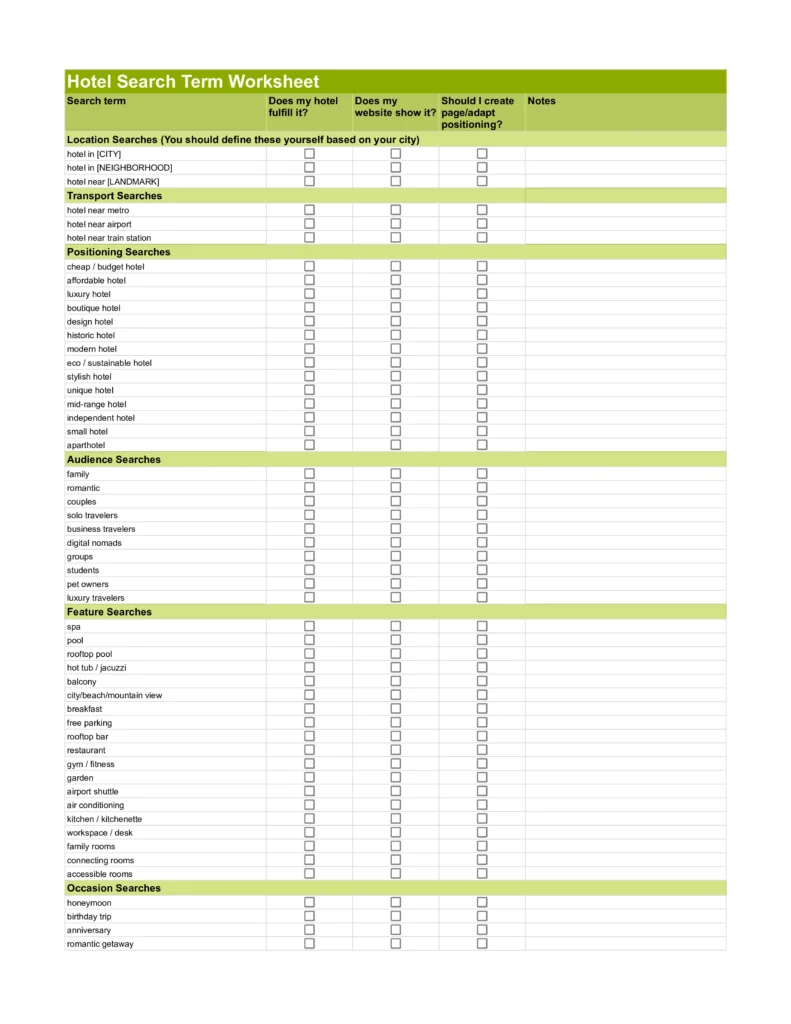
Download the full worksheet below for free and start turning search terms into more visibility and bookings.
These searches can be powerful because they often signal high purchase intent.
In the end you table could look like this and you have clear actions to take:
Search Term | Does my hotel fulfill it? | Does my website show it? | Should I create page/adapt positioning? |
family | ✔ | ❌ | ✔ |
near train station | ✔ | ✔ | ❌ |
wellness | ✔ | ❌ | ✔ |
The Key Strategy
Once you go through this worksheet, you will likely discover dozens of possible search opportunities.
But remember the rule from earlier: Don’t try to target everything.
Instead, choose 3–5 strong search positions where your hotel truly stands out. Then build clear pages on your website around those strengths. That’s how hotels turn search visibility into direct bookings.
A Quick Note About Search Volume
You may notice that some search terms in the list above are much more common than others.
For example, searches like:
- boutique hotel
- luxury hotel
- hotel with spa
- hotel near airport
are used very frequently by travelers.
Other searches, such as:
- unique hotel
- stylish hotel
- hotel with workspace
may have lower search volume, meaning fewer people search for them each month.
However, that doesn’t make them unimportant. In fact, smaller niche searches can often be much easier to rank for, especially for individual hotel websites.
Large booking platforms tend to dominate very broad searches like:
cheap hotel London
But they are often weaker when it comes to very specific search intents.
For example:
- hotel with rooftop pool near Hyde Park
- boutique hotel Covent Garden
- family hotel with connecting rooms
These types of searches may have fewer searches, but they often bring highly motivated travelers who know exactly what they want.
That’s why a smart hotel SEO strategy usually combines:
1–2 high-demand searches
and
2–3 very specific niche searches
This balance allows your website to attract both visibility and highly qualified guests.
How This Fits Into the Bigger Strategy of Direct Hotel Bookings
Everything we discussed in this article is actually just one piece of a bigger strategy. Many people think SEO is mainly about getting more traffic to a website. But in reality, good SEO is about solving traveler problems earlier in their journey.
When someone searches for something like:
- family hotel near Hyde Park
- hotel with spa in Covent Garden
- hotel near airport with shuttle
they are not just looking for a hotel.
They are looking for a solution to a specific need. The hotel that clearly answers that need first is the one that wins the booking.
Why This Matters for Direct Bookings
Platforms like Booking.com and Expedia are very good at understanding traveler searches. That’s why they often appear at the top of search results. But there are parts of the traveler journey where your hotel website can do a better job than any platform.
For example:
- explaining why your hotel is perfect for families
- showing the atmosphere of your boutique hotel
- presenting your spa, rooftop, or unique view
- recommending what to do in your neighborhood
These are things no booking platform can explain as well as you can. When your website clearly answers these questions, something powerful happens: Travelers start to trust your hotel directly. And trust is one of the most important factors when people decide where to book.
The Positive Booking Flywheel
If you do this consistently, you create a powerful flywheel.
It works like this:
1️⃣ Travelers find your hotel because your website answers their search.
2️⃣ They book directly because your website clearly shows why your hotel fits their needs.
3️⃣ They have a great stay and leave positive reviews.
4️⃣ Those reviews strengthen your reputation and positioning.
5️⃣ Search engines and AI tools start recommending your hotel more often.
Over time, this creates something every hotel wants: A sustainable direct booking engine.
And the first step to building that engine is simple: Understand how travelers search for hotels and make sure your website answers those searches better than anyone else. 🚀
Conclusion: Turning Search Intent Into Direct Bookings
Many hotels invest a lot of time and money into their website. But surprisingly few take the time to understand how travelers actually find hotels online. Once you start looking at the traveler journey more closely, an important insight becomes clear:
People rarely search for a specific hotel.
They search for solutions like:
- family hotel near a landmark
- hotel with spa
- boutique hotel in a specific neighborhood
The hotels that win these searches are usually not the biggest ones. They are the ones that clearly communicate what they offer and who their hotel is perfect for. By identifying the search terms travelers use, testing them, and building dedicated pages around your strengths, you make it much easier for search engines and AI tools to recommend your hotel. And when travelers understand quickly why your hotel fits their needs, they are also much more likely to book directly.
If you want to go deeper into how hotels can build a full strategy around this idea, I recommend reading my guide on hotel SEO and direct bookings:
👉 https://patricklindbichler.com/hotel-seo-how-hotels-get-more-direct-bookings-from-google-chatgpt/
Because once you understand how travelers search for hotels, you’ve already taken the first step toward building something every hotel wants:
A sustainable engine for direct bookings.
FAQs: How Travelers Find Hotels Online
1. How do travelers usually find hotels online?
Most travelers start their search on Google, AI tools like ChatGPT, or booking platforms like Booking.com and Expedia. They usually search for specific needs such as “hotel near airport,” “family hotel,” or “hotel with spa.”
Hotels that clearly answer these searches on their websites are more likely to appear in results and attract direct bookings.
2. What are the most common hotel search terms?
Hotel searches usually combine location with a specific feature or audience.
Examples include:
- hotel near Hyde Park
- family hotel London
- boutique hotel Covent Garden
- hotel with rooftop pool
These types of searches are often called search intent queries because they reflect what travelers are actually looking for.
3. Why do booking platforms often rank higher than hotel websites?
Platforms like Booking.com and Expedia rank highly because they analyze millions of traveler searches and build pages around those queries.
Many hotel websites, on the other hand, are structured like brochures and don’t include pages for specific search terms such as “hotel with balcony” or “family hotel near landmark.”
When hotels create pages that match traveler searches, they can compete much more effectively.
4. How many search terms should a hotel target?
Instead of trying to rank for dozens of keywords, most hotels should focus on 3–5 strong search positions.
For example:
- boutique hotel in a neighborhood
- family hotel near a landmark
- hotel with spa or wellness
Focusing on a few clear positions helps search engines and travelers understand what your hotel is known for.
5. What is the best way to rank a hotel website on Google?
The most effective strategy is to create clear pages that match traveler search intent.
For example:
- a page about your wellness area
- a page about family rooms
- a page about your neighborhood
- room pages that highlight specific features
The clearer and more helpful these pages are, the easier it becomes for Google and AI tools to recommend your hotel.
Want to know what your hotel website is missing?
I help independent hotels improve their website structure, Google visibility, AI search readiness, content clarity, and direct booking journey. In a free website check, I’ll show you specific opportunities your hotel may be missing right now.
The Prompt used To Create this article
I want to be transparent on how this article was written, so below you will find the prompt to create this article. Of course, I asked for adjustments afterwards, but here is the initial input:
Check the prompt
Can you create a compelling blog article for my website, www.patricklindbichler.com? I will first give you a full outline of my draft for the article, so you have the full context. Then we will create each section together step-by-step. So, no need to start writing, just give me feedback on the ideas of the draft and where you would see good additions or improvements.
I want to make the articles a bit longer, so people can find clear information. The article should be clear and easy to understand, especially for people who are new to the topic. Still it should stay as compelling as the original article and also have the same length. It should be written in good American English, using not too complicated words so that even non-native English speakers can follow along easily. The tone should reflect my expertise as a thought leader in SEO, content creation, and leadership. Feel free to use examples from my experience as proof points and explain them in a clear and compelling way.
I am typically a positive and humorous person, so the writing style can be upbeat with a few lighthearted jokes here and there—just nothing offensive. The article should be engaging, fun to read, and educational. Please follow the structure outlined below, and feel free to expand on the points with additional context to ensure that each paragraph presents clear arguments.
Structure of the article:
- Introduction or The Problem (Hook): Start with a paragraph that summarizes the topic and grabs attention. You can make a strong statement or ask a thought-provoking question that will be answered later in the article.
- Key Highlights (3-4 bullet points): Include a few short bullet points summarizing the key takeaways of the article. Each point should be 1-2 sentences long.
- Main Content: Break the main part of the text into several text parts, each with a heading optimized for SEO and AI search. Each text part can have 1-3 paragraphs with 5-20 sentences each, depending on how much content is needed to explain the point clearly and bring the argument across. The paragraphs should be easy to read and compelling. Here is a structure for the main content:
- Explain Why the Problem Exists
- The Framework / Solution
- Deep Dive into Each Element
- Practical Examples
- Quick Checklist
- Connect to the Bigger Strategy
- Internal Links (Very Important)
- Headlines: Please formulate the headlines and include important keywords for SEO.
- Conclusion: Wrap up the article by summarizing the main points and inviting readers to reach out if they have any questions or want to learn more.
- FAQs: Include 5 frequently asked questions about the topic, with clear answers that add value to the reader.
Formatting:
- Use bold for key points, ensuring every 4th or 5th sentence has something in bold for emphasis.
- Add emojis throughout (but no more than 50 total) to make the article more visually appealing.
- If you include practical tips, illustrate them with real-life examples to make the content relatable.
- Please make the article a minimum of 1800 words. Feel free to ask me if you need more input or add information and context where you feel it’s necessary to convey a message or provide more clarity.
Goals:
- Please optimise the article for SEO. Give recommendations for search terms to include and integrate them into the titles of the paragraphs and the beginning of the article
- Please make the article engaging so people are intrigued to read, but also enjoy reading.
- What readers learn in the article, should be easy to apply for them because everything is explained clearly and has examples
Please use the following input to create the article:
- The Problem (Hook)
Do you actually know how people find your hotel online. Sure some come through Google, some through AI like ChatGPT or Gemini, some through platforms like Expedia or Booking.com. But do you actually know their journey? What do they type to search you? How do they find you? What are the reasons why the book or don’t book with you?
If you have never asked yourself those questions, start doing it. The people at platforms like Expedia or Booking.com are constantly doing it, with success. That’s why many people book there instead of your website. Because they provide the answers to people’s questions. And they do it well.
The good news: No one can do specific parts of the journey as good as you. That’s why you should read this article and increase your bookings and revenue. Thank me later.
- Explain Why the Problem Exists
→ Discuss with AI to create or collect ideas
- The Framework / Solution
I’ll show you a simple framework, on how you can look at the customer journey
- Identifying: Identify the potential search terms people use to find your hotel
- Stress Test: Google those terms to see who comes up and if your hotel website comes up
- Matching: Evaluate the features of your hotel to see which search terms you can fulfil
- Integrating: Learn from the top positions what they are doing well and do it better
Don’t worry, I’ll walk you through the steps.
The goal is:
- That you identify clear search terms you want to get found for
- You improve your website with some very easy steps
- Get found, get more bookings, get more revenue
- Deep Dive into Each Element
Now I’ll show you how you can do each of the steps in practice
- Identify the potential search terms people use to find your hotel
First step is to identify, which terms people might use to search for your hotel. I’ll give you a clear starting point:
“Hotel + LOCATION”
This can be a city or an area. If you are one of very few hotels in the area, then you should show up here. If there are many hotels, you should identify niche segments, otherwise you will disappear in a sea of hotels.
There are a couple of ways to identify specific niche searches. Here are my 3 favourites:
- Google Autocomplete: It’s very simple, when you type something on Google, you receive proposals. They are actually based on user data, so what comes up there is a query that is actually used by many people. Try type “hotel + your location” and see which suggestions come up. You can add words like “in”, “near”, “with”, or “for” to receive more specific proposals. Write all of them in a list.
- AI: Ask ChatGPT or Gemini. For instance put the link of your website, copy your homepage content and ask what might be likely search terms people search on Google or LLMs for my hotel? (Let’s add an info box with an actually prompt people can just copy)
- Your hotel: You are right, your hotel can give you the answers. Just ask it nicely. Just kidding. What you can do is looking at features of your hotel. Does it have a pool? Is it located near a landmark? Is it especially suited for families? … Again write everything down.
If you need inspiration, here are some types of searches how people search for hotels:
- Location Searches
Examples:
- hotel near Hyde Park
- hotel near Heathrow Airport
- hotel near Times Square
Explain: Why Google prioritizes location relevance.
- Audience Searches
Examples:
- family hotel
- romantic hotel
- business hotel
Explain: Why hotels should clearly state their audience.
- Experience Searches
Examples:
- spa hotel
- boutique hotel
- wellness retreat
Explain: Why experience-driven searches convert well.
- Feature Searches
Examples:
- hotel with pool
- hotel with balcony
- hotel with parking
My advice is to combine location searches with at least one of the others.
Now you should have a nice list of potential search terms people might use to find you.
- Stress Test: Google those terms to see who comes up and if your hotel website comes up
Next up, is a stress test. Simple google those terms you identified and see what comes up. This will help us identify if it is worth pursuing them or not. What I would check in the results:
- Are the mostly platforms and articles? → very difficult to rank.
- Are there many sponsored results? → also a sign that it is competitive to get clicks, but no reason to give up
- Are there other hotels? → Good sign that it is possible to rank. The question is, can your hotel compete with them?
One important note: We only care about the first page.
I was doing a test for hotels in London, what I found to give you an idea:
- I searched for “budget hotel covent garden london” and only found platforms. Which makes sense because budget-conscious people want to compare prices across various hotels. It doesn’t help if you say you are the most budget-friendly hotel. People will still compare. I’m not saying you can’t show up here, but it seems to be a more difficult niche.
- On the other hand, when I was checking “hotel covent garden london for singles”, mostly hotels showed up. Here, it is a great opportunity for hotels to convey trust for single travellers, which is more difficult for platforms. So this seems like a good opportunity. Of course you need to have dedicated offers for single people, which we’ll check in the next section.
Of course, just checking your own area might be misleading sometimes. Try doing the same for neighbouring areas of your city to confirm your theory. Also below, I give you some indication of what I’ve discovered in a case study below in chapter.
- Matching: Evaluate the features of your hotel to see which search terms you can fulfil
Now you have a list of a lot of specific search queries travellers use in your area. Next step is to identify which you can actually fulfil well and ideally where you are uniquely positioned. So go through your list, and put a checkmark next to each search query that you can fulfill well. Next, go through all the search queries again that you have put a checkmark and google them. Check the other hotels that appear in the top results. Ask yourself 2 things:
- What are they doing well?
- Can I compete with them?
Try to do an honest assessment and identify your top positionings. It can also only be one. If executed well, it can be the one thing people, as well as search engines and AI will recognize you. I give you some examples:
- 80% of your guests are families, which means you are doing something well for them
- You have the most beautiful wellness area in your area
- You are one of the nicest boutique hotels in the area
Those are some of the examples you can target well. So let’s see how to do it.
- Integrating: Learn from the top positions what they are doing well and do it better
Now comes the interesting part: Using what you identified to your advantage. The search terms, that you target, become actually the positioning of your website or at least very prominent elements. Let me give you some examples, and I recommend reading all of them because some of the ideas you can use for other features as well:
- Family Hotel
If you want to become known as a family hotel in your area, I recommend the following:
- Feature the term “family” in the title of your homepage + provide some reasons why you are a family hotel (e.g. we have family suites with extra bed rooms for children and bath tubs, our restaurant offers a special kids menu, we have a big playing area for kids, we offer nursing for kids so parents can have some private time, families recommend us, …)
- Have a separate page that features a family room and describes why it fits families so well
- Have pages for individual features designed for families like a playing area for kids, nursing for kids so parents can have some private time, …
- Collect reviews from families and respond to them. Include words like “We are happy you visited us with your family”
- Hotel with Wellness
A nice wellness area can be a big selling point, what I’ve seen for top performing hotels in search what you can do:
- Create a nice separate page about your wellness area with high quality images and videos and a detailed description
- Mention when booking the rooms that you have free (or for an extra charge of …) access to the hotels wellness area
- Mention the wellness on your homepage at the top or even consider calling yourself a “wellness hotel”
- Boutique Hotel
Also this can be a very nice positioning, what you can do in this case
- Call your hotel a “Boutique Hotel” (obviousely)
- Describe vibe, style and personal service in detail. Mention the intimate size if applicable.
- Use stylish images
- Describe how you reflect the culture, history, and style of their surrounding neighborhood in the hotel
- Ask blogs and websites about boutique hotels to feature you
- Hotel with a view
This can be big seller and there are a couple of things you can do:
- Most important of all are the visual elements. Show the view on the homepage, show the view on room pages (for those that have a nice view), show the room from the rooftop terrace if you have one
- Call the rooms that have a view “… room with view over Soho” or “with view of Tower Bridge” or “with balycony with view of Westminster Abbey”
- Have a separate page for each facilitiy with view e.g. wellness, gym, rooftop bar/restaurant with view, … Also mention if your hotel is unique in this regard
- Hotel in AREA
I saved the most important for last, because you should always highlight the area you are in. What you should do:
- Mention the area in the title on your homepage and room pages
- Have a page describing the area, why your hotel is a proud part of it, give local recommendations, highlight the most important landmarks, mention distances to each, describe a perfect day → if you have too much to say, consider writing a couple of blog articles about the area
- Whenever you describe something, mention specific names e.g instead of beach view → view at Coogee Beach, city view → view of Downtown Manhattan, walking distance to railway station → walking distance to King’s Cross Railway Station
Those are just a few examples. In general what is true is, that you can add information and details. Make things very clear and explicit. Search engines and AI love context. The more they have, the more they can use it. My clear advice is to create a unique page for each point. Don’t mix to many things into one.
Next, we’ll see some hotels that did it very well
- Practical Examples
I did a case study of hotels in London, to show you some examples of hotels that integrated their positioning very well, so they are featured very prominently in organic search results.
Search: Hotel near Hyde Park with Spa
I found the Mandarin Oriental when I was looking for Hotel near Hyde Park with Spa. I think their website is stunning. What they did exceptionally well regarding their spa, is to have a full page about it with several sub-pages. Look for yourself
https://www.mandarinoriental.com/en/london/hyde-park/wellness
Search: Hotel Covent Garden with Parking
The Problem: Parking in Covent Garden is notoriously difficult and expensive, leading many travelers to avoid the area if they are driving.
The Clever Move: They created a dedicated “Car Parking” landing page. So they get found without even having car parking at their hotel.
Why it works: Most hotels bury parking info in a small FAQ section. By creating a dedicated page with specific garage names, walking distances, and discount partner rates, they rank for “Hotels with parking Covent Garden.” They aren’t just selling a room; they are solving a major logistical anxiety before the user even books.
https://www.residenthotels.com/covent-garden/car-parking/
Search: Hotel near Hyde Park with Hot Tub
The Problem: The “Jacuzzi/Hot Tub” category is almost entirely owned by big platforms like Booking.com and Expedia because they have “filter” pages.
The Clever Move: The NOX Kensington Gardens created a stand-alone URL for the “Signature Jacuzzi Suite.”
Why it works: By putting the high-value keyword “Jacuzzi” in the URL slug and the H1 header of a dedicated room page, they tell Google that this specific page is a 100% match for that intent. This allows them to “leapfrog” over giant platforms that only offer a general list of hotels, as Nox provides the single most relevant direct answer.
Search: Hotel near Hyde Park with View
The Cumberland (Hyde Park)
Strategy: The “Attribute-to-Title” Mapping
The Problem: Thousands of hotels claim to have a “view,” making it hard for Google to distinguish which ones actually prioritize it.
The Clever Move: They officially named a specific room type the “Park View Room.”
Why it works: By making the “View” part of the product title rather than just a bullet point in a description, they create a perfect semantic match for the query “Hotels with Hyde Park view.” When Google’s algorithm looks for the most “authoritative” source for a view, a room named after the view carries more weight than a generic room that just happens to have a window.
https://www.thecumberland.com/room/park-view-room/
- Quick Checklist
Create list of search terms from here: https://docs.google.com/spreadsheets/d/19dZVKGOTtr89ezeF5JmXlYOq46eqPeNEulRh_lp0wD4/edit?gid=0#gid=0
With checklist if hotel getsfalready found for it + can position itself for it + has done so on their website
- Connect to the Bigger Strategy
This is actually one of the puzzle pieces to get more direct bookings on your hotel website. If you can understand how people find you, you have put yourself in the position to solve key parts of their journey. The better you do it, the more trust you create and the more people will directly book with you.
Of course you need to deliver when they are at your hotel. If you promise something that you can’t deliver, it will backfire. But if you deliver, people will recommend you and that supports your positioning even further. And this will become a positive flywheel and you have created yourself a very profitable booking engine
- Internal Links (Very Important)
Every article should link to 3–5 others.
Example:
- hotel SEO guide
- how to write room descriptions
- how to structure your homepage
- how to rank for landmarks
This builds topical authority.




One Response
I really like your point about hotels knowing their property and guests better than booking platforms. It makes me think about how hotels could use that knowledge to create descriptions and content that align with the exact search terms travelers use. That seems like a practical way to make a hotel more discoverable online without relying solely on platforms.