
Intro: Why Most Hotel Room Descriptions Fail (And Cost You Bookings)
I’ve analyzed hundreds of hotel websites, and one problem keeps showing up again and again:
Hotels lose direct bookings because their room descriptions are not clear enough.
And the frustrating part? Most of them don’t even realize it’s happening. Let me show you what actually goes on in a guest’s mind.
A traveler is planning a trip. Maybe it’s a couple looking forward to a quiet weekend. Maybe it’s a business traveler who needs to be sharp the next morning. Or someone who simply wants to sleep well for once.
They land on your website, click on a room… and start imagining their stay.
But with that imagination come very specific questions.
- Will the bed actually be comfortable or is it two single mattresses sliding apart?
- Is the room quiet enough to sleep through the night?
- Can I control the temperature, or will I wake up freezing or sweating?
- Are there proper pillows or the kind that ruin your sleep after one night?
These are not “nice-to-have” details. For many guests, these are dealbreakers.
Some will take the time to ask.
They’ll write an email. Maybe even call.
But many won’t. They’ll scan your page for a few seconds, not find the answers… and move on.
Back to Google.
Over to Booking.com.
Gone.
Not because your hotel isn’t a great fit — but because the information wasn’t there when they needed it.
And here’s where it gets even more interesting. On platforms like Booking.com, these details are often easier to find. Not perfect — but clearer, more structured, more complete.
So even if a guest discovered you through Google… they end up booking somewhere else.
I’ve spent years working in travel and tourism, optimizing booking flows and analyzing what actually drives conversions. And one pattern became incredibly obvious:
Uncertainty kills bookings.
The moment a guest is unsure about something important (even a small detail) the chance that they leave your website increases dramatically.
And now, with AI search tools like ChatGPT or Perplexity, this effect is accelerating. Guests can compare dozens of hotels in seconds. They can ask highly specific questions and get direct answers instantly.
✔️The hotels that provide clear, structured, detailed information will be recommended.
❌The ones that stay vague will simply be skipped.
The good news?
📈 You can outperform every booking platform.
Because no one knows your rooms better than you do.
In this article, I’ll show you exactly how to create high-converting, SEO-friendly hotel room descriptions that:
- remove uncertainty
- match what guests actually care about
- perform in Google and AI search
- and most importantly → turn visitors into direct bookings
In this guide
- Why most hotel room descriptions stay vague and why that costs you bookings
- The Zero-Uncertainty Framework to turn room pages into booking drivers
- Step-by-step: how to create clear, high-converting room descriptions
- A full best-practice example you can use as a template
- Real hotel examples — what works, what doesn’t, and why
- How to structure your room categories based on real guest decision factors
- Why better room descriptions improve SEO, AI visibility, and direct bookings
- FAQs on hotel room descriptions
Key Highlights in this article
Before we dive in, here’s why this topic matters for your hotel.
✔ Most hotels lose direct bookings because their room descriptions are too vague.
Guests don’t ask questions when something is unclear. They leave, compare options, and often book through platforms instead.
✔ Booking platforms perform better because they remove uncertainty.
Platforms like Booking.com don’t necessarily have better hotels — but they provide clearer, more structured information that helps guests make decisions faster.
✔ In this article, you’ll learn a simple framework to create high-converting room descriptions.
You’ll understand how to structure your content so guests can quickly grasp the room, explore details, and feel confident booking.
✔ You’ll get a practical checklist and workflow to document your rooms properly.
Use the checklist to capture every relevant detail and a simple system to turn guest questions into better descriptions over time.
✔ You’ll be able to generate structured room descriptions with a Custom GPT.
Instead of starting from scratch, you can use your data to create consistent, high-quality descriptions and refine them to match your style.
Why Most Hotel Room Descriptions Stay Vague (And Why That’s a Problem)
I completely understand why this happens. Most hotel owners don’t intentionally hide information. In fact, it’s often the opposite.
You want to present your rooms in the best possible way. You focus on what sounds good, what feels safe to say, what creates a nice impression.
A clean description. A few beautiful images.
Nothing too complicated. Nothing overwhelming.
And on the surface, that makes sense.
But here’s the problem: A guest’s journey begins with an impression, but it only ends in a reservation when they trust the promise
What feels like “keeping it simple” from your side often feels like “missing information” from the guest’s side.
The Real Gap: Hotels Don’t Have the Same Data as Booking Platforms
There’s another reason this happens and it’s a big one. Platforms like Booking.com or Expedia don’t just list hotels. They analyze millions of user interactions.
They see:
- which details people click on
- which information increases conversion
- which missing details cause drop-offs
Over time, they’ve learned something very simple: The more relevant information you provide, the more people book.
That’s why their room pages are packed with details:
- bed configuration
- room size
- bathroom setup
- amenities
- policies
- edge cases you might not even think about
Not because they want to overwhelm users, but because they want to remove every possible doubt.
The Structural Problem: Hotel Websites Are Built Like Brochures
From what I’ve seen across hundreds of websites, most hotel pages follow the same pattern:
Beautiful images.
Short, generic descriptions.
A focus on atmosphere rather than clarity.
In other words: They look great, but they don’t answer real questions.
This aligns with a broader pattern I’ve seen again and again: Many hotel websites are built like brochures, not like booking machines.
They inspire. But they don’t guide decisions.
Why “Less Information” Feels Safer (But Hurts You)
There’s also a psychological layer behind it.
You might think:
- “If I mention downsides, people won’t book”
- “If I add too much detail, it becomes overwhelming”
- “Let’s keep it simple and positive”
But in reality, the opposite is true. Vague descriptions don’t increase bookings they increase doubt.
And doubt leads to:
- more comparisons
- more platform switching
- fewer direct bookings
Or even worse: guests booking with the wrong expectations leading to bad reviews later
The Missed Opportunity: You Actually Have the Advantage
Here’s the part most hotels underestimate: You already have all the information. You don’t need millions of data points. Because:
- you know your rooms in detail
- you can physically check every feature
- you hear real guest questions every day
- you receive feedback after every stay
This is something no platform has at the same level. So, what you should implement as a way of thinking:
- Every guest question is a signal
- If one guest asks, many others were wondering the same
The Shift You Need to Make
Instead of asking:
“How do we describe this room nicely?”
Start asking:
“What does a guest need to know to feel completely certain about booking?”
That’s a very different mindset. It shifts your room page from a marketing description to a decision-making tool
And once you make that shift:
- You don’t just improve your content
- You improve your conversions, your SEO, and your independence from booking platforms
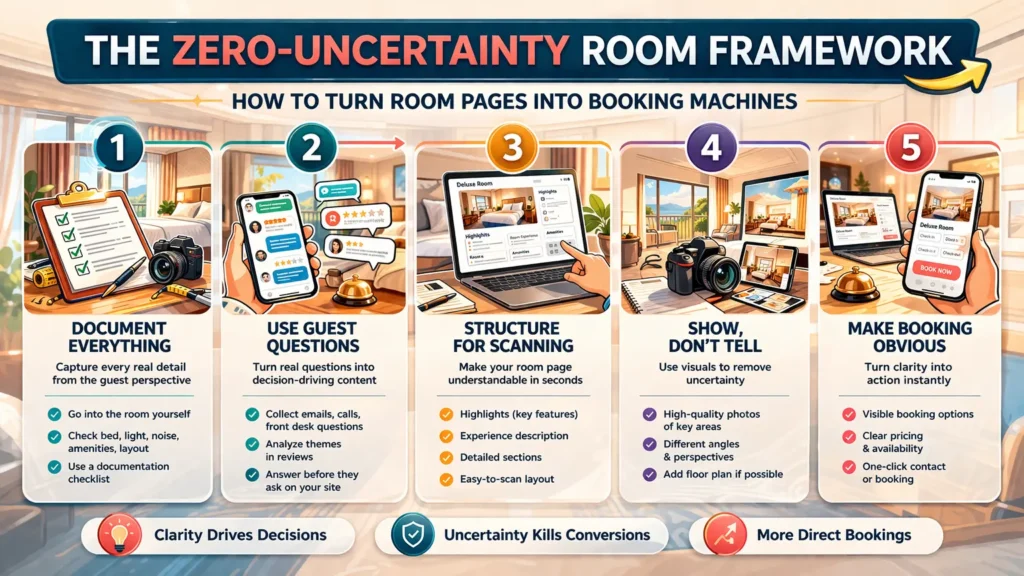
The Zero-Uncertainty Room Framework (How to Turn Room Pages Into Booking Machines)
After years of optimizing booking flows in travel and tourism, everything comes down to two simple principles:
- Clarity drives decisions.
- Uncertainty kills conversions.
If a guest understands your room within seconds and finds every important detail easily, they move forward. If they hesitate, search, or second-guess… they leave.
Based on this, here is a simple, practical system you can apply to every room page.
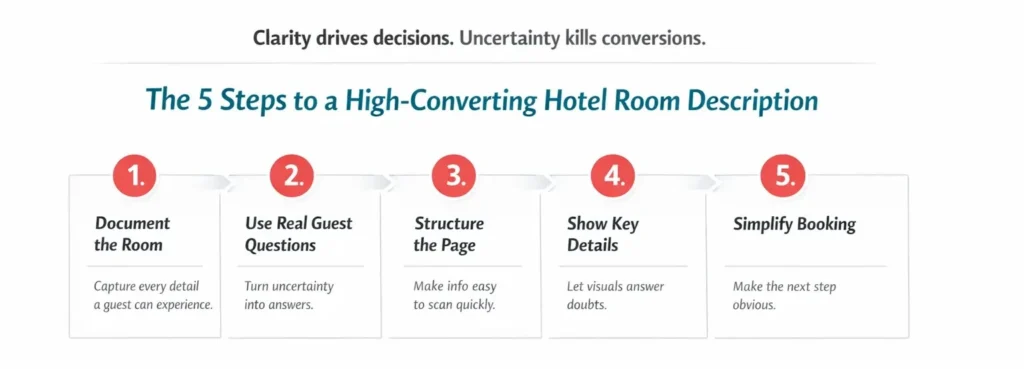
The 5 Steps to a High-Converting Hotel Room Description
1. Go into the room and document everything — literally everything
This is where most hotels underestimate the work. Don’t sit at your desk and “summarize” the room. Go into the room. Walk through it like a guest would. Look at the bed. Sit on it. Open the window. Turn on the shower. Then start writing everything down:
- What type of bed is it really?
- How firm is the mattress?
- Can you hear the street?
- How much natural light comes in?
If a guest can experience it, you should describe it.
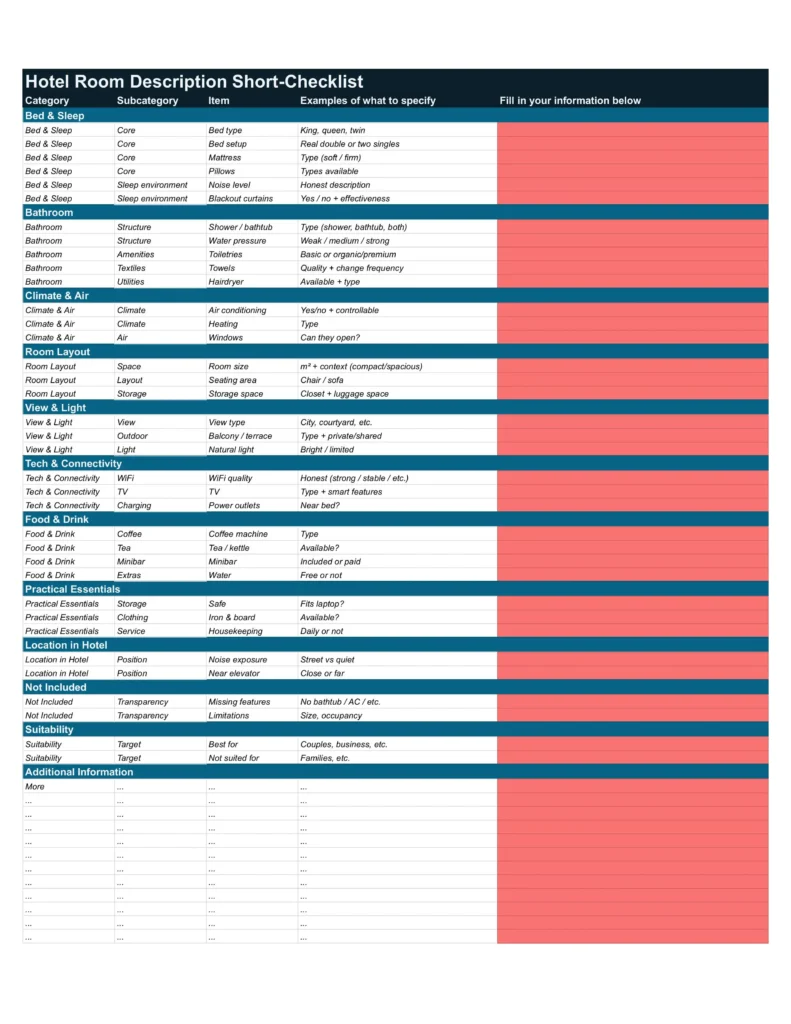
To make this easier, I’ve created a full checklist you can use as a guide. It’s available to download below and in the Checklist-Chapter. It covers everything from sleep comfort to layout, light, and even micro-details most hotels miss.
2. Turn guest questions and reviews into your content strategy
Your guests are telling you what matters. What you need is a way to collect what they say. So start collecting:
- questions you receive via email or phone
- comments at the front desk
- recurring themes in reviews (positive and negative)
You’ll quickly notice patterns:
- “Was the room quiet?”
- “Is there a real double bed?”
- “Can I work from the room?”
These are not random questions. They are decision drivers for potential guests.
As said earlier, if one guest asks, ten, a hundred, or more others are wondering the same thing but might never ask. Your goal is simple: Answer these questions directly on your room page before they even come up.
The great side-benefit of this is, you and your team will get asked less questions.
3. Structure the page so guests understand it in seconds
Guests don’t read your room description from top to bottom. They scan, compare, and decide quickly. That’s why structure matters more than wording. A high-performing room page usually has three layers:
- Highlights → a quick overview of the most important features, so visitors can compare rooms easily
- Experience description → helps guests imagine the stay
- Detailed sections → answer specific questions clearly to remove any doubts
You can see this in the example I’ve included in the next chapter. It allows guests to both get a fast overview and dive deeper where needed.
Good structure reduces effort. Less effort means more bookings.
4. Show every important detail visually
Photos are not decoration. They are proof. What is more, they catch the attention of a visitor. Many people check the images before the even read a thing. If you mention something important, show it:
- the balcony
- the workspace
- the bathroom layout
- the view
- …
And ideally:
- different angles
- real proportions
- how spaces connect
This way, people get a feeling for the room and have a much better picture.
What I’ve seen more and more often is a floor plan. This can be especially powerful because people can actually see the layout of the room. Personally, I’m a big fan of short videos. I’m aware that for room tours, videos are not the easiest to create, but they can provide an even clearer impression of the room compared to images.
The more a guest can “mentally walk through” the room, the easier the decision becomes.
5. Make booking the natural next step
Once a guest understands the room and feels confident, your job is almost done. Now don’t lose them.
Make sure:
- booking options are clearly visible
- pricing is easy to find and up to date (ideally people see a price prominently right from the beginning)
- contact options are one click away (options to contact you, are another way to remove uncertainty → respond fast!)
Clarity should not stop at the description it should continue into the booking flow. If someone has to search for how to book, you’re reintroducing friction at the worst possible moment.
What This Framework Actually Changes
This is not about writing longer descriptions. It’s about changing the role of your room page.
Instead of: “This looks nice.”
Your guests think: “This fits exactly what I need.”
And that shift is where direct bookings happen.
One Important Step Before You Start
Before you apply this framework, there is one critical question:
What should actually be a separate room category — and what shouldn’t?
Because if you mix fundamentally different experiences (for example, balcony vs. no balcony or quiet vs. street-facing), even the best description won’t remove confusion. We’ll break this down later in the bonus section and it’s one of the biggest missed opportunities I see across hotel websites.
Want more hotel website ideas like this?
I regularly share practical thoughts on hotel SEO, AI search, direct bookings, website clarity, and how independent hotels can become easier to find and book directly.
Step-by-Step: How to Create a High-Converting Hotel Room Description
Now let’s turn the framework into something you can actually implement.
This is a practical workflow you can follow with your team.
If you do this once properly, you’ll have a system you can reuse for every room.
1. Document the Room (Use the Checklist)
This step is simple, but essential. Instead of guessing or summarizing, use a structured checklist to capture everything consistently across rooms. Go into each room, and not everything. I really mean everything. Every feature, every brand and add notes wherever it makes sense.
You can download and use this checklist here. I tried to make it very complete. If you miss anything, please let me know. I happily update it 😁:
Tip: Do this once per room category and update it over time if something changes.
2. Capture Guest Questions Systematically
Now you add the layer most hotels are missing: real guest thinking. Instead of relying on assumptions, create a simple system where your team logs:
- questions before booking
- comments/questions during the stay
- recurring review feedback
The easier this is accessible for your team, the more likely it will work. A shared spreadsheet works perfectly for this. I created an example for you here:
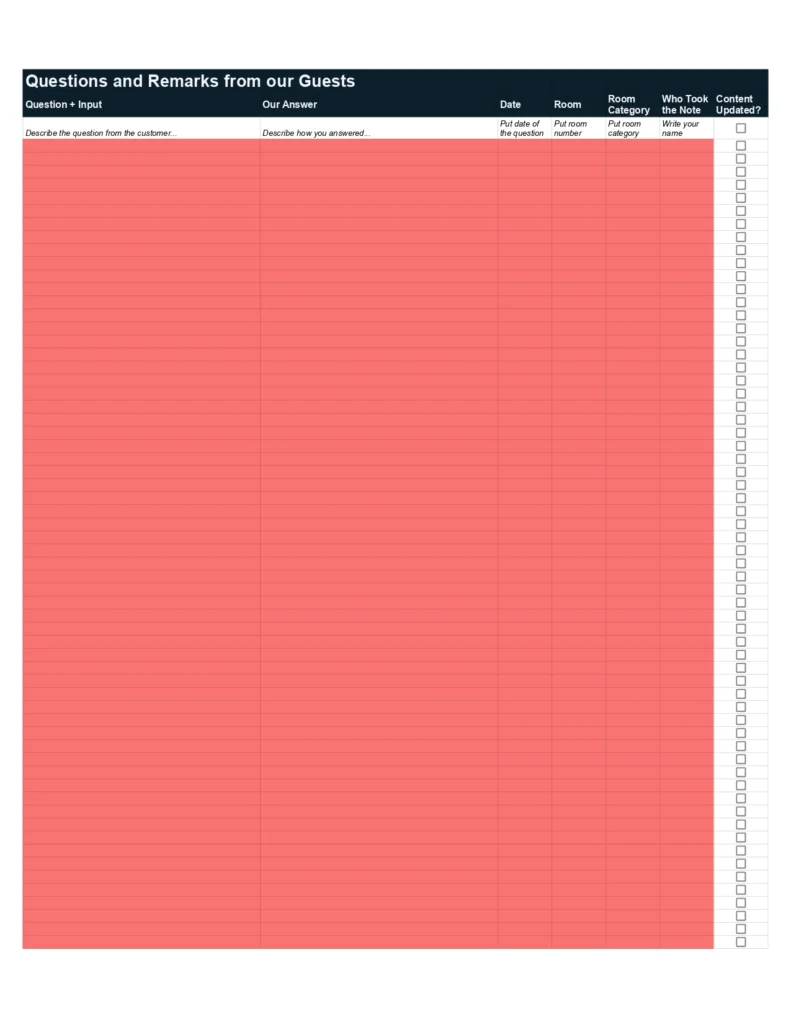
My recommendation is to make it part of daily operations:
- front desk logs questions
- reservations team adds email inquiries
- reviews are scanned regularly
Maybe provide incentives for your team to do it and stress the importance. Things like that often are not prioritised, so you need to really push it. I speak from experience, it needs to be a mandatory step in the process. This step is so important because:
This turns random feedback into structured insight.
Over time, you’ll clearly see:
- what creates uncertainty
- what drives decisions
- what your description needs to answer
3. Generate a Structured Description + Free GPT
This is where everything comes together and where I help you save a lot of time. Instead of starting from a blank page, you can use the CustomGPT I’ve created for this exact purpose:
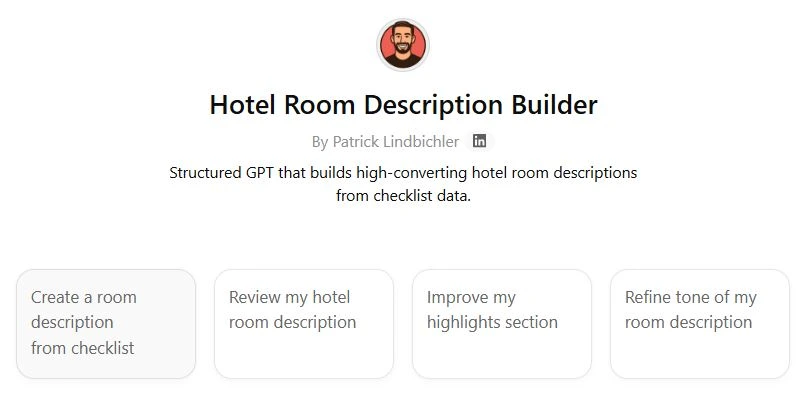
You simply:
- Open the link, select a way you want to create your hotel room description and follow the instructions
- Optionally upload guest feedback (from your sheet) to improve the outcome
And the GPT will generate a fully structured room description that follows the framework from this article:
- clear highlights
- an experience-driven description
- detailed, scannable sections
From there, you can:
- adjust wording
- refine tone
- add your brand personality
The goal is not to replace your voice, but to give you a strong, structured starting point in seconds.
This makes the process:
- faster
- more consistent
- easier to scale across all your rooms
4. Take Photos That Answer Questions (Not Just Look Good)
Most hotel photos are designed to impress. But the ones that convert are designed to inform. When you create or update your images, focus on clarity:
- Show the bed setup clearly (no ambiguity)
- Capture the room from realistic angles (what guests actually see)
- Show how spaces connect (bed → bathroom → window)
- Include key features like workspace, balcony, or view
Avoid:
- extreme wide-angle distortion
- overly staged lighting
- hiding limitations (guests will notice later anyway)
If you work with a photographer:
- choose someone experienced with interiors or hotels
- walk through the room together
- explain what guests typically ask about
I personally recommend hiring a photographer at least once. Visuals are a key part of the customer journey, even more so then descriptions. Plus, if you work with a photographer, it is a great opportunity to learn. If they are fine, ask them questions and watch how they do it. It will make things much easier for you in the future.
A good photo answers a question before it’s even asked, and it attracts guests.
5. Make Booking the Natural Next Step
Once a guest understands the room and feels confident, your job is almost done. Now remove the last bit of friction, because this is where many bookings are still lost.
The mistake most hotels make: They invest in great content… and then hide the booking action.
Make the Booking Action Impossible to Miss
Your main goal is simple: The booking button should always be visible without effort.
Here are practical ways to implement this:
- Add a primary CTA above the fold
→ “Check availability” or “View prices” directly visible when the page loads - Use a sticky booking button
→ stays visible while scrolling (especially important on mobile) - Repeat the CTA throughout the page
→ after highlights, after description, after amenities
This ensures that whenever the guest reaches a “yes moment,” they can act immediately.
Show Pricing Early (Even If It’s Not Exact)
One of the biggest hidden drop-offs is uncertainty around price. If users don’t know what to expect, they hesitate.You don’t need perfect dynamic pricing here. Even simple options help:
- “From €180 per night”
- “Prices vary by season check availability for exact rates”
This sets expectations and filters serious users early.
Reduce the Number of Steps to Book
Every additional step reduces conversion.Check your current flow:
- How many clicks does it take from room page → booking confirmation?
- Are users redirected to another system unexpectedly?
- Do they need to search again for the room they just selected?
Your goal:
- 1 click → availability
- 2–3 clicks → booking started
If it feels like a process, it’s already too long.
Keep the Booking Context (Don’t Make Users Start Over)
This is a subtle but very important one. If someone clicks on a specific room: The booking flow should already reflect that room
Avoid:
- sending users to a generic booking page
- forcing them to re-select dates and room
Instead:
- pre-select the room
- pre-fill dates if possible
The less users have to repeat, the more likely they are to complete the booking.
Offer Instant Reassurance at the Decision Moment
Right before booking, small doubts can still kill conversion. Add simple reassurance elements close to the CTA:
- “Free cancellation”
- “Best price guaranteed”
- “No hidden fees”
- “Pay at the hotel”
These are small, but extremely powerful. They reduce last-second hesitation.
Make Contact Effortless (For the 10–20% Who Still Hesitate)
Not everyone will book immediately. Some guests need one final confirmation. Make it easy:
- visible phone number
- quick email link
- optional: WhatsApp or chat
Position it as: “Still have a question? We’re happy to help.”
This turns hesitation into conversion instead of abandonment.
The One Rule to Remember
If you take only one thing from this section, it’s this:
At any point on your room page, a guest should be able to move forward instantly.
No searching. No scrolling back up. No thinking about “what to do next.”
Because the moment someone is ready to book… speed matters more than anything else.
🧩 What You Have After These Steps
At this point, you’ve built everything you need:
- structured room data
- real guest insights
- a consistent description format
- visuals that support decisions
- a clear path to booking
Now let’s bring it all together. In the next section, I’ll show you a complete best-practice room description — so you can see exactly how this looks when everything is applied properly.
Best-Practice Example ✍️: A High-Converting Hotel Room Description
Let’s bring everything together. Below is a real example of how a well-structured, high-converting room description can look. As you go through it, I’ll highlight why certain elements are there, so you can apply the same thinking to your own rooms.
The Example: Quiet Courtyard Double Room in London
Highlights
- King-size bed with premium mattress (real double, no split beds)
- Quiet courtyard-facing room (noticeably less street noise)
- Walk-in rain shower with organic toiletries
- Practical workspace + fast WiFi
- Nespresso coffee machine with complimentary capsules
(Why this matters: This section allows guests to understand the room in seconds and quickly compare it to others. It’s ideal to list the features that are actually different between your rooms)
The Experience
You enter the room and step onto a hardwood floor, with a clear layout: bed on one side, a small seating area by the window, and a desk along the wall. The design is simple and functional, without unnecessary decoration.
The king-size bed takes up a good part of the room but still leaves enough space to move around comfortably. It has a medium-firm mattress and cotton bedding. Since the room faces the inner courtyard, it’s generally quiet — you won’t hear traffic, though occasional hallway noise can still be noticeable.
In the evening, you can sit in the armchair or stay in bed and watch TV — both are positioned so you don’t need to adjust much. The desk is straightforward but practical, with enough space for a laptop and a few items.
The bathroom is compact but efficiently designed. The walk-in rain shower heats up quickly and maintains steady water pressure. Everything is within reach, though space around the sink is limited.
In the morning, natural light comes in through the window. It’s not a panoramic view, but it’s open enough to bring in daylight. You can open the window for fresh air, make a coffee, and get ready without needing to search for anything — the layout is intuitive.
(Why this matters: This helps guests imagine their stay and emotionally connect with the room.)
Room Overview
- Size: 22 m² (typical for central London, enough space for 2 guests + luggage)
- Bed: King-size double bed (180 × 200 cm, one mattress)
- Occupancy: Up to 2 guests
- Floor: 2nd–4th floor (elevator access)
- View: Inner courtyard (no city view, but quieter)
(Why this matters: Quick facts reduce uncertainty and are easy to scan. Phrases like typical for central London can set expectations.)
Bed & Sleep Comfort
- King-size bed with medium-firm mattress (balanced support, not overly soft)
- Choice of pillows (soft / firm / hypoallergenic, available on request)
- 100% cotton bedding (breathable, comfortable in different temperatures)
- Blackout curtains (block most light, slight edges of daylight possible)
- Sound-insulated windows (reduce outside noise significantly)
(Why this matters: Sleep quality is one of the biggest booking drivers. Notice how the details about the bed, pillows and curtains can already provide an impression of sleep quality)
Bathroom
- Walk-in rain shower (even water flow, stable temperature)
- Strong water pressure
- Organic toiletries (standard range, refilled daily)
- Soft cotton towels (large + small, changed daily)
- Hairdryer (1800W, suitable for everyday use)
- Heated towel rack
- Slippers included
- Limited counter space around sink
(Why this matters: Bathroom expectations vary a lot and clarity avoids disappointment. Some people for instance only want to use organic products. For things like the Hairdryer, you could even mention the brand and model)
Climate & Air
- Individually adjustable air conditioning (cools efficiently)
- Heating available year-round
- Windows can be opened (fresh air possible, depending on weather)
(Why this matters: Temperature and air quality are often silent dealbreakers. When I know it’s not too hot in a room, I’m already much more comfortable booking it)
Furniture & Layout
- Armchair + small table (suitable for reading or coffee)
- Workspace with desk and ergonomic chair (comfortable for a few hours of work)
- Wardrobe with hangers + space for suitcases
- Hardwood flooring (no carpet)
(Why this matters: Guests want to understand how usable the space really is.)
Tech & Connectivity
- 43” Smart TV (Netflix & YouTube ready, comfortably viewable from bed or chair)
- Free high-speed WiFi (stable for video calls, occasional fluctuations at peak times possible)
- USB charging ports + sockets next to the bed
- Telephone
(Why this matters: Especially important for business travelers and longer stays. Notice the details about the TV: Guests keen on watching their favourite series from the bed can already imagine it)
Food & Drink
- Nespresso coffee machine (capsules included, 2–4 per day)
- Tea selection & electric kettle
- Complimentary bottled water on arrival
- Minibar (paid, standard selection of drinks and snacks)
(Why this matters: Small details here often influence perceived quality. To me I love it if I can a free coffee on the room.)
Practical Amenities
- In-room safe (fits most laptops up to ~15”)
- Iron & ironing board
- Full-length mirror
- Daily housekeeping
(Why this matters: These are the “expected but important” details guests check for. For instance, if I have sensitive stuff on my laptop, the safe explanation would already give me peace.)
Room Location Benefits
- Facing inner courtyard → quieter than most street-facing rooms
- Positioned away from the elevator → reduced foot traffic noise
- Short indoor walk to breakfast area
(Why this matters: Micro-location inside the hotel can strongly affect experience. Every person who has slept next to a loud elevator has this topic in mind)
Available on Request
- Baby crib (free of charge, subject to availability)
- Extra pillows / blankets
- Laundry service
(Why this matters: Shows flexibility and removes edge-case concerns. A laundry service can be a huge deal in regards of your guests luggage)
Good to Know
- No bathtub (shower only)
- No city or landmark view
- Bathroom is compact
- Not suitable for more than 2 guests
- Non-smoking room
(Why this matters: This is expectation management, it builds trust and avoids disappointment. People might somehow recognise this anyway, e.g. from reviews ot latest when they stay in the room, so you might as well explicitly mention it)
Best Suited For
Perfect for:
- Couples who prioritize a quiet room over a city view
- Business travelers needing a practical and reliable setup
Not ideal for:
- Guests looking for spacious rooms or a bathtub → in this case, we recommend our 32m² Junior Suite with Bathtub
- Guests who specifically want a scenic view → in this case, we recommend our Deluxe Double Room with Big Ben View
(Why this matters: Helps guests quickly self-qualify and disqualify if needed.)
FAQ
(Why this matters: Answers last-minute questions that would otherwise stop a booking.)
Is the bed one mattress or two?
One king-size mattress (no gap in the middle).
How quiet is the room really?
No street noise due to courtyard orientation. Light hallway noise can occur occasionally.
Is the room large enough for two suitcases?
Yes, but space will feel more limited once both are open.
Can I work comfortably from the room?
Yes — desk and chair are suitable for several hours of laptop work.
Is there natural light?
Yes, the room gets daylight, but without a wide or scenic view.
How strong is the WiFi?
Generally stable for video calls and streaming. Like most hotels, minor fluctuations can happen during peak times.
(Why this matters: Answers last-minute questions that would otherwise stop a booking.)
🧠 What You Should Take From This
This example is not “long for the sake of being long.” It works because it does three things extremely well:
- It answers real questions before they arise
- It sets clear expectations (including limitations)
- It allows both quick scanning and deep understanding
That’s exactly what reduces uncertainty and what turns interest into bookings.
Get practical hotel website ideas in your inbox
In my newsletter, I share clear, actionable ideas for hotel owners and marketers who want more guests to find, trust, and book their hotel directly.
Practical Examples: What Great (and Poor) Room Descriptions Look Like
Theory is helpful. But seeing how hotels actually do it makes everything much clearer. Here are a few real-world examples from my analysis of hotel websites in London and what you can learn from each of them.
1. Royal Lancaster London — Details That Matter (Especially for Business Travelers)
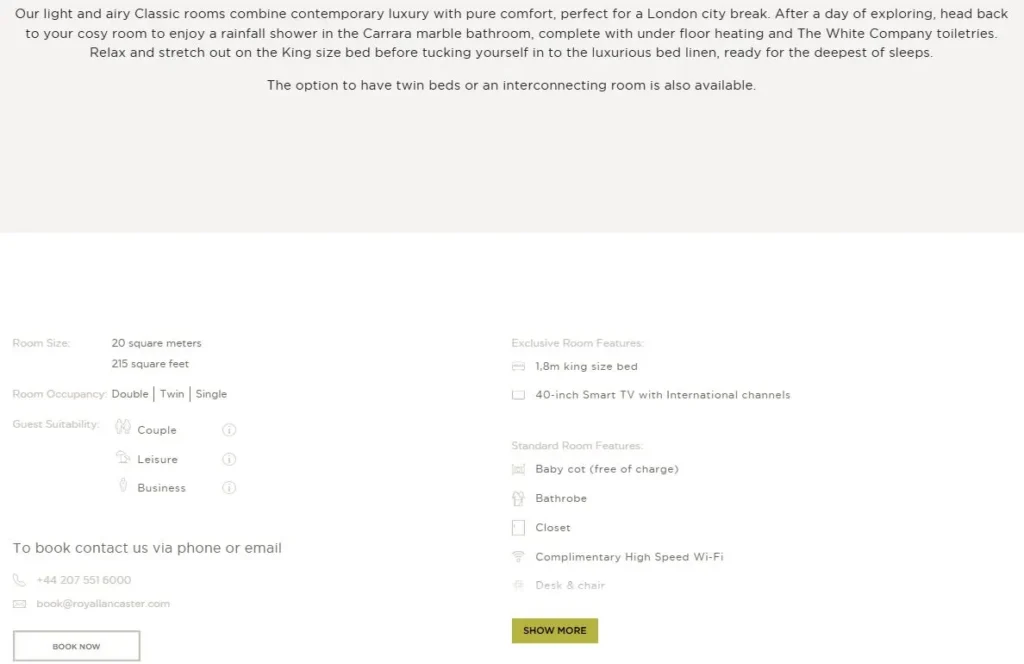
The Royal Lancaster London does an excellent job at describing technical and practical details that many hotels overlook.
You can see it here: https://www.royallancaster.com/rooms/classic/
What stands out:
- They specify things like TV size, plug types, and USB charging options
- They include thoughtful extras like yoga mats, umbrellas, and premium bathrobes
Why this works:
These are not “luxury add-ons” — they answer real questions:
- Can I work comfortably here?
- Do I need an adapter?
- What’s actually in the room?
Takeaway: Small, practical details often have a big impact on booking decisions.
2. Mandarin Oriental Hyde Park London — Remove Uncertainty Through Specificity
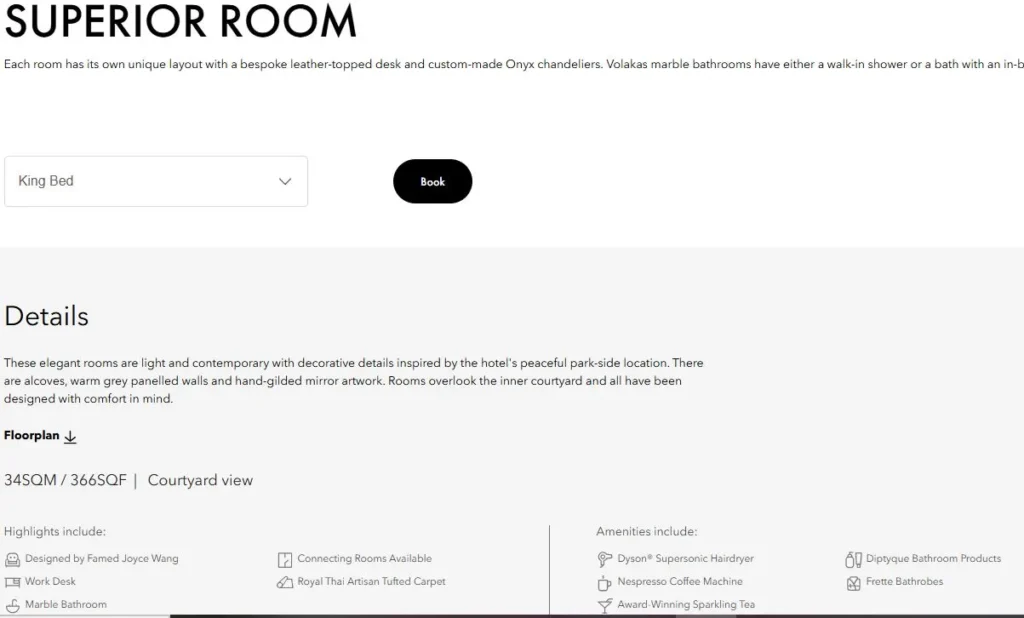
The Mandarin Oriental takes a different approach. They lean heavily into specificity and brand clarity.
You can see it here: https://www.mandarinoriental.com/en/london/hyde-park/stay/superior-room
What they do well:
- They name exact brands (Dyson hairdryers, Diptyque toiletries, Frette bathrobes)
- They clearly state the view type (Park, Knightsbridge, Courtyard)
- They even include unique touches like curated libraries by Heywood Hill
Why this works:
There is zero ambiguity. Guests know exactly what to expect and at this level, that matters.
Takeaway: The more specific you are, the more trust you build.
3. NOX Hotels — Competing with Booking Platforms on Detail
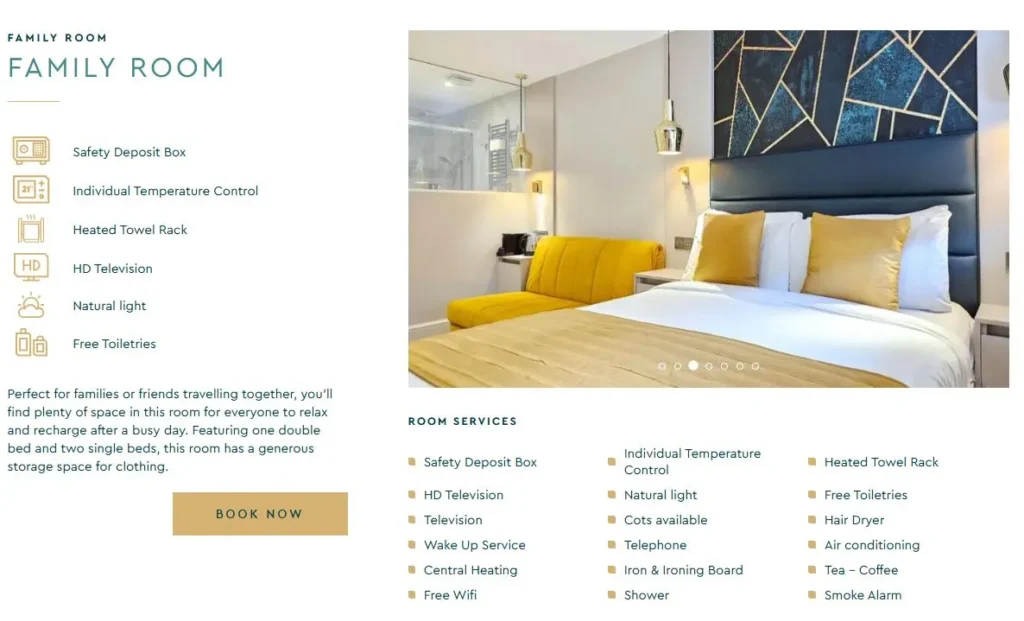
NOX Hotels show that you don’t need to be ultra-luxury to do this well.
You can see it here: https://www.noxhotels.co.uk/en/hotel-hyde-park-in-hyde-park-bayswater/accomodation/family-deluxe/
What stands out:
- Their descriptions include a high level of detail across categories
- They cover many of the same aspects you would find on Booking.com
Why this works:
They reduce the need for users to leave their website.
Instead of: “I’ll check Booking.com for more details…”
Guests already find the answers directly.
Takeaway: If your website has the same (or better) information than OTAs, you keep the booking.
4. The Z Hotel — Honest Communication Wins
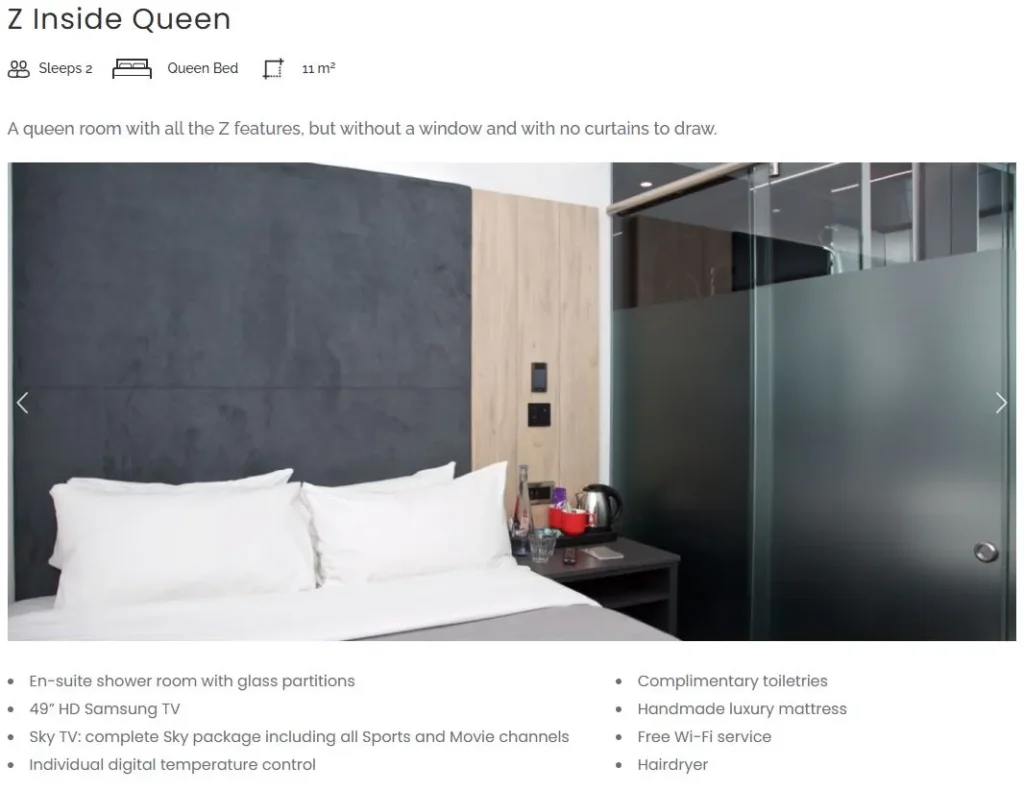
This is one of my favorite examples not because it’s perfect, but because it’s honest.
You can see it here: https://www.thezhotels.com/hotels/covent-garden/ (navigate to the booking of a room)
What they do:
- Clearly state when rooms have no windows
- Explicitly mention that rooms are compact (around 10–12 m²)
Why this works:
Most hotels would hide this. They do the opposite.
And because of that:
- expectations are aligned
- disappointment is avoided
- trust increases
Takeaway: Clarity beats persuasion. Every time.
5. St. Pancras London Autograph Collection — Strong Detail, But Structural Weakness
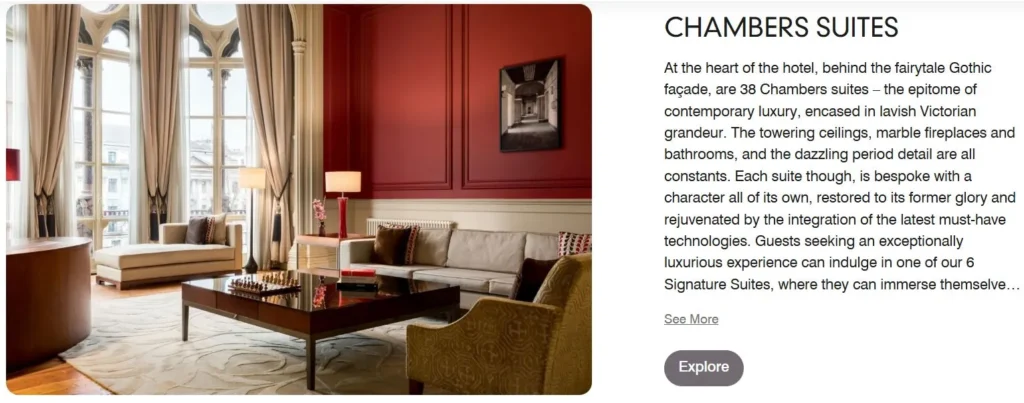
St. Pancras London provides a lot of detail, which is great. But there’s a structural issue.
You can see it here: https://www.marriott.com/en-us/hotels/lonpk-st-pancras-london-autograph-collection/rooms/
What they do:
- Describe rooms in detail
- Use strong, emotional language (e.g. “lavish Victorian grandeur”)
Where it falls short:
- Multiple room types are grouped on one page
- This makes it harder to understand differences quickly
Why this matters:
Guests don’t just evaluate one room, they compare.
If comparison is difficult:
👉 decision-making becomes harder
👉 drop-off increases
Takeaway:
Even great content needs clear structure to perform.
❌ How Not to Do It (A Real Booking Experience)
Let me give you a real example from my own experience.
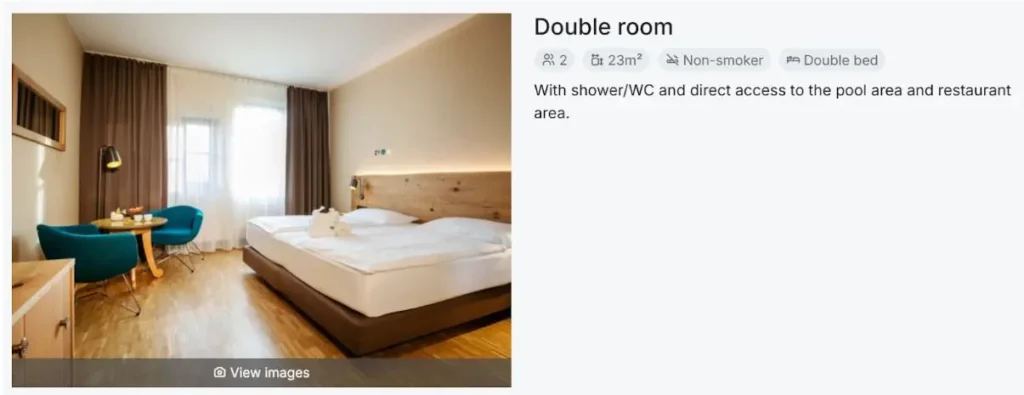
I recently booked a hotel where:
- the room description was extremely vague
- there was only one image available
- and it was almost impossible to understand the difference between room categories
In the following image, you see all the information that was available for the room:
What made it even more difficult, was the comparison to other rooms:
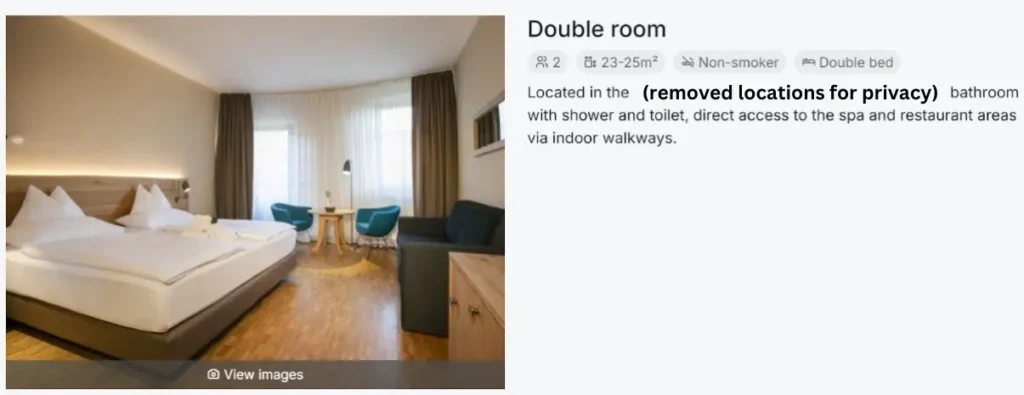
At some point, I literally asked myself: “What exactly am I booking here?”
And I still booked it. But only because I already knew the hotel. If I hadn’t? I would have left. No question.
What Went Wrong Here
- No clear differentiation between room types
- No detailed explanation of features
- No visuals to support the description
In other words: Maximum uncertainty.
Why This Matters
Most guests won’t:
- send an email
- ask follow-up questions
- take the risk
They’ll simply move on to the next option.
A Fair Note
I want to say this clearly: This is a hotel I really like. Which makes it even more interesting because it shows:
Even great hotels lose bookings because of weak room descriptions.
So if this is you: Don’t worry but fix it. Feel free to contact me, I’m more than happy to help 😉
What You Should Take From These Examples
Across all these cases, one pattern becomes clear:
- The best hotels remove uncertainty
- The average ones leave questions open
- And the worst ones force guests to guess
And in a world where guests can compare options instantly:
The hotel that answers best… wins.
What I also want to mention, all of those hotels came from my case study, where I identified top-positioned hotels on Google for relevant hotel search queries. So clarity is also an SEO boost.
Want to improve more than just this one page?
This guide focuses on one specific part of your hotel website. But direct booking growth usually comes from improving the full system: your positioning, homepage, room pages, feature pages, Google visibility, AI search readiness, and booking journey.
Bonus: How to Structure Your Room Categories (The Most Overlooked Growth Lever)
Here is now the promised bonus, and it is an important one: Before you optimize your room descriptions, there’s one decision that has an even bigger impact: What should actually be a separate room category and what shouldn’t?
Because if you group together rooms that offer fundamentally different experiences, even the best description won’t remove confusion.
And confusion leads to:
- hesitation
- comparison
- lost bookings
The Principle Behind It
Not every feature deserves its own room category. But some absolutely do.
You should split room categories when a feature:
- is actively searched for
- is a dealbreaker for guests
- significantly changes the experience
If one of these is true, it’s not a “detail” anymore, it’s a decision factor.
Core Features You Should Always Separate
These are the big ones. If you mix them, you create friction.
Bed type (double vs. twin)
Couples vs. friends/business travelers.
If this is unclear, people don’t book — simple as that.
Bathroom (bathtub vs. shower)
For some guests, this is non-negotiable.
Especially in destinations where the experience matters (e.g. spa, mountains).
Balcony / terrace
For many, this is the difference between
“nice stay” and “perfect stay.”
View (city, landmark, courtyard, ocean)
Views are emotional.
People don’t just book rooms — they book experiences.
Private pool / hot tub
Not relevant for everyone — but for the right guest,
this is the reason they choose you.
High-Impact Features Most Hotels Underrate
These are often hidden in descriptions — but they shouldn’t be.
Quiet vs. street-facing rooms
This is a major decision factor, especially for light sleepers.
Search behavior proves it:
- “quiet hotel room London”
- “hotel room no street noise”
Air conditioning vs. no AC
In many cities, this alone decides bookings in summer.
Workspace vs. no workspace
Post-COVID, this is critical for business travelers and remote workers. You can even differentiate further (basic vs. ergonomic setup).
Context-Dependent (But Very Powerful)
These depend on your audience and positioning.
Family vs. couple vs. single setup
Different needs, different expectations, different booking triggers.
Pet-friendly vs. no pets
Binary decision. People filter hard for this.
Accessible vs. standard rooms
For affected guests, this is not optional — it’s essential.
Room size (compact vs. spacious)
Sets expectations early → avoids disappointment later.
Natural light (bright vs. darker rooms)
Rarely searched explicitly — but strongly felt in the experience.
Floor level (low vs. high floor)
Often overlooked, but powerful when combined with view and light.
Why This Matters More Than You Think
Most hotels treat these as “details” inside a description. But from a guest perspective, they are often:
The reason to book or not to book.
If you hide them:
- users hesitate
- users compare
- users leave
If you structure them clearly:
- users find what they want faster
- users feel confident
- users book directly
This Is Bigger Than Just SEO
Yes, this helps you rank for:
- “hotel room with balcony London”
- “quiet hotel room city center”
- “hotel room with bathtub Paris”
But more importantly: It aligns your entire website with how people actually search and decide.
A Quick Personal Example
My wife and I have skipped hotels we actually liked
simply because we couldn’t confirm one thing:
Is it a real double bed or two singles pushed together?
That’s how small details become big decisions.
What to Do Next
Take a look at your current room categories and ask yourself:
- Are we mixing different experiences into one category?
- Are we hiding decision factors inside long descriptions?
- Are we forcing guests to figure things out themselves?
If yes, that’s your biggest opportunity.
Want to Go Deeper?
This topic deserves its own deep dive. In a separate article, I’ll show you:
- how to identify the right room categories
- how to structure them for SEO and conversions
- and how to avoid the most common mistakes
Follow me on LinkedIn to see when the article is live:
Why Room Descriptions Are Actually a Growth Strategy
At first glance, this article is about writing better room descriptions. But in reality, it’s about something much bigger.
It’s about aligning your website with how people actually search, think, and make decisions.
Today, travelers don’t browse websites the way they used to. They search with intent. They compare options quickly. And increasingly, they rely on AI tools to summarize and recommend the best choices. That means your content is no longer just read by humans. It’s interpreted, structured, and surfaced by systems like Google and AI assistants.
And those systems prefer content that is:
- clear
- structured
- specific
- and complete
Exactly the type of content you create with strong room descriptions.
When you describe your rooms in detail:
- you rank for more specific search queries
- you appear in AI-generated recommendations
- you reduce dependency on platforms like Booking.com
But even more importantly: You make it easier for guests to choose you.
This is the core idea behind what I share around SEO, content, and growth:
Create a great user experience online, and search engines, as well as AI, will reward you. Hotels that structure their websites around real guest intent don’t just get more traffic, they get more direct bookings.
Go Deeper: How to Turn Visibility Into Direct Bookings
If you want to go deeper into how travelers actually search and how you can structure your website accordingly, these guides will help:
- How your turn your website in a booking engine
https://patricklindbichler.com/optimize-your-hotel-booking-funnel/ - How you structure your website to be clear for guests, search engines, and AI
https://patricklindbichler.com/hotel-website-structure/ - How to optimise your hotel website for Google, ChatGPT, and AI search
https://patricklindbichler.com/hotel-seo-how-hotels-get-more-direct-bookings-from-google-chatgpt/ - How travelers search for hotels online
https://patricklindbichler.com/hotel-search-terms-seo/ - How you can create a breakfast page for your hotel
https://patricklindbichler.com/create-a-hotel-breakfast-page/
These articles connect directly to what you’ve learned here and help you build a complete, future-proof strategy.
Conclusion: If Guests Understand Your Room, They Will Book It
Most hotels don’t lose bookings because of their product. They lose bookings because of uncertainty. When guests don’t find the answers they need, they often don’t ask, they leave.
And in a world where alternatives are just one click away, that’s all it takes.
The good news is:
You don’t need more traffic.
You don’t need more ads.
You need better clarity.
When you:
- describe your rooms in detail
- answer real guest questions
- structure your content clearly
- and make booking effortless
You remove doubt. And when doubt disappears, decisions become easy. That’s when guests stop comparing and start booking. If you apply what you’ve learned in this article, your room pages won’t just look better.
They will perform better.
And that’s what ultimately matters.
Want to know what your hotel website is missing?
I help independent hotels improve their website structure, Google visibility, AI search readiness, content clarity, and direct booking journey. In a free website check, I’ll show you specific opportunities your hotel may be missing right now.
FAQs on Hotel Room Descriptions
1. What makes a good hotel room description?
A good hotel room description is clear, structured, and specific. It should answer real guest questions, describe the actual experience, and remove uncertainty. The best descriptions combine highlights, a short narrative, and detailed sections.
2. How detailed should a hotel room description be?
More detailed than most hotels think. Guests don’t read everything, but they scan for specific answers.
The goal is not to be short, but to be easy to navigate. If a detail can influence a booking decision, it should be included.
3. Do detailed room descriptions really increase bookings?
Yes,significantly. When guests don’t find the information they need, they don’t guess. They go back to Google or Booking.com. Clear descriptions reduce doubt, increase trust, and lead to more direct bookings.
4. What are the most important details to include?
Some of the biggest decision drivers are:
- bed type (double vs. twin)
- bathroom (bathtub vs. shower)
- noise level (quiet vs. street-facing)
- air conditioning
- workspace
- room size and layout
These are often dealbreakers, not just “nice-to-have” details.
5. Should I include negative aspects of a room?
Yes, and this is one of the most underrated tactics.
Mentioning things like:
- no bathtub
- limited space
- no city view
builds trust and sets expectations. Guests prefer honesty over surprises.
6. How can I collect the right information for my descriptions?
Start with two sources:
- A structured checklist (to capture all room details)
- Guest feedback (questions, reviews, conversations)
Over time, this gives you a very clear picture of what actually matters.
7. Can AI help write hotel room descriptions?
Yes, especially for structure and speed. If you provide:
- detailed room information
- guest insights
- a clear format
AI can generate a strong first version. But always refine it to match your tone and ensure accuracy.
8. How do room descriptions impact SEO and AI search?
Very directly. Detailed and structured descriptions help you:
- rank for specific search queries
- appear in AI-generated recommendations
- match user intent more accurately
The clearer your content, the more visible you become.
The Prompt used To Create this article
I want to be transparent on how this article was written, so below you will find the prompt to create this article. Of course, I asked for adjustments afterwards, but here is the initial input:
Check the prompt
Can you create a compelling blog article for my website, www.patricklindbichler.com? I will first give you a full outline of my draft for the article, so you have the full context. Then we will create each section together step-by-step. So, no need to start writing, just give me feedback on the ideas of the draft and where you would see good additions or improvements.
I want to make the articles a bit longer, so people can find clear information. The article should be clear and easy to understand, especially for people who are new to the topic. Still it should stay as compelling as the original article and also have the same length. It should be written in good American English, using not too complicated words so that even non-native English speakers can follow along easily. The tone should reflect my expertise as a thought leader in SEO, content creation, and leadership. Feel free to use examples from my experience as proof points and explain them in a clear and compelling way.
I am typically a positive and humorous person, so the writing style can be upbeat with a few lighthearted jokes here and there—just nothing offensive. The article should be engaging, fun to read, and educational. Please follow the structure outlined below, and feel free to expand on the points with additional context to ensure that each paragraph presents clear arguments.
Structure of the article:
- Introduction or The Problem (Hook): Start with a paragraph that summarizes the topic and grabs attention. You can make a strong statement or ask a thought-provoking question that will be answered later in the article.
- Key Highlights (3-4 bullet points): Include a few short bullet points summarizing the key takeaways of the article. Each point should be 1-2 sentences long.
- Main Content: Break the main part of the text into several text parts, each with a heading optimized for SEO and AI search. Each text part can have 1-3 paragraphs with 5-20 sentences each, depending on how much content is needed to explain the point clearly and bring the argument across. The paragraphs should be easy to read and compelling. Here is a structure for the main content:
- Explain Why the Problem Exists
- The Framework / Solution
- Deep Dive into Each Element
- Practical Examples
- Quick Checklist
- Connect to the Bigger Strategy
- Internal Links (Very Important)
- Headlines: Please formulate the headlines and include important keywords for SEO.
- Conclusion: Wrap up the article by summarizing the main points and inviting readers to reach out if they have any questions or want to learn more.
- FAQs: Include 5 frequently asked questions about the topic, with clear answers that add value to the reader.
Formatting:
- Use bold for key points, ensuring every 4th or 5th sentence has something in bold for emphasis.
- Add emojis throughout (but no more than 50 total) to make the article more visually appealing.
- If you include practical tips, illustrate them with real-life examples to make the content relatable.
- Please make the article a minimum of 1800 words. Feel free to ask me if you need more input or add information and context where you feel it’s necessary to convey a message or provide more clarity.
Goals:
- Please optimise the article for SEO. Give recommendations for search terms to include and integrate them into the titles of the paragraphs and the beginning of the article
- Please make the article engaging so people are intrigued to read, but also enjoy reading.
- What readers learn in the article, should be easy to apply for them because everything is explained clearly and has examples
Please use the following input to create the article:
- The Problem (Hook)
I’ve checked hundreds of hotel websites and one problem became very clear:
Many hotels lose out because they don’t clearly describe their room.
Even worse, they put many more details on booking.com. And people book there instead of their hotel website.
I worked for years in travel and tourism and optimised online booking flows. One thing became very obvious to me: When people are uncertain, the likelihood of a booking drops significantly.
- Explain Why the Problem Exists
I get the problem. You don’t want to scare away people, so you focus only on the positive of your room. All the things that are safe to say. Also you don’t want to overwhelm your guests. Just describe the room nicely, put a few images and all good.
What is more, you don’t have the data. Different to Expedia or Booking.com you don’t have people tracking and analysing what increases the likelihood of a booking on a large scale of hotels. And I’m very certain they identified the same thing I did: More clarity leads to more bookings. That is why they put so many details in their room descriptions.
But that doesn’t mean that you can’t outperform them. Use what you put on a booking platform and go into further detail, because you know every detail of your room. You can go in there and check. You can ask your customers. You have all the information.
- The Framework / Solution
What I learned after years of optimising descriptions in travel and tourism are 2 things:
- You need to make everything as clear and simple as possible → people need to find all the information easily, get an overview quickly and are guided to the next steps
- Uncertainty kills conversions → if potential customers are unsure about something they want to book and can’t solve it, likelihood they will book somewhere else skyrockets.
To create a great room description I have 5 easy steps:
- Write down every detail the room has to offer
- Collect feedback from travelers what they liked and didn’t like about the room
- Put this information in a clear structure, I’ll show you an example in chapter 4
- Add visuals of every part of the room. Really great is also a floorplan
And most importantly, link to booking and contact options. Show up-to-date prices. Make this incredibly easy for people!
I know it’s easier said then done, but I have built a workflow that can help you in the next section.
But before we do that, there is something important, which is to decide what is a room category and what isn’t.
I’ve created an overview in a bonus section of this article
- Deep Dive into Each Element
- Write down every detail the room has to offer
Here you have a checklist of everything a room contains → insert the checklist
- Collect feedback from travelers what they liked and didn’t like about the room
This is the best indication of what actually matters to your guests
- Put this information in a clear structure
→ Copy structure in here and explain why
Best practice example
Quiet Courtyard Double Room in London
Highlights
- King-size bed with premium mattress (real double, no split beds)
- Quiet courtyard-facing room (noticeably less street noise)
- Walk-in rain shower with organic toiletries
- Practical workspace + fast WiFi
- Nespresso coffee machine with complimentary capsules
The Experience
You enter the room and step onto a hardwood floor, with a clear layout: bed on one side, a small seating area by the window, and a desk along the wall. The design is simple and functional, without unnecessary decoration.
The king-size bed takes up a good part of the room but still leaves enough space to move around comfortably. It has a medium-firm mattress and cotton bedding. Since the room faces the inner courtyard, it’s generally quiet — you won’t hear traffic, though occasional hallway noise can still be noticeable.
In the evening, you can sit in the armchair or stay in bed and watch TV — both are positioned so you don’t need to adjust much. The desk is straightforward but practical, with enough space for a laptop and a few items.
The bathroom is compact but efficiently designed. The walk-in rain shower heats up quickly and maintains steady water pressure. Everything is within reach, though space around the sink is limited.
In the morning, natural light comes in through the window. It’s not a panoramic view, but it’s open enough to bring in daylight. You can open the window for fresh air, make a coffee, and get ready without needing to search for anything — the layout is intuitive.
Room Overview
- Size: 22 m² (typical for central London, enough space for 2 guests + luggage)
- Bed: King-size double bed (180 × 200 cm, one mattress)
- Occupancy: Up to 2 guests
- Floor: 2nd–4th floor (elevator access)
- View: Inner courtyard (no city view, but quieter)
Bed & Sleep Comfort
- King-size bed with medium-firm mattress (balanced support, not overly soft)
- Choice of pillows (soft / firm / hypoallergenic, available on request)
- 100% cotton bedding (breathable, comfortable in different temperatures)
- Blackout curtains (block most light, slight edges of daylight possible)
- Sound-insulated windows (reduce outside noise significantly)
Bathroom
- Walk-in rain shower (even water flow, stable temperature)
- Strong water pressure
- Organic toiletries (standard range, refilled daily)
- Soft cotton towels (large + small, changed daily)
- Hairdryer (1800W, suitable for everyday use)
- Heated towel rack
- Slippers included
- Limited counter space around sink
Climate & Air
- Individually adjustable air conditioning (cools efficiently)
- Heating available year-round
- Windows can be opened (fresh air possible, depending on weather)
Furniture & Layout
- Armchair + small table (suitable for reading or coffee)
- Workspace with desk and ergonomic chair (comfortable for a few hours of work)
- Wardrobe with hangers + space for suitcases
- Hardwood flooring (no carpet)
Tech & Connectivity
- 43” Smart TV (Netflix & YouTube ready, comfortably viewable from bed or chair)
- Free high-speed WiFi (stable for video calls, occasional fluctuations at peak times possible)
- USB charging ports + sockets next to the bed
- Telephone
Food & Drink
- Nespresso coffee machine (capsules included, 2–4 per day)
- Tea selection & electric kettle
- Complimentary bottled water on arrival
- Minibar (paid, standard selection of drinks and snacks)
Practical Amenities
- In-room safe (fits most laptops up to ~15”)
- Iron & ironing board
- Full-length mirror
- Daily housekeeping
Room Location Benefits
- Facing inner courtyard → quieter than most street-facing rooms
- Positioned away from elevator → reduced foot traffic noise
- Short indoor walk to breakfast area
Available on Request
- Baby crib (free of charge, subject to availability)
- Extra pillows / blankets
- Laundry service
Good to Know
- No bathtub (shower only)
- No city or landmark view
- Bathroom is compact
- Not suitable for more than 2 guests
- Non-smoking room
Best Suited For
Perfect for:
- Couples who prioritize a quiet room over a city view
- Business travelers needing a practical and reliable setup
Not ideal for:
- Guests looking for spacious rooms or a bathtub → in this case, we recommend our 32m² Junior Suite with Bathtub
- Guests who specifically want a scenic view → in this case, we recommend our Deluxe Double Room with Big Ben View
FAQ
Is the bed one mattress or two?
One king-size mattress (no gap in the middle).
How quiet is the room really?
No street noise due to courtyard orientation. Light hallway noise can occur occasionally.
Is the room large enough for two suitcases?
Yes, but space will feel more limited once both are open.
Can I work comfortably from the room?
Yes — desk and chair are suitable for several hours of laptop work.
Is there natural light?
Yes, the room gets daylight, but without a wide or scenic view.
How strong is the WiFi?
Generally stable for video calls and streaming. Like most hotels, minor fluctuations can happen during peak times.
- Practical Examples
- Royal Lancaster London
The Royal Lancaster London is particularly thorough when it comes to the technical and modern conveniences of their rooms, which is very helpful for business travelers.
Tech Specs: They list the specific size of the Smart TVs and detail the availability of multi-national plug sockets and USB charging points.
Complimentary Extras: Descriptions include small but important details, like the presence of a yoga mat, an umbrella, and premium bathrobes.
https://www.royallancaster.com/rooms/classic/
- Mandarin Oriental
What they provide: They list specific high-end brands like Dyson Supersonic hairdryers, Diptyque toiletries, and Frette bathrobes. They also explicitly state the view (Park, Knightsbridge, or Courtyard) so there are no surprises.
Unique Detail: They even mention the curated libraries by Heywood Hill in certain suites.
https://www.mandarinoriental.com/en/london/hyde-park/stay/superior-room
- Nox Hotel
Shows a lot of details that can compete with big platforms
https://www.noxhotels.co.uk/en/hotel-hyde-park-in-hyde-park-bayswater/accomodation/family-deluxe/
- The Z Hotel
Just as you thought I would only show you luxury hotels as good examples. Not the most detailed room description, but it is still very clear what you get. What I especially like is that the highlight when a room has no windows. They explicitly detail that these rooms have no windows and are compact (usually around 10–12 $m^2$), preventing any disappointment upon arrival.
- St. Pancras London
I don’t like that they have all rooms on one page, so the context is more mixed. But they describe them in a lot of detail. Very nice is how they make the difference between the Chambers Suites with lavish Victorian grandeur (whatever that means).
https://www.marriott.com/en-us/hotels/lonpk-st-pancras-london-autograph-collection/rooms/
How not to do it
The is one example, that I actually booked in the end, despite the room description (because I knew the hotel). Btw this was also the only image that was available. Would you have an idea what you book?
I was also asking what the difference in the categories was:
I removed the names to give the hotel privacy and I want to stress that this is a hotel that I absolutely love. If you are this hotel, please call me so we can make room descriptions that are worthy of your greatness!
- Bonus Section
Core (must split)
- Bed type (double vs. twin)
- Bathroom (bathtub vs. shower)
- Balcony / terrace
- View
- Private pool / hot tub
High-impact additions
- Quiet vs. street-facing
- AC vs. no AC
- Workspace vs. no workspace
Context-dependent (use if relevant)
- Family vs. couple vs. single set-up
- Pet-friendly
- Accessible rooms
- Room size (compact vs. spacious)
- Light (bright vs. darker rooms)
- Double Ded vs. Two Single Beds
- Room with double bed → is for couples, families
- Room with two single beds → is for friends, business travelers, colleagues
This matters more than you think, because the majority of people search either one or the other. If it’s not clear from the room category they book, they might not book at all, even though they liked your hotel. My wife and I have skipped hotels simply because they could not guarantee a double bed.
- Bathtub vs. Shower
Some people only want a bathtub.
Some people only want a shower.
And if your hotel is in the snowy Alps?
A warm bathtub becomes part of the entire fantasy of the trip.
Don’t hide this feature somewhere in the 5th bullet point of a long description — give it a category, give it a page, give it pictures.
- Balcony / Terrace
For some travelers, having a private outdoor space is the difference between
“Nice hotel.”
and
“I’m absolutely booking this.”
Fresh air, a place to sit, a morning coffee with a view — these moments matter.
- View (Ocean, City, Landmarks)
This one is huge.
Imagine someone traveling to Paris for the first time.
They’ve dreamed of seeing the Eiffel Tower for years.
If they can see it from their window?
You’ve just given them the highlight of their trip.
People book with their hearts — and views are pure emotion.
- Private Pool / Hot Tub
Is this for everyone? No.
But for some travelers, this is the reason they book.
It’s the “treat yourself” moment. The honeymoon moment.
If you have it, celebrate it.
- 🧘 Quiet vs. Street-Facing Rooms
This is massively underrated.
- Quiet room (courtyard / back side) → light sleepers, couples
- Street-facing room → people who don’t care or want a view
👉 Many guests won’t book if they don’t know this.
Search behavior:
- “quiet hotel room London”
- “hotel room no street noise”
Insight:
This is not a “detail” — it’s a dealbreaker.
- 🌅 Bright vs. Dark Rooms (Natural Light)
People rarely say it explicitly, but they feel it.
- Bright room (large windows, lots of daylight)
- Darker room (smaller windows, lower floors)
👉 Especially relevant for:
- longer stays
- remote workers
- winter destinations
- 💻 Workspace vs. No Workspace
Post-COVID, this is huge.
- Room with proper desk + chair
- Room without workspace
👉 Business travelers filter hard for this.
You can even go further:
- basic desk vs. ergonomic setup
- 👨👩👧👦 Family vs. Adult-Oriented Rooms
Not just size — setup matters.
- Family rooms (extra beds, space, layout)
- Adult-focused rooms (quiet, design, intimacy)
👉 Parents and couples have completely different needs.
- ♿ Accessible vs. Standard Rooms
Often hidden. Shouldn’t be.
- Wheelchair accessible
- Step-free access
- Accessible bathroom
👉 For affected guests: absolute requirement, not a nice-to-have.
- 🐶 Pet-Friendly vs. No Pets
Binary decision.
- Pet-friendly rooms
- Non-pet rooms
👉 People literally filter for this.
- ❄️ AC vs. No AC
This one is brutal in certain markets.
- Air-conditioned rooms
- Non-AC rooms
👉 In cities like London, Paris, etc.:
This alone can decide bookings in summer.
- 🚬 Smoking vs. Non-Smoking
Still relevant globally.
- Smoking rooms
- Non-smoking rooms
👉 Especially important for certain regions and audiences.
- 🛋️ Size & Space (Compact vs. Spacious)
Hotels hide this too much.
- Compact room (city standard)
- Spacious room (above average)
👉 This sets expectations → avoids disappointment.
- 🏨 Floor Level (Low vs. High Floor)
More important than it seems.
- High floor → better views, more light
- Low floor → easier access
👉 Combine with view/light = powerful.
🧠 The Real Framework
👉 Split rooms when a feature:
- is searched for
- is a dealbreaker
- changes the experience significantly
- Connect to the Bigger Strategy
Please use the information of what we crafted so far in all LinkedIn and Blog Posts, as well as the documentation I shared with you
- Internal Links (Very Important)
How travelers search for hotels online:
https://patricklindbichler.com/hotel-search-terms-seo/
Guide on how to optimise your hotel website for search engines and AI:
https://patricklindbichler.com/hotel-seo-how-hotels-get-more-direct-bookings-from-google-chatgpt/