
Chapter 1: The Problem — Why Your Hotel Website Doesn’t Rank on Google or Drive Direct Bookings
You invested in a beautiful website for your hotel. The photos are perfect, the rooms are described in detail, and everything looks exactly how you want your hotel to feel.
And yet it barely shows up on Google. ChatGPT doesn’t mention it. Most guests still book through platforms instead of directly with you.
It’s frustrating, especially because it feels like you’ve done everything right.
But here’s the uncomfortable truth: the problem is rarely the quality of your hotel, and it’s rarely the effort you put into your website. It’s how your website is structured.
Most hotel websites are built like digital brochures. They look polished, they feel premium, but they don’t guide anyone. Not your guests. Not Google. Not AI tools.
Think about what a potential guest actually experiences when they land on your site. They arrive with a very specific question in mind: Does this hotel have a spa? Which room is right for my family? Is there parking nearby?
Instead of finding a clear answer, they click around, scroll past beautiful imagery, and piece things together themselves. That uncertainty slows them down and hesitation is exactly the moment bookings are lost.
Search engines and AI tools face the exact same problem. If your website doesn’t clearly separate topics, define pages, and answer specific questions, they simply can’t figure out what your hotel is actually relevant for. And if they don’t understand it, they won’t show it.
This is where most hotels get stuck, not because they lack quality, but because they lack clarity and structure.
The good news? This is completely fixable.
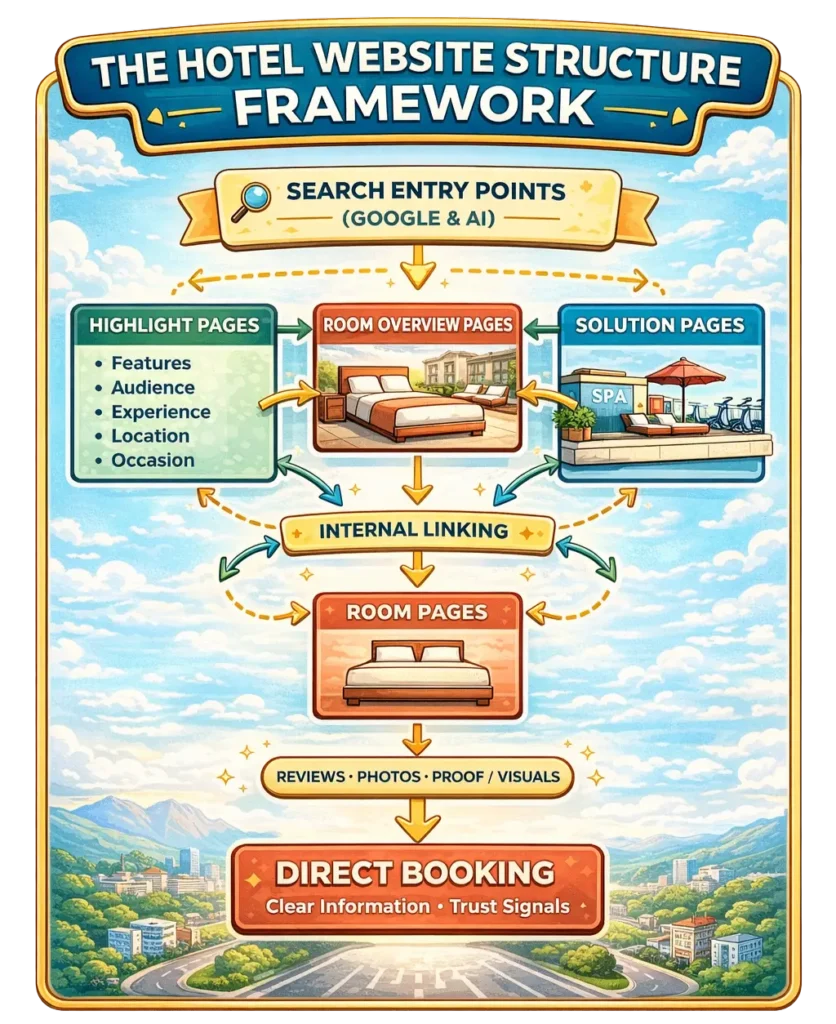
In this article, I’ll walk you through a simple system I call the 5-Part Hotel Website Structure Framework — a practical way to turn your website from a digital brochure into a booking engine.
It’s built around five key elements:
- Core pages that guide guests through your hotel
- Highlight pages that showcase what makes you special
- Solution pages that answer real guest questions
- Internal linking that connects everything seamlessly
- A fast booking path that removes friction and drives conversions
Together, these create a structure that:
- helps guests immediately understand what you offer and feel confident booking
- gives Google clear signals on what your pages should rank for
- allows AI tools to confidently recommend your hotel by name
And most importantly, it helps more people book directly with you, instead of through a platform taking a cut of every reservation.
In this guide
- Why Most Hotel Websites Are Structured Wrong (And What Guests Actually Need)
- The Framework — The 5-Part Hotel Website Structure Framework (Step-by-Step Guide for SEO, AI, and Direct Bookings)
- Deep Dive — How to Structure the Pages That Actually Drive Bookings
- Practical Examples — How Great Hotel Websites Apply This Framework
- The Checklist — What Pages Should You Actually Create?
- Connect This to the Bigger Strategy to Attract More Guests
- Go Deeper — Build Your Hotel Website on This Foundation
- FAQs: Structuring a Hotel Website for SEO, AI, and Direct Bookings
Key Highlights in this article
Before we dive in, here’s why this topic matters for your hotel.
✔ Most hotel websites don’t get found because they lack clear structure.
It’s not about design or effort. It’s about whether guests, Google, and AI can quickly understand what your hotel offers.
✔ Guests don’t book when they have to search for answers.
If key information is scattered or unclear, hesitation creeps in and hesitation is where bookings are lost.
✔ Google and AI tools rely on structure to rank and recommend you.
If your pages don’t clearly define topics and answer specific queries, you simply won’t show up when it matters.
✔ In this article, you’ll learn a simple 5-part framework to structure your website.
From core pages to highlight and solution pages, everything working together to guide guests and drive bookings.
✔ You’ll get a practical system to turn your website into a booking engine.
Not just more pages, but the right pages, structured to attract the right traffic and convert it into direct bookings.
Chapter 2: Why Most Hotel Websites Are Structured Wrong (And What Guests Actually Need)
Most hotel websites are built like brochures. They highlight a few nice features, show beautiful images, and try to capture the “feeling” of the hotel. And to be fair, that’s not wrong. Inspiration matters. But inspiration alone doesn’t get someone to book. Because the moment a guest moves from “this looks nice” to “should I actually book this?”, something changes. They stop browsing and start asking very specific questions.
And this is exactly where most hotel websites break down.
Over the past 8 years working in SEO in travel and tourism, I’ve seen this pattern again and again. Hotels invest heavily in design and content, but there is no clear structure behind it. Pages are created without a system. Information is scattered. Important details are hidden inside long descriptions or buried somewhere in the navigation.
The result?
Guests have to work to understand your hotel.
Google has to guess what your pages are about.
And AI tools don’t have enough clarity to confidently recommend you.
And if guests have to work, they hesitate.
If Google has to guess, it won’t rank you.
And if AI tools aren’t sure, they simply won’t mention you.
That’s the real problem.
The clearer your website structure, the easier it is for guests to navigate, for Google to rank, and for AI to recommend.
But here’s the shift that changes everything: Your website should not be built like a brochure. It should be built like a system that answers questions.
Think about how a guest actually moves through your website when it’s structured well. They land on your homepage and immediately understand who your hotel is for and what makes it special. From there, they move to a room overview where they can quickly compare options and see what fits their needs. Once they’re interested, they dive into a specific room and get every relevant detail they need to make a decision.
Not ready to book yet? No problem. They can explore your amenities — your spa, your breakfast, your gym — each explained clearly on its own page. Still unsure? They find answers to specific concerns — parking, arrival, accessibility — without having to search for them. And if anything is still unclear, there’s always an easy way to contact you.
At every step, the experience feels simple. Natural. Effortless. And this is where structure comes in.
Because behind that smooth experience is a very clear principle:
One page should answer one specific question.
- The homepage gives an overview
- The room overview helps compare options
- The room detail page supports the final decision
- The breakfast page explains your breakfast
- The gym page explains your gym
- The parking page solves the parking question
Simple. But incredibly powerful.
Because this structure does three things at the same time:
- It helps guests move forward without friction.
- It helps Google clearly understand what each page should rank for.
- And it gives AI tools the confidence and context to recommend your hotel in real conversations.
That’s why structure is not just a design decision.
It’s the foundation of whether your hotel gets found, understood, and booked… or ignored.
Chapter 3: The Framework — The 5-Part Hotel Website Structure Framework (Step-by-Step Guide for SEO, AI, and Direct Bookings)
So how do you actually structure a hotel website so it ranks on Google, gets picked up by AI tools, and drives direct bookings? How do you go from a website that looks good to one that gets found, understood, and booked?
You need a clear structure.
A structure where every page has a clear purpose and every question has a clear answer.
One that guides your guests, gives Google clarity, and gives AI the context it needs to recommend your hotel with confidence. That’s exactly what this framework is designed to do.
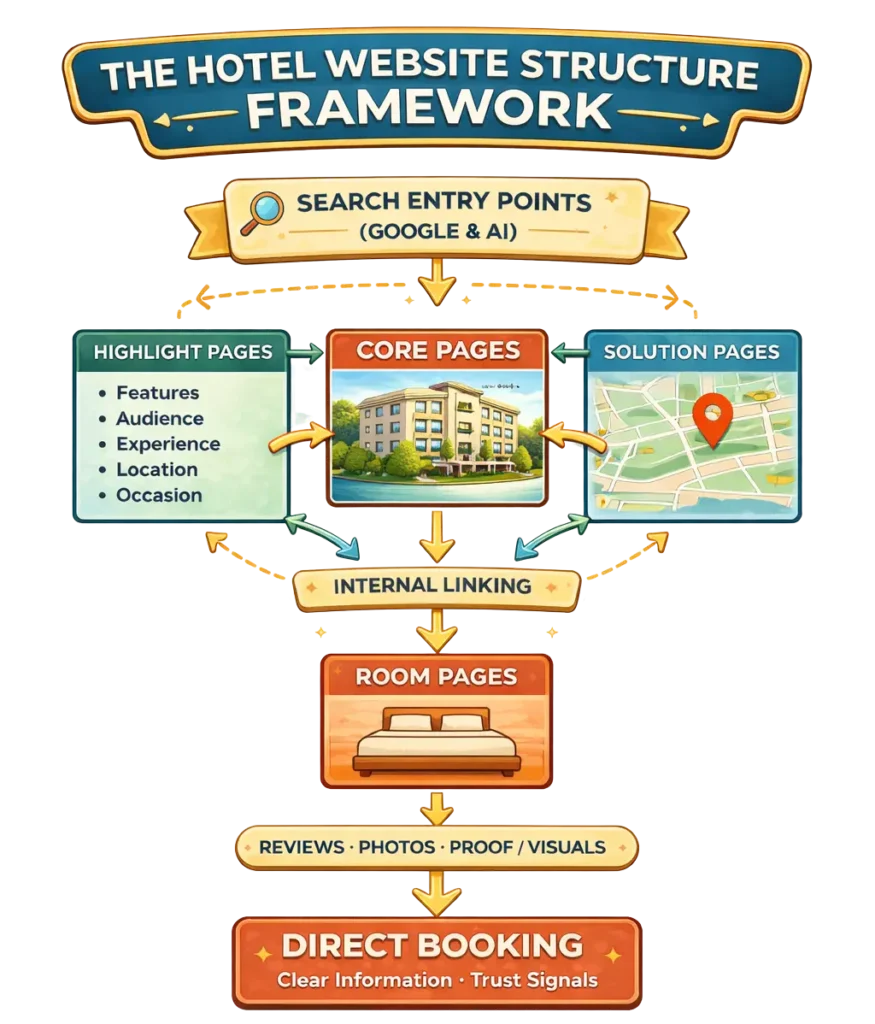
1. Core Pages — The Backbone of Your Website
Every hotel website needs a small set of core pages that guide guests through the most important decisions. Think of these as your foundation: if they’re weak, nothing else will compensate for it.
At minimum, you need three core pages and one thing that must be accessible everywhere:
- Homepage: Guests decide within seconds whether your hotel is for them. This page should make that crystal clear and lead them directly to your rooms.
- Room Overview Page: One of the most underrated pages on any hotel website. Guests need to compare rooms quickly, understand the differences, and check availability. If that comparison is hard to make, the decision gets delayed — and delayed decisions rarely convert.
- Room Detail Pages: This is where final uncertainty gets removed. Layout, features, visuals, pricing: everything a guest needs to feel confident enough to book.
One more thing that’s easy to overlook: make it genuinely easy to contact you. Whether that’s a dedicated contact page or visible options throughout the site — phone, email, messaging — guests should never have to hunt for help. Every unanswered question is a potential lost booking.
2. Highlight Pages — Show What Makes Your Hotel Worth Choosing
Once the core journey is in place, the next step is giving your strengths room to breathe. Your spa, your rooftop terrace, your breakfast, your location. Instead of mentioning these briefly on one page, each gets its own dedicated space.
This forces a useful kind of clarity. You’re no longer saying “we also have a spa”, you’re showing exactly what that experience looks like, with images, details, and answers to the questions guests actually have.
And here’s where it gets interesting: these pages don’t just help guests decide, they help you get discovered. People don’t only search for “hotel in Vienna” they search for “hotel with spa in Vienna” or “hotel with rooftop terrace.” A dedicated page on each topic signals to both Google and AI tools that you’re genuinely relevant for those searches, not just tangentially related. That clarity is exactly what search engines and AI rely on to confidently surface your hotel.
3. Solution Pages — Answer the Questions That Block Bookings
This is one of the biggest opportunities most hotels completely miss. Guests don’t just search for hotels, they search for solutions to specific problems they’re trying to solve before they even arrive:
Where can I park? How do I get there from the airport? Is this hotel suitable for families? What is there to do nearby?
These are often the questions that decide whether someone books or quietly moves on. And yet on most hotel websites, the answers are either missing or buried.
Solution pages fix this proactively. A clear arrival page. A dedicated parking page. A family-friendly page. A local area guide. Each one removes a specific doubt before it becomes a reason not to book, and each one targets exactly the kind of searches where big booking platforms are weakest. That’s your opening. That’s your opportunity to win where platforms fall short.
4. Internal Linking — Connect Everything Into One System
Pages alone aren’t enough. Without connections between them, even great content sits in isolation and fails to function as a whole. Internal linking is what turns a collection of pages into a coherent website.
The logic is simple, but often overlooked: every page should point toward a natural next step. Your homepage links to rooms and key highlights. Your highlight and solution pages link back to the room overview. Your room pages link to relevant features and information. The result is that no matter where a guest enters your site, they can always move forward and they never hit a dead end.
Google and AI work the same way. Clear internal links help them understand how your content is connected, which pages carry the most weight, and what your hotel is actually about.
5. Fast Booking Path — Remove Every Bit of Friction
Everything on your website ultimately leads to one goal: a booking. And this is where many hotels quietly lose guests, not because the offer is wrong, but because the path to booking is unnecessarily complicated.
The standard should be simple: from any page, a guest should be able to reach checkout in two or three steps. Browse the room overview, check availability, choose a room, and book. That’s it. No confusion, no dead ends, nothing that makes someone stop and think about whether it’s worth the effort.
The easier it feels to book, the more people actually will.
Bringing It All Together
When these five elements work together, your website stops being a collection of pages and becomes a system — one that guides guests toward a decision, gives Google clear signals for ranking, and gives AI tools the structure they need to recommend you with confidence.
That’s the shift that changes everything: The clearer your structure, the easier it becomes for guests to decide, for Google to rank, and for AI to recommend.
Chapter 4: Deep Dive — How to Structure the Pages That Actually Drive Bookings
Now let’s make this practical. Up to this point, the framework might still feel a bit abstract. So let’s walk through it step by step and turn it into something you can actually implement on your website.
We’ll start with the most important pages. The ones that shape how guests understand your hotel, how Google interprets your content, and how easily someone can move toward a booking.
Homepage — Orient, Prioritize, Move
We’ll go deeper into homepage optimization in a separate article, but for now, there’s one simple way to think about it.
Your homepage has three jobs:
- Orient → What kind of hotel is this? Who is it for?
- Prioritize → What should I explore next? Rooms, spa, location?
- Move → How do I get closer to booking quickly?
Most hotel homepages try to show everything and end up making nothing clear. A strong homepage does the opposite. It reduces complexity. It gives direction. And it makes the next step obvious. Because if a guest doesn’t know where to click next, they won’t.
I’ll add an article on how to create a great hotel homepage. Follow me on LinkedIn to see when it gets published:
Room Overview Page — The Most Underrated Page on Your Website
If there is one page that can dramatically improve your conversions, it’s this one.
The room overview page is not just a list of rooms. It’s the place where guests decide: “Which option is right for me?” If that decision is hard, slow, or unclear — bookings drop.
A great room overview page helps guests:
- compare rooms quickly
- understand differences instantly
- check availability for their dates
- see prices early
- move to booking without friction
In other words, it removes the need to think too much.
To make this work, each room should be presented in a way that is easy to scan and compare:
- A clear room title that already communicates key features
- 1–3 strong images (with the option to explore more)
- A visible price or starting price, not hidden later in the flow
- 1–3 key highlights that summarize the room
- Structured details like size, bed type, bathroom, balcony, view
- Optional: who the room is best suited for (couples, families, business travelers)
- Ideal: reviews on a room level, which are incredibly powerful
This is not about adding more information. It’s about structuring information so decisions become easy. Because when guests can compare confidently, they move forward.
Room Detail Pages — Remove the Final Doubt
Once a guest has a room in mind, they want certainty. This is where your room detail page comes in.
Its job is simple:
Remove every remaining question before the booking.
Layout, features, atmosphere, amenities, visuals, policies, … everything should be clear, structured, and easy to understand. At this stage, guests are no longer exploring. They are deciding. And every unanswered question introduces doubt.
If you want a full breakdown of how to structure these pages in detail, I’ve covered it step by step here:
Contact & FAQ — Don’t Let Questions Kill Bookings
Even with a well-structured website, some guests will still have questions.
And when they do, one thing matters most:
How easy is it to reach you?
If someone has to search for your contact options, you’re already creating friction.
A strong setup keeps it simple and accessible:
- Call
- Message (e.g. WhatsApp)
- A structured contact form
That’s enough. No complexity. No unnecessary steps. If there are recurring questions that don’t clearly belong on other pages, your FAQ can catch them, but don’t use it as a dumping ground. Most important questions should already be answered where they naturally belong. Because every unanswered question is a potential lost booking.
Highlight Pages — Create Desire
Once your core structure is in place, the next step is to give your best qualities room to shine.
These are your highlight pages, the pages that show what makes your hotel attractive in the first place. In simple terms: they create desire.
Maybe that’s your spa. Maybe it’s your rooftop terrace, your breakfast, your pool, your garden, or your restaurant. Maybe it’s not a classic amenity at all, but a type of room people specifically care about, like rooms with a balcony, rooms with a view, family rooms, suites, or soundproof rooms for light sleepers. Or maybe your hotel stands out because of who it is for: families, couples, solo travelers, business guests, or people looking for a quiet wellness retreat.
That is exactly the point: your highlights are not limited to facilities. They can come from features, audiences, positioning, rooms, or even the kind of experience your hotel offers.
And that is why these pages matter so much.
When you only mention these strengths briefly on your homepage, they stay vague. But when you give them their own space, they become real. You stop saying “we also have a spa” and start showing what the spa actually feels like, what is included, what guests can expect, and why it matters.
That is powerful for guests because it makes your offer tangible.
But it is just as powerful for search.
Because travelers rarely search in broad terms alone. They search for things like hotel with spa, hotel with rooftop terrace, hotel with balcony, family hotel, boutique hotel, or wellness retreat. A dedicated page for each important topic sends a clear signal to Google and AI tools that this is not some side note on your website. It is part of what defines your hotel.
And the clearer that signal is, the easier it becomes for search engines to rank you and for AI tools to confidently recommend you.
Later in this article, I’ll give you a practical checklist you can use to identify which of these highlight pages make sense for your hotel. That will help you go through your property systematically instead of guessing.
Solution Pages — Remove Hesitation
If highlight pages create desire, solution pages remove hesitation.
And you need both.
Because a guest can absolutely love the look of your hotel and still not book because of one small unanswered question.
- Where do I park?
- How do I get there from the airport?
- Is this hotel easy with kids?
- Can I bring a stroller?
- Is it accessible?
- What can we actually do nearby?
These are not small details. They are often the exact moments where bookings are won or lost.
That is what makes solution pages such a big opportunity.
Instead of waiting for guests to email you, call reception, or quietly leave your site, you create pages that solve these problems in advance. An arrival page. A parking page. A page about accessibility. A page for families. A local area guide. A page explaining early check-in, long stays, pets, luggage storage, or work-friendly setups.
This is where the distinction becomes very useful:
- Highlight pages answer: Why should I want this hotel?
- Solution pages answer: What might stop me from booking it?
That second category is often where hotels can outperform the big platforms.
Platforms are good at listing options. They are good at filtering by price, stars, or amenities. But they are usually much worse at solving real-life questions in depth. They rarely explain parking properly. They don’t guide someone through arrival in a helpful way. They don’t calm the doubts a parent, a solo traveler, or a guest with accessibility needs might have before booking.
That is your advantage.
And just like with highlight pages, I’ll give you a practical checklist later in the article so you can identify which solution pages are most relevant for your hotel. Because not every hotel needs the same pages, but every hotel has friction points that are worth solving.
The hotels that win direct bookings are often not the ones with the fanciest websites.
They are the ones that make the decision easiest.
How to Prioritize and Build These Pages Step by Step
At this point, this might sound like a lot of pages.
And it is.
But that does not mean you need to create everything at once. In fact, trying to do that is one of the fastest ways to end up with a half-finished website and a mild hotel-owner identity crisis.
The smarter approach is to build your structure step by step. Start by asking yourself one simple question:
Which new page would create the biggest impact right now?
Sometimes the answer is obvious.
- It might be the strongest highlight of your hotel. The thing many guests already book you for. Maybe it’s your spa, your rooftop terrace, your family rooms, or your view.
- Sometimes it’s the thing guests ask about all the time. Parking. Arrival. Breakfast. Accessibility. The kind of question your reception team has probably answered 600 times already.
- And sometimes it’s a topic where there is clearly search demand on Google, but no one is answering it as well as you could.
That is where you start. Pick one page. Then give it real attention.
Don’t just create a thin placeholder because you feel like the page “should exist.” Create something genuinely useful. Take great images. Write down the details. Think through the questions guests actually have. Then structure the page so it becomes easy to scan, easy to understand, and easy to act on.
A strong page usually includes:
- a clear title that says exactly what the page is about
- strong visual elements, like photos or even a short video
- a few key highlights in text
- a clear description that explains the experience or solution
- bullet points for clarity, where useful
- a small FAQ section for the recurring questions
- links to the room overview and contact options, so guests always have a next step
And depending on the page, the next step might be more than just booking a room. On a spa page, someone might reserve a treatment. On a restaurant page, they might book a table. On a family page, they might contact you about specific room setups. The key idea is always the same:
Never leave a useful page without a clear next action.
Once the page is live, the process is not over. It’s just beginning.
Now you watch what happens.
- Do people visit the page?
- Do they find it through Google?
- Do they continue to your room overview or booking flow?
- Do guests still ask the same questions or fewer of them?
You can get those answers from tools like Google Analytics, from guest feedback, from reviews, or simply from the questions your team receives. And that is what makes this approach so powerful: it becomes a process.
You don’t create one page, check a box, and move on forever. You publish it, observe how it performs, improve it, and learn from it. Then you repeat the process with the next page. Over time, this creates real momentum.
One strong page often leads naturally to the next. A wellness page might later expand into a spa page, a treatments page, a gym page, and maybe even a wellness retreat package page. A family page might lead to dedicated pages for family rooms, kids’ activities, and practical travel tips for parents.
That is how a useful website grows: not randomly, but through a sequence of clear improvements. And this is also why I strongly recommend creating separate pages for separate topics whenever possible.
There are three reasons.
- First, it creates a much clearer structure for your visitors. Instead of one overloaded page trying to do everything, each topic has its own home.
- Second, it forces you to deal with each topic properly. You can’t just mention the spa in one sentence somewhere on the homepage and call it done. A separate page makes you explain it, visualize it, and make it useful.
- Third, it is incredibly valuable for search engines and AI tools. When a topic has its own dedicated page, and that topic is also mentioned naturally across your website, Google and AI can understand much more clearly what your hotel offers and where it is relevant.
I’ve seen this again and again: hotels start showing up for searches around things like parking, spa, or family stays simply because they finally gave those topics their own space and explained them well.
That is the real power of structure.
Not more pages for the sake of more pages. But clearer pages, with clearer purposes, that make your hotel easier to understand, easier to find, and easier to book.
Chapter 5: Practical Examples — How Great Hotel Websites Apply This Framework
At this point, you might be wondering what this actually looks like in practice. So let’s look at a few real hotel websites across different positioning levels and break down what they do well. Not to copy them, but to understand the underlying principles you can apply to your own hotel.
Example 1: Mandarin Oriental Hyde Park — A Complete and Structured Experience
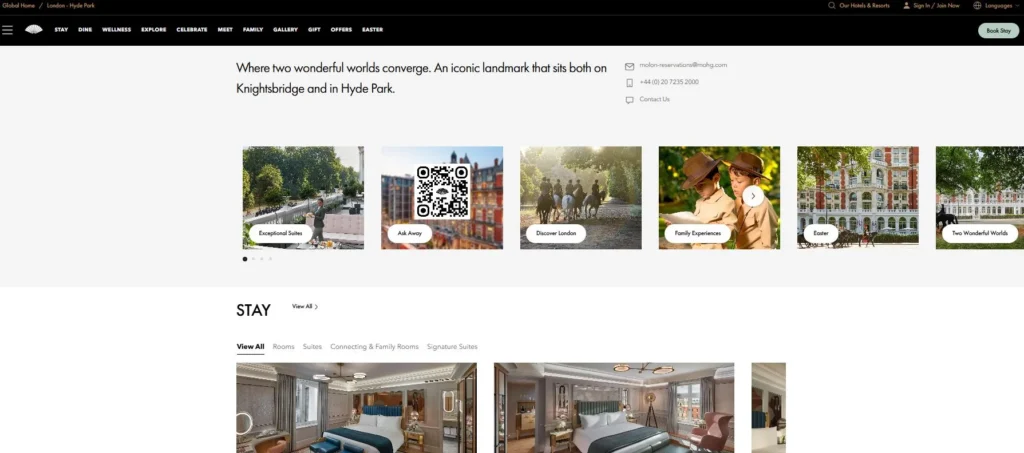
https://www.mandarinoriental.com/en/london/hyde-park/
What stands out immediately is how structured and intentional the entire website feels. From the homepage, you quickly understand what kind of experience the hotel offers. Just as importantly, you are guided naturally toward the rooms, while still being able to explore other areas like wellness, dining, and location.
But what really sets this website apart is depth.
Every important aspect of the hotel, rooms, spa, dining, has its own dedicated space. Nothing feels like an afterthought. Everything is explained, visualized, and easy to navigate.
Why this works:
For guests, it creates a seamless experience where you always know where to go next.
For Google, each topic is clearly defined and can rank independently.
For AI tools, the structure provides strong context about what this hotel is known for.
What you can learn:
A well-structured website doesn’t just present your hotel it mirrors the quality of your experience.
Example 2: Henrietta Experimental — Focus Creates Clarity
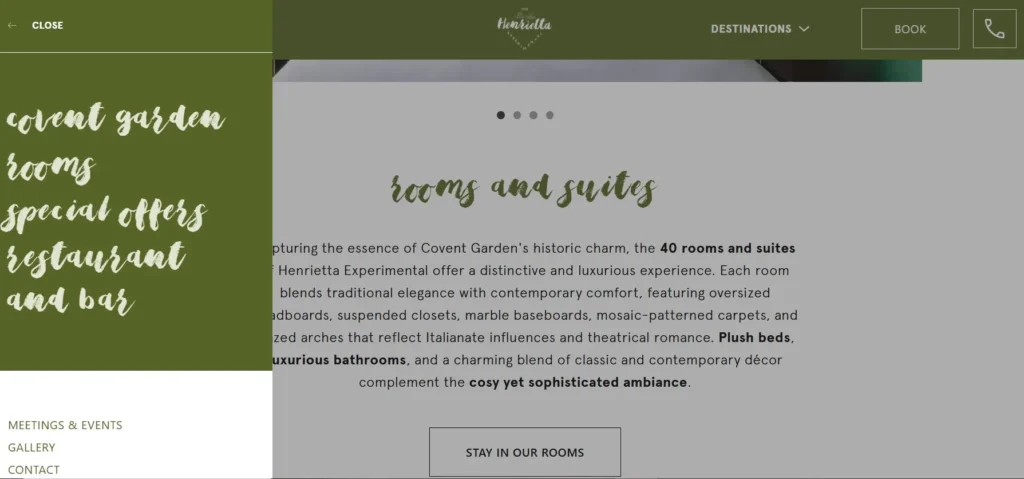
https://www.henriettahotel.com/
Henrietta Experimental takes a different approach. Instead of trying to show everything, they focus on a few key strengths and do that very well.
The website clearly communicates three things:
- what the rooms feel like
- what the neighborhood offers
- what the restaurant experience is
That’s it. And that focus gives the website a very distinct and almost intimate feeling, even though it’s part of a larger group.
Why this works:
For guests, it reduces complexity and highlights what actually matters.
For Google and AI, it creates strong signals around specific topics instead of diluted ones.
What you can learn:
You don’t need to cover everything at once, but what you highlight, you need to do well.
Example 3: Belgrove Hotel — Structure Beats Design
https://www.belgrovehotel.com/
This is a great example because it proves a very important point: You don’t need a perfect design to have a functional website.
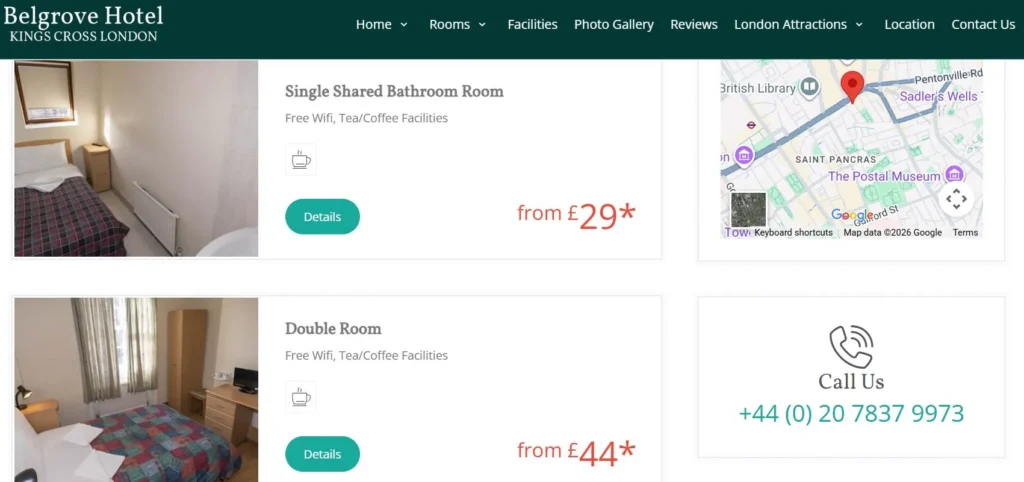
The Belgrove Hotel is not a luxury experience online. But it does something many hotels fail at. It gives you the information you’re looking for quickly.
The rooms are clearly structured and differentiated through their titles. You can understand what you’re booking without digging through long descriptions.
You can also see that they try to address common questions, like how to reach the hotel.
Why this works:
For guests, it reduces friction. You find what you need. Even if it’s mostly about the rooms.
For Google, the structure still provides clear signals.
Where it could improve: Some information is repeated across rooms instead of clearly differentiated. That makes comparison harder than it needs to be.
What you can learn:
Clarity beats aesthetics. A simple, structured website will outperform a beautiful but confusing one.
Example 4: The Megaro — Clean Structure and Constant Access to Booking
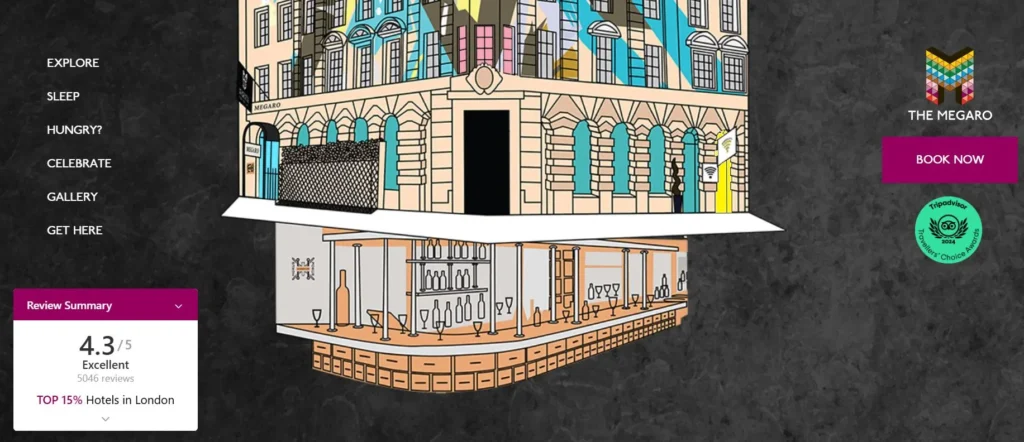
The Megaro is a very strong example of clean structure and usability. From the moment you land on the site, the navigation is simple and intuitive. You can quickly access rooms, dining, and practical information without feeling overwhelmed.
What stands out in particular is how easy it is to move through the website.
And then there is one small but powerful detail: The sticky “Book Now” button. No matter where you are on the site, you are always one click away from entering the booking flow.
Why this works:
For guests, it removes friction and keeps momentum.
For Google and AI, the structure clearly separates topics like rooms, breakfast, and arrival.
What you can learn:
Structure is not just about pages, it’s about making the next step obvious at all times.
Example 5: The Resident Covent Garden — Turning a Problem into a Strength
https://www.residenthotels.com/covent-garden/car-parking/
Let’s look at a more specific example. Search for something like: hotel Covent Garden with parking
You’ll notice something quickly, parking in that area is a real problem. And that’s exactly what The Resident Covent Garden addresses.
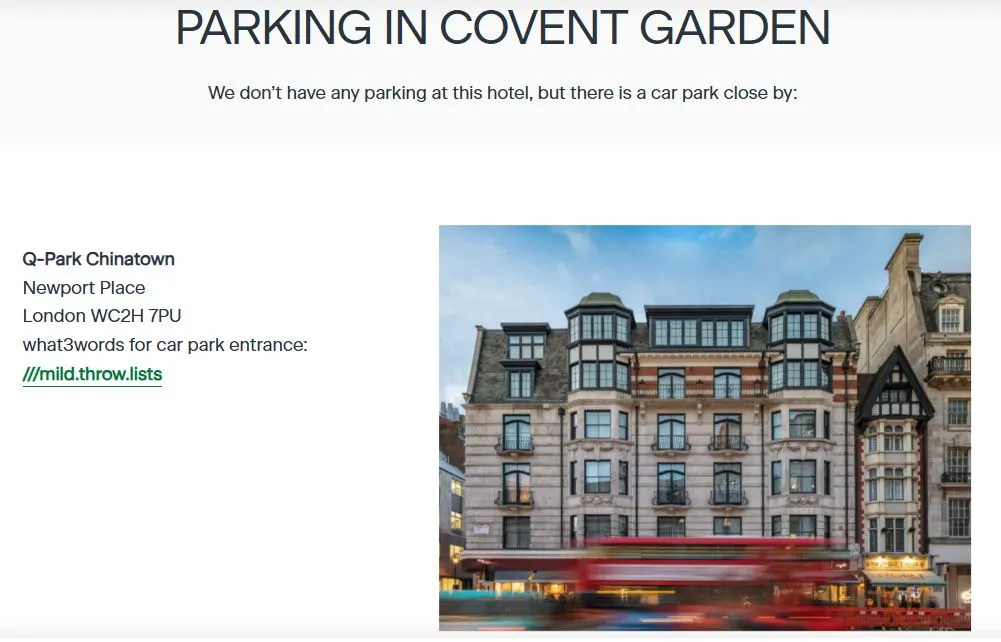
Instead of ignoring the issue, they created a dedicated parking page that explains:
- available options
- costs
- practical advice
They don’t just mention parking. They solve it.
Why this works:
For guests, it removes a major source of hesitation.
For Google, it targets a very specific and high-intent search.
For AI tools, it provides a clear, structured answer to a real-world problem.
What you can learn:
The best pages are often not about what you offer, but about what your guests are worried about.
Example 6: Mandarin Oriental (Wellness Section) — Depth Creates Authority
https://www.mandarinoriental.com/en/london/hyde-park/wellness
The Mandarin Oriental again? Yes. I want to get invited by them for a sponsored vacation. No, seriously, I want to prove a point: This is a perfect example of what a well-built highlight section looks like.
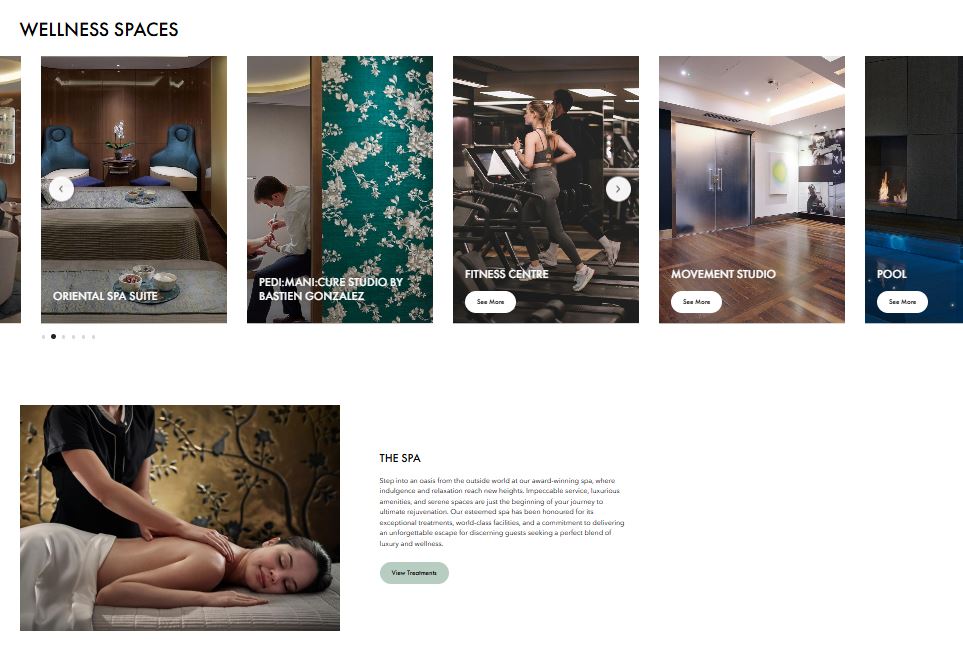
Instead of simply mentioning the spa somewhere on the website, Mandarin Oriental created an entire wellness structure:
- a main spa page
- dedicated treatment pages
- detailed descriptions of facilities
- high-quality visuals and videos
This turns “we have a spa” into a fully developed experience.
Why this works:
For guests, it builds desire and trust.
For Google, it creates strong relevance for queries like hotel with spa near Hyde Park.
For AI tools, it provides rich context that supports recommendations.
What you can learn:
Depth signals importance. If something matters to your guests, give it the space it deserves.
What All These Examples Have in Common
These hotels are very different. Luxury, boutique, budget, … different styles, different audiences. But they all follow the same underlying principle: They make it easy to understand their hotel.
And that is exactly what your structure should do. Because in the end:
The clearer your website is, the easier it is for guests to choose, for Google to rank, and for AI to recommend.
Chapter 6: The Checklist — What Pages Should You Actually Create?
At this point, you understand the structure. But when it comes to actually building your website, most hotels run into a simple problem:
What pages should I create first?
Because suddenly, everything feels possible. You could create pages for your spa, your rooms, your restaurant, your location, your audience… And very quickly, it starts to feel overwhelming.
That’s exactly why I created a full checklist you can download below, so you don’t have to figure this out from scratch.
But instead of throwing the full list at you here, let me walk you through it in a simpler way.
Think in Page Categories to See the Full Opportunity
At this point, you might wonder: Which pages should I actually create? Instead of thinking page by page, zoom out first.
Think in categories of pages.
Not to decide what to build next, but to see what’s possible. Because most hotels don’t lack ideas. They simply don’t see how many opportunities they’re missing.
This checklist gives you that overview: what you can highlight, what you can explain, and what you can solve for your guests.
From there, you go back to prioritizing:
Which page will have the biggest impact right now?
A) Highlight Pages — What Makes Your Hotel Worth Choosing
Let’s start with highlight pages.
These are the pages that showcase what makes your hotel attractive in the first place — the things that create interest, emotion, and preference.
And instead of treating them randomly, it helps to group them into a few clear categories:
1. Feature Pages — What You Actually Offer
Start with the most concrete part of your hotel. What do you physically offer that people care about?
This could be:
- your spa or wellness area
- a rooftop terrace
- your pool
- your restaurant or breakfast
- parking
- or specific room features like balconies or views
These are often your strongest assets.
And more importantly: These are things people actively search for.
If someone is looking for a hotel with a spa or a hotel with parking, they’re not browsing anymore. They’re already narrowing down their decision.If you only mention these features somewhere on your homepage, you’re making it hard for both guests and search engines to understand how important they are.
A dedicated page forces you to go deeper: to show it properly, explain it properly, and position it as part of your core offer.
2. Audience Pages — Who You Are Perfect For
The next layer is not about what you offer, but who you are best for. Because not every guest is the same.
Some hotels are perfect for:
- families
- couples
- business travelers
- solo travelers
- or even digital nomads
And many people search exactly like that. But here’s where most hotels fall short:
They say “perfect for families” — but don’t explain why. An audience page works when you connect it back to reality.
For example, if you say you’re great for families, show:
- which rooms work for them
- what facilities you have
- what makes the stay easier for them
Otherwise, it remains just a claim.
3. Experience & Positioning Pages — What It Feels Like to Stay
Beyond features and audiences, there’s a third layer: How does it feel to stay at your hotel? This is where positioning comes in.
Maybe you are:
- a boutique hotel
- a wellness retreat
- a quiet nature escape
- a design-focused city hotel
These are not just labels. They shape expectations. And they often match how people search when they are still exploring options. These pages help translate your concept into something tangible, something a guest can picture before they arrive.
4. Location Pages — Everything Around Your Hotel
Your hotel is never just your hotel. It’s also everything around it.
- The neighborhood.
- The restaurants.
- The walks.
- The small experiences guests will remember.
Pages about your area help guests understand what their stay will actually look like. They also make your hotel more relevant for searches connected to your location, especially when people are still in the discovery phase.
5. Occasion Pages — When the Stay Has a Purpose
Sometimes people don’t just book a hotel. They book a moment.
- A honeymoon.
- An anniversary.
- A weekend escape.A birthday.
These occasions come with very specific expectations. And if your hotel fits them well, it’s worth making that explicit. These pages don’t need to be complex.
But they should clearly show:
- why your hotel works for that occasion
- and how you support it (e.g. packages, services, small details)
B) Solution Pages — Where You Win Against Platforms
This is the category most hotels underestimate. And it’s often where the biggest impact lies. Because even when someone likes your hotel, small uncertainties can still stop them from booking.
Questions like:
- How do I get there?
- Where do I park?
- Is this easy with kids?
- Can I check in late?
These are not edge cases. They are part of almost every booking decision. Solution pages exist to answer these questions clearly, before they become a reason to leave your website.
This can include:
- arrival guides (car, train, airport)
- parking explanations and alternatives
- accessibility information
- guidance for families or specific needs
- even simple itineraries or tips for the stay
This is also where you can go deeper than any platform ever will. Because platforms list options. But they rarely solve real problems in detail.
How to Work with This in Practice
At this point, it might still feel like a lot. That’s normal. You’re not supposed to build everything at once.
Instead, take a step back and ask yourself:
- What is one thing we are truly strong at?
- What do guests keep asking us about?
- What is something people care about, but we haven’t explained well yet?
Then select this one as #1 priority and work on it. For the full process, go back to the section: How to Prioritize and Build These Pages Step by Step
The Full Checklist
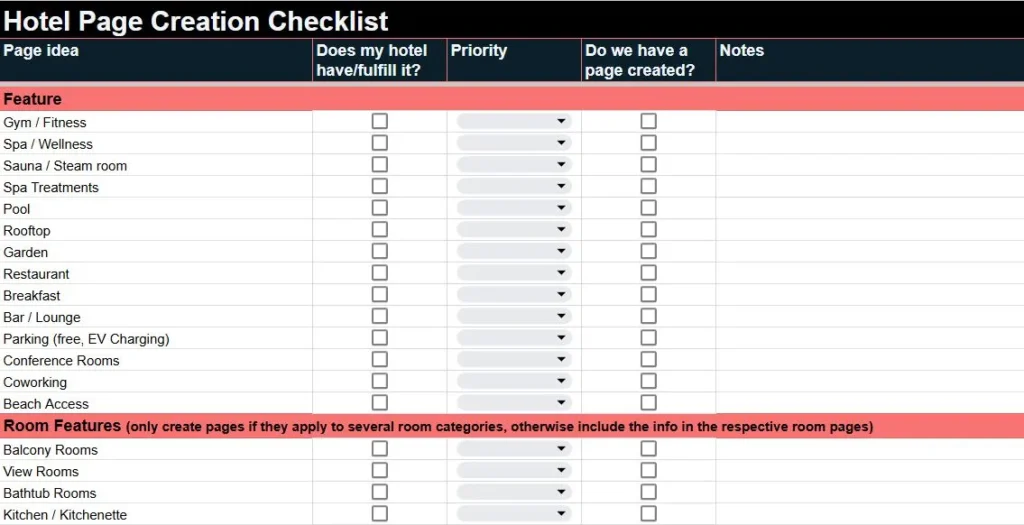
To make this easier, I’ve put together a full checklist you can use as a working document.
It includes:
- a more complete list of page ideas
- a structure to prioritise them
- and a way to track what you’ve already created
👉 Download the checklist and use it step by step:
Chapter 7: Connect This to the Bigger Strategy to Attract More Guests
Once that foundation is in place, something shifts. You stop creating random content and start building a system. Each page becomes a well-defined container for a specific topic: your restaurant page covers everything about dining, your parking page removes every doubt about arrival, your room pages guide guests from curiosity to confidence. There’s no scattered information, no hunting around, just clear answers in the right places.
That’s precisely what Google and AI tools are looking for. It’s how you start appearing for the searches that actually convert: “hotel with spa in Vienna,” “family-friendly hotel with balcony,” “hotel with parking near the city center.” And it’s how AI tools develop the confidence to recommend you by name because your content is structured, complete, and unambiguous.
From there, everything compounds. Better room descriptions, stronger content, more visibility, more direct bookings, each improvement reinforces the next. Structure isn’t the final step. It’s the starting point.
Once your structure is clear, you can finally match how people actually search. You’re no longer guessing what to write, you’re answering real queries with dedicated pages. A guest searches for a hotel with a spa, and you have a page that shows exactly that experience. They wonder about parking, and you remove that doubt before it becomes a reason not to book. This alignment between search intent and page structure is what drives qualified traffic to your website in the first place.
And because every page is built to be clear, focused, and complete, that traffic doesn’t just visit. It converts. Guests understand what you offer within seconds. They find what they need without effort. And moving from discovery to booking feels natural, not forced. That’s the shift: your website stops being a static brochure and becomes a system that attracts the right people, answers their questions, and turns them into direct bookings.
Chapter 8: Go Deeper — Build Your Hotel Website on This Foundation
If this framework resonates with you, the next step is to go deeper into each part of it.
To understand how to align your pages with what guests actually search for, start here:
https://patricklindbichler.com/hotel-search-terms-seo/
Once your structure is in place, the biggest impact often comes from your room pages. This guide shows you how to turn them into real conversion drivers:
https://patricklindbichler.com/hotel-room-descriptions/
If you want the full picture of how SEO and AI work together to drive direct bookings, you’ll find it here:
https://patricklindbichler.com/hotel-seo-how-hotels-get-more-direct-bookings-from-google-chatgpt/
And if you want to keep improving step by step, I share practical ideas, frameworks, and examples regularly in my newsletter for people in hospitality:
https://substack.com/@patricklindbichler
Because this is not a one-time fix. It’s a system you build and improve over time.
Conclusion: A Clear Website Structure What Drives Bookings
Most hotel websites don’t fail because of poor design or lack of effort. They fail because they are hard to understand. For guests, for Google, and for AI. And when something isn’t understood, it doesn’t get found and it doesn’t get booked.
The shift is simple, but powerful: move from a brochure to a structured system. One where each page has a clear purpose, answers a specific question, and guides guests toward a decision. Core pages create orientation, highlight pages build desire, solution pages remove hesitation, all connected through clear internal links and a fast path to booking.
This structure does more than organize your website. It aligns your content with how people actually search. It gives Google clear signals to rank you. And it gives AI the confidence to recommend you. That’s how you start showing up for the searches that matter, the ones that lead to real bookings.
From there, everything compounds. Better pages lead to better visibility. Better visibility brings more qualified guests. And clearer information turns those guests into direct bookings.
If you take one thing from this article, let it be this:
The clearer your website structure, the easier it becomes to get found, understood, and booked.
FAQs: Structuring a Hotel Website
1. What pages should a hotel website have for SEO?
At minimum, every hotel website should include:
- a homepage that clearly explains the hotel and guides users
- a room overview page to compare options
- detailed room pages that remove uncertainty
Beyond that, the biggest impact comes from highlight pages (e.g. spa, breakfast, location) and solution pages (e.g. parking, arrival, family stays). These are the pages that help you rank for specific searches and convert visitors into bookings.
2. Why is website structure important for hotel SEO?
Structure determines whether Google and AI tools can understand your website.
If your content is scattered, they have to guess what your pages are about and you won’t rank.
If each page clearly focuses on one topic, they can confidently match your site to search queries.
At the same time, a clear structure helps guests find answers faster, which directly increases bookings.
3. What is the most important page on a hotel website?
One of the most underrated but important pages is the room overview page.
This is where guests compare options and decide which room fits their needs.
If that comparison is unclear, slow, or requires too much effort, bookings drop.
A strong room overview page makes differences obvious, shows prices early, and allows guests to move quickly into the booking flow.
4. What are highlight pages and why do they matter?
Highlight pages focus on what makes your hotel attractive:
- spa
- rooftop terrace
- breakfast
- rooms with balcony
- restaurant
They create desire and help you rank for searches like:
“hotel with spa” or “hotel with balcony”.
Instead of mentioning features briefly, you give them their own space, making them clearer for both guests and search engines.
5. What are solution pages and how do they increase bookings?
Solution pages answer the questions that often stop people from booking:
- Where can I park?
- How do I get there?
- Is this hotel family-friendly?
They remove hesitation before it becomes a reason to leave.
This is also where you can outperform booking platforms, because they often list options, but don’t solve real problems in depth.
6. How many pages should a hotel website have?
There is no fixed number.
What matters is not quantity, but clarity:
- each page should answer one specific question
- each important topic should have its own space
Start with the most impactful pages (rooms, key features, common questions) and expand step by step.
7. How do I prioritize which pages to create first?
Start with the highest impact:
- your strongest selling point (e.g. spa, view, location)
- questions guests ask frequently (e.g. parking, arrival)
- topics with clear search demand
Build one page properly, learn from it, and then move to the next. Over time, this creates momentum instead of overwhelm.
8. How does website structure help with AI tools like ChatGPT?
AI tools rely on clear structure and context.
If your website:
- has dedicated pages for specific topics
- explains them clearly
- connects them logically
AI can confidently understand what your hotel offers and is more likely to recommend it in answers.
9. How do I turn my hotel website into a booking engine?
It comes down to three things:
- Attract the right traffic → by matching search intent with clear pages
- Remove uncertainty → by answering every important question
- Make booking easy → with a fast, frictionless booking path
When these work together, your website stops being a brochure and becomes a system that drives direct bookings.
10. Can small or budget hotels apply this framework?
Yes and often even more effectively.
You don’t need a perfect design or luxury positioning.
What matters is clarity.
A simple, well-structured website that answers real questions will outperform a beautiful but confusing one — especially in niche searches.
The Prompt used To Create this article
I want to be transparent on how this article was written, so below you will find the prompt to create this article. Of course, I asked for adjustments afterwards, but here is the initial input:
Check the prompt
Can you create a compelling blog article for my website, www.patricklindbichler.com? I will first give you a full outline of my draft for the article, so you have the full context. Then we will create each section together step-by-step. So, no need to start writing, just give me feedback on the ideas of the draft and where you would see good additions or improvements.
I want to make the articles a bit longer, so people can find clear information. The article should be clear and easy to understand, especially for people who are new to the topic. Still it should stay as compelling as the original article and also have the same length. It should be written in good American English, using not too complicated words so that even non-native English speakers can follow along easily. The tone should reflect my expertise as a thought leader in SEO, content creation, and leadership. Feel free to use examples from my experience as proof points and explain them in a clear and compelling way.
I am typically a positive and humorous person, so the writing style can be upbeat with a few lighthearted jokes here and there—just nothing offensive. The article should be engaging, fun to read, and educational. Please follow the structure outlined below, and feel free to expand on the points with additional context to ensure that each paragraph presents clear arguments.
Structure of the article:
- Introduction or The Problem (Hook): Start with a paragraph that summarizes the topic and grabs attention. You can make a strong statement or ask a thought-provoking question that will be answered later in the article.
- Key Highlights (3-4 bullet points): Include a few short bullet points summarizing the key takeaways of the article. Each point should be 1-2 sentences long.
- Main Content: Break the main part of the text into several text parts, each with a heading optimized for SEO and AI search. Each text part can have 1-3 paragraphs with 5-20 sentences each, depending on how much content is needed to explain the point clearly and bring the argument across. The paragraphs should be easy to read and compelling. Here is a structure for the main content:
- Explain Why the Problem Exists
- The Framework / Solution
- Deep Dive into Each Element
- Practical Examples
- Quick Checklist
- Connect to the Bigger Strategy
- Internal Links (Very Important)
- Headlines: Please formulate the headlines and include important keywords for SEO.
- Conclusion: Wrap up the article by summarizing the main points and inviting readers to reach out if they have any questions or want to learn more.
- FAQs: Include 5 frequently asked questions about the topic, with clear answers that add value to the reader.
Formatting:
- Use bold for key points, ensuring every 4th or 5th sentence has something in bold for emphasis.
- Add emojis throughout (but no more than 50 total) to make the article more visually appealing.
- If you include practical tips, illustrate them with real-life examples to make the content relatable.
- Please make the article a minimum of 1800 words. Feel free to ask me if you need more input or add information and context where you feel it’s necessary to convey a message or provide more clarity.
Goals:
- Please optimise the article for SEO. Give recommendations for search terms to include and integrate them into the titles of the paragraphs and the beginning of the article
- Please make the article engaging so people are intrigued to read, but also enjoy reading.
- What readers learn in the article, should be easy to apply for them because everything is explained clearly and has examples
Please use the following input to create the article:
- The Problem (Hook)
You built a very beautiful website for your hotel, but it doesn’t show up on Google. ChatGPT doesn’t mention your hotel. Guests rarely book over your website.
Even though you put so much effort into it. You described everything so beautifully. You handpicked the best images of your hotel. Everything looks shiny and nice.
But it simply doesn’t work.
What your website is probable missing is:
- Clarity. Clarity to answer questions in the inspiration, comparison and booking process of your guests systematically
- Structure. Providing a clear structure for your website so guests understand it. But also that search engines and AI understand it and pick your content as answers for queries and prompts of potential guests.
Let’s change that. In this article you will learn a simple framework to structure your website
(Make a whiteboard drawing of the flow homepage to room overview to rooms PLUS from homepage to all other pages and from them back to room overview)
- Explain Why the Problem Exists
Hotel websites are often built like brochures.They just usually highlight some feature of the hotel.
Why? Because there is no clear structure on how to do it. In 8 years of SEO in travel and tourism I learned about the importance of structure.
So instead hotel websites should be built to answer questions of potential guests in a systematic way
First I come to the homepage and I see who this hotel is for and what are the highlights
I then can check out the rooms and see which features they have
Not ready to book? Maybe check all the amenities we have of the hotel
Have some specific problems? Here are some pages and FAQs that help you solve them
Still have questions? There is an easy way to contact us
And most important, have a clear structure.
Think of one page, solves one particular problem
Homepage = get an overview
Room overview = compare rooms
Room details = get every detail about a room and book it
Breakfast = all info about breakfast
Gym = all info about the gym
Parking = all info about the parking
You get the idea. This is vital because this way customers have a clear structure to find answers for any potential questions. And this same structure helps search engines and AI understand your website. This increases the likelihood you appear in results and responses massively.
- The Framework / Solution
You have, on the one hand, your main pages
- Homepage: Provide an overview of your hotel and links to the room
- An article about
- Room details:
- Provide a clear overview of your rooms/room categories so people can on first glance understand their difference and compare them
- Provide details for each room. More details in this article: https://patricklindbichler.com/hotel-room-descriptions/
Those are the first ones you need to get right.
What also must be prominent is a way to contact you. Either you have a separate page, or highlight your phone number or email on all critical pages. If you are not sure which pages are critical, then on all pages.
Then there are additional pages, which I call highlight and solution pages
- Page needs:
- Identify the highlights of your hotel
- Identify the problems of your guests
- Page creation:
- Create a page for everything you identified
- Go into details + have images = answer questions
- Clear Structure & Linking
- Link to each page from the homepage
- Link from each page back to your room overview (so people have a quick access to book)
- People should be able to book a room in 3 steps always from everywhere on the website: Navigate to room overview → select period and pick an available room and go to room details → select room options (cancellation option, food option, …) and go to checkout. Why? This should always be incredibly easy and quick, no barriers)
- Deep Dive into Each Element
So let’s go through this step by step. First let’s identify the pages you need.
- Homepage: We will handle this in a future article. Follow me on LinkedIn to see when I publish this article: linkedin.com/in/patrick-lindbichler
- Room overview: This is an important page, that is often overlooked. Create a page where visitors can easily compare each room or room category. Ideally, provide them with a calendar filter already so they can see if the room is available on their preferred dates. And then make it as easy as possible to see the differences, this should include:
- A clear title the room/room category already including some features
- 1-3 images of the room (maybe even an option to open the gallery, so people can go through them)
- The price or from price. Many hotels only show them later, but this makes it quite a hassle for visitors to compare
- 1-3 most important highlights of the room
- Structured information to compare the rooms (e.g. room size, bed type, shower/bathtub, balcony/no balcony, view, …)
- Optional: Target audience, if some rooms a clearly suited for couples, singles, business travelers, families, …)
- Ideal: Reviews (yes it’s even more powerful to have them on a room basis)
- Room details: From the room overview, link to a detailed room details page. See how to create that one here: https://patricklindbichler.com/hotel-room-descriptions/
- Contact/FAQ: If customers need some help, make it very easy to reach out to you. On this page offer various options, but don’t overcomplicate it. Ideally you cover 4 methods: An option to call, write an e-mail, send a text message with a popular tool (e.g. WhatsApp), and fill a structured form. If there are some recurring questions that don’t fit or belong on another page, you can add it here
- Highlight and Solution pages: Then there are the pages that help define your hotels. Highlight pages will show strengths of your hotel and why it’s suited for a particular audience. Solution pages, will solve a specific question or problem for visitors, to turn them into guests.
Let’s start with identifying highlight pages, for this identify them by category:
Features, which features does your hotel have, this can include:
- Gym
- Wellness
- Spa
- Rooftop terrace
- Garden
- Breakfast
- Dinner
- Restaurant
- Parking
- Playground
- Seminar rooms
- Private beach / beach access
- Pool
Activities
- City tours arranged/organised by hotel
- Nature walks
- …
Audience
- Explain why your hotel is suited for a particular audience:
- E.g. for families: Do you have dedicated rooms, special offers and features for families with kids, …)
- E.g. for business travelers: Do you have seminar rooms, single rooms so each participant has a private room, …)
- E.g. for single travelers: Are there single rooms, are there comfortable setting arrangements in the restaurant to sit alone, is there an option to meet other travelers like group activities, …
Area
- Describe highlights of the area (e.g. sights, restaurants, …)
Then we have the solution pages. People might face recurring challenges when visiting your hotel, solve them as good as you can. Some of the problems could already be addressed in one of the highlight pages, but it still makes sense to explicitly state the solution there or create an extra page. Solution pages could circle around:
- Arrival: How can people get to your hotel? Describe this clearly. Break it down by the methods people arrive at your hotel (car, plane, train, bus, ship, …)
- Parking: In some areas, especially cities, parking is a particular challenge. Provide solutions. Do you have a parking spot? Is it free? If not are there cheaper parking options nearby? Or is it better I park my car at the outskirts of the city and use public transport?
- Accessibility: Is your hotel accessible e.g. for people in wheelchairs?
- Families: Are there day care options, can they bring strollers to the room and store easily, …
In the checklist chapter you find a comprehensive overview of what could actually become a page plus a checklist to download.
This might seem like a lot of pages. You don’t need to create all at once, but step by step:
- Ask yourself which new page will create the biggest impact?
- Because it’s the greatest highlight of the hotel and the reason many people book
- Because you get so many questions about it from your guests
- Because there is search on Google and no one answered it as well as you can
- Then create this page with all your focus and dedication. Take great images, take time to note every detail and then create a compelling well structured page. This can include:
- A clear title (e.g. Our x m² infinity hotel pool with ocean view
- Highlight images or even videos
- Highlights in text
- A clear description
- Bullet points for clarity
- FAQs
- Link to room overview and contact pages (always provide an option for customers to get more engaged without the need to navigate back somewhere). Here could also be an option to book something like a spa treatment, reserve a table at your restaurant, book a special package, …
- Put it online and collect feedback. To constantly improve your page, collect feedback. Ideally have a tool (e.g. Google Analytics) to see how many people visit the page, if they find it organically, if they continue booking from there, …) or ask guests or check reviews that cover the topic of this page (e.g. the pool was not as described because …, the food met our expectations). From there you can constantly improve your pages and it becomes a process. Don’t move on to step 4 even you are not sure you can continue improving the page.
- Start with step 1 again and add the next page. Around some topics, you might create a cluster of pages e.g. a wellness page could lead to the spa area page, a spa treatments page, the gym page, …
The reason why I stress to create a separate page for each are 3:
- It provides a clear structure for your visitors. For each topic, there is a dedicated page
- It forces you to describe and deal with each element in detail, not just add it somewhere
- It’s incredibly valuable for search engines and AI. They can simply understand your hotel and all the context better. I’ve seen it often that hotels show up for searches about spa or parking, when they had a dedicated page for that and mention it across their website
- Practical Examples
Example 1: Mandarin Oriental – Have a clear overview on homepage and website structure
They have a very clear overview of the experiences of the website and hotel. You navigate quickly to the room overview. And in general they go deep into various topics. I know it’s a high class hotel, but that is also reflected on the quality of their website
This is a great example for a very complete website, where you find everything needed for your stay
A luxury experience that starts on the website
https://www.mandarinoriental.com/en/london/hyde-park/
Example 2: Henrietta Experimental – Focus on key strengths
What the Henrietta Experimental does very well, is highlighting key needs and address them. There are 3 things they focus about:
- Giving a feeling of their rooms
- Showing the highlights of their neighbourhood
- Showcasing their restaurant
3 basic needs of a traveller well met while providing the vibe of a Boutique hotel. Even though it’s a chain, they give an intimate feeling of their website.
https://www.henriettahotel.com/
Example 3: Belgrove Hotel – A budget hotel that has a well-structured website
It might not be the most beautifully designed website, but you find what you need. Especially the rooms are clearly structured based on the title. Unfortunately, the structured information repeats across all rooms, but with the title you can differentiate them.
You can also see that they try to solve the most commonly asked questions, like for instance how you can reach the hotel.
There are probably not many features, so they focused on the rooms.
Not fancy, but does the job.
https://www.belgrovehotel.com/
Example 4: The Megaro – Again a hotel with a clean structure
On The Megaros website I can navigate really fast to each section, they have created a very clean overview and structure on the top, that is very easy to understand. Not full of details, but they answer key questions about the room, breakfast and how to get there.
To optimise for search, the restaurant and bar even got their own website, but are still well integrated with the hotel website.
Important is the sticky “Book Now” button on the side, so you can always go to booking mode.
Very well done and probably my favourite example.
https://www.themegaro.co.uk/
Example 5: Resident Hotel – Making Parking an Asset:
Search: hotel Covent Garden with parking
Parking in Covent Garden is notoriously difficult and expensive. Because of this, many travelers hesitate to book a hotel there if they arrive by car. The Resident Covent Garden hotel solved this problem in a very clever way.
They created a dedicated Car Parking page:
https://www.residenthotels.com/covent-garden/car-parking/
Example 6: Again Mandarin Oriental – Turning Wellness into Spa, Fitness, Treatments, …
Search: hotel near Hyde Park with spa
When searching for this query, one hotel that appears prominently is the Mandarin Oriental Hyde Park.
What they do exceptionally well is how they present their wellness offering. Instead of simply mentioning the spa somewhere on the website, they created a complete wellness section with dedicated pages.
You can see it here:
https://www.mandarinoriental.com/en/london/hyde-park/wellness
Their wellness section includes:
a main spa page
separate pages for treatments
detailed descriptions of facilities
high-quality images and videos
This creates a very strong signal to search engines that wellness is a core part of the hotel experience. And because the hotel is located directly next to Hyde Park, it becomes a very relevant result for searches combining location + spa.
- Quick Checklist
Here I have a checklist to download what could actually become a page. Note that sometimes, when you don’t have sufficient content, you can combine some features on one page, but still explain them explicitly.
🏨 1. Features Pages (Amenities & Physical Offer)
You already have a great base — let’s complete it:
Core Hotel Features
- Gym / fitness center
- Wellness / spa
- Sauna / steam room
- Pool (indoor / outdoor / rooftop)
- Private beach / beach access
- Garden / park
- Rooftop terrace / rooftop bar
- Restaurant
- Breakfast (buffet / à la carte / healthy / vegan)
- Bar / lounge
- Parking (on-site / nearby / valet)
- EV charging stations
- Conference / seminar rooms
- Coworking space
- Elevator / accessibility
Room-Related Features
- Balcony rooms
- Rooms with view (city / sea / landmark)
- Bathtub rooms
- Kitchen / kitchenette
- Air conditioning
- Soundproof rooms
- Connecting rooms
- Family rooms
- Suites
- Accessible rooms
Service Features
- 24h reception
- Concierge service
- Room service
- Airport shuttle
- Laundry service
- Bike rental
- Ski rental / storage
- Pet-friendly services
These are gold because people search:
“hotel with balcony”, “hotel with parking”, etc.
- Audience Pages
- Family hotel
- Hotel for couples / romantic hotel
- Hotel for solo travelers
- Hotel for business travelers
- Hotel for digital nomads
- Hotel for groups
- Hotel for friends / girls trip
- Hotel for seniors
- Hotel for long stays
- Hotel for remote work
Important nuance: Don’t just say it, prove it with features (this is where most hotels fail).
- Experience / Positioning Pages
This is where you differentiate yourself. The positioning might not be solved in a single page, but you can transport this throughout the website
- Boutique hotel
- Luxury hotel
- Budget / affordable hotel
- Design hotel
- Eco / sustainable hotel
- Wellness retreat
- Romantic getaway
- City break hotel
- Nature retreat
- Ski hotel / mountain hotel
- Beach hotel
- Lifestyle hotel
- Quiet / relaxing hotel
- Social / community-driven hotel
These map to emotional searches:
“boutique hotel”, “wellness retreat”, etc.
- Solution Pages (This is your biggest opportunity)
This is where you can outperform platforms.
Think: What problems stop someone from booking?
Logistics Problems
- Parking near the hotel
- How to get there (airport, train, car)
- Public transport connections
- Travel time to key locations
Stay Planning
- Early check-in / late check-out
- Luggage storage
- Long stay options
- Work-friendly setup (WiFi, desk, quiet areas)
Specific Needs
- Traveling with kids
- Traveling with pets
- Accessibility / barrier-free stay
- Allergies / special diets
Experience Planning
- What to do nearby
- 24h itinerary from the hotel
- Weekend itinerary
- Rainy day activities
This is EXACTLY what platforms don’t do well.
People don’t search for hotels.
They search for solutions.
- Location / Area Pages
- Guide to the neighborhood
- Best restaurants nearby
- Hidden gems nearby
- Walking routes
- “Perfect day” from the hotel
Describe on those pages what people can do.
- Occasion Pages
- Honeymoon hotel
- Anniversary hotel
- Birthday stay
- Weekend getaway
- Christmas stay
- New Year stay
- Wedding accommodation
- Bachelorette / girls trip
These convert well. Describe why your hotel is suited for a specific occasion, maybe you even have some packages or special services.
- Connect to the Bigger Strategy
A clear page structure is extremely vital to be shown for niche searches on Google and AI. It’s kind of the backbone for your content and SEO strategies to get your hotel discovered. Because when your website is set up in a clear way, search engines and AI can understand the structure. What is more, you have the right container to fill each section with clear content. If you have a restaurant page, you have the container to put all key information about your restaurant, …
So from there you can fill this structure with great content as we dealt with in other articles and still will deal with.
- Internal Links (Very Important)
This article makes it clear that the structure should meet the search intent of your potential guests: https://patricklindbichler.com/hotel-search-terms-seo/
Once you have the main structure of your hotel website, here is how you can go deeper into hotel room descriptions: https://patricklindbichler.com/hotel-room-descriptions/
For an overall overview about SEO for hotels, go here: https://patricklindbichler.com/hotel-seo-how-hotels-get-more-direct-bookings-from-google-chatgpt/
If you are keen to constantly improve your presence online, I have a lot of articles and a newsletter for people working in hospitality on Substack. Check it out here and I’m happy when you subscribe: https://substack.com/@patricklindbichler