Introduction: Your Hotel Is Not Appearing at the Top of Google and Here Is Why
You type “boutique hotel Vienna with spa” into Google. Instead of a simple list of blue links, you see something different: a detailed AI-generated answer at the top of the page, complete with hotel names, ratings, spa features, and price ranges. Three hotels are highlighted. Yours is not one of them.
This is Google’s AI Overview, and it is changing how potential guests discover hotels. Instead of scrolling through results and clicking through to websites, guests increasingly get their answer directly from an AI-generated summary at the very top of the search results page. If your hotel is featured there, you are seen. If it is not, you are invisible at the most critical moment of the guest’s decision journey.
The good news? Appearing in Google’s AI Overview is not reserved for large chains or big marketing budgets. Independent hotels can earn a place there, if they understand what Google’s AI is actually looking for and give it what it needs.
In this article, I will walk you through six practical steps to help your hotel get featured in Google’s AI search results. I will share real examples from my own testing, data from travel industry research, and specific actions you can take on your own hotel website and Google Business Profile. Let’s go. 🚀
🔑 Key Highlights in This Article
Before we dive in, here is why this matters specifically for your hotel and what you will learn.
✔ Google’s AI Overview is already changing how guests find hotels. More than 55% of travel keywords on the first page of Google now trigger an AI Overview. If your hotel is not optimised for it, you are missing the most prominent position on the results page.
✔ Appearing in AI search is not the same as ranking in classic SEO. Research in travel shows that only 23% of hotel links featured in AI Overviews overlap with the hotels ranking in the classic organic top ten. A strong traditional ranking does not guarantee AI visibility.
✔ Your Google Business Profile may be more important than your website for AI search. In a landmark behavioral study of travel searches in Google AI Mode, 46% of sessions included a click to a Google Business Profile. A separate study found that 79% of hotel links in AI Mode responses route to a Google Business Profile, not to the hotel website directly.
✔ The structure, specificity, and trust signals on your hotel pages determine whether Google’s AI features your content. Generic descriptions will not be featured. Specific, well-organised answers to real guest questions will.
✔ The opportunity for independent hotels is significant. In the Propellic behavioral study, 56% of bookings made through Google AI Mode went directly to the hotel or activity website. OTAs captured fewer than 10%. AI search is shifting power back to hotels that show up well, without OTA commissions.
What Is Google's AI Overview and Why Should Your Hotel Care? 🔍
Google’s AI-powered search experience has fundamentally changed what appears at the top of the results page. Instead of just a list of links, Google now generates a direct, conversational answer to the user’s query, pulling information from multiple sources and presenting it in a structured, easy-to-read format. This AI-generated summary appears before any organic results. It is the first thing a potential guest sees.
When I tested this myself with hotel searches in Vienna, the results were striking. I typed “boutique hotel Vienna with spa” into Google AI search and received a detailed response: a structured table comparing the top-rated boutique hotels with spas, including ratings, spa highlights, atmosphere descriptions, and prices. The AI then explained exactly why it recommended each hotel.
Here is an example of what that looks like. When I searched for boutique hotels in Vienna with a spa, the AI produced a comparison table showing Hotel Sans Souci Wien (rated 4.8, highlighted for its 20-meter indoor pool beneath crystal chandeliers), Small Luxury Hotel Das Tyrol (rated 4.8, highlighted specifically because guests can book the entire gold-tiled spa privately at no extra charge), and Hotel MOTTO (rated 4.7, described as a “moody, stylish secret retreat” that matches the hotel’s Parisian design aesthetic). When I asked the AI why it recommended these hotels and not others, it gave a criteria-based explanation for each one.
This is a completely different discovery experience from traditional search. Guests are not clicking through five websites to compare hotels anymore. They are getting a curated, AI-generated recommendation with reasons attached. For a hotel that appears in that response, the trust level is enormous. For a hotel that does not appear, the opportunity is simply gone.
How Search Behavior Has Changed for Hotel Guests in the AI Era 🔍
Longer, More Specific and Conversational Hotel Searches
Traditional hotel searches averaged three to four words. AI-powered searches now regularly exceed 20 words. A guest is no longer typing “hotel Vienna.” They are asking: “What is the best boutique hotel in Vienna for a romantic weekend with a private spa and a good breakfast near the museums?”
This is great news for independent hotels with distinctive features. A hotel that clearly communicates what makes it special like the private sauna you can book exclusively, the rooftop with panoramic city views, the 20-meter indoor pool, gives AI search exactly the kind of specific, differentiated answer it needs to make a recommendation. Generic hotel descriptions do not get surfaced.
Follow-Up and Clarification Behavior
In AI Mode, guests ask follow-up questions. When I tested a Vienna spa hotel query, the AI’s first response prompted my follow-up: “Why did you recommend these hotels?” The AI gave a detailed, criteria-based explanation for each property and then asked me to describe my preferred vibe to narrow down the recommendation further.
Your hotel pages need to anticipate those follow-up questions. What makes your spa different from the one down the street? Why should a couple choose you over a larger luxury property? Who is your hotel really for? The answers to those questions, clearly stated on your pages, become the material AI uses to justify a recommendation.
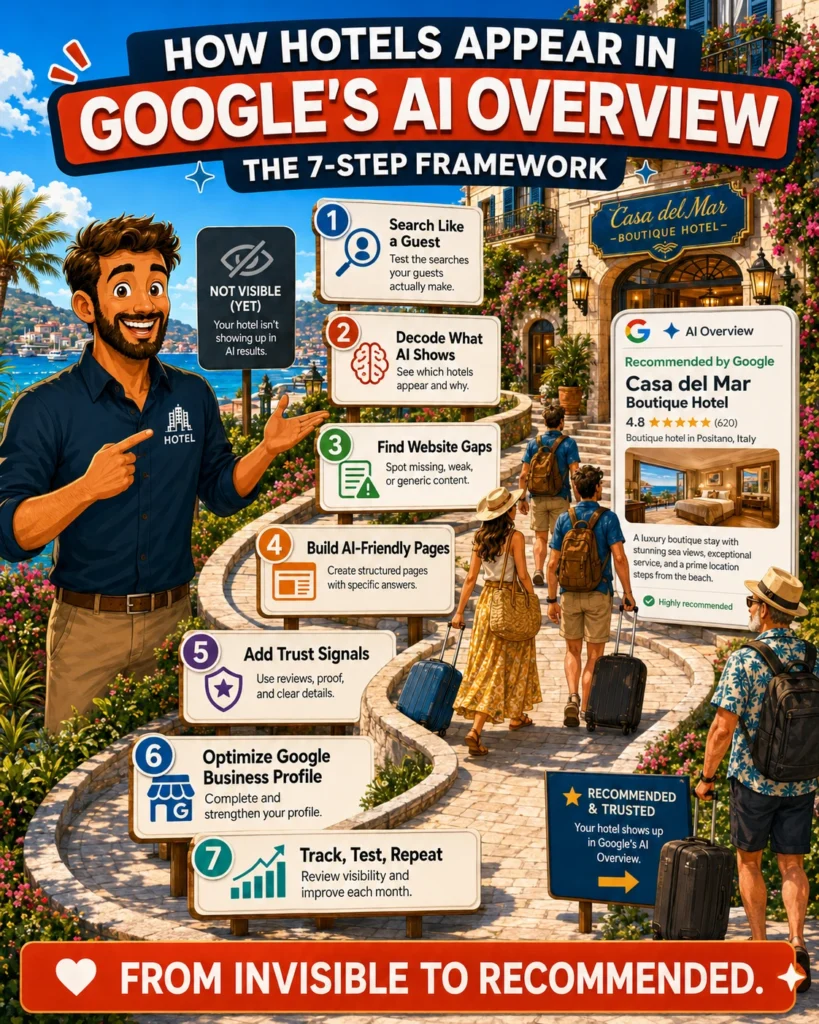
Step 1: Play Detective and Search for Your Hotel the Way a Guest Would 🕵️
The first step is to understand what Google’s AI currently shows for the searches that matter to your hotel. Open Google and switch to AI Mode, or observe the AI Overview at the top of standard results, and search as a guest would. Use specific, conversational queries relevant to your property.
For a boutique hotel in Vienna with a spa, I tested queries like:
- “Boutique hotel Vienna with spa and rooftop”
- “Best intimate hotel Vienna for couples with wellness”
- “Vienna hotel with private sauna and good breakfast”
- “Small luxury hotel Vienna near museums”
Then observe carefully: which hotels appear in the AI response? What specific features does the AI highlight? How does it organise the results? And crucially: when you ask the AI why it recommended those hotels, what criteria does it name?
That last step is the most valuable. Google AI will often tell you exactly why it featured a hotel, citing things like rating quality, specificity of spa features, the uniqueness of an offering, or the clarity of the description. In my Vienna test, the AI specifically noted that one hotel’s private spa booking option “solves the problem of hotel spas being crowded or lacking privacy.” That kind of insight is your content brief.
💡 Pro Tip: Screenshot the AI summaries and save them. These are not just search results. They are a clear signal of what Google’s AI values most for hotel searches in your category and location.
Step 2: Understand What Google's AI Highlights in Hotel Results ❤️
Once you have observed the results, it is time to understand the patterns. What do the hotels that appear in AI Overviews have in common? In my testing across multiple hotel searches, several patterns emerged consistently.
What tends to appear in AI-featured hotel results:
Specific, verifiable feature descriptions. Not “comfortable rooms with modern amenities” but “32 m² double room with a king-size bed, floor-to-ceiling windows overlooking the Naschmarkt, walk-in shower, and breakfast from 7:00.” The AI references specific details because specific details answer specific guest questions.
Clear differentiation. The AI does not feature hotels that sound like every other hotel. It features hotels that have a clearly communicable reason to be recommended. A private bookable spa, a rooftop bar with a specific view, a pool that is genuinely rare among boutique properties in that city. Your hotel’s unique features, stated plainly and specifically, are your strongest AI asset.
High ratings with substantial review volume. In my Vienna test, every hotel featured had a rating of 4.6 or above and hundreds or thousands of reviews. Both quality and quantity matter, and recent reviews matter too.
Trust signals throughout the content. Credentials, awards, press mentions, expert descriptions, and consistent guest feedback all contribute to the trust score that determines whether Google’s AI is confident enough to feature your hotel.
Structured, scannable content. The hotels whose content appeared most prominently had clear headings, specific feature sections, and FAQ-style content that directly answered common guest questions.
💡 Ask Google AI directly: after it recommends a set of hotels, type “Why did you recommend these?” or “Why this result?” The AI will list the exact criteria it used. Screenshot those explanations and use them as a to-do list for your own hotel pages. These are no longer mysterious ranking signals. Actually, they are a direct brief for what your content needs to say.
Want to improve more than just this one page?
This guide focuses on one specific part of your hotel website. But direct booking growth usually comes from improving the full system: your positioning, homepage, room pages, feature pages, Google visibility, AI search readiness, and booking journey.
Step 3: Identify What Your Hotel Pages Are Missing 🔍
Once you understand what the AI values, look honestly at your own hotel website and identify the gaps. In my experience auditing hotel websites, the same missing elements come up repeatedly, and they are almost always the same gaps that prevent a hotel from appearing in AI results.
Ask yourself these questions about each key hotel page:
Do your room descriptions answer specific guest questions? A guest searching “Vienna hotel with king-size bed and city view” cannot find your hotel if your room page says “double room with comfortable bed and beautiful view.” Bed size, view direction, room dimensions, bathroom configuration, included amenities — these are what the AI uses to match your page to a specific query.
Do you have dedicated pages for each key amenity? A hotel that mentions its spa, gym, breakfast, parking, and bar all on one generic facilities page gives the AI nothing specific to surface for any one of those searches. A dedicated spa page that describes the sauna, whether it can be booked privately, what treatments are available, and who it is ideal for — that is what gets featured.
Does your content communicate who your hotel is for? “Boutique hotel for couples,” “family hotel with kids activities,” “business hotel near the convention centre” — these audience signals help the AI match your hotel to the right guest query. If your pages never say who your hotel is designed for, the AI cannot make that connection.
Do you have enough trust signals? Review snippets, award mentions, press citations, staff credentials, specific guest testimonials — all of these build the credibility that Google’s AI needs to feel confident featuring your property.
👉 For a practical guide on how to structure hotel pages so each one can rank and be featured: How to Structure a Hotel Website for SEO, AI, and Direct Bookings
👉 For a guide on how guests search and how to match your content to their intent: SEO for Hotels: 5 Beginner Tips to Get Found on Google
Step 4: Build Hotel Pages That AI Can Feature 🚀
Now comes the most important work: improving your hotel pages so they contain what Google’s AI needs to feature them confidently. This is not about writing more generic content. It is about adding the specific, structured, trustworthy information that AI systems are designed to surface.
Answer the guest’s question at the top of each page
Your goal is not just to write a good hotel page. Your goal is to make the answer so useful, so clear, and so reassuring that Google’s AI cannot help but feature it.
Every key hotel page should open with a direct answer to the most likely guest question. Your spa page should immediately confirm what spa facilities exist, what makes them distinctive, and who they are for. Your family rooms page should immediately confirm that families are welcome, what the room setup looks like, and what is available for children nearby.
Ask yourself before publishing any hotel page: if I were the guest, would I feel relieved landing here? Would I immediately find what I was looking for? If not, make it better.
The AI scans your entire page and can summarise it, but it privileges content that answers questions clearly and early. If the most important information is buried three paragraphs down, it may not be surfaced.
One more thing worth knowing: unlike a human reader who might skim or miss important points, AI can scan your entire page and extract key insights fast. That means that in case of doubt, it is okay to create more content than you normally would. More high-quality, well-structured content gives the AI more to work with. Just make sure it is well-organised. Use clear headings, keep paragraphs digestible, and do not be afraid to go deep on topics your guests genuinely care about.
Use structured, scannable formatting throughout
AI systems favour content that is easy to parse. Use clear headings for each section. Use bullet points for lists of features, amenities, and included items. Use comparison tables where relevant. For hotel room pages, consider a structured format like this:
- Room size: 32 m²
- Bed: King-size
- View: Courtyard, quiet
- Bathroom: Walk-in rainfall shower
- Included: Air conditioning, free Wi-Fi, blackout curtains, workspace
- Breakfast: Available from 7:00, included in select rates
This gives the AI precisely the kind of machine-readable specifics it needs to answer a guest query accurately.
Make sure your key content is visible in the page HTML
AI crawlers do not interact with your page the way a human does. They do not click on tabs, expand dropdown sections, or scroll through carousels. If your room specifications are hidden inside a collapsible section, or your spa details only appear after clicking a button, the AI may never read them. Your important content must be present in the raw HTML of the page, fully visible by default.
To check: right-click on your page, select “View Page Source,” and look for your key content in the plain text. If it is not there, it needs to be moved. ⚠️
Keep your content fresh
Fresh content is a trust signal. Use seasonal price updates as an opportunity to refresh your key pages. Add a section for recent guest reviews. Update your FAQ sections with new questions you hear regularly. Google’s AI favours pages that are actively maintained over pages that were last updated two years ago.
👉 For a detailed guide on the content types and page structures that AI search rewards: How to Make Google’s Ranking Systems Work in Favour of Your Hotel Website
Want more hotel website ideas like this?
I regularly share practical thoughts on hotel SEO, AI search, direct bookings, website clarity, and how independent hotels can become easier to find and book directly.
Step 5: Use Trust Signals That AI Search Rewards 🏅
Getting featured in Google’s AI Overview is not just a content quality question. It is a trust question. Google’s AI needs to be confident enough in your hotel’s reputation and credibility to recommend it to a guest.
Guest reviews are the most important trust signal for hotels
In the Propellic behavioral study of travel searches in Google AI Mode, AI recommendations scored 4.3 out of 5 in consumer trust ratings. That trust is partly built on the underlying data: hotels that appear in AI results consistently have high ratings, substantial review volume, and recent reviews. A hotel with 1,200 reviews at 4.8 is far more likely to be featured than one with 40 reviews at 4.7.
Actively collect reviews. Ask guests at check-out. Follow up with a post-stay message. Respond to every review, positive and negative, because responses show Google and future guests that your hotel is engaged, professional, and trustworthy.
Specific credentials, awards, and recognitions
If your spa therapists are certified, say so on the spa page. If your chef has a recognised background, mention it on the restaurant page. If your hotel has received press coverage or notable awards, feature them prominently. These signals help Google’s AI categorise your hotel as an authoritative and credible source.
Testimonials with specificity
A testimonial that says “wonderful stay, highly recommend” does not give the AI much to work with. A testimonial that says “the private spa booking was the highlight of our anniversary trip. We had the sauna and hammam entirely to ourselves for two hours” gives the AI a specific, quotable trust signal that reinforces your hotel’s distinctive offering.
Get practical hotel website ideas in your inbox
In my newsletter, I share clear, actionable ideas for hotel owners and marketers who want more guests to find, trust, and book their hotel directly.
Step 6: Track, Test, Repeat = Your Hotel Keeps Improving 📈
Appearing in Google’s AI Overview is not a one-time achievement. AI results evolve constantly, and so should your approach to them.
Test your hotel’s AI visibility regularly
At least once a month, open Google AI Mode and search for your hotel using the kinds of queries a guest would use. Does your hotel appear? If it does, what specific features does the AI highlight? If it does not, which hotels do — and what do their pages do that yours currently does not?
Use Google Search Console to track the effect of your changes
When you improve a hotel page, monitor it in Google Search Console. Look for increases in impressions, improvements in click-through rate, and new search queries bringing guests to that page. While there is no direct AI Overview report yet, changes in traffic patterns after content improvements are a clear signal that your pages are being picked up differently.
Update content based on what AI highlights
Test this regularly: after the AI recommends a set of hotels in your category, ask it “Why did you recommend these?” The criteria it gives you are a direct content brief for what your pages still need to communicate.
💡 Set a monthly reminder to test your hotel’s AI visibility. You are not just publishing content. You are building a relationship with an AI system that is increasingly influential in guest booking decisions.
👉 For a step-by-step guide on using Google Search Console to track your hotel’s search performance: How to Set Up Google Search Console for Your Hotel Website
🏨 Your Google Business Profile: The Most Underestimated AI Asset for Hotels
If there is one thing the latest travel industry research makes unmistakably clear, it is this: for hotels in AI search, the Google Business Profile has become as important as the hotel website, and in many cases more so.
The numbers are striking. In Propellic’s behavioral study of Google AI Mode use for travel, analysing over 300 real booking journeys, AI Mode sessions included a click to a Google Business Profile 46% of the time. A separate study analysing 4,000 queries across eight cities found that 79% of hotel links in Google AI Mode responses route to a Google Business Profile, not to the hotel website. Only 16% of links went directly to hotel websites.
I have seen this pattern consistently in my own testing. Every time I search for hotels in Gemini or Google AI Mode, the AI response includes links that route through the Google Business Profile rather than directly to the hotel website. In every test I have run, the Business Profile appeared as the primary access point. Guests see photos, ratings, key details, and a link to the website, all within the AI response itself. The Business Profile has effectively become the hotel’s storefront inside Google’s AI ecosystem.
This is a structural shift, not a temporary trend. As Google embeds local business cards directly into AI-generated responses, the Business Profile is often the first and sometimes the only interaction a guest has before deciding whether to visit the hotel website at all.
How to optimise your Google Business Profile for AI search
Complete every section of your profile. Hotel name, address, phone number, website URL, check-in and check-out times, price range, hotel star rating, amenities list, accessibility information, parking details. Every field you leave blank is a missed signal to Google’s AI. Go through your profile section by section and fill in everything. 📋
Upload high-quality, current photos. The AI response often shows photos pulled directly from the Business Profile. Guests make fast visual judgments. Upload professional photos of your rooms, spa, restaurant, lobby, and outdoor areas. Keep them current since photos from a pre-renovation era can mislead guests and damage trust.
Collect and respond to Google reviews actively. Your Business Profile rating is one of the most visible data points in an AI response. Make collecting Google reviews a systematic habit. And respond to every review. Positive reviews deserve a thank you, and negative reviews deserve a professional, constructive response that shows future guests how you handle problems.
Use the Q&A section. Guests ask questions directly on your Business Profile. Monitor these and answer them promptly. You can also proactively add common questions and answers about parking, breakfast, check-in times, and nearby attractions to make your profile more informative and AI-friendly.
Post regular updates. Google Business Profile allows you to post updates, offers, and events. Regular posts signal to Google that your profile is actively maintained, which contributes to both AI visibility and local search performance. Use seasonal offers, new amenities, or upcoming local events as reasons to post.
Connect your website clearly. Make sure the website URL in your Business Profile is accurate and loads correctly. The profile and the website should tell a consistent story. Use the same hotel name, the same address, the same key features. Inconsistencies confuse both Google and guests.
💡 From my own testing: every hotel I searched for in Google AI Mode and Gemini surfaced its Business Profile as the primary entry point. Hotels with complete, well-photographed, actively reviewed profiles appeared far more prominently and were referenced with more confidence by the AI. Treating your Business Profile as seriously as your best hotel pages is one of the highest-return actions you can take for AI search visibility right now.
Classic SEO vs. AI-First SEO for Hotels ✅
What Changes | Old-School Hotel SEO | AI-First Hotel SEO |
|---|---|---|
| Main Goal | Rank for hotel search keywords | Appear in AI-generated hotel recommendations |
| Content Focus | Keyword optimisation + page structure + Good content | Specific answers to guest questions |
| Query Style | “Hotel Vienna” (3-4 words) | “Quiet boutique hotel Vienna for couples with spa” (20+ words) |
| Page Structure | H1/H2, meta, body content | Structured specifics: bullet points, tables, FAQs |
| Trust Signals | Reviews, credentials, updates | Reviews, credentials, updates (weighted more heavily) |
| Google Business Profile | Useful for local search | Essential for AI Mode visibility |
| Update Frequency | Regular | Regular, based on AI response changes |
| Measurement | Impressions, CTR, clicks | AI presence, GBP clicks, direct booking rate |
| Winning Approach | Technical + content SEO | Answer-first, specific, trust-rich content |
Conclusion: Be the Hotel Google's AI Recommends 🧠✨
We are already in the AI-first search era. When a guest searches for a hotel like yours on Google, the AI Overview at the top of the page is their first impression of what is available. If your hotel is featured there, you are seen before any other result. If it is not, you are invisible at the moment that matters most.
The path to appearing in Google’s AI Overview follows a clear logic: specific content that answers real guest questions, structured pages that AI can read and extract easily, trust signals that make Google confident enough to recommend your hotel, and a Google Business Profile that is complete, current, and actively maintained.
The research also carries an encouraging message for independent hotels. When guests interact with AI search in travel, they book directly with hotels 56% of the time. OTAs capture fewer than 10% of bookings in AI Mode. This is a structural shift that rewards hotels with a strong, well-optimised direct presence.
Work through the six steps in this article. Test your hotel’s AI visibility regularly. And treat your Google Business Profile as the primary storefront it has now become.
If you have questions, want a second opinion on your hotel’s AI search visibility, or want to talk through where to start, I would love to hear from you. ☕
FAQs: Hotels in Google AI Overview
1. What is Google's AI Overview and how does it affect hotel searches?
Google’s AI Overview is an AI-generated summary that appears at the top of search results, before any organic links. For hotel searches, it often includes a curated list of recommended properties with ratings, key features, and price ranges. More than 55% of travel keywords on Google’s first page now trigger an AI Overview. If your hotel is not optimised for it, you are not visible at the most prominent position on the page.
2. How do I get my hotel to appear in Google's AI Overview?
Focus on three areas. First, make your hotel pages specific: detailed room descriptions, dedicated amenity pages, clear audience signals, and fresh content. Second, build trust: collect Google reviews actively, respond to all of them, and add credentials and testimonials to your key pages. Third, optimise your Google Business Profile: complete every section, upload current professional photos, and post regular updates. These combined signals are what Google’s AI uses to evaluate whether your hotel is worth featuring.
3. Is a Google Business Profile really more important than my hotel website for AI search?
For AI Mode specifically, the evidence is compelling. Research found that 79% of hotel links in Google AI Mode responses route to a Google Business Profile, and 46% of AI Mode travel sessions include a click to a Business Profile. In my own testing across Gemini and Google AI Mode, the Business Profile consistently appeared as the primary entry point to the hotel. Both matter, but the Business Profile has become the primary storefront inside Google’s AI ecosystem and needs to be treated as such.
4. Do traditional SEO practices still matter for hotels in the AI search era?
Yes, absolutely. Classic SEO like keyword research, internal linking, page speed, and indexed pages, still underpins everything. But AI search adds an additional layer: your content needs to answer specific guest questions, your pages need to be structured so AI can extract key information, and your trust signals need to be strong enough for Google’s AI to recommend your hotel with confidence. Think of AI optimisation as an upgrade to your existing SEO, not a replacement.
5. How do I track whether my hotel appears in Google's AI Overview?
There is no dedicated AI Overview report in Google Search Console yet. The most reliable method is manual testing: regularly search for your hotel using the kinds of queries a guest would use in AI Mode and observe whether your hotel appears. Track changes in organic traffic and click-through rate in Search Console after you make content improvements. Some third-party SEO tools are beginning to track AI Overview appearances, though these are still evolving.
Want to know what your hotel website is missing?
I help independent hotels improve their website structure, Google visibility, AI search readiness, content clarity, and direct booking journey. In a free website check, I’ll show you specific opportunities your hotel may be missing right now.
The Prompt used To Create this article
I want to be transparent on how this article was written, so below you will find the prompt to create this article. Of course, I asked for adjustments afterwards, but here is the initial input:
Check the prompt
Can you restructure the article below, so it fits the structure for blog articles for my website, www.patricklindbichler.com? I want to go in the direction of making the articles a bit longer, so people find clear information. The article should be clear and easy to understand, especially for people who are new to the topic. Still it should stay as compelling as the original article and also have the same length. It should be written in good American English, using not too complicated words so that even non-native English speakers can follow along easily. The tone should reflect my expertise as a thought leader in SEO, content creation, and leadership. Feel free to use examples from my experience as proof points and explain them in a clear und compelling way.
I am typically a positive and humorous person, so the writing style can be upbeat with a few jokes here and there—just nothing offensive. The article should be engaging, fun to read, and educational. Please follow the structure outlined below, and feel free to expand on the points with additional context to ensure that each paragraph presents clear arguments.
Structure of the article:
- Introduction: Start with a paragraph that summarizes the topic and grabs attention. You can make a strong statement or ask a thought-provoking question that will be answered later in the article.
- Key Highlights (3-4 bullet points): Include a few short bullet points summarizing the key takeaways of the article. Each point should be 1-2 sentences long.
- Main Content: Break the main part of the text into several text parts, each with a heading optimized for SEO and AI search. Each text part can have 1-3 paragraphs with 5-20 sentences each, depending on how much content is needed to explain the point clearly and bring the argument across. The paragraphs should be easy to read and compelling.
- Conclusion: Wrap up the article by summarizing the main points and inviting readers to reach out if they have any questions or want to learn more.
- FAQs: Include 5 frequently asked questions about the topic, with clear answers that add value to the reader.
Formatting:
- Use bold for key points, ensuring every 4th or 5th sentence has something in bold for emphasis.
- Add emojis throughout (but no more than 50 total) to make the article more visually appealing.
- If you include practical tips, illustrate them with real-life examples to make the content relatable.
- Please make the article a minimum of 1800 words. Feel free to ask me if you need more input or add information and context where you feel it’s necessary to convey a message or provide more clarity.
Goals:
- Please optimise the article for SEO. Give recommendations for search terms to include and integrate them into the titles of the paragraphs and the beginning of the article.
- Please make the article engaging so people are intrigued to read but also enjoy reading.
- What readers learn in the article, should be easy to apply for them because everything is explained clearly and has examples
Please restructure the following article with the guidelines above:
AI Optimization: How to Optimize for Google’s AI-Powered Search Experience
Google has entered a new era of search by integrating AI-generated answers directly into the top of search results. These AI-powered summaries represent a fundamental shift in how content is discovered—and they’re already live in many markets. This transformation is reshaping the SEO landscape and requires marketers and website owners to rethink how they approach visibility, content, and trust-building.
In fact, in the U.S., Google now lets users test a dedicated “AI mode,” where search begins with a conversational AI result by default, not a list of links. Users can still switch to classic search via a tab—but this signals that Google is fully leaning into an AI-first search experience.
In this article, you’ll discover five simple steps to adapt your content for this AI-driven search future—and make sure your website still shines at the top.
The Rise of AI-Powered Search: What’s Changing
Google’s integration of generative AI directly into its search results page is changing the game in several key ways:
- More Conversational and Context-Rich Queries: Users now ask longer, more natural questions, expecting deeper and more personalized responses from the search engine. This creates more opportunities for niche, long-tail content to rank—but only if it answers these questions directly and clearly.
⚠️ Big Shift in Search Behavior:
While traditional search queries have historically averaged around four words, prompts in AI tools now average 23 words or more. People don’t just ask for “best hiking boots”—they ask “What are the best hiking boots for flat feet and rocky terrain under $150 in wet weather?”
Even more, they often follow up with additional clarifying questions. That means your content needs to be ready to answer a multitude of related questions—in a clear, modular, and context-aware way.
- AI Summaries Before Traditional Results: In many searches, an AI-generated answer is now the first thing users see. These summaries often pull from multiple sources and can include citations. Pages featured in or influencing these summaries are likely to see increased traffic—while traditional organic links below the fold may receive fewer clicks.
- Higher Standards for Content Quality: With AI highlighting specific pages as “high-confidence sources,” creating comprehensive, helpful, and trustworthy content is more essential than ever.
This is an exciting opportunity to boost your visibility—if you’re ready to optimize for AI in search.
Step 1: Explore AI-Driven Search with Your Own Queries
Start by searching the types of questions your target audience would ask and observe how AI summarizes answers. For example, if you run a ski school in Winterberg, Germany, try entering queries like:
- “Best ski school for beginners in Winterberg”
- “Ski lessons for kids under 10 in Winterberg”
- “Affordable adult ski classes in Winterberg”
See which websites are referenced or mentioned in the AI summary. Do they look like yours? What kind of information do they include?
Step 2: Understand What Content AI Prioritizes
Dig deeper into why the AI is surfacing certain results. While you can’t directly ask Google’s search engine why it chose a page, you can reverse-engineer patterns by comparing multiple queries and the types of content that appear frequently.
Look for common elements such as:
- Clear answers to common questions
- Structured information (e.g., bullet points, subheadings, FAQs)
- Authoritativeness and trust signals (certifications, reviews, etc.)
- Freshness and relevance of content
Step 3: Include Key Decision-Making Information
If your business or website serves specific customer needs, make sure you include the details that matter to users—and that AI is likely to surface in summaries.
Using the ski school example again, useful information might include:
- Class sizes (e.g., “Maximum 6 students per group”)
- Instructor qualifications (e.g., “DSV-certified instructors”)
- Lesson variety (e.g., “For beginners, intermediate and advanced levels”)
- Pricing transparency (e.g., “€35 for a 90-minute lesson”)
- Authentic testimonials and reviews
The goal is to preemptively answer what users (and the AI) are looking for—before they have to click.
Step 4: Optimize Placement of Critical Information
Make the essential content easy to find and extract. AI systems tend to scan structured and clearly formatted content. Here’s where to highlight key details:
- Homepage: Feature top value points and service highlights in prominent banners or intro sections.
- Landing Pages: Dedicate pages to individual service categories, customer types, or locations.
- Product/Service Pages: Add precise benefits, pricing, and differentiators.
- Reviews/Testimonial Sections: Include customer quotes and ratings.
- FAQ Pages: Use schema markup and include real questions your audience asks.
- Contact Pages: Ensure business hours, location, and contact info are current and easily visible.
💡 Technical Insight: Don’t Hide Your Content Behind Clicks
AI crawlers currently appear not to render JavaScript or interact with content like a human would. This means your important content must be present in the raw HTML of the page—not only loaded after user interaction (e.g., clicking tabs or expanding dropdowns).
If it’s not visible in the page source, it likely won’t be seen by AI—and therefore won’t be included in summaries.
Step 5: Rethink Your Content Quantity and Structure
Traditionally, SEO advice often leaned toward focusing on a few strong pages with clear topical authority. But with AI’s ability to summarize and extract relevant content for the user, you can confidently increase the amount of content you create—as long as it’s useful and connected to your main offerings.
🧠 Why More Content Can Be Smart (Now)
Users won’t have to wade through every word on your site—AI can help them surface exactly what they need. That gives you the freedom to:
- Cover more specific long-tail topics
- Provide unique insights others don’t
- Answer adjacent questions and edge cases
The key is that each piece of content should still be high quality and relevant to your site’s core topics, so AI can recognize it as trustworthy and connect it to your broader authority.
Step 6: Monitor and Continuously Refine
Google’s AI-generated answers are still evolving, and so should your content. Keep experimenting with search queries. Track whether your traffic is coming from AI-referenced results or classic rankings. Watch how your competitors are adapting.
Small tweaks—like adding more detailed comparisons or structuring your content better—can significantly improve your chances of being featured or cited in AI summaries.
Conclusion: Prepare for the AI-First Search Era
We’re no longer preparing for the future of search—we’re living in it. The rise of AI-generated answers in search means your content needs to go beyond ranking for keywords. It needs to become the answer.
While classic SEO practices still matter (title tags, internal linking, site speed, etc.), content quality, structure, and trust signals have become even more important. Think of AI optimization not as replacing SEO, but as an upgrade to your strategy.
By understanding what Google’s AI favors—and positioning your content accordingly—you’ll give yourself a clear edge in the evolving digital landscape.
Frequently Asked Questions (FAQs)
What is Google’s new “AI mode” in search, and how does it work?
Google has rolled out an AI-first search experience in the U.S. where users start with an AI-generated answer instead of traditional blue links. The AI response appears immediately after entering a query, often synthesizing information from multiple sources. Users can still switch to the “Web” tab to view traditional search results. This change reflects Google’s shift toward making AI the primary interface for answering questions.
How can I get my content featured in Google’s AI answers?
Ensure your content is comprehensive, helpful, and formatted clearly. Include structured data, answer real user questions, and highlight trust factors like reviews and certifications.
Should I stop traditional SEO work?
Absolutely not. Traditional SEO practices like keyword research, structured data, and mobile-friendliness still matter. But they now need to work alongside AI-oriented content strategies.
What types of content does Google’s AI like to show?
Content that directly answers user questions, includes unique value, and demonstrates authority tends to be prioritized. Helpful formatting (like bullet points, tables, and subheadings) also makes content easier for AI to digest and feature.