
Hotel SEO consulting by Patrick Lindbichler for independent hotels that want to rank on Google, get found for the right searches, and turn that visibility into direct bookings. Based in Vienna – made for the world.
Every day, travellers search for hotels like yours: boutique hotel near the old town, family hotel with pool, quiet hotel with great breakfast. Most of them click the first result they see. If that result is Booking.com instead of your website, you pay for a guest you should have earned directly.
To understand what makes independent hotels rank and what holds them back
As Head of SEO, AI Search and Content at a leading travel marketplace
Family hotel in the Austrian mountains. Hotel reception in Vienna.
The Search Landscape
OTAs invest millions into ranking on broad hotel searches. That battle is not yours to win. But there is a category of searches where independent hotels can consistently outrank every platform and where the guests who click convert at a far higher rate.
The searches on the right are not smaller opportunities, they are better ones. The traveller already knows what they want. They convert faster, complain less, and are more likely to book directly when your page gives them a clear reason to.
Why Hotels Stay Invisible on Google
Most hotels that struggle with SEO are not struggling because their property is average. They are struggling because their website does not give Google enough to work with. Here is what that usually looks like:
Your SEO Starting Point
The right action depends entirely on your current position. A hotel with zero organic traffic needs a completely different approach from a hotel with steady visitors but poor conversion. The framework below maps the journey and the priorities at each stage.
You don’t know how many people visit your website, what they search for to find you, or whether you rank for anything. The priority is foundation: clear positioning, core pages, and Google Search Console and Analytics set up so every next step is based on real data.
You have tracking in place, but your site does not rank for any of the searches your guests actually use. The priority is content that targets real search intent — dedicated pages for each use case, each feature, each type of guest and making sure Google can find and index them.
Traffic is arriving but inconsistently, and most bookings still come through OTAs or ads. The priority is a systematic content and optimisation process: regular improvement cycles, a content calendar based on keyword research, and fixing any technical issues quietly holding back rankings.
Organic is contributing but is not yet reliable enough to reduce OTA dependence meaningfully. The priority is building authority with complementary content, quality backlinks from relevant sources, and review management that strengthens both rankings and conversion.
SEO is producing results. The priority now is maintaining what is working, closing topical coverage gaps, building backlink authority, and starting to layer in AI search readiness — so the engine you have built keeps running as search behaviour evolves.
Hotel SEO Website Analysis
The analysis gives you a clear picture of your current Google visibility, what is holding you back, and what to fix first — with specific actions, not a generic report.
I check what your hotel currently ranks for in Google — which search terms drive impressions, which drive clicks, and where you are close to breaking onto page one. This is the clearest picture of where you stand today and where the fastest wins are.
I identify the specific search terms your hotel should realistically rank for — combining your location, property type, features, and target guest — and map which terms have existing pages, which have weak pages, and which have no page at all.
I review your homepage, room pages, facility and amenity pages, location content, FAQ sections, and booking path. For each, I check: does this page target a specific search intent, does it answer the guest’s question clearly, and does it give them a reason to take the next step?
I check whether Google can properly crawl and index your pages — looking at your sitemap, robots.txt, internal linking, page speed, mobile usability, and whether important content is buried in scripts, booking widgets, or PDFs where Google cannot read it.
Your Google Business Profile is often the first thing a traveller sees in local search results. I check whether it is complete, accurate, and actively managed — including categories, amenities, photos, Q&A, and whether your review profile supports or undermines your rankings.
I check which hotels in your market are currently ranking for the terms you should own — and what specifically they have on their websites that you do not. The gap between your current position and a competitor’s is almost always visible in the content.
Ranking on Google only matters if the visitor becomes a guest. I check whether your booking and contact path is clear, whether your room and feature pages answer the questions guests need answered before they decide, and where the drop-off is most likely happening.
You receive a clear output: what is working, what is missing, what to fix first, and (if relevant) which stage of the growth journey your hotel is currently at. Specific pages to improve or create, specific technical fixes, and a sequence that matches your current starting point.
Send me your hotel website by filling out this form below and I’ll show you 3 direct booking leaks you can fix within one week.
If you want to understand how this could work for your hotel, we can walk through your website together and identify where you’re currently losing bookings.
What the Hotel Website Analysis Contains
The analysis follows a structured process covering your Google visibility, content quality, technical foundations, and booking journey. You can read the full breakdown of what gets reviewed, how it works, and what you receive as an output.
How I Work
There is no one-size-fits-all hotel SEO strategy. A 12-room family-run guesthouse in Tyrol and a 40-room design boutique in Vienna need completely different approaches. Here is what stays consistent across every hotel I work with:
Before anything else, I understand what success looks like for your hotel. Whether that is reducing OTA commission, filling a specific room type, attracting a different guest profile, or building organic visibility for the first time. Every recommendation follows from that.
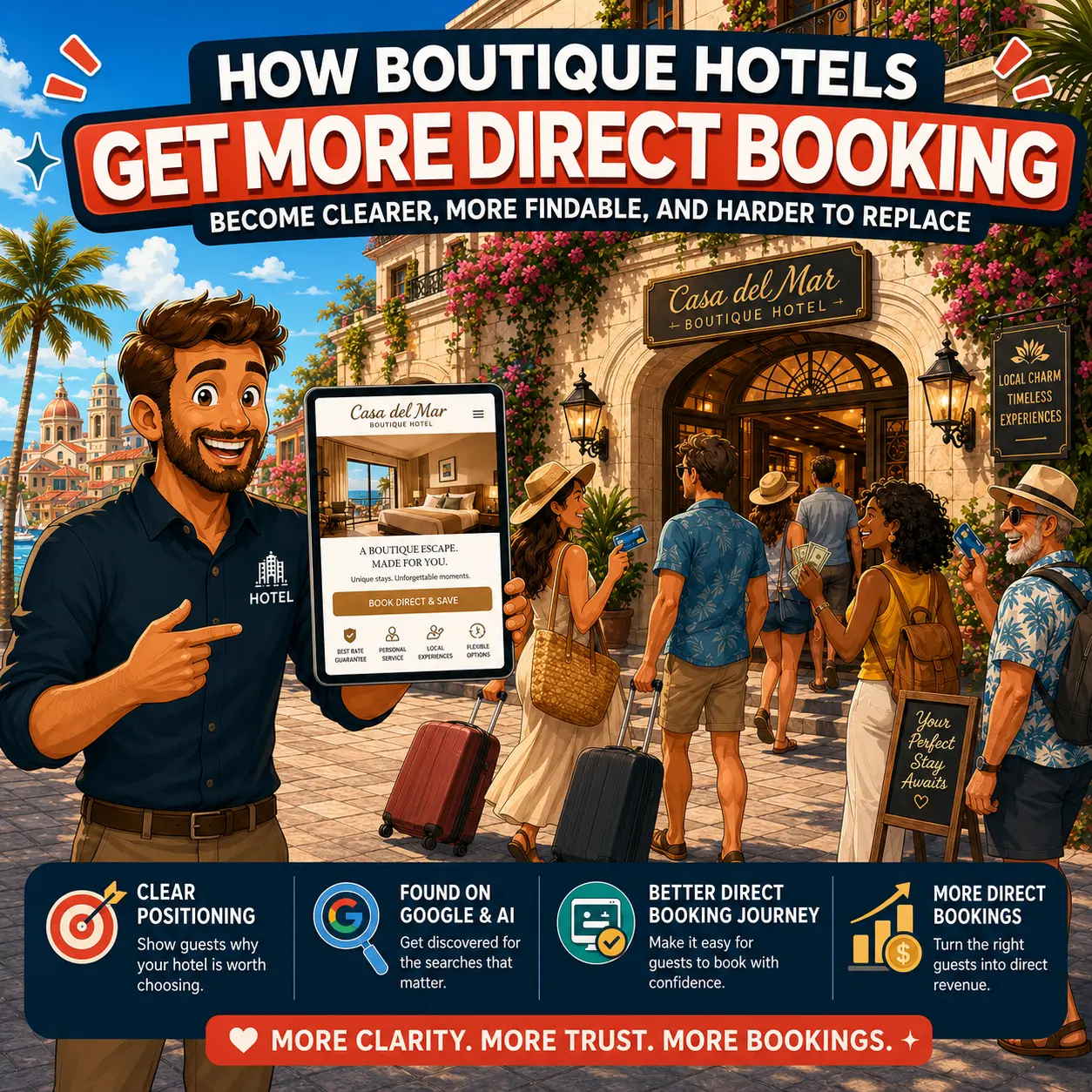
A guest who finds your hotel on Google and has every question answered on your website does not need to go back to Booking.com to compare. Clear pages for rooms, breakfast, parking, facilities, location remove doubt and make the direct booking the obvious choice.
Generic hotels do not rank for specific searches. The properties that rank consistently have found the combination of features, audience, location, and personality that makes them the right answer for a specific guest. I help identify and build around that.
Good SEO does not mean corporate language and keyword-stuffed pages. The tone, character, and communication style that makes your hotel feel different to guests are also what makes it feel different in search results. We work with your personality, not against it.
Honest About What This Is
✕ Ranking you for “hotel Vienna” and beating Booking.com. OTAs own broad terms and the economics of fighting them don’t make sense for independent hotels
✕ Publishing 50 blog posts about local sights with no connection to your booking journey
✕ Buying links from directories that have nothing to do with travel or hospitality
✕ Applying generic SEO tactics from e-commerce or SaaS to a hospitality context where they do not translate
✕ A one-time report that nobody reads and nothing changes from
✕ Promising a specific ranking position or a timeline that no honest consultant can guarantee
✕ Ignoring conversion, because ranking without booking is just traffic, not revenue
The goal is to build an organic traffic and booking engine that belongs to your hotel and not to rent visibility through ads or platforms indefinitely. That takes time, but the asset compounds. Every well-ranked page keeps working without additional spend.
Is This For You?
✔ Independent hotels, boutique properties, and owner-led collections that want to reduce dependence on Booking.com, Expedia, and other OTAs
✔ Hotels with a strong guest experience and positive reviews, but a website that does not reflect that quality to Google or to prospective guests
✔ Hotel owners or managers who want to understand exactly where they are losing visibility on Google, and what to do about it first
✔ Properties that have tried SEO before but saw no results, likely because the approach was not built around how hotel guests actually search
✔ Hospitality marketers who need a clear, honest audit of their current SEO situation before deciding where to invest next
✔ Hotels that want to grow direct bookings without increasing ad spend by building an organic channel they own
Why Patrick Lindbichler

Most hotel SEO advice is written by people who have never worked inside the travel industry. I spent eight years as Head of SEO, AI Search, and Content at one of Europe’s leading travel marketplaces, analysing which hotels rank, which ones don’t, and precisely why the gap exists.
Before that, I grew up in a family hotel in the Austrian mountains and worked at hotel reception in Vienna. I understand the daily reality of running an independent property. The pressure on margins, the dependence on OTAs, and what it actually takes to make a direct booking happen.
Over the past year, I built a database of 300+ Vienna hotel websites and analysed them systematically: what search terms they target, which pages they have, what they are missing, and how that translates into Google visibility. That research shapes every hotel analysis I do.
“I’ve seen exactly why guests book and why they don’t. And the answer is almost never the hotel. It’s the website.”
If you want to understand how this could work for your hotel, we can walk through your website together and identify where you’re currently losing bookings.
Free Hotel SEO Resources
Not ready to start a consulting engagement? These guides give you the full framework to start improving on your own — with real hotel examples and step-by-step actions.
Hotel SEO: 5 Steps to Rank on Google and Drive Direct Bookings The complete hotel SEO playbook — from structuring your homepage like a reception desk to technical foundations, Google Business Profile, and a system for continuous improvement.
A 4-step framework to identify the specific searches your hotel could rank for with real examples from London hotels and a practical worksheet. Understanding search terms is where every hotel SEO strategy starts.
Starting from scratch or not sure where to begin? This guide covers the fundamentals: what hotel SEO is, what it is not, and the first things to fix on any hotel website.
A clear explanation of how Google's ranking systems work and what that means specifically for hotel websites. Cuts through the noise to focus on what actually influences whether your hotel appears in search results.
The two elements that determine whether a traveller clicks your result or the one next to it with hotel-specific examples and a practical guide to writing them well.
Step-by-step setup and practical use of Google Search Console, the free tool that shows exactly what your hotel ranks for, where impressions are coming from, and which pages to prioritise for improvement.
FAQs About Hotel SEO Consulting
Hotel SEO means optimising your website so that it ranks in Google when travellers search for hotels like yours — quiet boutique hotel in Vienna, family hotel with pool and parking, hotel near the theatre district. When your hotel ranks for those specific searches, travellers find you before they find an OTA, which means no commission and a direct relationship with your guest from the start.
Yes, on the right searches. OTAs dominate broad terms like “hotel Vienna” and “cheap hotels London.” But for specific, intent-rich searches like “quiet boutique hotel Vienna 7th district with breakfast”, an independent hotel with a well-structured page can outrank any platform. These specific searches also convert better, because the guest already knows what they want before they click.
Most hotels see measurable improvements in organic impressions within 6–12 weeks of making meaningful structural and content changes. Ranking gains for more competitive terms typically take 3–6 months. The goal is to build an asset that compounds over time. A page that ranks today will keep ranking without additional cost, unlike ad spend that stops the moment you pause it.
The highest-impact pages are usually: the homepage (clear positioning for your primary search identity), individual room pages (with specific, searchable detail), amenity pages like breakfast, parking, spa, pool, family rooms, a location guide, a neighbourhood page, a clear FAQ section, and a contact or booking page. Each page should target a specific search intent, not just exist as a navigation item.
Most hotel SEO best practices like clear positioning, specific pages for each guest intent, crawlable content, consistent business information, strong reviews, are also the foundation of AI search visibility. That is why the website analysis covers both together. The two topics have separate pages on this website simply to address them clearly, but the underlying work is the same: making your hotel easier to find, understand, and choose… whether the guest is searching on Google or asking ChatGPT. Here you can find more info on AI search optimisation.
Yes, especially for local search results. Google’s local ranking algorithm weighs review quantity, recency, and sentiment. A hotel with consistent recent positive reviews across Google, Tripadvisor, and booking platforms will outperform a hotel with outdated or sparse reviews, even on identical keywords. Getting reviews onto Google (not just Booking.com) is one of the highest-impact, lowest-cost SEO actions available to most independent hotels.
A generic SEO agency applies standard tactics across industries. Hotel SEO consulting is built around how travellers actually search for accommodation: the specific search terms, the intent behind them, the page types that convert, the role of OTAs in the competitive landscape, and the dynamics between broad and specific searches in hospitality. The strategies are different because the landscape is different from e-commerce, SaaS, or local services.
A hotel SEO audit reviews your website’s current Google visibility, content quality and structure, technical performance, keyword targeting, Google Business Profile setup, and competitive positioning. It identifies exactly where rankings and traffic are being lost and produces a prioritised roadmap so you know what to fix first and why. Read more about the full direct booking growth audit here.
I’ll show you 3 specific direct booking leaks your hotel can fix within one week. You wil know what to improve first and whether a deeper website upgrade makes sense.
Read practical hotel website growth guides
I write about hotel SEO, AI search, direct bookings, website structure, room pages, breakfast pages, and the small content gaps that quietly send guests back to OTAs.

Navigate
Language
Contact
I’m based in Vienna, Austria. You can connect with me on LinkedIn or send a message through the contact section.
Google ADS Certified


© Patrick Lindbichler 2026 | Legal Disclosure (Impressum)