Direct Bookings for Hotels

Everything on this page comes from research I ran myself: searches I tracked, websites I audited, and AI recommendations I tested. No borrowed stats, no theory.
Vienna searches analyzed
Google results reviewed
hotel websites audited
THE REASON BEHIND THE RESEARCH
I started this research with one goal: find out, with real data, what actually separates a hotel that gets found and booked directly from one that doesn’t. Not theory. Not “best practices” copied from a template. Actual searches, actual websites, actual AI recommendations.
There are two threads I keep pulling on:
Direct bookings. Some hotels consistently get chosen over very similar competitors. I want to know exactly why, which patterns in their content, positioning, and website structure correlate with guests booking direct instead of through an OTA, so I can apply the same patterns to other hotels with confidence, not guesswork.
Visibility. Where guests look for hotels keeps changing. Two years ago that mostly meant Google. Now it also means ChatGPT and Gemini, and that mix will keep shifting. So I don’t audit a website once and call it done. I keep re-running the same kind of research as the platforms themselves change, because a strategy built for yesterday’s Google doesn’t automatically work for today’s AI search.
CASE STUDY
Case studies show the work end to end: what I found, what I changed, and what happened next. Right now there’s one. More are coming as projects finish.
A boutique hotel in Vienna already had the hard part: strong occupancy, a good product, and a clear brand. There were still opportunities hidden in their website: Around 60% of bookings still came through OTAs. A realistic 5% shift toward direct bookings could represent more than €36,000 per year in potential commission savings. In this case study, I show how a 37-point website audit turned into an agency-ready roadmap covering booking path friction, room comparison, technical SEO, Google and AI visibility, content clarity, and next-step measurement.
OTA bookings
audit findings
yearly opportunity
FIELD NOTES
Not every insight needs a full case study. Sometimes a five-minute check of one hotel’s Google result, website, and AI recommendation tells you everything. I post these as short field notes on LinkedIn. Here’s a running log.
ORIGINAL RESEARCH
Three studies, one question: when a guest searches for a hotel, what actually shows up and why? Here’s exactly how I tested it, what the data shows, and what it means for a hotel website like yours.
Those are the steps I took to run this study on which hotels appear on Google, ChatGPT, and Gemini results, and what hotels did to appear.
Step | What I built / did | What it tells me |
|---|---|---|
| 1. Google Search Visibility Tool | A tool that pulls the real top-10 organic Google results for defined hotel searches — combining location, landmark, feature, audience, and occasion (e.g. “boutique hotel near Prater,” “hotel near Schönbrunn for business travelers”). | Who actually shows up when a real guest searches: OTA, hotel, hotel chain, or editorial site. |
| 2. Website Content Audit Tool | A second tool that checks each hotel’s own website against the search intent. Does it have a dedicated page, a mention, or nothing at all about that feature, audience, or occasion? | Whether the hotel has earned the right to show up, or whether the gap is on Google’s side or the hotel’s own site. |
| 3. AI Recommendation Test | Manual prompts run in ChatGPT and Gemini for the same intents, cross-checked against what each recommended hotel’s website actually says. | Whether AI tools have enough evidence on the hotel’s own site to recommend it with confidence. |
This is directional research, not a fixed ranking-factor study. Results change by location, language, device, time, and model. The value isn’t a single number. It’s the pattern that repeats across hundreds of searches and websites.
THE RESEARCH FINDINGS VISUALIZED
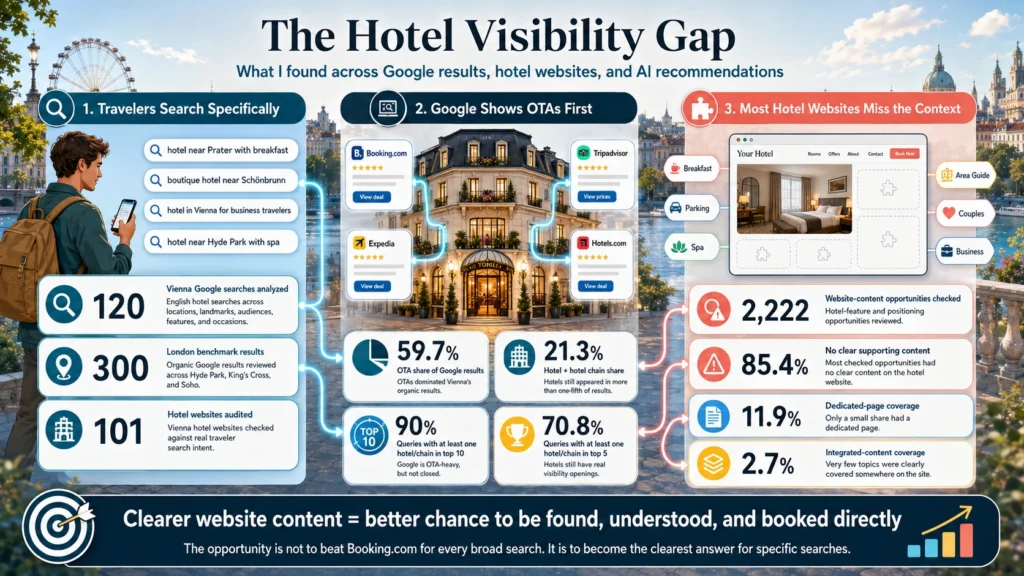
The study shows a clear pattern: when travelers search very specifically, Google often sends them to OTAs first, while many hotel websites do not provide enough clear content to become the obvious direct answer.
This visual summarizes the core finding: hotels are not locked out of Google or AI search, but they need clearer pages for the locations, features, audiences, and booking questions travelers actually search for.
STUDY 1
120 real English-language Google searches for Vienna hotels, combining location, landmark, audience, feature, and occasion, recording the top 10 organic results for each. 1,190 results reviewed in total. The idea was to see which hotels rank in the top 10 on Google for key search terms and why.
| 120 | 1,190 | 59.7% | 90% |
|---|---|---|---|
| searches analyzed | organic results reviewed | OTA share of all results | searches with a hotel/chain in the top 10 |
| Metric | Result |
|---|---|
| OTA share of organic results | 59.7% |
| Hotel + hotel-chain share | 21.3% |
| Searches with ≥1 hotel/chain in top 10 | 90.0% |
| Searches with ≥1 hotel/chain in top 5 | 70.8% |
| OTA share in top 3 | 73.6% |
| Hotel + hotel-chain share in top 3 | 18.3% |
| Strongest for hotels | Share | Weakest for hotels | Share |
|---|---|---|---|
| hotel with gym | 36.7% | hotel with hot tub | 6.7% |
| hotel with breakfast | 33.3% | budget hotel | 10.0% |
| hotel with parking | 28.3% | weekend trip hotel | 10.5% |
| hotel for singles | 28.3% | small hotel | 11.7% |
| boutique hotel | 26.7% | pet-friendly hotel | 15.0% |
Google is competitive, not closed. Stop aiming for “hotel Vienna”, that’s an OTA fight you’ll lose. Look at the searches above: gym, breakfast, parking, boutique positioning, families. Those are the searches where a clearly built page gives a hotel website a real, provable shot at the top 10.
STUDY 2
101 Vienna hotel websites, each checked against 22 attributes including features, audiences, occasions, and location angles guests actually search for. 2,222 checks in total, each scored as: dedicated page, mentioned somewhere, or nothing. The goal was to find what hotels did to appear on Google and AI and what separates the winners from the losers.
| 101 | 2,222 | 85.4% | 11.9% |
|---|---|---|---|
| hotel websites audited | content checks run | with zero supporting content | with a dedicated page |
Across 2,222 checked hotel-content opportunities, 85.4% had no clear supporting website content.
| Best covered | Coverage | Worst covered | Coverage |
|---|---|---|---|
| How to get there | 40.6% | Pet-friendly | 1.0% |
| Breakfast | 37.6% | Couples / Hot tub / Romantic / Singles | 2.0% |
| Spa | 33.7% | Anniversary | 3.0% |
| Business travelers | 30.7% | Weekend trip | 3.0% |
| Parking | 24.8% | Digital nomads | 4.0% |
Hotel-feature combinations with a dedicated page were about 3.7x more likely to appear in the tracked Google rankings than combinations with no clear content (7.9% vs. 1.9% appearance rate). This is observational, not proof of causation — rankings also depend on authority, reviews, Google Business Profile, and technical setup. But it supports a simple working rule: if a feature matters for bookings, it deserves a clear page.
If your hotel offers something guests search for — a view, a gym, breakfast, accessible rooms, a great location — and there’s no dedicated page explaining it, you are statistically very likely one of the 85.4%. That’s not a Google penalty. It’s a “we never explained it” problem, and unlike most SEO fixes, it’s something you can fix in days, not months.
STUDY 3
A second market, to see if the Vienna pattern holds elsewhere: 3 London areas (Hyde Park, King’s Cross, Soho) × 10 search modifiers, 300 organic results reviewed.
| 300 | 54.0% | 43.7% | 100% |
|---|---|---|---|
| organic results reviewed | platform share | hotel share | searches with ≥1 hotel in top 10 |
| Metric | Result |
|---|---|
| Platform share | 54.0% |
| Hotel share | 43.7% |
| Editorial share | 2.3% |
| ≥1 hotel in top 10 | 100.0% |
| ≥1 hotel in top 5 | 96.7% |
| ≥1 hotel in top 3 | 80.0% |
Strongest modifiers: Singles (70.0%), Business (60.0%), Spa / Luxury / Boutique / View (~46.7% each) Weakest modifiers: Hot tub (16.7%), Budget (20.0%)
The same pattern that holds in Vienna holds in London: hotels showed up more often here, especially for area + intent searches like “hotel near Hyde Park for business” or “boutique hotel Soho.” Wherever your hotel is, specific searches (not broad comparisons) are where you can realistically out-rank a platform.
Vienna and London aren’t directly comparable. The Vienna data separates “hotel” from “hotel chain”; the London data groups all hotels together under a different category set. Treat London as a second data point confirming the pattern, not an apples-to-apples comparison.
WHAT THIS MEANS FOR YOUR HOTEL
These are five separate observations they’re the same finding, tested five different ways: hotels that clearly explain what they offer outperform hotels that don’t, on Google and even more on AI. Here’s what each one means for your hotel specifically.
You don’t need to beat Booking.com on every search, just the ones where hotels already win. OTAs held 59.7% of all Vienna results and 73.6% of the top three. But a hotel or chain still made the top 10 in 90% of searches tested. For your hotel: Stop chasing “hotel Vienna.” Start with the narrower searches guests already use, by landmark, feature, audience, occasion, where a hotel website has a real, provable shot at outranking a platform.
The searches where hotels win most are also the searches closest to a booking decision. “Hotel with gym” (36.7% hotel share), “hotel with breakfast” (33.3%), and “hotel with parking” (28.3%) all beat broad searches like “budget hotel” (10.0%). For your hotel: A guest searching “hotel near Prater with a gym” already knows what they want. Win that search and you’re not buying traffic, you’re catching someone one step from booking.
If you can’t immediately point to the page that proves a feature exists, your website probably doesn’t have one. 85.4% of the 2,222 hotel-feature combinations checked had no clear supporting content, even when the hotel had the feature. For your hotel: This is true for most hotels I check, including, very likely, yours. The fix isn’t a redesign, it’s giving the features you already have the page they’ve never gotten.
Hotels with a dedicated page for a feature were 3.7x more likely to actually show up for it. 7.9% ranking-appearance rate with a dedicated page, versus 1.9% with none. For your hotel: This won’t guarantee a ranking on its own, because content is one factor among several, but it’s the one you can act on today, without waiting on backlinks, reviews, or anyone else.
ChatGPT and Gemini recommended the hotels that were easiest to verify, not the ones that tried hardest to rank. In manual testing, hotels with clearer positioning, stronger website context, and a solid Google Business Profile were recommended more consistently. For your hotel: You can’t game an AI recommendation. But you can become the easy, obvious, well-documented answer and that’s exactly what I check for in a Hotel Website Check.
These five patterns held across 120 searches, 101 websites, and two markets. They’re not five separate theories, they’re the same checklist I run on every hotel I work with. In a free Hotel Website Check, I’ll show you exactly which of these five apply to yours.
I’ll show you 3 specific direct booking leaks your hotel can fix within one week. You will know what to improve first and whether a deeper website upgrade makes sense.
MORE TO COME
This isn’t a one-time report. I’m extending it across more cities, more search terms, and more AI tools — and I’ll keep updating the numbers above as the dataset grows.
| Coming next | Focus |
|---|---|
| More Vienna searches | More landmarks and areas |
| More cities | To be decided |
| More AI testing | Structured ChatGPT, Gemini, Perplexity, Google AI tracking (prompt, hotel cited, GBP influence, source) |
| More website audits | Content gaps broken out by hotel type and size |
| More case studies | Real before/after outcomes |
Read practical hotel website growth guides
I write about hotel SEO, AI search, direct bookings, website structure, room pages, breakfast pages, and the small content gaps that quietly send guests back to OTAs.
Navigate
Language
Contact
I’m based in Vienna, Austria. You can connect with me on LinkedIn or send a message through the contact section.
Google ADS Certified

© Patrick Lindbichler 2026 | Legal Disclosure (Impressum)
