Chapter 1: The Problem - You Have a Beautiful Hotel, but Nobody Knows It
So I hear you are running a beautiful boutique hotel. You are really proud of it. It is special. Guests give you great feedback. And yet, there is a problem you want to address.
Most of your bookings are coming from OTAs like Booking.com or Expedia. Your own website is kind of invisible on Google or ChatGPT. The guests who do find it mostly end up booking somewhere else.
Getting bookings from OTAs is fine. But what bothers you is this:
- You pay a high commission on every single booking.
- You have to compete on price with every other hotel in your area, even though they are completely different from you.
- Guests who arrive through OTAs often have no idea what makes your hotel special. They booked a bed in a city, not your hotel.
Now imagine a different world. Most of your bookings come through your own website. You set prices that reflect your experience, not the market average. Guests genuinely understand why your hotel is worth choosing. They book happily, arrive with the right expectations, and leave reviews that tell exactly the story you want to tell.
That won’t happen overnight. But there are things you can do.
When I was working at an OTA, my team managed 16,000 travel experiences. Each one competed with similar offers in the same area, and often with the same provider’s listing on another platform. I spent years looking at what made the difference between an offer that got found and booked, and one that quietly disappeared. The same patterns showed up when I later analysed hundreds of hotel websites.
The offers that won (the ones that appeared on Google and AI search, and converted visitors into direct bookings) had a few things in common:
- They showed clearly how their offer was unique
- They addressed a specific audience
- They provided real clarity
- They made it very easy to book
- And there was a genuine advantage to booking directly, instead of going through an OTA
Boutique hotels are actually in a very strong position to do all of this. The challenge is that most of them don’t realise it yet. I recently worked with a boutique hotel with 57 rooms. On their website, they looked like just another city hotel. But in person, they had rooftop suites with extraordinary views, a gym that was better than most commercial gyms I have visited, and a breakfast buffet served in one of the nicest lobbies I have ever seen. None of that was visible online. They competed on price with hotels that had nothing close to their offer, because the website didn’t explain the difference.
That is exactly the problem this article is designed to fix.
In this article, I’ll show you eight strategies to position your boutique hotel online so you get found by the right guests, stand out from the competition, and turn your website into a real direct booking engine. These are not generic SEO tips. They are strategies that work specifically for boutique hotels, because they use the strengths you already have.
In this guide
- Why the problem exists and what you are actually up against
- The framework: 8 strategies for boutique hotels
- Deep dive into each strategy with real examples and an action step
- Practical examples from Boutique Hotels applying strategies successfully
- The Boutique Hotel Strategy Finder tool and a practical checklist
- How this connects to your bigger direct booking system
- Further reads to grow your Boutique Hotel
- FAQs on how Boutique hotels increase Direct Bookings
Key Highlights in this article
✔ Boutique hotels lose direct bookings for structural reasons, not because of price. OTAs win because they understand search intent better. You can change that.
✔ You don’t need more amenities. You need more clarity. A hotel that clearly explains one strong thing will outperform a hotel that vaguely mentions everything.
✔ These strategies work best when you commit to them fully. Positioning is not a tagline. It is something that needs to show up on your homepage, your room pages, your reviews, and in the experience itself.
✔ Start with one strategy. Not all eight at once. Pick the one that fits your hotel best, and the Boutique Hotel Strategy Finder at the end of this article will help you do that.
Chapter 2: Why Boutique Hotels lose bookings to OTAs
Boutique is not only size. It is personality, concept, design, service, independence, intimacy, or a distinct experience. But whatever form your boutique hotel takes, there are two constraints I am not going to pretend away:
- Smaller budget than bigger hotels
- Fewer amenities to show off
But here is the thing: both of those constraints can be turned into advantages, if you think about them the right way.
Because you have fewer rooms, you do not need to fill 300 of them every night. A smaller number of guests is enough. That means you do not need to appeal to every traveller in your city. You need to appeal to the right ones.
And that is where the strategy starts.
Before going further, it helps to think about which kind of boutique hotel you are running. The strategies in this article work for both, but with different weight:
Small boutique hotels (up to around 20 rooms) Personal, focused, often built around rooms, breakfast, location and atmosphere. Less depth of amenities, but much stronger potential for personal service and intimacy. The entire experience can feel tailored to a handful of guests at a time.
Larger boutique hotels (around 20 to 100 rooms) More complex, with multiple room types, amenities, services or guest segments. More to highlight, more to explain, but also more to get lost in if the positioning is not sharp.
I know the annoying reality: you probably do not have a twelve-person marketing team sitting in a glass office discussing “brand love” over oat cappuccinos. You have guests arriving, staff questions, breakfast feedback, room issues, supplier problems, reviews to answer, and maybe twenty minutes between two operational fires. So the answer cannot be “do everything.”
The answer has to be: find the few strengths that make your hotel worth choosing, and then make them impossible to miss.
In the following framework for Boutique Hotels to get more direct bookings, we’ll use your strengths as a Boutique hotel and the fact that you are truly unique. You don’t believe me? It’s even in your category: BoUNIQUE Hotel. A sorry, it’s actually utique. Okay, then you’re truly utique. A little warning: This section was written while listening to Like a Prayer on endless repeat. Truly sorry. But hey, the content is still awesome. And so is the song.
Chapter 3: The Framework for Boutique Hotels: 8 Strategies and the Basics To Increase Direct Bookings
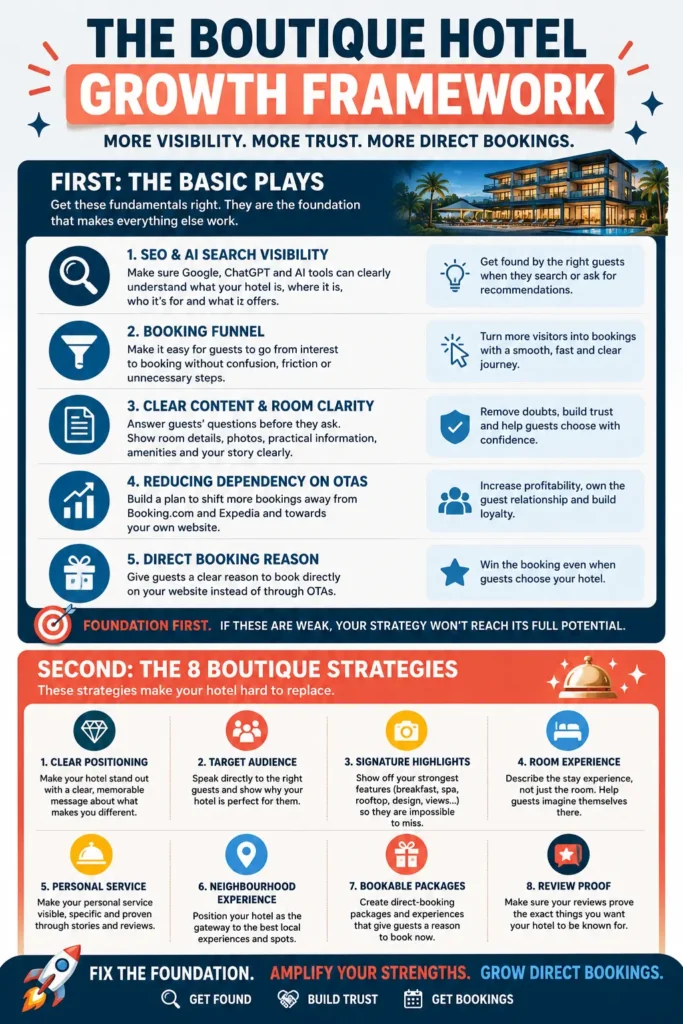
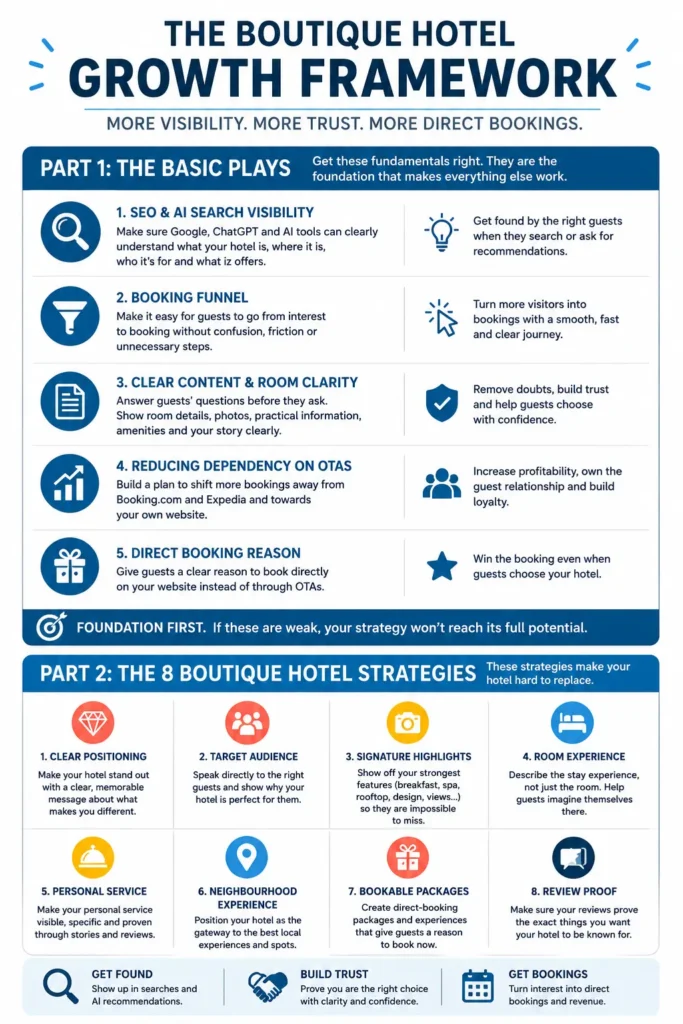
The 8 Boutique Hotel Strategies
This article covers eight strategies that work specifically well for boutique hotels. They are not all equal for every hotel. The right combination depends on your size, your location, your strengths and your guests. The Boutique Hotel Strategy Finder in Chapter 6 will help you identify which ones to start with.
Here is a quick overview:
- Position your hotel clearly – Make it obvious why you exist and for whom
- Target a specific audience – Speak to the right guests, not every guest
- Use your highlights as the highlight – Give your best features the space they deserve
- Create a special room experience – Make rooms worth choosing by name, not just by price
- Use personal service as a selling point – Turn what you naturally do well into a visible asset
- Use the neighbourhood – Make your location part of the experience
- Build bookable packages – Give the right guests a reason to say yes now
- Use reviews as strategic proof – Let guests confirm what you claim
Strategy Prioritisation: Where to Start
Not all strategies require the same effort. Here is a rough view of where each one sits:
| Impact vs. Effort | Strategies |
|---|---|
| High impact, low effort | Clear positioning, better room descriptions, one dedicated highlight page |
| High impact, medium effort | Audience page, neighbourhood guide, direct booking package, review system |
| High impact, higher effort | Full room redesign, new amenity, complete hotel repositioning |
Start in the top row. One well-executed page on your strongest feature will do more than ten half-finished ones.
The Basic Plays. What Also Needs to Be in Place
The eight strategies above are about how to stand out. But they only work if the underlying plumbing is solid. These are the fundamentals that every hotel website needs, regardless of positioning:
SEO and AI Search visibility If Google and AI tools can’t understand what your hotel is about, no positioning strategy will help you get found. Learn how to structure your content so search engines can read it: → Hotel AI Search Optimisation → Hotel SEO and Direct Bookings from Google and ChatGPT
A booking funnel that doesn’t leak Getting visitors to your website is only half the job. If your booking process creates friction (slow loading, confusing room comparisons, no visible price, a checkout that makes guests start over), you lose bookings even from people who already wanted to book with you. → Hotel Booking Funnel: 7 Touchpoints → How to Structure a Hotel Website
Reducing dependency on OTAs If Booking.com and Expedia currently handle most of your reservations, the strategies in this article will help. But there is also a broader tactical layer: how to price, how to communicate with repeat guests, and how to gradually shift the balance. → How Hotels Reduce Dependency on Booking and Expedia
Clear content that removes uncertainty Even if guests find you and want to book, they won’t if they can’t get their questions answered. Room details, photos, practical information, and honest descriptions are what close the gap between interest and booking. → How to Structure a Hotel Homepage → How to Write Hotel Room Descriptions
Why Direct Booking Needs Its Own Reason
One thing that is easy to forget: even when guests choose your hotel, they still have to choose how to book it. And if your direct website offers nothing that Booking.com doesn’t, many will book through the platform out of habit, convenience, or loyalty programmes.
That means you need a clear reason to book directly. This doesn’t have to be complicated. Some of the most effective direct booking incentives are:
- Best room selection: offer room types or configurations only available on your site
- Flexible cancellation: a more generous policy than OTAs
- Personal arrival planning: offer to help guests plan their first day, reserve restaurants, arrange transport
- A welcome treat: a drink, local snack, room upgrade. Something small but memorable.
- Direct-only packages: a breakfast, activity or experience bundled specifically for direct bookers
- Early check-in priority: for guests who request it
- Direct access to your team: the ability to message or call a real person before arrival
The key is that this reason is visible. Somewhere on your homepage and room pages, guests should understand that booking directly gives them something extra. It doesn’t need to cost much. It needs to feel personal.
Chapter 4: Deep Dive on the 8 Strategies for Boutique Hotels
Strategy 1: Position Your Hotel Clearly
The idea
Most boutique hotels describe themselves in ways that could apply to any other hotel in their city. “Charming boutique hotel in the heart of [city].” “Stylish rooms, warm service, central location.” These are not wrong. They are just invisible. They do not give a guest or a search engine any reason to choose you specifically.
Positioning is not a tagline. It is a clear answer to the question: Why does this hotel exist, and for whom?
The best boutique hotel positioning connects a specific value to something guests actually feel, sleep in, eat, or experience. Not just what you believe in. What shows up in the room, on the plate, in the atmosphere.
Your hotel might not have a floating cold bath, a UFO room or a regenerative island economy. But it almost certainly has something. Think small, but start to develop something. The key is that this positioning is not just on your website. It plays through everything: the first sentence on your homepage, the details of your rooms, and ideally the language guests use in their reviews.
Real Examples
Hotel Henriette, Vienna
Website: https://www.hotel-henriette.at
One of the clearest positioning examples in the market. They don’t just call themselves a “green hotel.” They connect sustainability directly to the guest experience: better sleep, organic linen, natural bedding, allergy-friendliness, regional breakfast and ecological cleaning. The result is a positioning that feels tangible, not just principled.
Positioning lesson: Don’t position around a value alone. Position around what the guest actually feels, sleeps in, eats or experiences.
Ett Hem, Stockholm
Website: https://www.etthem.se
Their positioning is beautifully simple. The website describes itself as being for people looking for “something more personal than the luxury hotel.” Everything about it, the kitchen, the garden, the furniture, the navigation, supports that one idea: you are staying in a private home.
Positioning lesson: A boutique hotel doesn’t always need more amenities. Sometimes the whole positioning can be a feeling: “This is not a hotel. This feels like a home.”
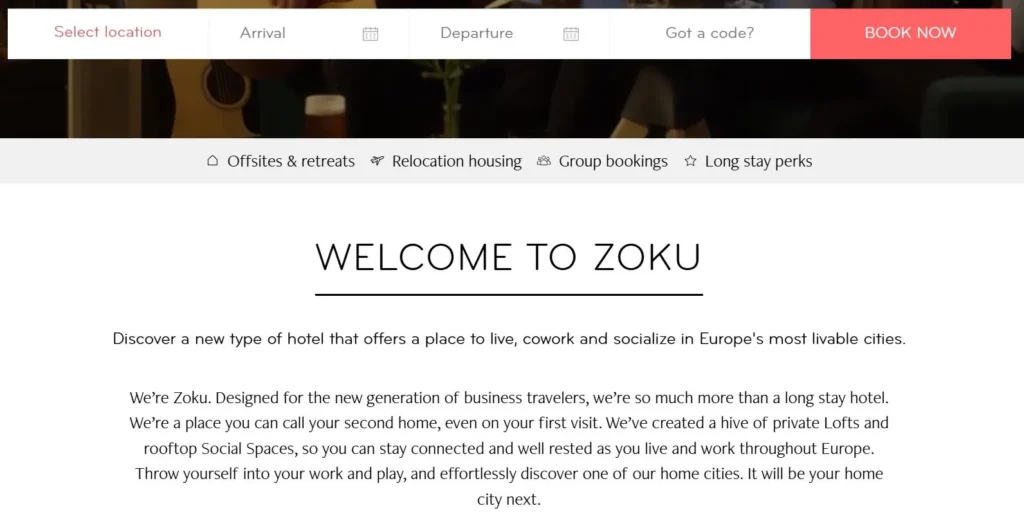
Zoku, Amsterdam / Europe
Website: https://www.livezoku.com
Zoku is very specific: it is a “home-office hybrid” for work, life and longer stays. The room is not positioned as a bed. It is positioned as a living and working system, designed for people staying one night or three months.
Positioning lesson: Position around a way of staying, not just a type of room. Especially powerful for business travellers, remote workers, and longer stays.
Action Step
Rewrite your homepage headline. Right now it likely says something generic. Replace it with a sentence that names: who the hotel is for, where it is, and what makes it distinctly worth choosing. Then check that this positioning shows up consistently: on your homepage, your room pages, your about section, and ideally in your guest reviews too.
Minimum Viable Version: Write one new homepage headline that includes your location + your main guest type + your strongest reason to book. Test it on someone who doesn’t know your hotel. If they understand who it’s for within ten seconds, it’s working.
Fit by hotel size
🟢 Works very well for small boutique hotels – a small hotel can adapt quickly and tailor its entire identity around one sharp positioning. No committee approval, no brand guidelines to argue with.
🟡 Also valuable for larger boutique hotels – more features to position around, more room to develop the story, but keep it focused.
Business Impact
- Visibility: stronger positioning helps Google and AI match your hotel to the right searches
- Conversion: guests who immediately understand your hotel are more likely to book
- Revenue: a clear position lets you set prices based on value, not comparison
Strategy 2: Target a Specific Audience
The idea
Your hotel isn’t big, which means you don’t need to attract everyone travelling to your city. You need to attract the right people. And the right people are the ones your hotel genuinely serves well.
This is not just about adding a “families” or “business travellers” section to your website. It is about building a real case for why your hotel is the best choice for a specific type of guest, and making that case specific enough to be convincing.
The mistake most hotels make: they say “perfect for couples” without explaining why. That is a claim, not an argument. A real audience page connects the hotel’s actual features (the quiet rooms, the bathtub, the breakfast for two, the walkable dinner options) to the experience that specific guest is hoping for.
A small recommendation for boutique hotels, especially small ones: couples. Couples dream of romantic small hotels. The search volume is strong, the conversion rates are high, and the experience you can offer is something no large city hotel can replicate.
On your website, this plays out in creating a dedicated page. Call it something specific: [Hotel Name]: The Boutique Hotel for Couples in [City]. On that page, explain why it’s a fit, what you have specifically for them, why your rooms are ideal, and what they will enjoy in the neighbourhood. If you want to play it hard, position for this audience on the homepage too, and mention it specifically in room titles: [Room Category] – Our Choice for Couples.
Real Examples
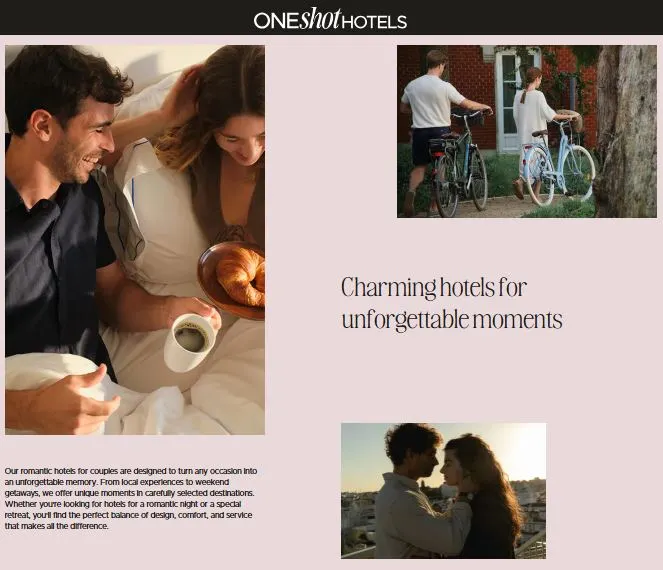
One Shot Hotels, Spain and Portugal
Website: https://www.oneshothotels.com
They have a dedicated “boutique hotels for couples” page that goes well beyond “romantic.” They describe spaces designed for closeness, art-filled ceilings, romantic dinners and moments where “connection takes centre stage.” They don’t just target couples. They describe what the couple feels.
Lesson: If you want couples, show couples why the stay will feel intimate. Mention quiet corners, bathtubs, views, breakfast in bed, romantic restaurants nearby, walkable date-night ideas. Not just “perfect for couples.” That is the lazy version.
Hotel Dylan, Woodstock, New York
Website: https://thehoteldylan.com/
All 22 rooms are named after rock and roll figures associated with Woodstock Nation. The hotel includes Crosley turntables and records guests can play. The positioning is embedded in the physical product, it’s not just a music package. It’s a music hotel.
Lesson: If your hotel has a cultural angle, make it visible in the physical product. Room names, playlists, local guides, art, events and partnerships can all support the positioning.
Hotel Domestique, South Carolina, USA
Website: https://www.hoteldomestique.com
A small luxury boutique hotel inspired by cyclist George Hincapie, positioned around cycling culture, good food, wine, design and proper recovery. It is not “cheap sports hotel.” It is cycling plus a premium experience.
Lesson: A niche audience doesn’t make your hotel feel narrow. Done well, it makes it feel more desirable. “For cyclists” becomes “for people who want beautiful rides, good food and a proper recovery afterwards.”
Action Step
Pick one audience your hotel genuinely serves better than competitors in your area. Create a dedicated page for them. The URL should be specific: /boutique-hotel-couples-[city] or /hotel-for-cyclists-[region]. On that page, explain why it’s a fit, what you have specifically for them, why your rooms are ideal, and what they will enjoy in the neighbourhood. Then make sure the page is linked from your homepage.
Minimum Viable Version: Create one dedicated audience page for your strongest guest type. Link to it from your homepage with a clear label. That page alone, done well, can shift how Google and AI tools understand your hotel.
Fit by hotel size
🟢 Ideal for small boutique hotels – a personal, focused experience is exactly what specific audiences are looking for, and the entire hotel can genuinely revolve around one type of guest
🟡 Works well for larger boutique hotels – can target multiple audiences with multiple dedicated pages, but be careful not to dilute the core positioning
Business Impact
- Visibility: audience-specific pages rank for searches like “boutique hotel for couples in [city]” that platforms rarely win
- Conversion: guests who feel directly addressed are far more likely to book
- Revenue: the right audience pays for the right experience, reducing price pressure
Strategy 3: Use Your Highlights as the Highlight
The idea
You might not have a long list of amenities. But the ones you do have, you do well. Admit it, you are doing them great, right? Come on, say it: “I have an amazing breakfast.” “My spa feels very exclusive.” “My rooftop bar is the best in town.” Feels good, doesn’t it? Good. Now let’s use it.
On your website, this plays out like this. You potentially have two or three highlights. They have to shine. Start by teasing them on your homepage. Show your rooms first, but then it’s highlight time. Write a short intro about what is so special, show a few photos, and then link to a dedicated page where you explain it in real detail. And when I say detail, I mean detail, why you chose the bread you serve, what music you play in the gym so guests get in the flow, why the lighting in the sauna is set a certain way.
Why this works: guests don’t need a super long list of things. They search for something specific. A great breakfast, a calm gym, a private rooftop. When you give your highlight its own page with real depth, you match those specific searches. And you give guests something they can actually picture, and want.
Real Examples
Hotel Henriette, Vienna (breakfast)
Website: https://www.hotel-henriette.at
Their breakfast is not described as “buffet included.” They position it as homemade, organic, regional and fair, and call it the “best organic breakfast in Vienna City Centre.” They explain certifications, what percentage of food is organic, and what the experience actually feels like. Breakfast becomes part of the hotel’s identity, not just a morning meal.
Lesson: If breakfast is genuinely good, give it its own page. Mention what is homemade, what is local, what is fresh, what is available for different diets, when it is served, and why guests should look forward to it.
Pillows Maurits at the Park, Amsterdam (parking)
Website: https://www.pillowshotels.com/amsterdam-mauritskade/location/
Even something as parking can become a highlight. The Pillows Maurits at the Park built a beautiful page on how to get to their hotel, where they offer valet parking as a special service. When I checked out there page, they even mentioned updates on the public transport that might affect their guests.
Lesson: Every aspect of a stay can become a special offer. In a city like Amsterdam, parking can become a special service. Highlight it and support your guests, and they will find you and arrive more relaxed.
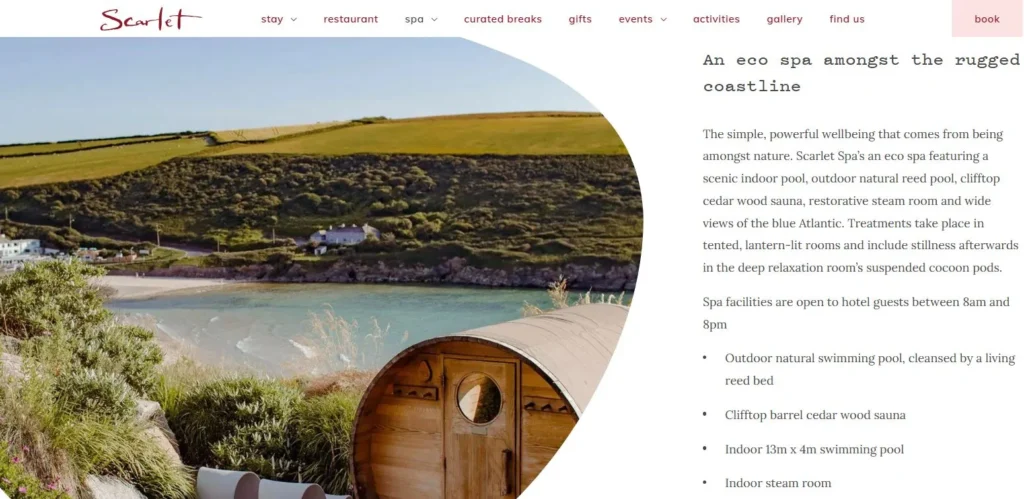
The Scarlet, Cornwall (spa)
Website: https://www.scarlethotel.co.uk
The Scarlet makes the spa one of the main reasons to book. It presents itself as an adults-only eco spa retreat with clifftop hot tubs, sea-view dining, a holistic spa and a reed-filtered natural pool. The spa is not an add-on. It is part of the destination.
Lesson: A boutique hotel spa does not need to be huge. It needs to be memorable. “Sauna and relaxation area” is forgettable. “Clifftop hot tubs overlooking the sea” is a reason to book.
Action Step
Identify your two or three strongest highlights. For each one, create a dedicated page, or significantly expand what already exists. On each page: explain what is genuinely special about it, show strong photos, go into real detail (the bread you chose, the equipment you selected, why the lighting is set the way it is), and link directly to your rooms and booking flow from that page. Then tease each highlight on your homepage with a short intro and a link.
Minimum Viable Version: Pick your single strongest highlight. Give it one proper dedicated page with at least four strong photos, a detailed description, and a clear link to book. That one page can start ranking for searches like “hotel with spa in [city]” or “hotel with rooftop in [neighbourhood]” almost immediately.
Fit by hotel size
🟡 Worth doing for small boutique hotels – even one or two strong highlights can be highly effective. You might only have breakfast and a beautiful lobby. That is enough. Sell the atmosphere, not only the buffet.
🟢 Ideal for larger boutique hotels – more highlights to showcase, more dedicated pages to build, and each one can rank independently for different search queries
Business Impact
- Visibility: dedicated highlight pages rank for specific feature searches that are hard for platforms to win
- Conversion: detailed pages remove uncertainty and build desire before the booking decision
- Review: guests who were excited by your highlight before arrival are more likely to mention it in reviews afterwards
Strategy 4: Create a Special Room Experience
The idea
One of the biggest advantages you have as a boutique hotel is that you don’t have two hundred identical rooms. Nobody wants to be the same. And guests who are searching for something special are already halfway to choosing you, if you can show them why your room is worth picking by name, not just by size.
You don’t need to make every room special now. Start with one and see how people react. If it sells out, add more. I’ve seen boutique hotels where the edge was just a record player in a room. Or rooms furnished in a specific style that felt completely unlike anywhere else. The range is big. What I want to say is: don’t try to be like everyone else. Create something that stands out. It’ll attract an audience.
On your website, this shows up on your room detail pages. Describe clearly what makes the room different from a standard hotel room. If it is truly unique, mention it on your homepage too. The sooner the better.
Real Examples
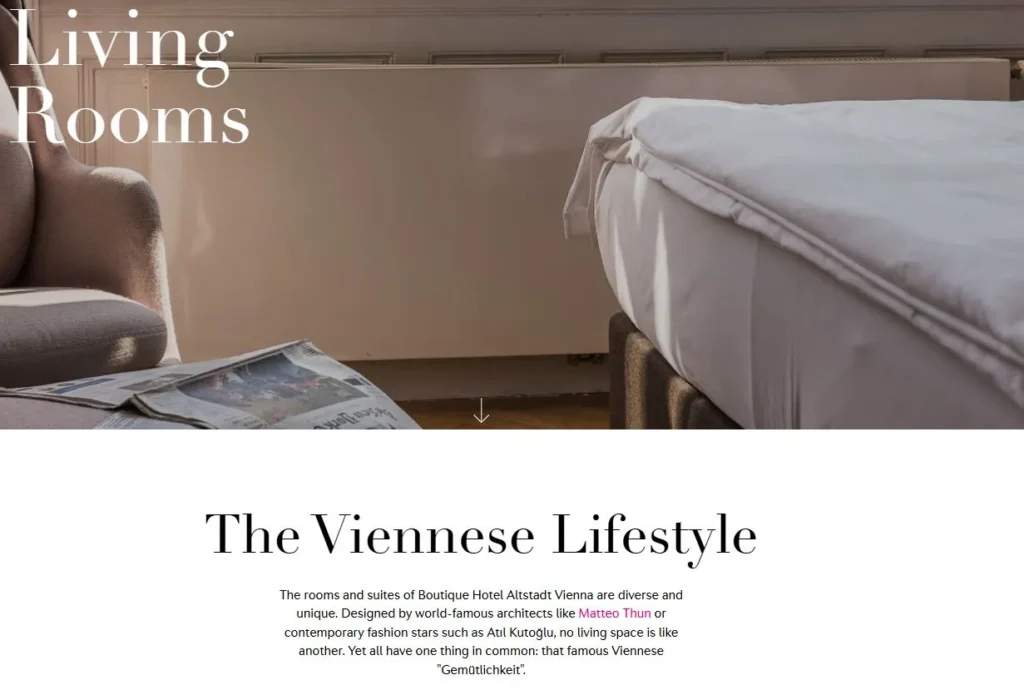
Altstadt Vienna, Vienna
Website: https://www.altstadt.at
Their 62 rooms and suites are each different. The hotel connects strongly to contemporary art, with works by Warhol, Prachensky and others throughout. Individual suite pages, like the Camilla Suite, described as a “work of spatial art”, make each room feel like a room with a story.
Lesson: If your building has history, high ceilings, parquet floors, local art or unusual layouts, don’t hide it. That is not decoration. That is your product.
25hours Hotel Bikini Berlin
Website: https://www.25hours-hotels.com/hotels/berlin/bikini
They let guests choose between Urban rooms with views of the Memorial Church and Jungle rooms overlooking the Tiergarten and Berlin Zoo. Room categories are not size categories, they are mood categories.
Lesson: Name room types around the experience, not only the square metres. A guest remembers “jungle room with zoo view” more than “double room medium.”
Artist Residence, UK
Website: https://www.artistresidence.co.uk
Their London property is described as a 10-bedroom townhouse in Pimlico with eclectic, homely, art-filled rooms. Not a themed hotel. Not a concept project. Just rooms that feel individual, warm and lived-in, and that is already enough.
Lesson: Not every room has to become a spaceship. Sometimes “beautiful townhouse room with original details and art” is already enough. Thank God, because not every hotel should become a spaceship.
Action Step
Look at your room categories right now. Ask yourself: are guests choosing between them based on desire, or only based on price and size? If mostly price and size, pick the room with the most potential and redesign how it is presented. Give it a name that describes the experience, not the category. Write a description that helps the guest imagine sleeping there. Then photograph it to match.
Minimum Viable Version: Rename one room category around the experience it delivers, not just the size. Update the room page with a genuine description and strong photos. If you can add one distinctive physical element, a record player, a local art piece, a bathtub with a view, do it for one room first and see what happens to direct booking rates for that specific room.
Fit by hotel size
🟢 Ideal for small boutique hotels – fewer rooms means more creative freedom per room, and the intimacy naturally supports making each one feel individual
🟡 Valuable for larger boutique hotels – harder to differentiate every room, but dedicating real effort to two or three signature room types can still drive strong direct booking results
Business Impact
- Visibility: room names and descriptions built around guest desires rank better for specific room searches
- Conversion: guests who can imagine sleeping in a specific room are far more likely to book it than one described by square metres alone
- Revenue: distinctive rooms attract guests who choose based on experience, not price
Strategy 5: Use Personal Service as a Selling Point
The idea
You know what you can really do great: personal service. Make the guest feel like they are genuinely, personally cared for.
This is where it gets interesting on your website. Almost every hotel writes about excellent service and nobody really knows what it means, and nobody really books because of it. But there are two things you can do that actually work.
First: offer assistance actively throughout your website. Give guests a reason to reach out before they book. Help with parking, even if you don’t have your own. A page explaining how to park near the hotel, nearby garages, walking distances, discount options, can rank surprisingly well and remove a real booking barrier. I’ve seen hotels getting a lot of traffic for searches like “hotel [location] with parking,” just because they created a page explaining how to park nearby. Offer to help with theatre tickets, restaurant reservations, arrival logistics, or a special request. Let guests feel that there is a real person waiting to help them, not just a booking form.
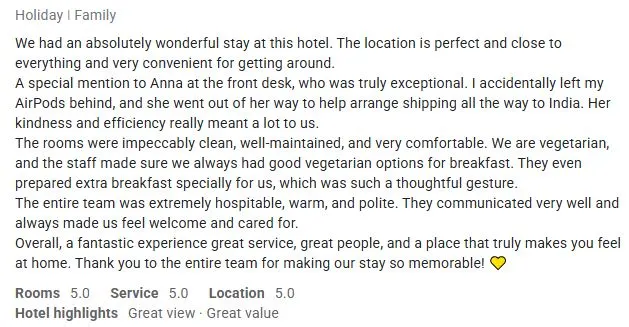
Second: train your team to create moments guests want to write about. The review is the proof. When a guest writes “Viktoria remembered our anniversary and left champagne in the room,” that does something beyond confirming service quality. It tells every future guest reading that review exactly what kind of experience to expect. You can’t fake that. But you can create the conditions for it. If guests celebrate something, arrange something unique for them. Or create little moments, I was once in a hotel where, out of nowhere, ice cream was delivered to our room terrace. Such a nice surprise. And then ask those guests at checkout to leave a review. The nice side effect: you will get an amazing rating. Unless some parts of your experience are not good. Then fix that first.
Real Examples
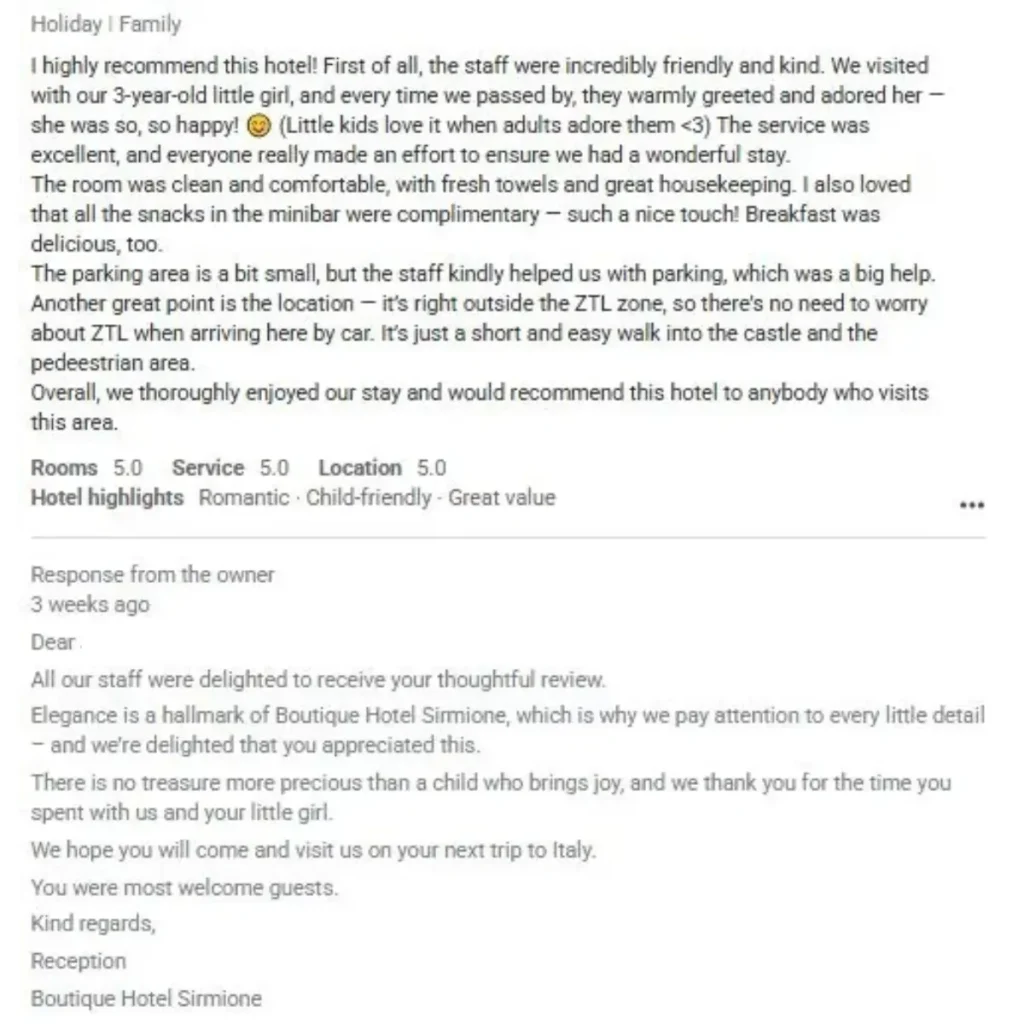
Boutique Hotel Sirmione, Lake Garda
Website: https://www.boutiquehotelsirmione.it/en/
Reviews mention names. Guests describe being welcomed by Viktoria, helped with parking and luggage, offered Prosecco and snacks, and given restaurant and boat-trip recommendations. One guest says the hotel gives “5-star service” and that the “personal touch” makes the difference. Another says the team “cannot do enough to treat you like family.”
Lesson: Personal service becomes review-worthy when it is concrete. Not “we are welcoming,” but: guests are welcomed properly, get local recommendations, someone helps with practical friction, and small surprises are included. That is what people remember.
Cozy Savvy Boutique Hotel, Hoi An
Website: https://cozysavvyboutique.hoianhotelsweb.com/en/
A guest review says the staff remembered them “from check-in to departure by name and room number,” and even remembered their plans, checking in to see how both the stay and their time in Hoi An were going.
Lesson: A simple guest note system can become a service advantage. “Arriving for anniversary.” “Wants quiet restaurants.” “Going hiking tomorrow.” The next interaction becomes personal. Not creepy. Just human.
Townhouse Weisses Kreuz, Salzburg
Website: https://www.weisseskreuz.at
Reviews describe staff who remembered guests’ names, favourite drinks and food. A luxury hideaway of only a handful of rooms, and a perfect example of using small size as a service advantage.
Lesson: A small hotel should not apologise for being small. It should use the smallness to make service feel personal. A 200-room hotel struggles to remember a guest’s favourite breakfast drink. A 6-room townhouse has no excuse. Harsh, but true.
Action Step
Do two things. First: create a simple guest notes system, even a shared spreadsheet, where your team logs useful details before arrival: occasion, preferences, questions asked, plans mentioned. Make it part of daily operations. Second: build a service-related page on your website. If parking is a common question, create a parking page. If guests ask about restaurants, create a neighbourhood recommendations page. If you help with special requests, say so explicitly on your homepage and contact page, something as simple as “Need help planning your arrival, finding a restaurant, or arranging something special? Just ask.” Link it to a contact option.
Minimum Viable Version: Set up one simple guest note system for your team this week. Then add one line to your homepage: “Need help planning your arrival, finding a restaurant, or arranging something special? Just ask.” That one line signals personal service more convincingly than any “warm and attentive” paragraph ever could.
Fit by hotel size
🟢 Ideal for small boutique hotels – small teams and small guest numbers make this genuinely feasible, and the intimacy is the product
🟡 Works for larger boutique hotels – requires more structured systems, but the payoff in reviews and guest loyalty is just as strong
Business Impact
- Conversion: practical help pages (parking, arrival, local tips) remove hesitation at the exact moment guests are deciding whether to book
- Review: intentional service moments generate specific, credible reviews that reinforce your positioning
- Revenue: guests who feel personally cared for become repeat guests and recommend you to others
Strategy 6: Use the Neighbourhood
The idea
What you have is neighbourhood. And people travel to your hotel to explore exactly that, your neighbourhood. So explain why you belong there, and what guests can experience.
On your website, it is particularly important to mention the location you are in by name. The neighbourhood. Places you are close to. Things people can actually experience. Describe it in detail, not just “convenient location” but what kind of lifestyle guests will have, what the streets feel like, what is worth knowing that they won’t find on a tourist map. Additionally, mention how your hotel blends into the neighbourhood, and potentially how locals connect with your hotel. Guests dig that.
The hotels that do this best don’t just list nearby attractions. They tell the story of the place. And there is a direct SEO benefit too: local guides, neighbourhood descriptions, and area-specific content give search engines and AI tools additional context that helps your hotel appear for searches beyond the generic “hotel in [city].”
Real Examples
The Laslett, Notting Hill, London
Website: https://www.living-rooms.co.uk/the-laslett/
The hotel is named after Rhaune Laslett, the community activist connected to the origins of Notting Hill Carnival. The hotel was created as a celebration of the locality, for both visitors and residents. Their ground floor functions as a neighbourhood hangout with art, food and drink from local suppliers.
Lesson: A boutique hotel can make the neighbourhood feel more meaningful by connecting to local history, local people, local art and local social life. Not just what is nearby, but why the area matters.
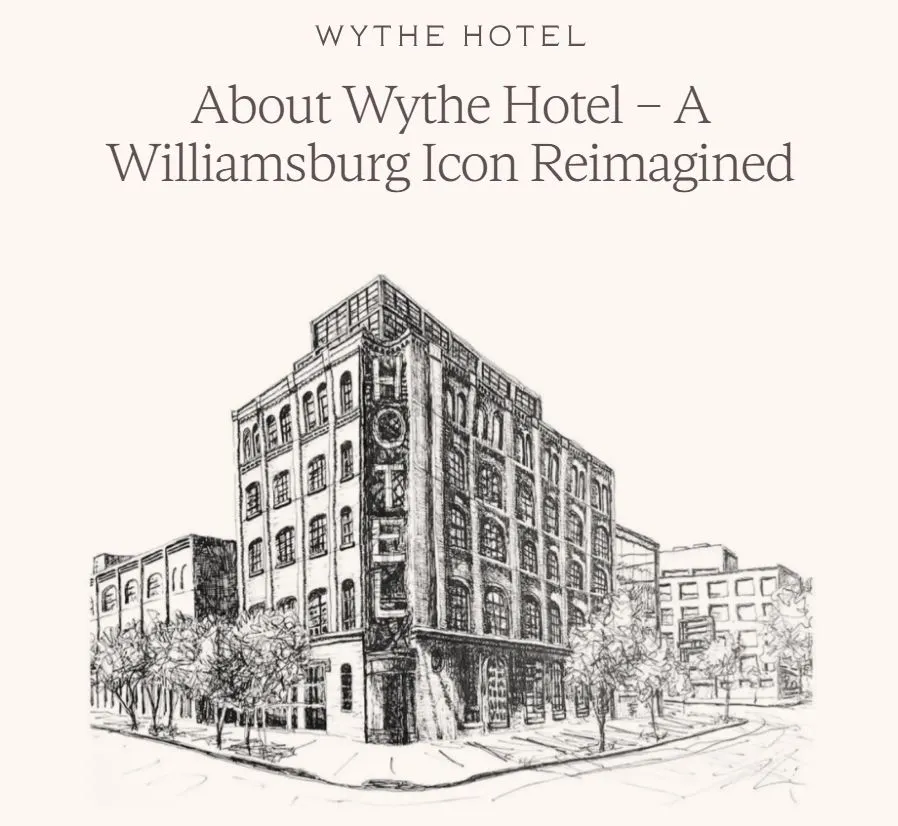
Wythe Hotel, Williamsburg, Brooklyn
Website: https://www.wythehotel.com
They have a dedicated “72 Hours in Brooklyn” neighbourhood guide and a whole blog category for local Williamsburg content. The hotel positions itself as a gateway into the neighbourhood, not just a room in it.
Lesson: A neighbourhood guide is not filler content. Done well, it helps guests imagine their trip and gives the hotel a reason to appear in more specific searches.
Lokal Hotel, Philadelphia
Website: https://www.staylokal.com
The hotel name itself supports the positioning. Their Fishtown neighbourhood page is a practical mobile-friendly guide with an interactive map, organised by food, drink, shopping, adventure and culture.
Lesson: A boutique hotel can turn local knowledge into a direct booking asset. A good local guide makes guests think: “If I book here, I’ll experience the city better.”
Action Step
Create a dedicated neighbourhood or location page on your website. Not a list of attractions, a real guide to the area, written in your voice, covering what you would actually recommend to a friend. Include the character of the neighbourhood, your favourite restaurants (not just “there are great restaurants nearby”), practical information like how to get there, and a sense of what a day in the area actually feels like. Bonus: mention how your hotel connects to or blends into the neighbourhood. Do locals come for your breakfast? Does your lobby feel like a community space? Say so.
Minimum Viable Version: Write one local guide based on the three or four questions guests actually ask at reception. Turn it into a page. Link it from your homepage. It is immediately more useful than anything a booking platform offers, and that is exactly the point.
Fit by hotel size
🟢 Very effective for small boutique hotels – a single honest local guide written in your personal voice will outperform a polished generic one every time
🟢 Also ideal for larger boutique hotels – more resources to create detailed, ongoing local content and neighbourhood series
Business Impact
- Visibility: neighbourhood content helps you rank for location-specific searches that go beyond “hotel in [city]”
- Conversion: guests who can picture their trip before they arrive are more likely to book, and less likely to cancel
- Review: guests who used your local recommendations often mention them in reviews, reinforcing your local credibility
Strategy 7: Build Bookable Packages Taylored to your Targeted Guests
The idea
I will be honest: this was the last strategy I added, and partly because ChatGPT suggested it. I still put it here because it has a point, and I added some real examples to show you it actually works.
Packages are not discounts. Done well, they are products.
A good package answers the question the guest already has: “What should we actually do while we’re there?” It bundles the stay with something that completes the trip, a cooking class, a guided hike, a wine tasting, a breakfast basket on the terrace. It removes decision fatigue and creates a moment the guest can picture.
The key is specificity. “Enjoy authentic local experiences” is not a package. “Two nights with a Tuscan cooking class, lunch and wine tasting” is a package. Give it a name that people might actually search. Make it bookable. Put it on your homepage and give it a dedicated page. And make it available only through your own website.
Real Examples
Torciano Boutique Hotel, Tuscany
Website: https://www.torciano.com
Two nights in the hotel with a cooking class, lunch and wine tasting in the Chianti region. Specific, priced, available year-round. The guest doesn’t need to figure out the trip. The hotel figured it out for them.
Lesson: A bookable experience should be concrete enough that the guest can imagine the day. “Two-night stay with Tuscan cooking class, lunch and wine tasting” is a booking trigger. “Enjoy authentic local experiences” is background noise. Obviously. Unless someone has a deep emotional connection to vague marketing language.
THE PIG Hotels, UK
Website: https://www.thepighotel.com
Their kitchen garden tours are guided by the hotel’s own gardeners. Guests can explore vegetable patches, raised beds, polytunnels, fruit cages, and even meet the animals. These run daily and are free to join. The result: the restaurant story becomes tangible. Guests don’t just eat local ingredients. They see where they come from.
Lesson: If your hotel has a strong breakfast, restaurant or garden, the experience should not end on the plate. Show guests the process. Let them meet the people. Make the food story real.
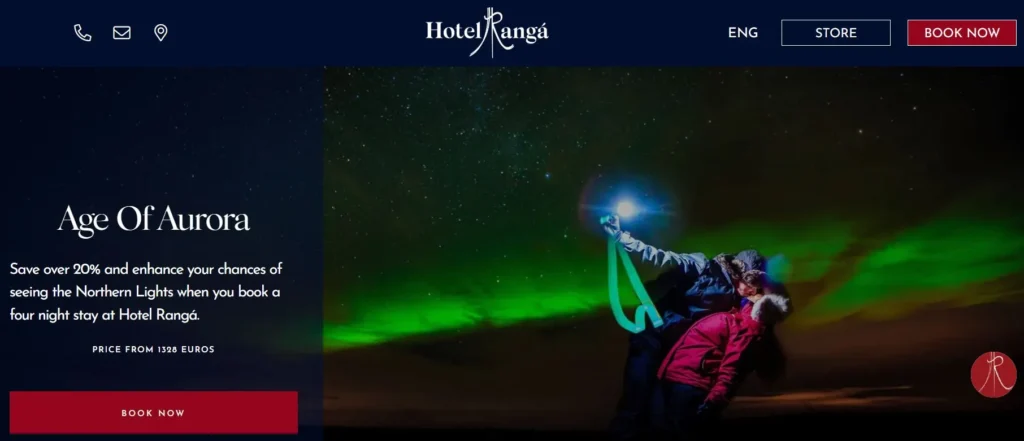
Hotel Rangá, Iceland
Website: https://www.hotelranga.is
They created a seasonal “Age of Aurora” offer designed to improve guests’ chances of seeing the northern lights. They include a special wake-up call service, warm snowsuits, blankets and custom outdoor benches for viewing. And they have a dedicated romantic northern lights getaway for couples.
Lesson: The best bookable experiences solve a guest anxiety. “Will I miss the northern lights? Will I know where to go? Will the romantic moment feel special?” The hotel answers: we’ve got you. Guests do not need to nervously stare out the window all night like an anxious weather goblin.
Action Step
Create one direct-booking-only package targeted at your primary audience. It should combine the stay with something that matches your positioning, a breakfast experience, a local activity, a personal service moment. Give it a name that people might actually search for, like “Romantic Weekend in [City] with Private Breakfast and Balcony View.” Put it on your homepage and give it a dedicated page. Make it available only through your own website, that alone gives guests a reason to book directly.
Minimum Viable Version: Create one direct-booking-only package for your strongest guest segment. It doesn’t need to be elaborate. Even “stay two nights and we’ll arrange your first evening for you”, with a restaurant recommendation and a pre-ordered welcome drink, is a package. Name it. Price it. Show it.
Fit by hotel size
🟢 Works great for small boutique hotels – packages feel genuinely personal and handcrafted when a small team creates them. That is actually the point.
🟢 Also effective for larger boutique hotels – can create multiple packages for different audiences and different seasons
Business Impact
- Revenue: packages increase the average booking value and shift guests away from OTA comparison mode
- Conversion: a specific, named package reduces decision fatigue and gives guests a clear reason to act now
- Visibility: package names built around real search terms can rank for specific occasion queries like “romantic weekend [city]”
Strategy 8: Use Reviews as Strategic Proof
The idea
This one might be similar to strategy 8, but I wanted to mention reviews again. They are the most powerful evidence you have, and they can enhance all of the strategies above, if you meet or even exceed your guests’ expectations.
Here is the shift: your website tells guests what you want to be known for. Reviews prove whether guests actually experience it. If you want to be known for personal service but your reviews mostly mention clean rooms and good location, there is a gap. Either the service is not as strong as you think, or the right moments are not happening, or guests are not being asked to write about them.
Reviews do a specific job that owned content cannot do. When your website says “we provide exceptionally personal service,” guests discount it. When a review says “Maria remembered my wife’s birthday and left flowers in the room,” guests believe it completely. That is independent evidence. It supports everything else you claim.
The goal is alignment. Your positioning, your website content, and your reviews should all tell the same story. If you are positioning as a romantic couples’ hotel, reviews should mention quiet rooms, bathtubs, breakfast for two, and the feeling of intimacy. If they don’t, that is a signal to act, either improve the experience, or create the moments that guests will want to write about. For AI tools especially, this matters enormously: independent review signals support what your own website claims. Owned content creates clarity. Reviews create credibility.
Real Examples
Boutique Hotel Sirmione, Lake Garda
Website: https://www.boutiquehotelsirmione.it/en/
Reviews mention names. They describe specific moments, being welcomed by Viktoria, being helped with parking, being given restaurant tips that were genuinely local. These are not just five-star ratings. They are descriptions that future guests read and think: that is the kind of stay I want.
Cozy Savvy Boutique Hotel, Hoi An
Website: https://cozysavvyboutique.hoianhotelsweb.com/en/
Staff remembered guests’ names and checked in about their plans. That one behaviour created reviews that directly supported the hotel’s positioning around personal, attentive hospitality. The review is the marketing.
Action Step
Do three things. First, map what your reviews are currently saying. Are they aligned with your positioning? If not, identify the gap. Second, create a few moments in the guest experience that match your positioning and are genuinely memorable, not scripted, but intentional. Third, ask guests to leave a review at checkout, especially the ones who had a moment worth writing about. Train your team to spot those guests and make the ask feel natural.
One more thing: respond to every review. Not with a template. With your voice. A response that says “We are so glad you enjoyed the breakfast, we have been working with the same bakery for six years” does more for your positioning than any tagline.
Minimum Viable Version: This week, read your last twenty reviews. Write down the five words guests use most often. Compare them to the five words you want to be known for. If they match, great, keep doing what you’re doing. If they don’t, that gap is your strategy.
Fit by hotel size
🟢 Essential for small boutique hotels – with only a small number of rooms, every review carries significant weight and is read closely by future guests
🟢 Essential for larger boutique hotels too, at scale, reviews are the most trusted signal for new guests and increasingly important for AI recommendation systems
Business Impact
- Visibility: review volume and review language help AI tools understand and recommend your hotel for the right searches
- Conversion: specific, detailed reviews from real guests convert far better than marketing copy
- Revenue: a consistent pattern of reviews that match your positioning builds the kind of trust that justifies premium pricing
Want more practical hotel website ideas in your inbox?
In my newsletter, I share clear, actionable ideas for hotel owners and marketers who want more guests to find, trust, and book their hotel directly.
Chapter 5: More Examples from Hotels applying Direct Booking Strategies
Below is a shorter overview of additional examples that didn’t make the main chapter but are worth knowing about. Each one illustrates a slightly different way to apply the strategies above.
Positioning
- Coco Hotel, Copenhagen (https://coco-hotel.com/), Sustainability done stylishly: award-winning boutique hotel in Vesterbro, Green Key-certified, solar energy, organic cotton bedding. Shows that eco positioning can feel urban and social, not serious and moralistic.
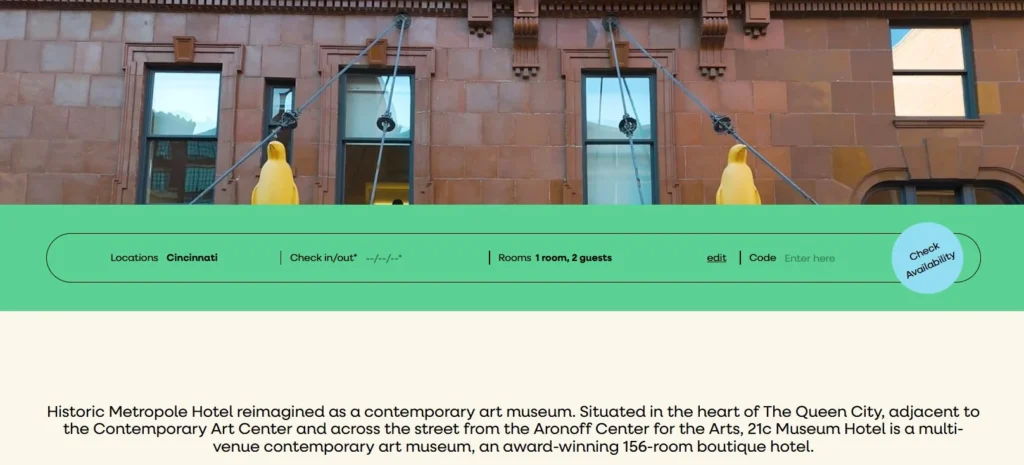
- 21c Museum Hotels, USA (https://www.21cmuseumhotels.com), One of the sharpest boutique concepts: contemporary art museum, boutique hotel and chef-driven restaurant combined. Strong because the hotel has a category idea, not just a style.
- Fogo Island Inn, Newfoundland (https://www.fogoislandinn.ca), “Entangled with nature, rooted in community.” 100% of operating surpluses reinvested into the community. Goes far beyond “local experiences”, the community and economic model become part of the booking reason.
- Treehotel, Sweden (https://www.treehotel.se), “The landscape hotel where nature and imagination run wild.” Every room is an architectural experience in the forest. The hotel itself is the attraction.
Audience
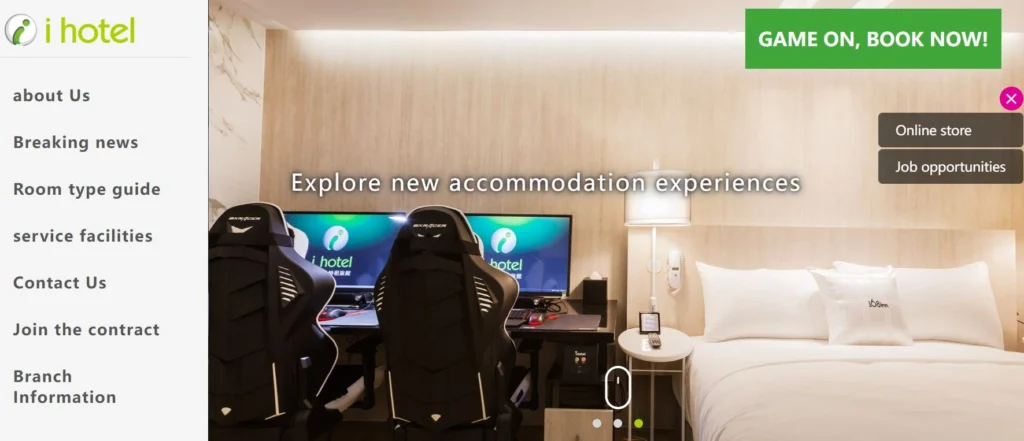
- i hotel, Taoyuan, Taiwan (https://www.ihotel.com.tw), Asia’s first hotel dedicated to esports: gaming computers in every room, large screens, flexible hourly rates. Extreme example, but shows what full audience commitment looks like.
- The Gilded Iguana, Nosara, Costa Rica (https://www.thegildediguana.com), Positioned for surfers and outdoor lovers, selling the lifestyle around the stay, not just the room. Great model for hotels near mountains, beaches, lakes or hiking areas.
Highlights
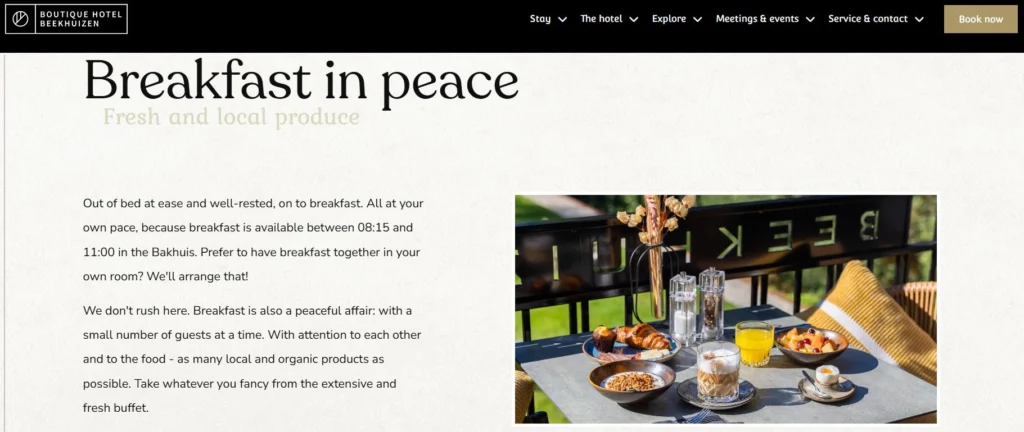
- Hotel Beekhuizen, Netherlands (https://www.hotelbeekhuizen.nl), Quiet, local, organic breakfast served at your own pace. Shows that a small, calm boutique breakfast can be just as compelling as a grand hotel buffet.
- Hotel Rangá, Iceland (https://www.hotelranga.is), A dedicated observatory page with high-quality telescopes and a resident astronomer. Not a normal amenity, a booking argument.
- Hotel Unique, São Paulo (https://www.hotelunique.com/en), A 25-metre heated rooftop pool with underwater music, described in detail: colour, design, location, temperature. Shows how to make a visual feature impossible to miss.
- Arctic Bath, Swedish Lapland (https://www.arcticbath.se), Floating hotel on the Lule River with an open-air river pool. The spa is the hotel concept. Extreme, but the underlying lesson, if a feature is visually unusual, build the page around it, applies to any hotel.
Rooms
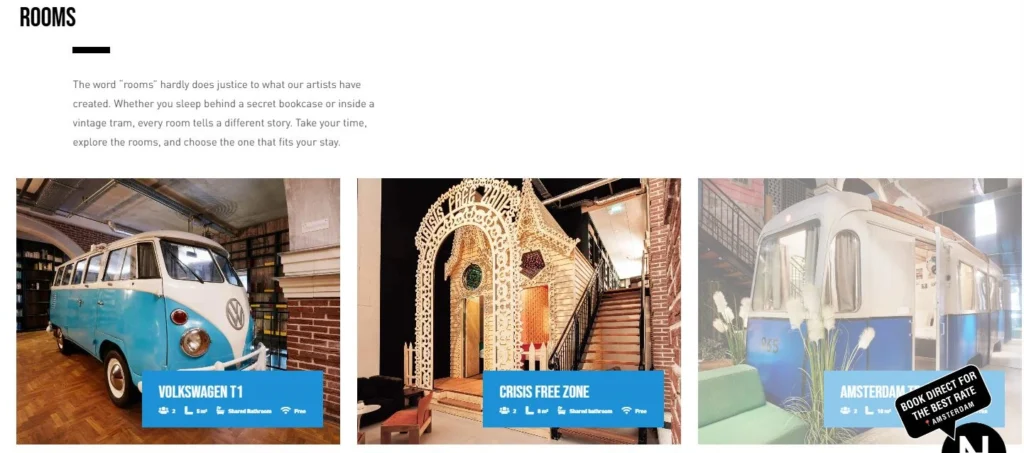
- Hotel Not Hotel, Amsterdam (https://www.hotelnothotel.com), Every room is a piece of art. You might sleep behind a secret bookcase or inside a vintage tram. Slightly mad, but brilliant. Shows that unusual rooms should be explained clearly and honestly, not hidden.
- Park Hotel Tokyo (https://www.parkhoteltokyo.com), Artist-designed rooms where the room is assigned at check-in. Guests are curious before arrival: “Which room will I get?” That anticipation is part of the product.
- Michelberger Hotel, Berlin (https://www.michelbergerhotel.com), Rooms move between industrial and domestic materials. The result feels like Berlin. The best boutique rooms often blend into the location.
- ICEHOTEL, Sweden (https://www.icehotel.com), Rooms made from crystal-clear ice from the Torne River. Every room is temporary, sculptural and impossible to replicate. The most extreme version of “make rooms stand out”, but the underlying lesson is real: the more specific the experience, the less price-sensitive the guest.
Neighbourhood
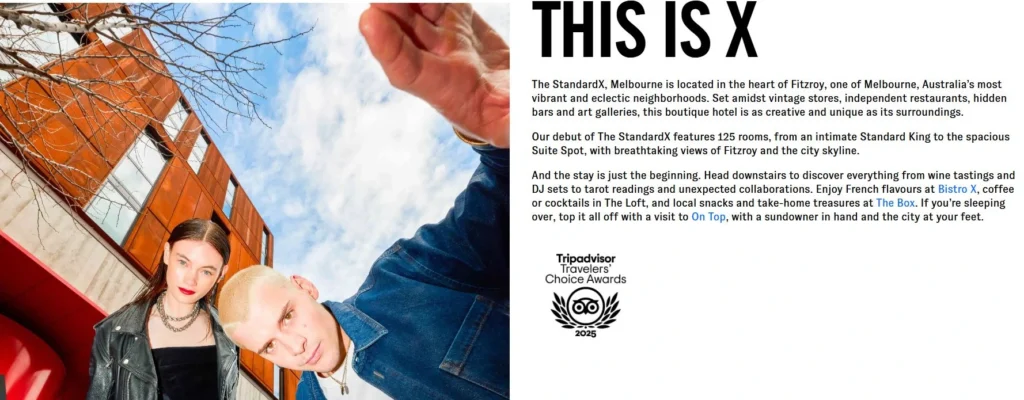
- The StandardX, Fitzroy, Melbourne (https://www.standardx.com/melbourne/), “As creative and unique as its surroundings.” Vintage stores, independent restaurants, hidden bars and art galleries. The neighbourhood’s identity becomes the hotel’s identity.
- Hotel Peter & Paul, New Orleans (https://www.hotelpeterandpaul.com), A restored building in the Marigny neighbourhood. The hotel is part of the physical and cultural fabric of the city, not just located near it.
- The Dean Cork, Ireland (https://thedeanhotels.com/locations/cork), Frames the hotel as a starting point for Cork’s creative, culinary and cultural scenes. Shows that even without a globally famous neighbourhood, you can make a location feel specific and desirable.
- The Hoxton (https://www.thehoxton.com), Positions itself as a series of “open-house hotels” inspired by the streets around them. Strong public spaces, restaurants and events that locals actually use make each hotel feel embedded in its neighbourhood.
Packages
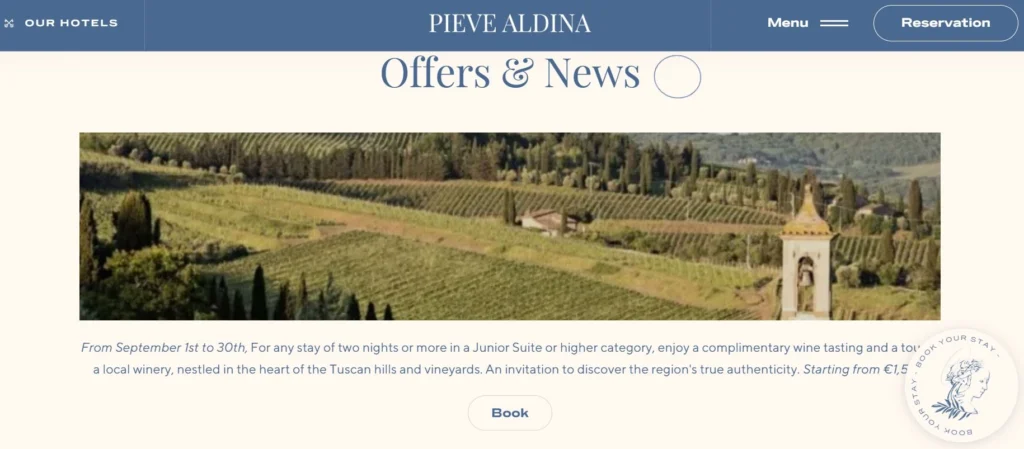
- Pieve Aldina, Tuscany (https://www.pieve-aldina.fontenille-collection.com/en/), Experiences around gastronomy, cooking classes, wellness, yoga and outdoor activities in the Chianti countryside. The hotel doesn’t just sell the room, it packages the reason people travel to Tuscany.
- Babylonstoren, South Africa (https://www.babylonstoren.com), Farm, garden, food and workshops all central to the hotel concept. Full-day workshops, garden tours and stretch-and-breathe sessions. The farm becomes a reason to stay longer and spend more.
- Fogo Island Inn, Newfoundland (https://www.fogoislandinn.ca), Local storytelling, music, seasonal programming and community-based activities. Not “local tips at reception.” A hospitality model built around place, people and community.
Want more hotel website ideas and examples like this?
I regularly share practical thoughts on hotel SEO, AI search, direct bookings, website clarity, and how independent hotels can become easier to find and book directly.
Chapter 6: The Boutique Hotel Strategy Finder
People love a checklist. And the most useful version of a checklist for this article is not a generic website audit, it is a tool that helps you figure out which of the eight strategies is the right starting point for your hotel.
Boutique Hotel Strategy Finder
Rate your hotel across the basics and the boutique-specific strategies. You will get two scores, your top priorities, practical next steps, and recommended guides if one of the foundations needs work.
1. Tell me a little about your hotel
This helps make the recommendation more useful. Nothing is saved or submitted.
2. The Basic Plays
These are the fundamentals. If they are weak, even a strong boutique hotel strategy can leak bookings.
3. Boutique Hotel Strategies
These questions identify which of your boutique strengths could become your clearest direct booking advantage.
The tool is a short interactive questionnaire. You check what applies to your hotel, what you already have, what you do well, what your guests say, what is missing. Based on your answers, the tool shows which strategies are most relevant for you right now, ranked by likely impact.
The logic behind it:
- Do you have one or two genuinely strong features, but they’re not visible online? → Highlights strategy
- Are your guests mostly one type of traveller, but your website doesn’t reflect that? → Audience strategy
- Is your location interesting but underexplained? → Neighbourhood strategy
- Do guests write reviews that mention personal moments? → Service and reviews strategy
- Are your rooms described by size and price only? → Room experience strategy
- Is your hotel essentially indistinguishable from competitors online? → Positioning strategy first
The finder is designed so that even a hotel owner with twenty minutes between fires can get a clear, prioritised answer.
A Quick Checklist, Is Your Website Ready?
If you prefer, use this as a practical self-assessment. Rate each item from 1 (missing or very weak) to 5 (clear, strong, no hesitation). Fix all the 1s and 2s first, working from top to bottom.
Positioning
Your homepage headline names who the hotel is for, where it is, and what makes it special
A new visitor understands your positioning within ten seconds
Audience
You have at least one dedicated page for a specific guest type
That page explains not just who you welcome, but why your hotel is ideal for them
Highlights
Each of your two or three strongest features has its own dedicated page
Those pages include detailed descriptions, strong photos, and a link to book
Rooms
Your rooms are named and described around the experience, not just the size
Each room page answers the questions guests actually have before booking
Service
Your website makes it easy to contact a real person before booking
You have at least one practical help page (parking, arrival, local guide)
Neighbourhood
You have a neighbourhood or location page that goes beyond a list of attractions
The page is written in your voice and reflects what you would actually recommend
Packages
You have at least one direct-booking-only package, targeted at your primary audience
The package is mentioned on your homepage and has its own page
Reviews
Your recent reviews are aligned with your positioning
You respond to reviews in your own voice, with specific details
Direct booking
There is a clear reason to book directly on your website, visible without searching
Bonus Chapter: Measurement - How to Know Whether It's Working
Strategy without measurement is just hope. Once you start implementing, here is how to track whether it is moving the needle:
Google Search Console Check organic impressions for your target searches (e.g. “boutique hotel couples [city],” “hotel with rooftop [neighbourhood]”). If your new pages are working, you will start to see impressions growing within six to twelve weeks.
Booking engine clicks Track how many users click through to your booking engine from your website. This is your most direct signal of commercial intent. If it is growing, your content is converting.
Direct booking share What percentage of your total reservations come through your own website versus OTAs? This is the number that matters most. Track it month by month.
Branded search volume If more guests are searching for your hotel by name (rather than generic “boutique hotel [city]”), your positioning is working. Branded searches signal awareness and preference.
Review language Every few months, read your most recent reviews and note which words guests use most. Are they aligned with your positioning? Are they mentioning the specific things you are trying to be known for?
AI mentions Search for your hotel by name in ChatGPT, Gemini, Perplexity and Claude. If AI tools are recommending you for the types of searches you’re targeting, your positioning and content structure are strong.
Chapter 7: Connect This to the Bigger Growth Strategy of your Boutique Hotel
The strategies in this article are not only website strategies. They are frameworks for thinking clearly about your boutique hotel, taking what you and your team already know intuitively, and making it visible, searchable, and bookable online.
If you say your target audience is couples, follow that all the way through. What do couples search for on Google and AI? What makes them choose your hotel over a similar one? What makes the actual experience feel tailored to them? How do you meet, or even exceed, what your website promises? Work through that consistently, and something changes.
More guests find you because the right content exists. More of them book directly because your website answers their questions and gives them a reason not to use a platform. More of them leave reviews that tell exactly the story you want told. Which attracts more of the right guests. And around it goes.
This is the direct booking flywheel. And the strategies in this article are how you start building it.
If you need help with any of this, I work with boutique hotels on exactly this, positioning, website content, SEO and AI visibility, and booking conversion. You can find more information and a calculator to estimate the revenue impact of more direct bookings here: → Hotel Direct Booking Consulting
Chapter 8: Go Deeper with Related Articles 🔗
Once your boutique hotel positioning is clear, the rest of the system needs to follow. These articles cover each part in more depth:
How to get found on Google and AI → Hotel Search Terms: How Travelers Actually Find Hotels Online → Hotel AI Search Optimisation → Hotel SEO and Direct Bookings
How to structure your website so it converts → How to Structure a Hotel Website → Hotel Homepage Structure → Hotel Room Descriptions That Drive Direct Bookings → Hotel Website Positioning for SEO and AI
More Strategies for Hotels on how to reduce OTA dependency → How Hotels Reduce Dependency on Booking.com and Expedia → Hotel Booking Funnel: 7 Touchpoints
Conclusion: Your Boutique Hotel Gets Found, Gets Chosen, Stays Chosen
Most boutique hotels don’t lose direct bookings because of price. They lose them because they are hard to understand. Their strengths are invisible online. Their website looks like every other city hotel in the area. And so they compete on price with hotels that are nothing like them.
The fix is not complicated. It is consistent.
Get clear on what makes your hotel worth choosing. Show it properly. Give it the space it deserves online. Target the right guests instead of all guests. Make it obvious why booking directly with you is better than going through a platform.
Do this with one strategy first. Not all eight. Pick the one that fits your hotel best, use the Strategy Finder if you’re not sure, and do it properly. One strong page, one clear positioning, one direct-booking reason. Then move to the next.
Over time, that is how a boutique hotel builds a sustainable direct booking engine. Not by outspending OTAs on advertising. By becoming clearer, more findable, and harder to replace.
Don’t choose the strategy that sounds coolest. Choose the strategy that can realistically bring the right guests at the right price.
That is the whole game.
If you found this helpful and want more ideas like this:
👉 Follow me on Substack for deep-dive guides on hotel SEO, AI, and direct bookings
👉 Connect on LinkedIn for shorter insights and real-world examples
Want to improve more than just this one page?
This guide focuses on one specific part of your hotel website. But direct booking growth usually comes from improving the full system: your positioning, homepage, room pages, feature pages, Google visibility, AI search readiness, and booking journey.
FAQs on Direct Bookings for Boutique Hotels
1. What is the most important strategy for a small boutique hotel to start with?
For most small boutique hotels, positioning or audience targeting is the highest-leverage starting point. If guests can’t understand why your hotel is worth choosing within ten seconds of landing on your homepage, none of the other strategies will fully work. Start there.
2. How long does it take to see results from these strategies?
Some changes, like improving a room description or adding a direct booking reason, can affect conversion within days. SEO and AI visibility improvements typically take six to twelve weeks to show up in search impressions. The biggest shifts in direct booking share usually become visible after three to six months of consistent work.
3. Do these strategies work if my hotel is not in a famous location?
Yes. In fact, hotels in less well-known locations often have more to gain from strong positioning, because they can’t rely on the destination doing the work for them. The neighbourhood strategy in particular is designed for hotels that want to make a less-famous area feel worth travelling to.
4. How do I know which strategy to start with?
Use the Boutique Hotel Strategy Finder in Chapter 6. It asks a short set of questions about your hotel and tells you which strategies are most relevant for your specific situation.
5. Can a boutique hotel compete with OTAs on search?
Not for broad generic searches like “hotel in [city].” But for specific searches, “boutique hotel for couples in [neighbourhood],” “hotel with rooftop bar near [landmark],” “hotel with best breakfast in [city]”, individual hotels can absolutely rank well. The strategies in this article are specifically designed to help you win those specific searches.
6. What is the best direct booking incentive to offer guests?
The most effective incentives are personal and visible: flexible cancellation, a welcome treat, access to a special package only available on your site, or direct communication with your team before arrival. The key is that the incentive reflects your positioning, a romantic hotel’s direct booking reason should feel romantic, not just transactional.
The Prompt used To Create this article
I want to be transparent on how this article was written, so below you will find the prompt to create this article. Of course, I made and asked for adjustments afterwards, but here is the initial input:
Check the prompt
Before writing the full article, first give me the strongest angle, SEO and AI search focus, what you would expand, where you would need more unique insights. Wait for my input before writing the full article.
Can you create a compelling blog article for my website, www.patricklindbichler.com? Below you have my input for the article and the structure. Please keep all my ideas and build on them to make the article clear and easy to understand for the target audience. The audience are hotel owners or people working with hotel websites.
The main goal is to great an article with unique insights that can be applied to hotel websites. It should therefore provide value to readers and AI tools. Ask me additional questions if unique insights are lacking or could be strengthened.
The article should be clear and easy to understand, especially for people who are new to the topic. It should be written in good American English, using not too complicated words so that even non-native English speakers can follow along easily. It should show my experience being Head of SEO, AI and Content for more than 8 years at an OTA, managing more than 16 000 offers focusing on conversion. Plus my background in growing up in a family hotel, as well as working at a hotel. Now I analysed hundreds of hotel websites to identify the winning strategies. You can also find them on my website.
I am an encouraging person with dry humour. The article should encourage hotels to make improvements on their website and wanting to learn more. It should convey a you-can-do-it attitude, just put some effort in.
Please follow the structure outlined below, and feel free to expand on the points with additional context to ensure that each paragraph presents clear arguments.
Structure of the article:
- Introduction or The Problem (Hook): Start with a paragraph that summarizes the topic and grabs attention. You can make a strong statement or ask a thought-provoking question that will be answered later in the article.
- Key Highlights (3-4 bullet points): Include a few short bullet points summarizing the key takeaways of the article. Each point should be 1-2 sentences long.
- Chapter overview: Create an overview of the following chapters
- Main Content: Break the main part of the text into several text parts, each with a heading optimized for SEO and AI search. Each text part can have 1-3 paragraphs with 5-20 sentences each, depending on how much content is needed to explain the point clearly and bring the argument across. The paragraphs should be easy to read and compelling. Here is a structure for the main content:
- Explain Why the Problem Exists
- The Framework / Solution
- Deep Dive into Each Element
- Practical Examples
- Quick Checklist
- Connect to the Bigger Strategy
- Internal Links (Very Important)
- Headlines: Please create clear headlines that are searchable, natural, useful as answer targets for AI
- Conclusion: Wrap up the article by summarizing the main points and inviting readers to reach out if they have any questions or want to learn more.
- FAQs: Include 5 frequently asked questions about the topic, with clear answers that add value to the reader.
Formatting:
- Use bold sparingly to highlight key strategic takeaways.
- Use subtle emojis only where they improve scanability.
- If you include practical tips, illustrate them with real-life examples to make the content relatable.
- Please make the article a minimum of 1800 words. Feel free to ask me if you need more input or add information and context where you feel it’s necessary to convey a message or provide more clarity.
- Don’t use —
- Avoid generic statements
Goals:
- Please optimise the article for SEO and AI search. Give recommendations for search terms to include and integrate them into the titles of the paragraphs and the beginning of the article
- Please make the article engaging so people are intrigued to read, but also enjoy reading.
- What readers learn in the article, should be easy to apply for them because everything is explained clearly and has examples
Please use the following input to create the article:
- The Problem (Hook)
I’ve looked at hundreds of hotel website. I think 99% of them had a missed opportunity that makes guests rather book on Booking.com.
I’m not even talking that the price was higher on their website. I saw things like:
- I had to scroll down very far on their homepage to find an option to book
- I saw no sign of any other guest who booked this hotel on their website
- The room pages were somewhere at the bottom of the homepage
- Comparing the rooms was a challenge in itself, I had to open every room page to see the details I needed to compare (Why do you like to hide the price so badly?)
- I selected a room, clicked on check availability, selected the dates and… All of a sudden I had to find my room again
- I checked the room details, but wait, what kind of bed do I get? Is there a balcony or not? What is the view? Do you have an image of the bathroom?
- I wanted to book, but wait… what if I have to cancel? There is either no info about it, it’s hidden somewhere in the terms or it’s much worse than booking.com or the hotel next door.
None of this has to scare a guest away, but each of them could and does.
- Explain Why the Problem Exists
I have one big advantage compared to your hotel: I worked at an OTA and optimised the booking funnel for 8 years. I’ve looked at all the elements, buttons, texts on elements, headlines of products, missing information, unclear information, pictures, colours of elements, … and all the details that could potentially decide if people book across 16 000 travel experiences. I’ve tested what changes of each elements had on the likelihood of people booking. And I’ve seen millions of people book and not book.
This is something you can’t replicate. That’s why I created this framework.
- The Framework / Solution
Summarise chapter 4 in a clear framework that hotel owners can understand immediately.
It should be a framework to smartly create and optimise the 7 booking touchpoints for hotels to increase the likelihood of a booking.
- Deep Dive into Each Element
Touchpoint 1: Top of your homepage (above the fold)
People arrive on your homepage, that’s the first touchpoint to bring them in the funnel.
What I recommend for hotels:
- Have a booking option in the header that is always accessible → this way people can navigate to the booking funnel from everywhere on the website.
- And key for this section, put a booking option above the fold, usually right below the first image or gallery of your homepage. Since you are a hotel, let guests select an arrival and departure date. People expect this even from a hotel website at this point. Plus it confirms that they are actually on a hotel website that they can book. Optionally you can test to have them also select the number of travelers to provide them with suitable rooms already in the next step.
The most common missed opportunity of hotel websites that I’ve seen across the websites that didn’t perform so well, was to not have a booking option there.
Touchpoint 2: Room page overview on your homepage
When people scroll down on your homepage, one of the first sections that should appear, should be your room overview. Ideally this is a compact section, where people can see what kind of rooms you have available and quickly crasp their differences. This could be a carousel, where they can scroll through for instance.
Most important, there is a clear CTA:
- For each room to check the details of the room linking to a page that shows the complete details of your room
- After the whole section, a button that links to a page where people can get the complete overview of the rooms (if the selection on the homepage didn’t provide the necessary details for them to make a decision.
Touchpoint 3: Confirmation + Third party proof
We are still on your homepage, people did not pick any of the options to get further in the funnel. So what they still need to solve is to decide if your hotel has and is what they need or they don’t trust you. So here is how to address this:
- Trust: Provide proof. The simplest is to show review from other travellers. Ideally also linking and showing a trusted platform like TripAdvisor or Google with star rating and link to the actual reviews. In addition, you can show certificates. Create a dedicated sections plus put some elements on top of the page (e.g. certificates or ratings plus the logos from the companies people recognize like TripAdvisor, Google, HolidayCheck, … → pick known ones from your area that also your guests know)
- Is your hotel the right one? → show clearly what you offer. You can find out how to this on your homepage here: https://patricklindbichler.com/structure-a-hotel-homepage/
The most common missed opportunity I saw, is that hotels didn’t have any reviews on their homepage. And another share showed reviews, but no rating or platform where they got the review from. This commonly gives the feeling that does reviews are not 100% reliable and also don’t do the job for many potential guests.
Touchpoint 4: Room comparison
The next job your guests need to do, is to decide which rooms fit their needs. So you need to provide them with a clear overview of your rooms, so they can decide. What you should show for each room:
- Pictures or even a video
- Price
- Number and type of beds
- View
- Features like balcony/bathtub or shower/TV/…
- Optional the size
From their, link for each room to a page where they can see the full details of the room.
Touchpoint 5: Room details
The room details should leave no question open. Learn how to do that here: https://patricklindbichler.com/hotel-room-descriptions/
Touchpoint 6:Date selection
Admittedly, there are 2 styles of guests:
A: The ones who decide on the room first and then see if it’s available at the dates they’d like to travel
B: The ones who pick a date and then see if there is a suitable room
You will always have both, so you want to cater for both. So what you ideally have:
A: On each room, people should be able to check the availability
B: An option to select dates and see which rooms you have available. Ideally, you provide that at point 4 already.
The most common problem I see between point 4, 5 and 6 is:
Guests can browse through the website, they can chose rooms and get all the details about the room. Once they click on book, they need to select a date and… START ALL OVER AGAIN.
I quite commonly see this mismatch between the website and the booking system. Hotels often have a room comparison without date selection on their website and then again a room comparison with date selection in the booking system but with often less information. Sometimes even worse if the booking system uses different names for rooms as the website.
Touchpoint 7: Booking & Payment
You almost did it, your guests selected a room and it’s available at their preferred date. What you now want to do is to remove any potential friction and perceived risk with.
- A clear cancellation policy. Also one that allows the guest to cancel without costs after they made the booking (e.g. at least within the first 48 hours). The more flexibility you offer, the more you increase the likelihood people book
- Provide common payment options: This is one of the biggest conversion levers I’ve seen. The more payment options you provide, the more likely people book. Just keep in mind the condition for each payment. The most common ones are probably credit/debit cards, Digital Wallets: Apple Pay, Google Pay, and PayPal, Buy Now, Pay Later (BNPL): Solutions like Klarna, Affirm, and PayPal Credit and of course pay at arrival.
- Make the steps simple and quick to do, what you need is:
- Information from the guests: All the information you absolutely need like e-mail, name, … → ask the optional details after payment if you have a lot of requirements. I’ve seen many hotels phrase it as a service to make the checkin at the reception faster when you provide those details online
- Payment
- Confirmation + confirmation mail
I recommend to make this incredibly standard and simple.
Extra point 1:
As you probably realised, people don’t necessarily go through each step in order. They will jump around, gather information and process. You job is to increase clarity along the way and remove any friction. Make the booking process logical, structured and easy to do.
Extra point 2:
You may be wondering, if only the pages mentioned here are part of the booking funnel, what do I have all the other pages for? 2 reasons:
- They increase the chance of getting found online (e.g. on search engines and AI). Each additional page increases the chance people discover your hotel website
- They support the decision of the guest. Most of the guests won’t arrive on your website and start booking, they want to know what your hotel is about. They give them clarity if your hotel is the right choice.
What is key for all the additional pages, is to make it very easy to link back to the booking funnel. The ideal step you direct them too is the room and date selection page. What you ideally have is:
- A sticky button in the header
- A section on each page that shows the rooms and navigates to the room overview
Extra point 3:
My recommended length of the funnel is this:
Landing page → Room & Date selection → Room details → Personal information → Payment → Booking confirmation
I believe this is the perfect balance for 2 reasons:
- Each page does one clear job, that is necessary in the decision process
- It is the minimum amount of steps. I’ve analysed funnels for years and what is very obvious when you look at analytics: You lose a big share of people at every step. That’s why big platforms like Amazon (who perfected the one-click checkout) and Booking.com try to remove as many steps as possible.
Be very ruthless in optimising your booking funnel, remove every uncertainty and unnecessary friction.
- Practical Examples
Example – Mercure Hotel Sydney on Booking Option on the top of the homepage
https://www.mercuresydney.com.au/
Before I start reading, I already have a clear booking option with arrival, departure date, number of adults and kids. I see immediately I’m on a hotel website that I can book.
Example – Hyatt Culver City on Room overview
https://www.hyatt.com/destination-by-hyatt/en-US/laxdi-the-shay/rooms
One example that shows a clear room overview that is easy to understand. The title and description makes the main elements of the room clear, while you can also check out the amenities of each room. What I don’t like is that you need to check the rates in an additional step.
Example – Nox Hotel for Hotel room descriptions
Clear and practical: A well-structured description that competes with booking platforms by making key information easy to scan and understand. NOX Hotels show that you don’t need to be ultra-luxury to do this well.
You can see it here: https://www.noxhotels.co.uk/en/hotel-hyde-park-in-hyde-park-bayswater/accomodation/family-deluxe/
What stands out:
- Their descriptions include a high level of detail across categories
- They cover many of the same aspects you would find on Booking.com
Takeaway: If your website has the same (or better) information than OTAs, you keep the booking.
Example – Hotel Portugal on selecting dates in room details
https://www.hotelportugal.com/en/rooms-suites/classic-33601/
The Hotel Portugal in Lisbon made a smart move using a standardised booking system without much friction. In the room page you can select the dates, and then you get to another page where the room is prefiltered and you can check the availabilities. Not the perfect solution, but they made it work with what they have.
Check examples here: https://chatgpt.com/c/6a1daa8e-cdac-83eb-96ae-d5a01cd38fae
Example – Booking.com showing the simplicity of choosing a room
https://www.booking.com/hotel/it/amalfi-luxury-house.html
I’m sorry for including Booking.com, but it shows clearly why people like booking there so much. See here that you have all the critical information in one place. The rates, what is included, features of the room, cancellation options and very detailed information about the room. They have been perfecting it for years, so why not take it as a rolemodel.
- Quick Checklist
Based on chapter 4, you can provide an easy checklist if their hotel website has all the elements proposed with a few checklist elements for each touchpoint.
- Connect to the Bigger Strategy
In the articles about SEO and AI search, I wrote a lot about on how to get users to find your hotel website. This article is about getting them to book, which is the key element of your strategy.
Providing a great experience on your website, in turn is promotion for your website. It is an integral part of the overall experience.
First it’s easy to find your website. Search engines and AI can match your hotel to exactly the right searches by guests.
Second, people find clear information on your website
Third, booking is made very easy. All questions are answered in the process and people can book with a good and positive feeling. The perfect preparation for their stay. Now you just need to meet their expectations during the stay and you built yourself a growth engine.
Here is a further read to move from OTA dependency to position your website as the main booking channel: https://patricklindbichler.com/how-hotels-reduce-dependency-on-booking-and-expedia/
- Internal Links (Very Important)
Articles on how to get found:
- https://patricklindbichler.com/hotel-seo-how-hotels-get-more-direct-bookings-from-google-chatgpt/
- https://patricklindbichler.com/ai-search-for-hotels/
On how to structure your homepage and website:
- https://patricklindbichler.com/structure-a-hotel-homepage/
- https://patricklindbichler.com/hotel-website-structure/
And additional articles to make the booking easy:
Have a question or want to share what’s working for your hotel? Drop a comment or reach out directly — I’d love to hear from you. 😊
If you’re a hotel owner and tired of being invisible for the searches that matter, click below and see how I can help you turn your website into a clear, high-converting booking engine.