Introduction: Can You Really Make Google Work in Favour of Your Hotel?
Google’s search algorithm often feels like a mysterious black box. Whispers of “secret tricks” echo across SEO forums, and some claim to know exactly “how the algorithm works” as if they have a hotline to Google HQ. 🤔 But let’s be honest: most of that is speculation, flat-out nonsense, or referenced from Harry Potter.
What really matters for hotel websites? Focusing on the ranking systems that actually drive performance and understanding what each one means for your specific situation as a hotel. Ranking systems that are confirmed in Google’s official documentation and that I have tested and seen work in years of managing SEO in travel and hospitality.
A bit of context on why I can say that with confidence: I spent years as Head of SEO at a major travel platform, managing SEO across several hundred thousand pages. I have also consulted for hotels and travel businesses independently since then. The recommendations in this article come from that SEO playbook. They are things I have seen lead to measurable growth in practice.
In this article, I will walk you through what genuinely makes a difference for hotel websites, from getting your key pages indexed (spoiler: it is not automatic) to building the kind of topical authority that makes Google trust your site. I will give you a clear sense of what to prioritise, from most critical to least critical, so you know where to focus your energy first.
If you are looking for real, sustainable visibility for your hotel on Google, keep reading. 🚀
Key Highlights in this article
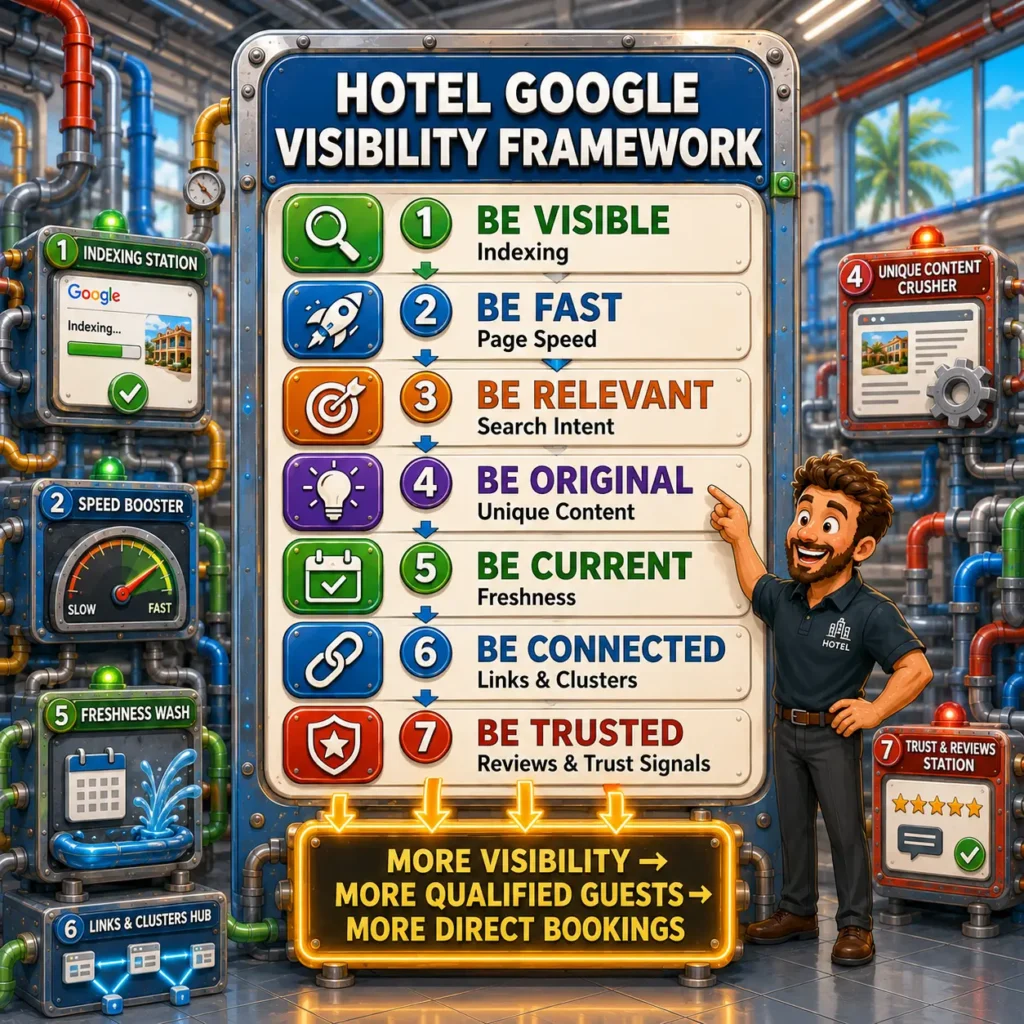
✔ Indexing is not optional. If Google has not indexed your hotel page, it will not rank. Full stop.
✔ User experience matters for rankings. Page speed, mobile performance, and search intent all play a direct role.
✔ Fresh, original content wins. Hotels have a natural update cycle, which you can use strategically.
✔ Link structure and topical authority build long-term visibility. The way your hotel website is structured sends powerful signals to Google.
📃 Step One: Why Aren't My Hotel Pages Showing Up on Google? (And How to Fix Indexing)
Let’s start with the most basic and most often overlooked requirement: if your hotel pages are not indexed by Google, they have no chance of ranking. You can write the most detailed room description in the world, but if Google has not added that page to its database, no guest will ever find it through search. (If this sounds familiar, you may want to read this article first: Why Your Website Gets No Traffic from Google.)
At the major travel platform where I led SEO, one of the very first things we did was establish clear indexing rules. This means deciding with intention which pages deserve to be in Google’s index and which do not. Combined with a fast crawling setup, getting indexing right was the foundation of a 3x year-on-year SEO growth. The scale was different from a hotel website, but the principle is exactly the same. If the wrong pages are indexed, they dilute the quality signals of your entire site. If the right pages are not indexed, they simply do not exist for Google.
When I audit hotel websites, indexing is the single area where I most consistently find value being left on the table. The typical pattern is not rogue pages or technical disasters. It is simply that pages a guest would genuinely search for, like a specific room type, a spa treatment page, a parking information page, have never been indexed at all. They are live on the website, but invisible to Google.
✅ How can you make sure only your best hotel pages get indexed?
Introduce a quality threshold. Before any page goes live on your hotel website, ask: does this page genuinely help a guest? Does it answer a real question, describe a real experience, or provide information they would actually need?
For offer and package pages specifically: only index a page if it contains enough content to be useful on its own. A page with just a package name and a price is not a page worth indexing. Add context, describe the experience, explain what is included, and give the guest a reason to stay on the page.
For seasonal pages: update them for the new season rather than creating a new one each year, or set them to noindex when they are no longer current. Outdated pages sitting in Google’s index quietly damage your site’s reputation.
💡 Fixing indexing costs nothing. It just requires looking. Open Google Search Console, check the Indexing report, and go through your most important pages one by one. You may be surprised by what you find.
Here, I created an article for hotels managing their website on WordPress on how to set up Google Search Console:
⌛ How Do Page Speed and Core Web Vitals Affect Your Hotel's Google Rankings?
User experience is a real ranking factor, not a nice bonus. If your hotel website is slow to load, unstable on mobile, or awkward to navigate, Google takes note. And so do your potential guests. 📱
Google measures how users experience your site through something called Core Web Vitals. You can find this report in Google Search Console. It focuses on three things: how fast the main content loads (called Largest Contentful Paint, or LCP), how quickly the page responds to interaction, and whether the layout shifts around unexpectedly while loading.
For hotel websites, the most common problem I find is poor LCP. Which means the page simply takes too long to show the main content. This is usually caused by large, unoptimised image files. Hotel websites are naturally image-heavy: room photos, spa shots, food photography. Each of those images, if not properly optimised, adds seconds to the loading time. And on a mobile connection, those seconds cost you guests.
Why does LCP matter specifically? Because it measures the moment when a guest feels the page has actually loaded. If that moment takes more than 2.5 seconds, Google flags it as poor. If a guest is on their phone comparing three hotels and yours is the one that takes forever to show the room photo, they have already moved on before your content even appears.
Color code cheat sheet:
🔴 Red = Poor. Fix immediately.
🟡 Yellow = Needs improvement.
🟢 Green = Good.
The simple rule: the more green pages your hotel website has, the better your chances of ranking and keeping guests on the page.
✅ What can you do to improve Core Web Vitals for your hotel website?
- Check your Core Web Vitals report in Google Search Console. Prioritise any pages marked red. Especially, your homepage, room pages, and booking page.
- Use PageSpeed Insights to test individual pages. It shows you exactly what is slowing things down and gives specific improvement suggestions.
- Act on the suggestions. For hotel websites, the biggest wins almost always come from compressing and properly sizing room and amenity photos, and from reducing unnecessary scripts that load in the background.
At the travel platform where I led SEO, improving Core Web Vitals was one of the two foundational steps alongside indexing that unlocked 3x year-on-year SEO growth. The pages that benefited most were not the ones with weak content. They were pages with solid, relevant content that was simply not performing because of speed issues. For a hotel website, that could easily be your rooms page or your spa page. Pages that guests want to find, that you have invested time in, but that are quietly underperforming because of a technical issue a developer could fix in an afternoon.
👉 For a step-by-step guide on checking your hotel’s technical performance: How to Set Up Google Search Console for Your Hotel Website
🧰 How Do You Win on Google by Fulfilling What Guests Are Actually Searching For?
SEO is no longer about cramming keywords onto a page. Thank goodness 🙏, that was a stupid time. It is about giving people what they are genuinely looking for. For hotel websites, that means understanding exactly what a guest has in mind when they type a query into Google and making sure your page delivers precisely that.
Google measures how users interact with your content. If they click, stay, explore more pages, and do not immediately hit the back button, those are strong signals that your page is doing its job. For hotels, that job is usually to help a guest decide whether your hotel is the right fit for their trip.
✅ How do you create hotel pages that fulfil search intent and attract clicks?
- Match your page content to what the guest is actually looking for. A guest searching “family hotel Vienna with pool” is not looking for a general hotel overview. They want to quickly confirm you have a pool, that families are welcome, and what the experience will feel like. Your page needs to answer that immediately. Learn more here: 👉 How Travelers Actually Find Hotels Online
- Make your search result as attractive as possible. A compelling SEO title and meta description lead to more clicks, and more clicks combined with guests who stay on the page improve your average ranking position over time. 👉 SEO Titles & Meta Descriptions for Hotels
- Create helpful, original hotel content that gives guests a genuine reason to stay on the page. This is the foundation of Google’s Helpful Content System and RankBrain, both of which reward content that people actually find useful. 👉 How to Write Hotel Room Descriptions 👉 How to Create a Hotel Breakfast Page
💡 Practical tips to keep guests engaged on hotel pages:
- Hook guests immediately. Your room page should open with the experience and specific highlights, not a generic header. “Wake up in a comfortable king-size bed to a panoramic mountain view” works better than “Welcome to our Deluxe Room.”
- Keep pages skimmable. Use clear headings, short paragraphs, bullet points for room features, and a logical flow from top to bottom.
- Add elements that invite engagement: a photo gallery, a video of the room or view, an FAQ section about check-in or breakfast, a map of the surrounding area.
The better your hotel pages fulfil what guests are searching for and the more attractive your result looks in Google, the more traffic you will get. Content that genuinely helps guests and appears as the most relevant result climbs the rankings consistently.
If you want to dig deeper, here’s the full guide to Google’s ranking systems to see how this all ties together.
📅 Why Does Google Care About Fresh Content and How Does a Hotel Stay Current?
Google wants to send guests to content that is up to date. That is where the Freshness Systems come in. For hotels, the good news is that you already have a natural update cycle built into your business. Seasons change, prices update, new offers launch. The key is making sure your website reflects that, rather than showing information from two years ago.
Fresh does not mean rewriting every page every month. It means proving to Google and to guests that your content is actively maintained.
✅ Three freshness tactics that work well for hotel websites:
1. Add a review section to key pages and keep it updated. Guest reviews on your room pages and amenity pages are one of the most powerful freshness signals available to hotels. Every new review adds new text, new keywords, and new content to that page automatically, without you writing a word. Make collecting reviews a routine. When a guest checks out, ask them directly. When you receive feedback through any channel, consider adding a curated response or highlight to the relevant page on your site.
2. Use your seasonal price updates as a trigger for a full page refresh. Most hotels update their rates at least twice a year. Every time you do, treat it as an opportunity to also refresh the rest of that page. Update photos, adjust the room description, add a new seasonal highlight or nearby event, and review whether the SEO title still reflects how guests are searching. This habit keeps your most important pages alive in Google’s eyes and takes very little extra time since you are already making updates anyway.
3. Make it a routine to collect guest questions and answer them on your website. Guests ask the same questions repeatedly: about parking, check-in times, breakfast, nearby attractions, what to do on a rainy day. Every time you notice a recurring question, add the answer to the relevant page or to a dedicated FAQ section. This keeps pages growing naturally, adds genuinely useful content, and signals to Google that the page is maintained and current.
💡 Fresh content signals to Google that your hotel website is actively maintained and trustworthy. I have seen pages rise in rankings simply through strategic refreshing, with no new pages required, just a commitment to keeping the existing ones current.
🤯 How Does Google Handle Duplicate Content and What Does That Mean for Hotel Websites?
If multiple pages on your hotel website look very similar to each other, or if your content closely mirrors what is already on other sites, Google may filter one of them out entirely. That is where the Deduplication and Original Content Systems come in.
For hotel websites, the most common duplicate content problem is internal. Two pages that end up covering essentially the same ground. A double room page and a standard room page with almost identical descriptions. A summer offer page and a weekend offer page listing the same packages. Google does not know which one to show, so it may show neither.
🔍 What happens when you have duplicate content?
- Google filters out similar pages to avoid cluttering search results.
- Only one version will rank, which is usually the original, well-maintained page.
- Internal duplicates (across your own site) confuse Google and waste crawl budget.
From my own experience, I’ve seen Google favor the original source, especially when it’s regularly updated and well-structured. That makes sense, because why reward someone who just copied your work?
✅ What can you do to avoid duplicate content problems on your hotel website?
Avoid internal duplicates. Each room type should have genuinely distinct content, not just a different headline over the same description. Describe what makes each room different: the view, the floor, the size, the bathroom, the specific mood it creates. If two pages truly overlap, consider merging them or setting the less important one to noindex.
Make your offer and package pages original. If your packages are similar, differentiate the pages through context. What experience does this package create? Who is it for? What is included in detail? A page that answers those questions clearly is a page Google will index and guests will value.
Do not copy content from other sources. This includes copying destination descriptions from tourism boards, copying amenity descriptions from a booking platform, or reusing your own text across multiple pages. From what I have seen, Google consistently favours the original, well-maintained source. Create your own and make it better.
💡 The practical rule: if you and a guest can clearly perceive a difference between two pages, you are probably safe. If you cannot tell them apart, neither can Google.
📈 How Does Topical Authority Help Your Hotel Website Rank Higher on Google?
Google increasingly rewards websites that demonstrate genuine depth and expertise in a specific area, rather than those that publish disconnected pages with no clear relationship to each other. For hotel websites, this principle — topical authority — is one of the most underused advantages available.
The idea is to organise your content into clusters that revolve around a central theme. Each cluster has a strong pillar page that covers a broad topic, surrounded by supporting pages that go deeper into specific aspects. The pages link to each other, Google can see the structure, and it understands that your website is a comprehensive resource on this topic.
A strong example of this working in practice is the Mandarin Oriental in London. Their wellness content is structured as a deep cluster: a main spa and wellness pillar page, supported by individual pages for specific treatments, therapists, retreat packages, memberships, and wellness philosophy. The result is that they rank well for “hotel spa London” and related wellness searches, attracting guests who were not initially searching for a hotel stay at all. A guest searching for a spa day in London finds the Mandarin Oriental, experiences the brand, and becomes a potential guest. That is topical authority turning content into a new audience.
🔧 What does a content cluster look like for a hotel website?
Hotels have several natural clusters available to them. Here are four that work well:
1. The neighbourhood cluster
Your hotel’s location is one of its most valuable assets. Create a pillar page about your neighbourhood and build out supporting pages around it: the best museums nearby, the best restaurants within walking distance, theatres and cultural venues, parks, markets, day trips. Guests searching for things to do in your area will find these pages and they will find your hotel in the process.
2. The rooms cluster
Your rooms pillar page gives an overview of all your room types, and each individual room type has its own dedicated page that links back to the pillar and to related amenity pages. A guest looking for a room with a balcony, a family room, or a suite should land directly on a page that answers exactly that question.
3. The amenities cluster
One pillar page covering your hotel’s facilities overall, with individual pages for the spa, the restaurant, the breakfast offer, the pool, the gym, the parking. Each amenity page is detailed enough to stand on its own in search results and all link back to the pillar. The Mandarin Oriental example above is this structure working at its best.
4. The audience cluster
If your hotel serves a specific type of guest well (families, couples, business travellers), create a pillar page around that audience and link it to every relevant page: the family rooms, the kids’ menu, the cot rental policy, the nearby playgrounds, the family offers. A parent searching “family hotel Vienna what to do with kids” should find a page that answers their entire question, not just a generic homepage.
🚀 Why does content clustering work so well for hotel websites?
- Google can easily understand your site structure and what your hotel is an expert on.
- You build depth around specific guest needs, which means more pages can rank for more specific searches.
- Internal links between cluster pages distribute authority across your site and help pages rank faster.
- Guests stay longer and explore more pages, which are exactly the engagement signals Google rewards.
💡 Start with one cluster that plays to your hotel’s strongest suit (your location, your rooms, or your most distinctive amenity) and build outward from there. Publishing smarter always beats publishing more.
Learn more about structuring your hotel website in this article:
⚡ What Spam Tactics Does Google Penalise and What Should a Hotel Website Avoid?
If you want to undermine your hotel website’s rankings quickly, use spammy shortcuts. Google has become very effective at identifying and penalising these. The good news for hotel owners who simply want to create a genuinely helpful website: you are naturally on the right side of this.
What Google penalises:
- Keyword stuffing: cramming “hotel Vienna” into every sentence of your room description does not help. It reads badly to guests and Google now recognises it as a negative quality signal.
- Link schemes: buying backlinks or exchanging links purely to manipulate rankings, with no relevance between the pages.
- Hidden text: adding invisible keywords to a page to try to rank for them without guests seeing them. This has not worked for years and is a fast way to get penalised.
- Cloaking: showing different content to Google than to guests. Do not do this.
For the full official list, see Google’s Spam Policies.
For a hotel focused on genuinely helping guests with clear room descriptions, honest amenity information, and useful local content, none of these should ever be tempting. The best spam protection for a hotel website is simply good content.
🔗 How Can Internal and External Links Boost Your Hotel Website's Authority?
One of Google’s oldest ranking systems analyses how pages link to each other to determine which are the most useful and relevant. It has evolved significantly over the years, but the core principle still holds: links are votes of relevance, and building a strong link structure remains one of the most effective things a hotel website can do for long-term SEO.
Externally: Earning links from other websites
The most valuable external links for a hotel website come from pages where the connection is genuinely relevant. A travel blog reviewing your city and recommending places to stay. A local magazine writing about boutique hotels in your neighbourhood. A wedding venue website recommending nearby accommodation. A tourism board featuring your hotel in their area guide. The key is relevance and quality. A link from a well-trafficked, trusted website whose content genuinely relates to yours is worth far more than dozens of links from random directories.
Internally: Connecting your own hotel pages
Build a clear, logical internal link structure. A good starting point is your homepage: the pages you link to from your homepage send a direct signal to Google that those pages matter. For hotels, that means your most important room pages and key amenity pages should have a visible link from the homepage, not just be reachable through a navigation menu buried two clicks deep.
Beyond the homepage, think about which pages can actually be booked. Room pages are the most important here. Link to them as often as it makes sense: from your homepage, from your amenity pages, from your neighbourhood and location pages, from any offer or package page. Every additional internal link to a room page reinforces to Google that this is a high-value page worth ranking, and it gives guests a natural path to the one action that matters most.
Every room page should also link to related amenity pages. Your spa page should link to your wellness packages. Your neighbourhood pages should link to your rooms and offer pages. No important page should sit on your site with no other page linking to it. Those isolated pages are invisible to both guests and Google.
Leverage other channels to link back to your hotel website
- Blog articles on your own site, each linking to the most relevant room or amenity page
- Your Google Business Profile
- Local platforms and tourism directories, especially those where your listing remains visible long-term rather than disappearing in a social feed
🚀 What Is Google's Passage Ranking System and How Can a Hotel Use It?
Google’s Passage Ranking System identifies individual paragraphs that directly answer a specific search query, even if the rest of the page is not a perfect match. This has become particularly important with AI-powered search overviews, where a single strong paragraph from your page can be featured directly at the top of a search result without the guest needing to click through at all.
For hotel websites, this is a genuine opportunity. If your spa page has a clearly written paragraph that answers “what treatments are available at the hotel spa,” Google can surface that specific paragraph in response to that search. If your neighbourhood page clearly answers “what is there to do near [your hotel],” that passage can be featured on its own.
✅ How to optimise hotel content for passage ranking:
- Use question-based headings throughout your pages. “What is included in the hotel breakfast?” is more powerful than “Breakfast.”
- Answer the question directly at the beginning of each section, not buried three paragraphs in.
- Keep each section focused on one clear topic. A paragraph that tries to answer three things at once is unlikely to be surfaced as a passage.
Ask yourself: if an AI model like ChatGPT or Google’s AI Overview summarised this page, would this paragraph be included? If yes, you have written it well. This practice is also one of the most effective ways to optimise your hotel website for visibility in AI-driven search, not just on Google, but across Gemini, Perplexity, and other platforms that increasingly surface hotel content.
🌐 Why Mixing Languages on Your Hotel Website Hurts Google Rankings
This is not listed as an official ranking system, but it consistently causes problems for hotel websites, particularly those targeting both international and local guests.
I have seen this play out in practice at a travel website that automatically fell back to English whenever a translation was not available in another language. The result was German pages filled with English content, a mix Google could not cleanly categorise. The consequence was poor performance across both languages, because Google could not confidently show those pages to the right audience in the right country. Rankings dropped, and the fix required a significant cleanup effort that could have been avoided entirely.
For hotel websites the same risk applies, especially if your site was translated partially or in a hurry. If your room descriptions are in English but your navigation is in German, Google does not know who that page is for.
For hotel websites:
- Use one language per page, consistently throughout.
- If your hotel offers a language switcher, make sure switching to English produces a fully English page, not a page with English navigation and German room descriptions.
- If you quote a guest review in a language other than the page language, either translate it or clearly mark it as a quote.
- If you cannot translate every page yet, it is better to only show fully translated pages in each language than to publish partially translated ones.
Clean language structure helps Google index and rank your content correctly and gives international guests a much smoother experience.
🚫 How Do Ads Affect Your Hotel Website's Page Experience?
Google prioritises a smooth browsing experience. For hotel websites this is particularly relevant because guests are often comparing multiple options quickly, and any friction that slows that process down means a lost visit.
Pop-ups or ads that interrupt the experience like a full-screen newsletter sign-up appearing before a guest can see a room photo, or a large banner pushing the room description below the fold, are treated by Google as poor page experience signals. They also simply annoy guests, which is never a good start to a potential booking relationship.
If you use pop-ups for newsletter sign-ups or special offers on your hotel website, set them to appear after a delay or when a guest shows exit intent, not the moment they arrive on the page. Keep the path from search result to room information as clean and fast as possible.
🔒 How Do Reviews and Trust Signals Help Your Hotel Rank on Google? (The E-E-A-T Principles)
Google wants to show guests websites they can trust. For hotels, trust is not an abstract concept. It is something guests assess in seconds, and it is something Google can measure through the signals your website provides.
Google applies what it calls EEAT principles when evaluating a hotel website: Experience, Expertise, Authoritativeness, and Trustworthiness. These shape how Google judges the overall quality and credibility of your site.
✅ How to build trust signals on your hotel website:
Reviews are the most immediate trust signal available to hotels. A row of genuine, recent guest reviews on your rooms page or homepage tells both guests and Google that real people have stayed, had an experience, and were willing to say so publicly. Create a Google Business Profile if you do not have one, and start collecting reviews there actively. Display your ratings on your website and link back to the review platform. Transparency builds credibility.
Show evidence of real experience on your pages. Original photos taken at your hotel, written by someone who actually knows the property, in language that reflects a genuine understanding of the guest experience, … all of this signals authenticity. Generic stock photography and templated descriptions do the opposite.
Make your hotel easy to verify as a legitimate business. An up-to-date About page, a clear Contact page, a visible address, and links to your social profiles and review platforms all contribute to Google’s assessment of your trustworthiness. These pages are often overlooked on hotel websites, but they matter.
Show credentials and expertise where relevant. If your chef has a background worth mentioning, mention it. If your spa therapists are certified, say so. If your hotel has received awards or press coverage, feature them. These details are signals to Google that your hotel is a credible, established business.
Learn how to do this on your most important page, your hotel homepage:
❓ Why You Do Not Need to Worry About Every Single Google Ranking System
Google uses many more ranking systems than the ones covered in this article, for instance, BERT, Site Diversity, Local News preferences, Spam Demotion, and others. But for most hotel websites, these either apply automatically when you do the basics right, or they are simply not relevant to your situation.
If you focus on creating original, genuinely helpful hotel content, keeping your important pages indexed and up to date, building a clear internal structure, and earning the trust of your guests, you are already aligned with the vast majority of Google’s ranking systems. You do not need to understand every technical detail. You need to understand your guests and build a website that serves them well.
🧠 Final Thoughts: Who Should You Really Be Helping... Guests or Algorithms?
I hope this gave you a clearer picture of how Google’s ranking systems apply specifically to your hotel website and where to focus your energy first.
Start with the basics: make sure your key pages are indexed, that your site loads well on mobile, and that your content genuinely helps guests make a decision. Then build from there with fresher content, stronger clusters, better internal links, and more trust signals. In my experience across travel platforms and hotel websites, the hotels that win on Google are not the ones with the most technical sophistication. They are the ones that have built the clearest, most useful, most trustworthy presence on the web.
SEO for hotels is not about tricking Google. It is about building a website that is genuinely useful to the guests who are searching for exactly what your hotel offers. When you do that consistently, most of Google’s ranking systems take care of themselves.
If you have found a specific approach that has worked well for your hotel website, or if you have questions about any of the systems covered here, I would love to hear from you. 👇
FAQs: Google Ranking Systems for Hotel Websites
1. My hotel pages are not showing up on Google. How do I know if they are indexed?
Type site:yourhotelwebsite.com into Google and browse the results. For a more detailed view, open Google Search Console and check the Indexing report. It shows which pages are indexed and flags any issues. If important pages like room pages or your spa page are missing, use the URL Inspection tool to request indexing and check whether there are any technical barriers stopping Google from crawling them.
2. How often should I update my hotel website content to stay fresh for Google?
Use your seasonal price updates as a natural trigger for a page refresh like updating photos, adding new guest questions and answers, and refining descriptions at least twice a year. For pages like your neighbourhood guide or local recommendations, a quarterly review is a good habit. Guest reviews on your key pages provide ongoing freshness automatically, which is one reason collecting them consistently is so valuable.
3. I have similar room pages on my hotel website. Is that a duplicate content problem?
It can be. If two room pages have near-identical descriptions, Google may filter one out. The fix is specificity: each room type should be described in its own terms. You can use the view, the size, the bed configuration, the specific mood it creates, the type of guest it suits best to differentiate them. If rooms are genuinely very similar, consider combining them into a single, more detailed page rather than maintaining two thin ones. However, I do recommend make very specific room pages. See a guide here: How to Write Hotel Room Descriptions
4. What is the best way to build backlinks for a hotel website?
Focus on relevance over volume. Reach out to local travel bloggers, city guides, wedding venues that might recommend nearby accommodation, and tourism boards featuring hotels in your area. A single link from a well-trafficked local travel site is worth far more than dozens of links from generic directories. Creating genuinely useful local content like a neighbourhood guide, a seasonal events page, naturally attracts links over time without any outreach at all.
5. How does Google's AI Overview affect my hotel website's visibility?
AI Overviews increasingly surface specific paragraphs or facts from hotel pages directly in search results, sometimes without a click. To take advantage of this, structure your hotel pages with clear question-based headings and direct, specific answers at the beginning of each section. A paragraph that clearly answers “does the hotel have parking” or “what is included in the spa package” is exactly the kind of content Google’s AI systems are designed to surface. This is true for both in standard search and across AI platforms like Gemini and Perplexity.
The Prompt used To Create this article
I want to be transparent on how this article was written, so below you will find the prompt to create this article. Of course, I asked for adjustments afterwards, but here is the initial input:
Check the prompt
Can you create a compelling blog article for my website, www.patricklindbichler.com? I want to make the articles a bit longer, so people can find clear information. The article should be clear and easy to understand, especially for people who are new to the topic. Still it should stay as compelling as the original article and also have the same length. It should be written in good American English, using not too complicated words so that even non-native English speakers can follow along easily. The tone should reflect my expertise as a thought leader in SEO, content creation, and leadership. Feel free to use examples from my experience as proof points and explain them in a clear and compelling way.
I am typically a positive and humorous person, so the writing style can be upbeat with a few lighthearted jokes here and there—just nothing offensive. The article should be engaging, fun to read, and educational. Please follow the structure outlined below, and feel free to expand on the points with additional context to ensure that each paragraph presents clear arguments.
Structure of the article:
- Introduction: Start with a paragraph that summarizes the topic and grabs attention. You can make a strong statement or ask a thought-provoking question that will be answered later in the article.
- Key Highlights (3-4 bullet points): Include a few short bullet points summarizing the key takeaways of the article. Each point should be 1-2 sentences long.
- Main Content: Break the main part of the text into several text parts, each with a heading optimized for SEO and AI search. The paragraphs should be easy to read and compelling.
- Headlines: Please formulate the headlines and include important keywords for SEO.
- Conclusion: Wrap up the article by summarizing the main points and inviting readers to reach out if they have any questions or want to learn more.
- FAQs: Include 5 frequently asked questions about the topic, with clear answers that add value to the reader.
Formatting:
- Use bold for key points, ensuring every 4th or 5th sentence has something in bold for emphasis.
- Add emojis throughout (but no more than 50 total) to make the article more visually appealing.
- If you include practical tips, illustrate them with real-life examples to make the content relatable.
- Please make the article a minimum of 1800 words. Feel free to ask me if you need more input or add information and context where you feel it’s necessary to convey a message or provide more clarity.
Goals:
- Please optimise the article for SEO. Give recommendations for search terms to include and integrate them into the titles of the paragraphs and the beginning of the article
- Please make the article engaging so people are intrigued to read, but also enjoy reading.
- What readers learn in the article, should be easy to apply for them because everything is explained clearly and has examples
Please use the following input to create the article and keep all the information:
Title: Understand Googles Search Ranking Systems and use them for your Website for great SEO results
Googles ranking mechanisms are a mystery to some people and there are also weird practices spreading because someone knows how Google works. I definitely want to avoid that in this article and will just list the things which I have seen actually resulted in an SEO uplift. I’ll go through it from most critical to least critical so you can easily prioritise.
Let’s start with the basics, before we get to the reaily interesting part.
Indexing
The first challenge is actually that your page is indexed, otherwise there is anyways no chance for traffic. Read more about it in my article on why your website gets no traffic: https://patricklindbichler.com/why-your-website-gets-no-traffic-from-google/
There is one key addition I want to make, which makes a big difference: Introduce a quality criteria for your page to be met in order to get indexed. A mistake many websites make, and I also made, is to simply index every page you create. Sometimes there are some pages that don’t provide any value users, which will result in people being very dissatisfied with the result and consequently with your website. How you can avoid it, is to introduce a quality criteria for you when you index a page or not. It can be a manual criteria for yourself, for instance that you don’t index a page that doesn’t serve a purpose for customers when the land on it e.g. because there is little content on it. Or it can be also an automated criteria e.g. if you have pages with lists of offers, that you only index it with a minimum amount of offers.
Core Web Vitals + Pagespeed Insights
In the Google Search Console you see the core web vitals report. This is how Google measures how users experience your page. If they are red, they are poor. Yellow they can be improved. Green they are good. When you turn your pages into green, you will experience growth. It’s as simple as that.
In addition, you can use the Pagespeed Insights test to improve the performance of your page. Try to drive the result as high as possible by following the proposals to improve your page. Your SEO performance will benefit from that.
Fulfil the search intent + Have an attractive search result
If the majority of people are happy with what they experience on your page, this will let your average ranking improve. Read more on how to optimsie your page for the search intent here: https://patricklindbichler.com/how-to-understand-search-intent-in-8-steps/
In addition, an attractive search result leads to a higher click-through rate. Which in turn leads to an improvement in average position if the search intent is met. Read more how to create an attractive search result here: https://patricklindbichler.com/meta-titles-descriptions-that-get-attention-and-convert/
In general the most important SEO skill is to create helpful, original content for people. This is reflected in several ranking systems like the Helpful Content System and RankBrain / Behavior Signals. So on the one had create content that helps people, see here what I think is important: https://patricklindbichler.com/%f0%9f%a7%b1-the-4-pillars-of-creating-great-content-simple-useful-engaging-trustworthy/
And optimise your content so people show great signals. Which means they engage with your content and stay on your page by:
- Design your content to hook users immediately with strong intros.
- Keep content skimmable: headings, bullets, summaries.
- Add interactive elements like videos, infographics, FAQs to improve engagement.
Now let’s get to the ranking mechanisms that you can use for your benefit. To cross-check that I don’t through random things at, please also see the guide of Googles ranking systems here: https://developers.google.com/search/docs/appearance/ranking-systems-guide
Freshness systems – Update your page regularly
The first I want to target are the Freshness systems. Google wants to make sure that content is not outdated. This varies of course for the type of content you put online. A news article page of course is to be expected to be updated more frequently than a history website (unless there are new findings on a daily basis of course ;)). My recommendation for you if you are somewhere in the middle and especially when you are offering products in any kind of way, is to update the content as often as possible, but at least every 3-6 months.
I recommend some measures:
Small Websites:
- Have an update schedule: Set yourself a schedule when you review your pages and add or change information. E.g. every X weeks/months you check your blog articles, review search data and incorporate findings, check information from top performing pages and add content, change things that have changed, add images or videos, simply add sections or tools, … There are plenty of options to improve your page while making sure the content stays fresh.
- Add a review/comment section: Let others do the work. If users add reviews with texts and maybe even images or texts or comment on your page, then you automatically gain new = fresh content.
Big Websites:
For big websites, it gets hard to do everything manual, so you need to think off clever systems like:
- Add a review/comment section: Is also applicable here
- Add sections that automatically shuffle content: You could introduce sections on your page that randomly change regularly or also in a structured way. Ideas could be like a “most recent articles/products” section, if there are constantly new ones added or a “popular articles” section, where you shullfe the articles automatically out of a pool of articles.
- Integrate information that changes: Add sections with up-to-date info e.g. like weather sections. Here I don’t have insights but I assume that might work.
- Think creatively: Think about your website and think of creative ways on how your pages stay very dynamic with new/different content regularly. Of course you should not change the main purpose of the page of the page.
Deduplication systems (+ Original content systems)
If the content on pages is very similar, Google systems will omit pages to avoid unhelpful duplication. In this case Google trys to show the most relevant result out of all the duplicates, which one that is, is not quite clear. From what I’ve seen the original = first one with the content has the best chances to stay when they are well maintained. Which would make sense to me because otherwise people could just copy a page and steal their traffic. The Original Content systems are supporting that too, that the pages with original content are actually favoured. So when you create something similar to what already exists, make sure that there is some new, original content on your page that differentiates you. How much should be different is hard to say. My rule of thumb is if users or you can perceive actually a difference, then you are fine. In general don’t copy someone else, it’s bad practice.
Ideally also avoid internal duplicates. In general, there is no penalty from Google for internal duplicates. On the one hand because you lose crawling resources on duplicates and on the other hand your users might be confused, because they don’t know which one is the correct page. Also Google might be confused and non-index your pages when they are similar. The bad part, it doesn’t know which one to index and which one not. So better take action and remove duplicates yourself.
To avoid this problem, think of systems to change the content when you run into a problem that 2 or more pages might have the same content or create a system where one of the pages is set to not be indexed (ideally the less valuable one). The danger of duplicates is usually when you show a list of things on a page and another page with a different target could end up with the same list. What you can do then:
When 2 lists have the same items
- The less important page shows only a part of the items on their list
- The content of the list itself changes e.g. one page shows different information about the list items
- The less important page is automatically set to no index
- Or a combination: E.g. the less important page shows only a part of the items and once it falls below the quality criteria (see above) it falls out of the index
Topical Authority and Content Clustering
Why: Google increasingly rewards sites that are comprehensive in a niche, rather than spreading too thin.
How to implement:
- Create topic clusters: one pillar page + multiple subpages that link internally.
- Example: Main page “Skiing in Austria” links to pages like “Best Resorts in Tyrol,” “What to Pack,” “Ski School Prices,” etc.
- This builds depth and increases internal link equity.
Spam detection systems
In the recent years, Google focused a lot on removing spammy pages. It’s very easy for you: Don’t create a spammy website. What Google considers as spam you can find here: https://developers.google.com/search/docs/essentials/spam-policies
I am a big fan that Keyword Stuffing and Link spam are considered spam. It’s such a horrible practice that many so-called SEO experts recommend.
Link analysis systems and PageRank
This one is almost a history lesson, because PageRank is one of the oldest ranking systems from Google. It analysis how pages link to each other and based on that determines the most helpful page for a query.
This is how you can use it to your benefit:
Externally:
- Identify key websites and try to get them to link to your page if:
- The content of their page has a strong fit with your page. E.g. a blog article about buying great Ferraris links to a page where you can buy a Ferrari
- The website is a strong domain with a lot of traffic
Internally:
- Build a good internal structure of links. I want to write an article about this
- Use other media to link to your page like:
- Your blog
- Social Media preferably if the content remains seen. I think good platforms are YouTube, Reddit, Pinterest etc. The more dynamic ones like Instagram, Facebook, X, TikTok etc. might also give it a push, but since SEO is a longterm game, I’d rather focus on platforms where your content remains searched. TikTok might work because content is also searchable there.
Passage ranking system
This system identifies passages of a page that might fulfil the search intent. Which means you search for something and only a part of a website might be interesting for you. Then Google is able to redirect you to that individual part. Or probably now you will just see it in the AI overview in the beginning of the search result page.
Nonetheless what you can do is design your paragraphs in a way, that they answer questions. You can phrase the headlines as questions and try to answer as good as possible the question in the paragraph, ideally rather at the beginning. This is also a great way to optimsise for AI Models like ChatGPT, Gemini etc.
Mix of Languages
It’s not stated in the ranking systems, but what results in bad performance is having a mix of languages on your page. Which makes sense, if Google doesn’t know for which language the page is actually designed, for which searches and users should Google match it? So make sure you have only one language per page and a clear switch of your website = if I switch the language to English, I should only get English on your page unless clearly stated differently e.g. you quote someone in German (but even then I’d offer a translation).
Ads
If Ads interfere with the usage of a page, Google considers that as a bad page experience. This can be:
- Ad pop-ups
- Huge ads before the main content
Trust = Reviews (Reliable information systems)
Google wants to make sure to only show authoritative pages. Citations of your content might be one way to prove it. The most practical one that is immediately understood by users is reviews, ideally in the simplest form as 5-star ratings. To show you are a credible page, great a Google MyBusiness account and ideally even another platform like Trustpilot and start collecting reviews. Show them on your page with a link to the rating websites and even use them for your search result snippet.
Google applies for Trust the EEAT (Experience, Expertise, Authoritativeness, Trustworthiness) principles. It’s not a direct ranking system, aligning with EEAT principles helps build long-term visibility.
How to apply:
- Add author bios with credentials and experience.
- Cite sources and link to trusted domains.
- Show evidence of first-hand experience (e.g., personal stories, original images, use cases).
- Ensure transparency: contact info, privacy policy, about pages, etc.
What helps in addition is showing that you are a legit business including ways that people contact you.
You might have noticed that I left out some Search ranking systems. I simply did so because if you create original, high-quality content for people and fulfil the recommendations above, you automatically fulfil them e.g. BERT or they are not applicable for the majority of websites e.g. Local news systems or you can’t influence them e.g. Site diversity system or are just met when you don’t break the law e.g. Removal-based demotion systems.
Hope you got some inspiration of how you can improve your website to get more traffic. As I’ve said, first I’d make sure you fulfil the Basics, then go for the rest 😉 Remember, SEO isn’t about tricking Google—it’s about helping users in the best possible way. When you genuinely focus on providing helpful, fast, well-structured, and up-to-date content, you automatically align with most of Google’s ranking systems.
Let me know if you have discovered a practice on how you used Googles Ranking Mechanisms for your benefit, I’d be happy to hear about it!.