Chapter 1: Most Hotels Are Invisible for the Searches That Matter
I ran a case study on over a hundred popular search queries, the kind of searches tourists type into Google when they’re planning a trip. And the results? A little depressing if you’re an independent hotel owner. 😬
Out of the top 10 organic results across all those searches, only 20% were hotels or hotel chains and half of those were big chains. That means only around 10% were independent hotels. The rest? 61% OTAs like Booking.com and TripAdvisor, and the remainder were editorial sites or tourism boards. Guests are searching but most hotels are not positioned to be the answer.
So even for quite specific searches, the majority of visibility doesn’t go to hotels themselves. It goes to platforms that aggregate them.
And this is where it gets uncomfortable.
Every day, potential guests are searching for exactly what you offer. A location. A feature. A type of stay.And they book. Just not with you. Not because your hotel is worse.
But because your hotel website positioning is unclear, so Google and AI don’t recognize you as the best answer.
👉 If your hotel tries to appeal to everyone, you’ve already lost.
But here’s the thing that really stood out: the independent hotels that did show up all had one thing in common. They weren’t necessarily the best hotels, or the ones with the highest ratings, or even the closest to the city center. They were the most specific. They had positioned themselves clearly and Google noticed.
And that’s the part that changes the perspective. Because it means this is not about competing with OTAs on scale. It’s about being the clearest answer to a specific search.
In other words, this is not just about SEO. It’s about having a clear hotel positioning strategy for Google and AI and building your website around it.
In this article, I’ll share exactly what I found and how you can use it. It all comes down to one core framework:
🏨 Hotels don’t win search by being better. They win by being specific.
In this guide
- Why Most Hotel Websites Are Invisible Online (And Why That Keeps Happening)
- The Hotel Search Positioning Framework: How Specific Hotels Win Search
- From Framework to Execution: How to Position Your Hotel Clearly
- Real-World Examples: How Vienna Hotels Are Doing It Right
- Checklist & Tools: Hotel Search Positioning
- Why Positioning Needs to Go Beyond Your Website
- How to Connect This to Your Broader SEO Strategy
- FAQs on Hotel Website Positioning
Key Highlights in this article
Before we dive in, here’s why hotel positioning matters more than most hotels think.
✔ OTAs win broad searches, but hotels can win specific ones.
Platforms dominate generic and price-driven queries, but clear positioning allows hotels to capture high-intent searches directly.
✔ In this article, you’ll learn a simple framework to position your hotel clearly.
Based on location, features, audience, and category and how combining them creates strong visibility.
✔ You’ll see real examples of hotels that turned clarity into rankings and bookings.
Learn what they do differently and what you can directly apply to your own website.
✔ You can use the checklist and positioning score to audit your own hotel.
Quickly identify where your website is unclear and where you can improve.
✔ You can use my custom Hotel Positioning GPT to find your best opportunities.
Generate search ideas, define your positioning, and turn it into concrete pages for your website.
✔ The goal: turn your website into a clear answer to what guests are searching for.
So you get discovered more often and convert more direct bookings without relying on OTAs.
Chapter 2: Why Most Hotel Websites Are Invisible Online (And Why That Keeps Happening)
The root cause is actually pretty understandable. Hotel owners want to appeal to as many guests as possible. Every tourist coming to the area is a potential booking, right? So they write descriptions like “centrally located,” use photos that show every corner of the hotel, and list amenities in a single bullet-pointed block. The homepage tries to be everything to everyone.
This is also where OTAs have a structural advantage, especially for broad searches. Platforms like Booking.com or TripAdvisor have millions of pages and listings, which means they can cover almost every possible combination a traveler might search for. They are built as comparison engines, which makes them the perfect answer for vague or exploratory searches like “hotel Vienna” or “cheap hotel city center.” In that phase, travelers are still browsing, comparing, and figuring out their options… and OTAs are designed exactly for that.
⚠️ Where hotels consistently lose is when the query is broad, comparative, or price-driven. Searches like “hotels in Vienna,” “best hotels Vienna,” or “cheap hotels Vienna” are pure OTA territory. Competing there directly is extremely difficult, because those searches naturally favor platforms built for comparison at scale.
The big problem when you don’t position your hotel website clearly
And here’s the big problem: when your website is generic, three things become impossible.
First, your hotel can’t match the specific needs of guests. A couple looking for a romantic getaway near the Stephansdom won’t recognize themselves in your site. Neither will the family searching for kid-friendly rooms near Schönbrunn. When nobody sees themselves, nobody books.
Second, Google can’t match you to specific searches. Search engines are essentially pattern-matching machines. They look at your page and try to understand: what question does this page answer? If the answer is “everything and nothing,” Google will rank you for nothing. The algorithm rewards clarity.
Third, and this is increasingly important, AI-powered tools can’t recommend you for specific queries. When someone asks ChatGPT or Google’s AI overview for a “family hotel near MuseumsQuartier with parking,” the system will recommend hotels whose websites explicitly and repeatedly connect those three ideas. If that’s not on your website, you’re invisible to AI too. 🤖
The result? Broad searches are dominated by OTAs. Hotels with a specific position capture the niche demand. And hotels with generic websites end up 100% dependent on OTAs for their bookings, paying commissions they shouldn’t have to pay, for guests they could have reached directly.
Chapter 3: The Hotel Search Positioning Framework: How Specific Hotels Win Search 🏆
After analyzing dozens of hotel websites and search results, I found that the hotels consistently winning visibility for specific queries weren’t doing anything mysterious.
They were simply giving Google, AI, and potential guests a much clearer answer.
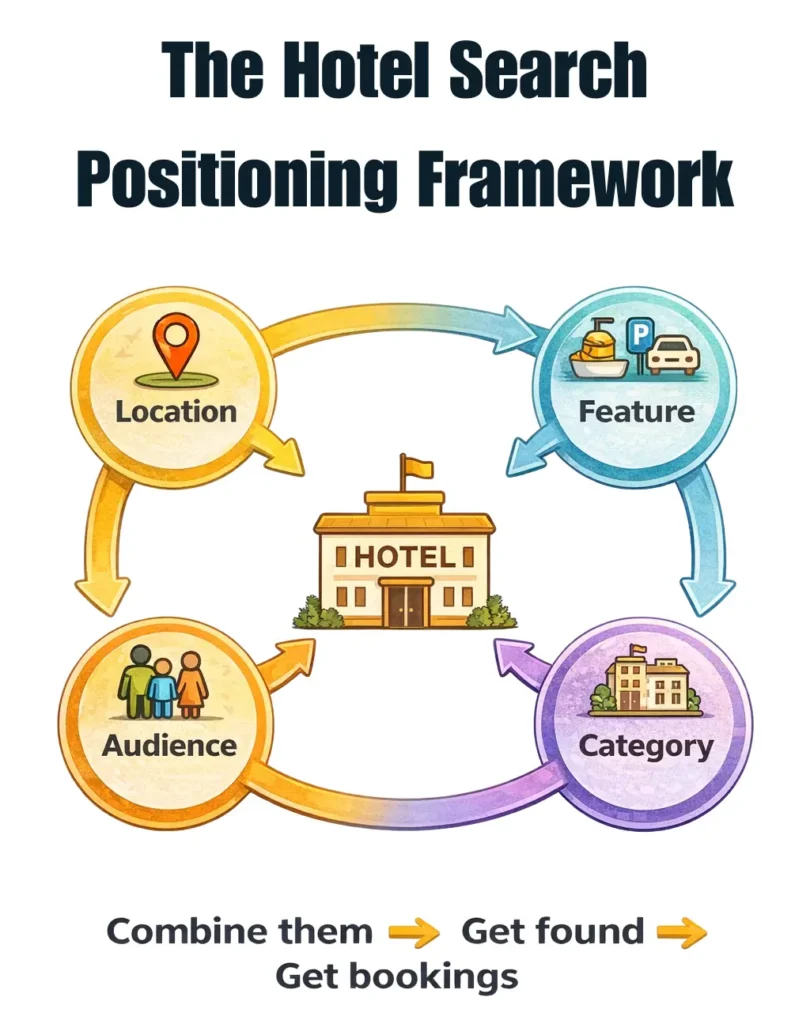
A traveler does not usually search for “a nice hotel website.” They search for something specific. A hotel near a landmark. A hotel with parking. A boutique hotel in a certain area. A family hotel with enough space and the right setup. The hotels that appear are usually the ones that answer that search clearly. Again and again, it came down to four core questions:
Where? → Location
Near which landmark, neighborhood, transport hub, beach, lake, or area is your hotel relevant?
What? → Feature
What does your hotel offer that people actively look for, like parking, breakfast, spa, gym, rooftop, balcony, or family rooms?
Who for? → Audience
Who is the stay especially suited for, such as couples, families, business travelers, solo travelers, or digital nomads?
What type? → Category
What kind of hotel are you, for example, boutique, luxury, budget, lifestyle, aparthotel, wellness, or sustainable?
That, on its own, is already useful. But the real difference is not in answering just one of those questions. It is in combining them. That is where the strongest hotels stand out.
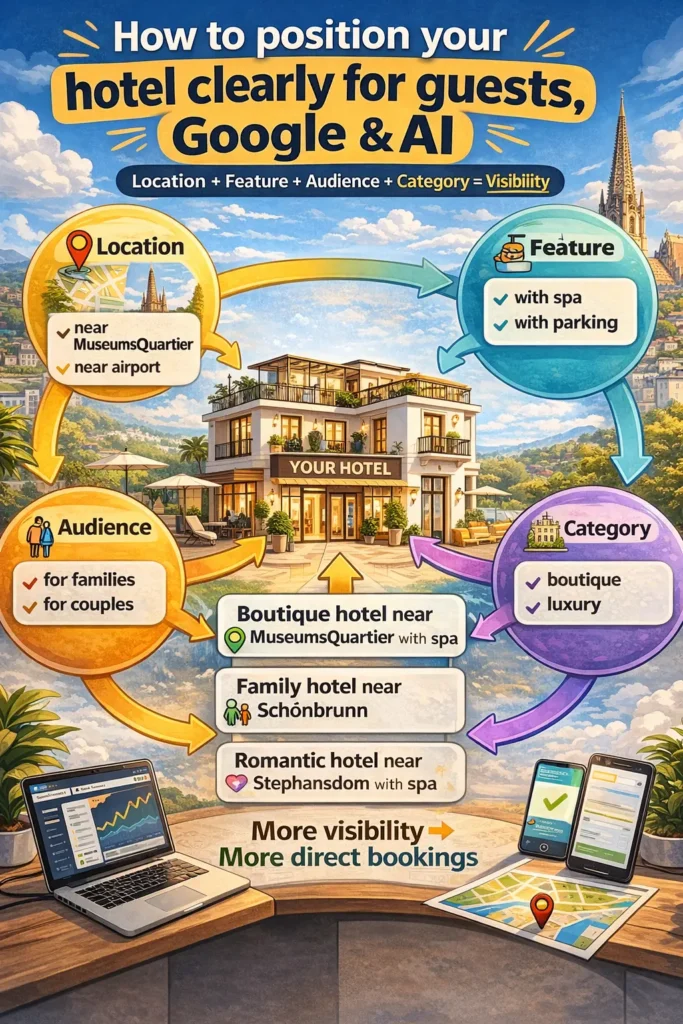
A broad term like “hotel Vienna” gives very little context. A more specific combination like “boutique hotel near MuseumsQuartier” already gives Google and the guest a much clearer picture. Add one more layer like “boutique hotel near MuseumsQuartier with parking” and now the page starts to become a very strong match for a specific type of search.
That combination is what I call your search identity.
Your search identity is the specific combination of signals that tells Google and AI:
this page is a strong answer for this kind of guest and this kind of search.
And that is the big shift. Hotels do not usually win visibility because they are bigger, broader, or trying to appeal to everyone. They win when they make it very easy to understand where they are relevant, what they offer, and who they are a great fit for.
Or in simpler words:
🏨 The clearer your positioning, the easier it is for Google and AI to match you to the right search.
In the next chapter, I’ll break down each part of the framework and show you how hotel owners can actually apply it in practice.
Chapter 4: From Framework to Execution: How to Position Your Hotel Clearly
The framework gives you the structure. Now it’s about execution. Hotels that rank don’t just understand positioning. They build their entire website around it. Page by page, signal by signal.
Before we go into each element, there’s one important distinction that will make everything much easier to apply.
Primary vs. Secondary Positioning: Laying the Foundation
Before diving into each layer of the framework, there’s an important distinction I want to make, one that most hotel websites miss completely.
Your primary positioning is the core identity of your hotel. It’s what you want to be known for above everything else. If you’re a boutique hotel, that needs to be felt the moment someone opens your homepage — in the photography, the copy, the design, the tone of voice. If you’re a family hotel, every element of your website should make a family feel like this place was built for them. Primary positioning isn’t just a page or a headline, it’s the entire experience of your website.
Secondary positioning is everything you build around that core. These are dedicated pages targeting specific audiences or features: a page for business travelers, a parking information page, a breakfast page. They don’t all need to live on the homepage, but they need to exist so that Google, AI, and potential guests can find and understand them.
Think of it this way: primary positioning is your foundation, and secondary positioning is how you expand your reach without losing your identity. 🎯
1. Own a Location: Claim Your Place in the City
Location is your most powerful entry point into search. But here’s where most hotels get it wrong: they mention location as a vague claim (“centrally located,” “in the heart of Vienna”) rather than building an explicit, consistent, and specific connection to actual places.
The best-performing hotel in my case study didn’t just mention a landmark. They built their entire web presence around it. The cathedral appeared in room descriptions, on their terrace page, in their directions section, in photo captions, even in how they described the surrounding neighborhood. Every single page reinforced the same location signal. Google understood exactly where they were relevant. So did the guest reading the page.
You don’t need to be the closest hotel to a landmark to rank for it. You just need to mention it more clearly and more consistently than the hotels that are closer but less deliberate about it. That said, if a dozen competitors have already built their positioning around the same landmark, the bar is higher. You’ll need every lever, not just a single mention on your homepage.
🗺️ Practical steps (Location)
- Map your real search landscape.
List every relevant landmark, neighborhood, transport hub, and natural feature within a meaningful radius of your hotel. Don’t filter yet, the goal is to see the full picture of where you could be relevant. - Choose 1–2 primary location anchors
Pick the places guests actually search for, not just what sounds nice. If no one searches for a district name, it’s not a strong anchor. Then go one step further: check which hotels already appear for those searches and how they position themselves. This gives you a realistic benchmark. You don’t need to be the perfect match, but you should be able to compete with what’s already ranking, ideally aiming to be among the top 2–3 most relevant options. - Create a dedicated page per anchor.
Each important location should have its own page, clearly focused on that place and why your hotel is relevant for it. - Repeat the signal across your entire website.
Homepage (especially above the fold), room descriptions, getting-there pages, neighborhood guides, photo captions, and meta titles should all reinforce the same location.
Be explicit in your URLs and titles.
A URL like /boutique-hotel-near-museumsquartier-vienna is far more powerful than /about-our-location.
Clarity beats elegance in SEO. 🗺️
2. Own a Feature: Turn Amenities into Answers
Most hotels list their features. The ones that rank explain them and give each one its own dedicated page.
Here’s the logic: a guest searching for “hotel with gym Vienna” isn’t looking for a bullet point. They want to know what the gym is actually like. A dedicated page with photos, opening hours, equipment details, and nearby running routes answers that query far better than a line in your amenities list. Google rewards the page that best answers the question and so does the guest who lands on it.
What deserves its own page? More than you might think:
- Gym or fitness facilities
- Spa and wellness
- Breakfast (yes, even if you think yours is nothing special)
- Pet-friendly policy
- Parking
- Meeting rooms
- …
Parking is a fascinating case. Several hotels in my study rank well for “hotel with parking Vienna” by writing a thorough, helpful page about nearby parking garages: distances, prices, walking directions from the garage to the hotel. They’re not solving the problem themselves; they’re being the most useful answer to it. That’s enough. 🚗
One more thing that’s wildly underrated: specific room types per audience. Not just “Standard,” “Superior,” and “Suite.” Think: single rooms, couple rooms with a double bed, family suites, business rooms. These simple labels are targetable, searchable, and give Google a clear signal about who each room is for. Most hotels have these configurations already. They just don’t label them this way.
🏋️ Practical steps (Feature)
- Turn important features into dedicated pages.
If guests actively search for it, it deserves its own page. Think: gym, spa, breakfast, parking, pet policy, meeting rooms. - Answer the real question behind the search.
Don’t just list “gym available.” Show photos, opening hours, equipment, and even nearby running routes. The more complete your answer, the stronger your page. - Solve problems even outside your hotel.
If you don’t have parking, explain nearby garages, prices, and walking routes.
You don’t need to own the solution. You need to be the best answer. 🚗 - Upgrade your room categories.
Rename generic rooms into something searchable and meaningful:
“Single Room,” “Family Suite,” “Business Room with Desk.”
These are not just labels — they are entry points into search.
Link features where they matter.
Mention and link to feature pages from relevant places: room descriptions, homepage sections, and FAQs. This strengthens both SEO and user experience.
3. Own an Audience: Solve a Situation, Not a Segment
Here’s where I see the biggest difference between hotels that rank and those that don’t. Generic phrases like “perfect for families” or “ideal for business travelers” don’t rank, and they don’t convert. They describe a segment. What you need to do is solve a situation.
“Family rooms near Schönbrunn with activities for kids” solves a situation. “Perfect for families” speaks to no one in particular.
You have two strategic paths here, and the right one depends on your hotel:
Path A — Go all-in on one audience. If your hotel is genuinely the ideal choice for couples, or digital nomads, or adventure travelers, make that the entire backbone of your website. The homepage, the room descriptions, the photography, the copy — everything should make your target guest feel this hotel was made for them. The tradeoff is real: guests from other groups will self-select out. But that’s not a problem — it’s the point. A family that books a hotel clearly positioned for romantic getaways is likely to leave a disappointed review. Losing that booking protects your reputation.
Path B — Create dedicated landing pages for specific audiences. If you serve a range of guests but want to actively attract certain groups, build a page for each one. A family page describes your room configurations, kids’ menu, the playgrounds within walking distance, and family packages. A business traveler page covers fast Wi-Fi, quiet rooms, proximity to conference centers, and early check-in. Each page makes one type of guest feel genuinely considered. 🤝
The principle in both cases: don’t label, solve. Describe the actual experience of staying at your hotel as that type of guest.
🤝 Practical steps (Audience)
- Define 1–3 priority audiences.
Don’t try to serve everyone equally. Decide which guests you want to attract most. - Create dedicated pages per audience.
Each page should answer one question:
“Why is this hotel perfect for this type of guest?” - Describe real situations, not labels.
Don’t say “perfect for families.”
Explain: room setup, nearby activities, practical details, and what a stay actually feels like. - Align rooms with audiences.
Create or rename room categories to match audiences:
family suites, couple rooms, business rooms, single rooms.
Extend the story beyond your hotel.
Show why the neighborhood works for that audience too:
parks for families, cafés for remote work, romantic spots for couples.
4. Own a Category: Set the Expectation Early
Your hotel category — boutique, luxury, budget, aparthotel, lifestyle — adds a lot of value, but often doesn’t rank on its own. “Boutique hotel Vienna” is too broad to compete for. But category language does something important: it filters. When someone reads “boutique hotel near MuseumsQuartier” versus “hotel near MuseumsQuartier,” the first phrase attracts a guest who already knows what they want and is much more likely to book.
Category language belongs in your page titles, your meta descriptions, and your homepage headline. Not as the main positioning, but as the qualifier that makes everything else more specific and more attractive to the right guest.
🏨 Practical steps (Category)
- Make your category visible immediately.
Your category (boutique, lifestyle, luxury, etc.) should appear in your homepage headline, titles, and meta descriptions. - Use category as a filter, not the main hook.
It rarely ranks on its own, but it sharpens every other positioning element. - Be consistent across your site.
If you are a boutique hotel, the design, tone, and imagery should reinforce that everywhere. - Integrate category into key elements.
Page titles, H1s, and descriptions should combine category with location or feature:
“Boutique Hotel near MuseumsQuartier Vienna” - Even consider naming.
If it fits, include the category in your hotel name:
“Boutique Hotel NAME” or “Lifestyle Hotel NAME”
The Multiplier: Stack Your Intents for Maximum Visibility 🚀
Each element above has value on its own. Combined, they compound dramatically.
The approach is to build individual pages that each answer two or three questions at once — location, feature, audience, category — in a single, coherent search identity. Here are some real examples of what that looks like in practice:
- “Boutique hotel near Schönbrunn with parking” → category + location + feature
- “Family hotel near MuseumsQuartier Vienna” → audience + location
- “Romantic hotel near Stephansdom with spa” → audience + location + feature
Each of those is a real query that a real guest types when they’re close to booking. And each one can be the title of a page that your hotel owns, if you’ve built the content to back it up.
The more precisely a page matches a specific query, the less competition it faces. You’re no longer fighting every hotel in Vienna for a generic ranking. You’re the obvious answer to a specific question. And that is a fight you can win. 🥊
🚀 Practical steps (The Multiplier)
- Build pages around combinations, not single ideas.
On rach page you can combine 2–3 elements: location + feature, or audience + location, etc. - Use real search queries as inspiration.
Think in phrases like: “Hotel for families near Schönbrunn” or “boutique hotel with parking Vienna” - Create one clear page per combination.
Each page should answer one specific search intent - Prioritize clarity over coverage.
It’s better to have 5 very clear pages than 20 vague ones. - Connect everything through internal linking.
Link between location, feature, audience, and room pages so Google and AI understand the full context.
Want more practical ideas like this?
I share one actionable hotel growth idea every week – focused on SEO, AI, and direct bookings on Substack.
Chapter 5: Real-World Examples: How Vienna Hotels Are Doing It Right 🌟
Let me share five hotels from my research that I genuinely admire for executing this framework well.
Example 1 - Hotel am Stephansplatz
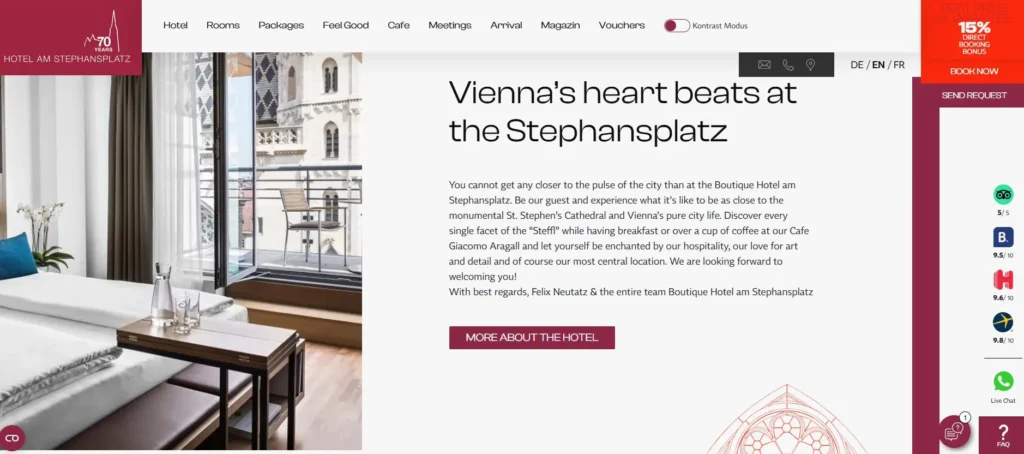
Hotel am Stephansplatz completely owns their location position. The moment you open their website, you feel it. The cathedral appears in room descriptions, in the café section, in their photos, they even have an image that literally shows the hotel right next to St. Stephen’s Cathedral. Admittedly, they probably do have one of the best locations in the city. But the lesson is in the execution: they don’t take that location for granted. They amplify it everywhere.
Visit: hotelamstephansplatz.at
👉 What you should steal from this: Don’t just mention your location once. Repeat it consistently across your entire website. The stronger and more consistent the signal, the easier it is for Google and guests to understand where you are relevant.
Example 2 - Mooons Vienna
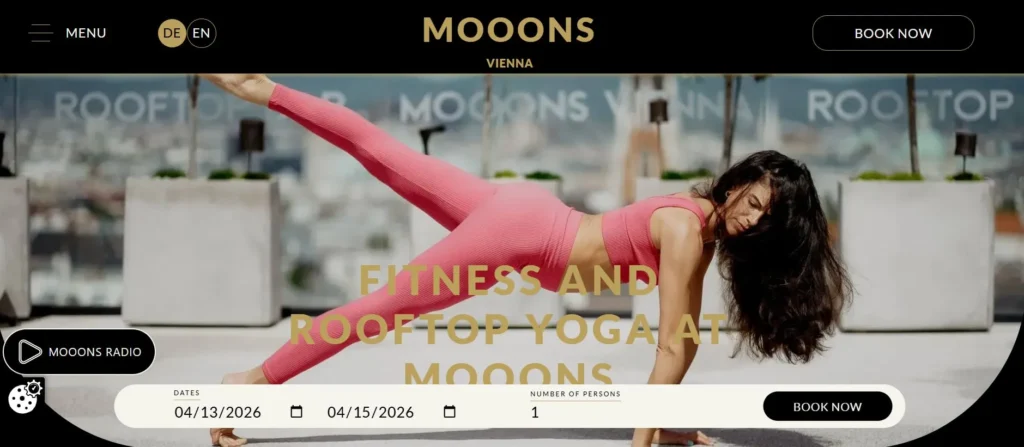
Mooons Vienna did something clever with their gym page. They built something genuinely unique: fitness and yoga at the rooftop with stunning views over the city, and then they dedicated a whole page to it. Travelers who want to keep up their workout routine during a trip will find this hotel. And once they see the rooftop? They’ll book.
Visit: mooons.com/en/vienna/gym
👉 What you should steal from this: Turn a feature into a destination. Don’t list your amenities, but build a story and a dedicated page around them so they become a reason to choose your hotel.
Example 3 - Hotel Henriette
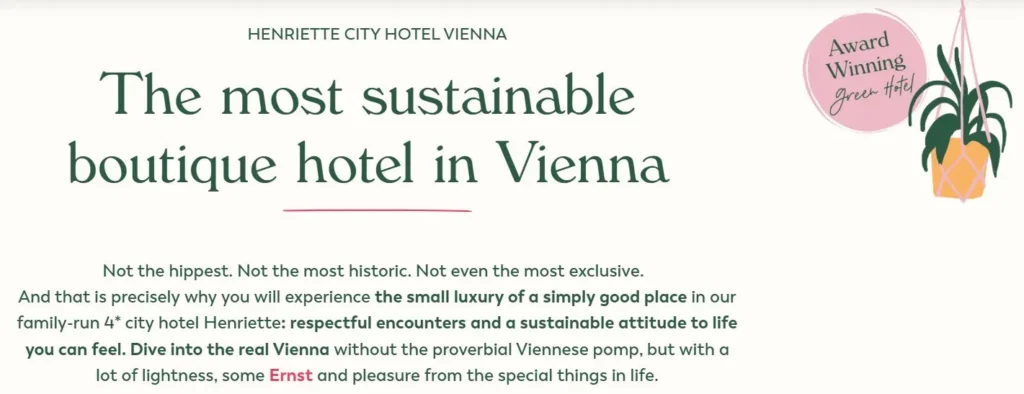
Hotel Henriette found a winning combination: boutique style plus sustainability, and they followed through completely. The boutique vibe is reflected throughout the website’s design and imagery. The sustainability commitment comes through in multiple dedicated pages: natural bedding, organic breakfast, a clear explanation of why it matters. You can sense they’re on a real mission, not just ticking boxes. That clarity of purpose is exactly what earns rankings and loyal guests.
Visit: hotelhenriette.at
👉 What you should steal from this: Combine two strong positioning elements and fully commit. The category alone is not enough. When you stack it with a clear belief or mission, your positioning becomes much more powerful and memorable.
Example 4 - Hotel Stadthalle
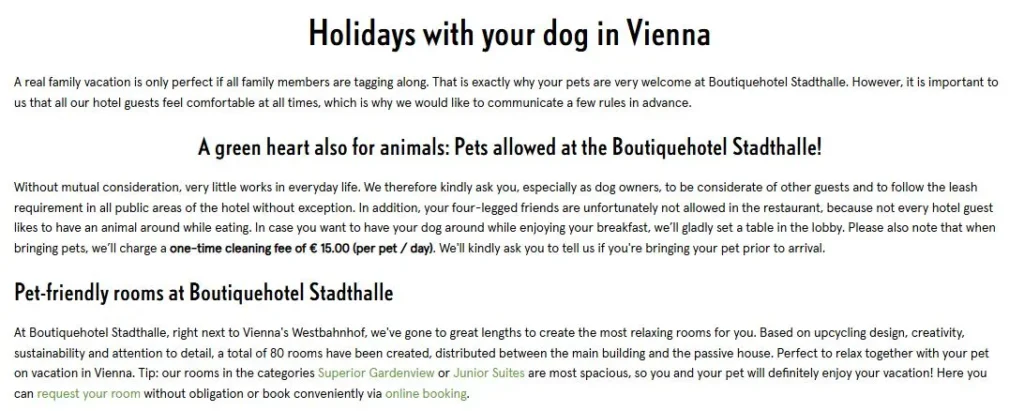
Hotel Stadthalle is a great example of how specific audience targeting can unlock visibility even without a central location. They appeared frequently in my study despite being nowhere near the neighborhoods I was searching for. Why? Because they address specific needs, a dedicated pet-friendly page, an accessible room category, so well that Google recommends them for those searches regardless of geography.
Visit: hotelstadthalle.at
👉 What you should steal from this: You don’t always need the best location. If you solve a very specific need better than others, Google will show you. Clear audience or use-case pages can outweigh geography.
Example 5 - Hotel City Central
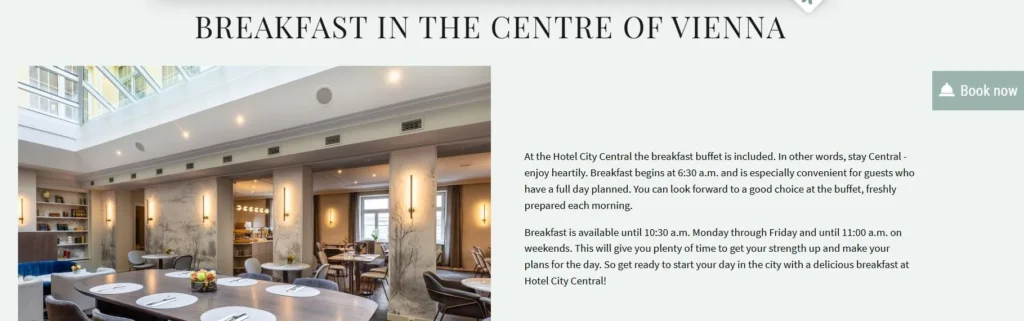
Hotel City Central makes something ordinary look remarkable: breakfast. Having breakfast included might be completely standard in Vienna hotels, but they made it explicit, gave it its own page, and explained it in detail. That’s why they appear on Google for breakfast-related searches even though the majority of their competitors offer the same thing. They repeated the same logic for their gym and parking, and added specific room categories for singles and families. Nothing invented, just everything that was already there, made visible.
Visit: hotelcitycentral.wien
👉 What you should steal from this: You don’t need unique features; you need clear communication. Take what you already offer and make it explicit, detailed, and easy to understand. Clarity beats uniqueness in most cases.
I break down real hotel strategies like this every week
Connect with me on LinkedIn for short, practical tips and ideas based on real examples.
Chapter 6: Quick Checklist: Hotel Search Positioning ✅
Use this as a starting point to audit your own website.
But before you go through the checklist, let’s make this a bit more practical.
👉 Give yourself a quick score first.
Your Hotel Positioning Score (0–10)
For each question, give yourself:
0 = not clear at all
1 = somewhat clear
2 = very clear
Do you clearly own a location? (0–2)
(e.g. near a specific landmark, neighborhood, or area)
Do you clearly own one or more features? (0–2)
(e.g. parking, spa, rooftop, breakfast, gym)
Do you clearly target an audience? (0–2)
(e.g. families, couples, business travelers)
Do you show your positioning clearly on your homepage? (0–2)
(can someone understand it within a few seconds?)
Do you have dedicated pages for each position? (0–2)
(e.g. separate pages for location, features, audiences)
👉 Your result:
- 0–4 → Invisible
Your hotel is likely too generic to rank for meaningful searches. - 5–7 → Potential
You have some clear signals, but they’re not strong or consistent yet. - 8–10 → Competitive
You’re clearly positioned and have a strong chance to get found for specific searches.
The important part is knowing how to improve it.
To make this easier, I’ve created two simple tools you can use to identify your hotel’s positioning and turn it into concrete actions:
Option 1: Use the Hotel Positioning GPT (fast & guided)
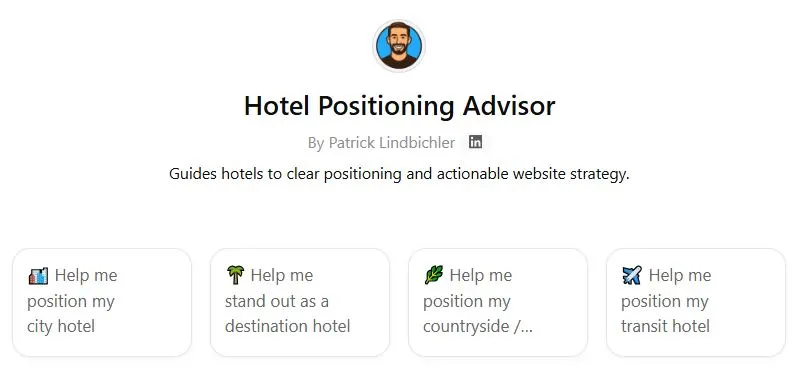
If you want a quick and structured way to find your positioning, you can use my Hotel Positioning GPT.
👉 It helps you:
- analyze your hotel setup
- generate realistic search positioning ideas
- combine location, features, audience, and category
- turn those ideas into concrete pages for your website
This is the fastest way to go from “not sure where to start” → “clear positioning ideas you can implement.”
⚠️ Important: This is an AI tool. It can make mistakes or suggest ideas that don’t fully fit your hotel. Use it as a starting point, not the final answer. Always challenge the results and combine them with your own knowledge of your guests and your market.
Option 2: Use the Positioning Questionnaire (deeper & strategic)
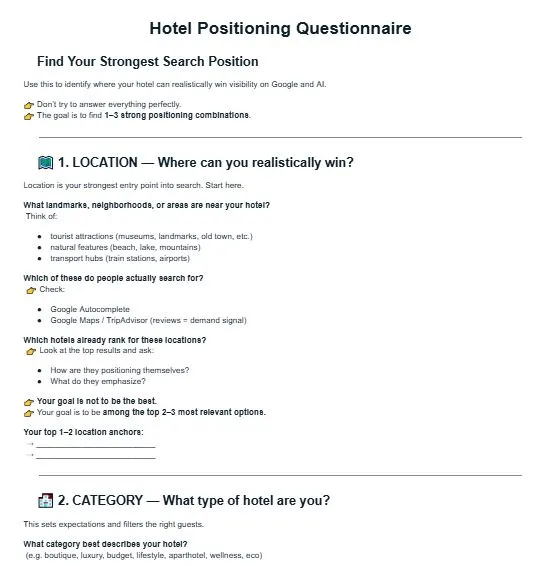
If you prefer to think it through yourself, use the positioning questionnaire from this article.
👉 It helps you:
- map your strongest location anchors
- identify your most valuable features
- define your key audiences
- combine them into clear positioning options
- and choose your primary and secondary positions
This takes a bit more time, but gives you a much deeper understanding of your positioning.
Now go deeper with the checklist
Your homepage should clearly show:
- ✓ Who the hotel is for (primary audience or positioning)
- ✓ Where it’s located (specific landmark or neighborhood, not just “central”)
- ✓ What makes it special (your primary feature or category)
- ✓ What the rooms look like and who they’re designed for
- ✓ How to book directly (with a clear, visible call to action)
Your supporting pages should include at least:
- ✓ One page per location anchor (landmark, neighborhood, or area)
- ✓ One page per major feature (gym, parking, spa, breakfast, pet policy)
- ✓ One page per target audience (families, couples, business travelers, etc.)
- ✓ Room descriptions that name the audience, not just the room size
- ✓ Meta titles that include category + location (e.g., “Boutique Hotel near MuseumsQuartier Vienna”)
What to avoid:
- ✗ Vague location language (“centrally located,” “in the heart of the city”)
- ✗ Generic feature lists without dedicated pages
- ✗ Identical descriptions for different room types
- ✗ A homepage that tries to speak to everyone at once
Chapter 7: Why Positioning Needs to Go Beyond Your Website 🌍
Here’s something I realized while going through hundreds of hotel websites: great positioning doesn’t stop at the browser window. The hotels that earn the most visibility aren’t just optimized on their websites; they’ve built their entire experience around their positioning.
Take Hotel Henriette again. Sustainability isn’t just a claim on a web page. You experience it in every interaction: the bedding, the breakfast, the product choices, the tone of communication. When the promise on the website matches the reality of the stay, guests become advocates. They leave reviews that reinforce your positioning. They share it with friends. They tell the story you want told.
And that story starts attracting something even more powerful: editorial coverage. Publications and travel blogs are always looking for hotels with a clear story. A generic hotel is hard to write about. A boutique hotel with rooftop yoga and a view of the cathedral? That writes itself. Editorial links and mentions are one of the strongest ranking signals in Google and they’re almost impossible to buy, but easy to earn when your positioning is specific and authentic. 💡
Being specific isn’t a risk. It’s the thing that makes you worth writing about, worth searching for, and worth booking directly.
Chapter 8: How to Connect This to Your Broader SEO Strategy 🔗
Positioning is the foundation, but it needs to be built into every part of your website to work.
To understand how guests are actually searching before you choose your position, check out: How Guests Actually Search for Hotels
Once you know your positioning, here’s how to implement it:
- On your homepage: How to Design and Structure the Perfect Hotel Homepage
- In room descriptions: How to Write Hotel Room Descriptions That Drive Direct Bookings
- In your website structure: How to Structure a Hotel Website for SEO and Conversions
- For a full SEO overview: Hotel SEO: How Hotels Get More Direct Bookings from Google and ChatGPT
Hotels that treat these as separate tasks struggle. Hotels that connect them around their positioning build something much more powerful:
👉 a website that matches how guests search
👉 a structure that Google and AI can understand
👉 and content that turns clarity into bookings
That’s when your website stops being a brochure and starts becoming a real booking engine.
Conclusion: Make Your Hotel Positioning Clear
Here’s the bottom line: Google doesn’t reward the best hotel, it rewards the clearest one. The independent hotels that consistently appear in search results aren’t there because they have bigger budgets or better reviews than everyone else. They’re there because they made it easy for search engines and travelers alike to understand exactly who they are, exactly where they are, and exactly who they’re for.
The good news? You don’t need to reinvent your hotel to achieve this. In most cases, everything you need to build a strong search position already exists: the location, the features, the rooms, the character. You just need to make it visible. One dedicated page at a time. 🎉
If you have questions, want to discuss your hotel’s specific positioning strategy, or just want to nerd out about hotel SEO together, feel free to reach out. I’d love to help.
If you found this helpful and want more ideas like this:
👉 Follow me on Substack for deep-dive guides on hotel SEO, AI, and direct bookings
👉 Connect on LinkedIn for shorter insights and real-world examples
FAQs on Hotel Website Positioning
1. My hotel isn't near a famous landmark. Can I still use the location framework?
Absolutely. Famous landmarks are the most obvious location anchors, but they’re not the only ones. Think about the neighborhood your hotel is in: does it have a name or identity guests might search for? A metro station or tram stop? A riverside path or market? A business district? Many guests search specifically for areas with a distinct character (“hotel in the 7th district Vienna,” “hotel near Naschmarkt”) rather than just for big tourist attractions. Start by mapping everything within a 15-minute walk or ride, and choose the anchors your ideal guests would actually search for.
2. Won't targeting a specific audience mean I lose bookings from everyone else?
This is the fear that keeps most hotels generic and it’s understandable. But the reality is the opposite. When you’re specific, you rank higher for the guests who are looking for exactly what you offer. You get more of the right bookings, at a higher conversion rate, and with fewer disappointed reviews from guests who misunderstood what you were. The hotels I’ve studied that went specific didn’t see less traffic. They saw more relevant traffic and better revenue as a result.
3. How many dedicated feature and audience pages does my hotel actually need?
Start with the features and audiences that genuinely represent your hotel, and build from there. Don’t create pages you can’t back up with real content, because a half-empty page with three sentences won’t rank and won’t convert. A realistic starting point is 3–5 feature pages (gym, parking, breakfast, spa, pet policy → pick what applies) and 1–2 audience pages for your clearest guest segments. Over time, you can expand. Quality beats quantity here.
4. How do I know which combination of location + feature + audience to prioritize?
Think about what your best guests, the ones who loved their stay and left glowing reviews, actually searched for or said when they chose you. That’s often your best clue. You can also look at your Google Search Console data to see which queries are already bringing people to your site. And check what your top-performing competitors are doing: what specific pages do they have that you don’t? Use the hotel search terms guide for more inspiration.
5. Does this positioning framework also work for AI tools like ChatGPT or Google's AI overviews?
Yes, and this is actually more important now than ever. AI tools generate recommendations based on content that is specific, structured, and clearly connected to a topic. If your website says “boutique hotel near MuseumsQuartier Vienna with rooftop yoga” on multiple pages, in meta titles, in room descriptions, and in a dedicated gym page, then when someone asks an AI assistant for exactly that, your hotel becomes a natural candidate to recommend. Generic websites are invisible to AI for the same reason they’re invisible to Google: no clear signal means no recommendation. The framework in this article applies to both.
The Prompt used To Create this article
I want to be transparent on how this article was written, so below you will find the prompt to create this article. Of course, I asked for adjustments afterwards, but here is the initial input:
Check the prompt
Can you create a compelling blog article for my website, www.patricklindbichler.com? I will first give you a full outline of my draft for the article, so you have the full context. Feel free to ask me questions before writing the full article and give me proposals to improve the article for impact. It should be in a similar style to the other articles that I have attached to this project. So try to match my tone of voice and aim for clarity while still getting to the point. So hotel owners can easily understand.
I want to make the articles a bit longer, so people can find clear information. The article should be clear and easy to understand, especially for people who are new to the topic. Still it should stay as compelling as the original article and also have the same length. It should be written in good American English, using not too complicated words so that even non-native English speakers can follow along easily. The tone should reflect my expertise as a thought leader in SEO, content creation, and leadership. Feel free to use examples from my experience as proof points and explain them in a clear and compelling way.
I am typically a positive and humorous person, so the writing style can be upbeat with a few lighthearted jokes here and there—just nothing offensive. The article should be engaging, fun to read, and educational. Please follow the structure outlined below, and feel free to expand on the points with additional context to ensure that each paragraph presents clear arguments.
Structure of the article:
- Introduction or The Problem (Hook): Start with a paragraph that summarizes the topic and grabs attention. You can make a strong statement or ask a thought-provoking question that will be answered later in the article.
- Key Highlights (3-4 bullet points): Include a few short bullet points summarizing the key takeaways of the article. Each point should be 1-2 sentences long.
- Main Content: Break the main part of the text into several text parts, each with a heading optimized for SEO and AI search. Each text part can have 1-3 paragraphs with 5-20 sentences each, depending on how much content is needed to explain the point clearly and bring the argument across. The paragraphs should be easy to read and compelling. Here is a structure for the main content:
- Explain Why the Problem Exists
- The Framework / Solution
- Deep Dive into Each Element
- Practical Examples
- Quick Checklist
- Connect to the Bigger Strategy
- Internal Links (Very Important)
- Headlines: Please formulate the headlines and include important keywords for SEO.
- Conclusion: Wrap up the article by summarizing the main points and inviting readers to reach out if they have any questions or want to learn more.
- FAQs: Include 5 frequently asked questions about the topic, with clear answers that add value to the reader.
Formatting:
- Use bold for key points, ensuring every 4th or 5th sentence has something in bold for emphasis.
- Add emojis throughout (but no more than 50 total) to make the article more visually appealing.
- If you include practical tips, illustrate them with real-life examples to make the content relatable.
- Please make the article a minimum of 1800 words. Feel free to ask me if you need more input or add information and context where you feel it’s necessary to convey a message or provide more clarity.
Goals:
- Please optimise the article for SEO. Give recommendations for search terms to include and integrate them into the titles of the paragraphs and the beginning of the article
- Please make the article engaging so people are intrigued to read, but also enjoy reading.
- What readers learn in the article, should be easy to apply for them because everything is explained clearly and has examples
Please use the following input to create the article:
- The Problem (Hook)
I ran a case study on over a hundred popular search queries from tourists on Google. Even though I avoided the generic searches like “hotel vienna”, the outcome of the top 10 organic results was:
– Only 20% were hotels or hotel chains.
- Only 20% were hotels or hotel chains. Half of them independent hotels.
- 61% were OTAs like Booking.com and TripAdvisor
- The remain were editorials or tourism boards
So only 10% were independent hotels, but those did something well: They positioned themselves clearly.
In this article I’ll share my findings in how you can position your hotel clearly, so it gets found. It came down to the following framework:
🏨 Hotel Search Positioning Framework
To rank, your hotel must clearly answer:
- Where? → Location
- What? → Feature
- Who for? → Audience
- What type? → Category
And combine at least 2–3 of them per page
Core Idea (anchor of your article)
Hotels don’t win search by being better — they win by being specific.
- Explain Why the Problem Exists
I think the main reasons the problem exists, because hotels want to appeal for everyone. In some way it makes sense: Address every tourist coming to your area, everyone is a potential guest.
The problem, when you keep everything generic on your website, there is no way:
- Your hotel matches specific needs of guests
- Google can match you to specific searches
- AI can recommend you for specific hotel inquiries
And what’s ultimately going to happen:
- The broad searches are dominated by OTAs
- Hotels with a specific position capture this demand
- Your hotel is invisible online, depends on OTAs for bookings
- The Framework / Solution
Analyzing my case studies, I found that hotels consistently win visibility for specific queries like “boutique hotel near MuseumsQuartier Vienna” or “hotel near MuseumsQuartier Vienna with parking” — not by being better, but by being more specific.
The core idea is simple: search rewards clarity, not quality.
To rank, a hotel page needs to clearly answer at least two or three of these questions at once: Where is it? What does it offer? Who is it for? What type of hotel is it? That combination is your search identity.
- Own a Location
Location is your entry point into search. Rather than describing yourself as “centrally located,” create dedicated pages tied to specific places — tourist attractions like Schönbrunn or Stephansdom, neighborhoods like MuseumsQuartier, or transport hubs. Each page targets one location intent: “Boutique hotel in MuseumsQuartier”, not a vague claim about being nearby.
- Own a Feature
This is where independent hotels can actually beat OTAs. Features like parking, a gym, breakfast, or pet-friendly rooms become powerful when they’re treated as experiences rather than checklist items. “24/7 gym with rooftop yoga sessions” signals something specific. “We have a gym” signals nothing.
- Own an Audience
Rather than labeling a room type, solve a concrete scenario. “Family rooms near Schönbrunn with activities for kids” speaks to a real situation. “Perfect for families” speaks to no one in particular. Build pages around situations — couples, business travelers, digital nomads — and describe what their stay actually looks like.
- Own a Category
Positioning yourself as boutique, luxury, or lifestyle only works in combination with something else. “Boutique hotel Vienna” is too generic to compete. “Boutique hotel near MuseumsQuartier” gives Google a clear, rankable signal.
The Multiplier: Stack Your Intents
The hotels that consistently rank don’t target one dimension — they combine two or three. Location plus feature (“hotel near Schönbrunn with parking”), location plus audience (“family hotel near Schönbrunn”), or all three together (“family hotel near Schönbrunn with parking”). The more specific the combination, the higher the chance of ranking.
What Doesn’t Work
Most hotels put everything on one page, trying to appeal to everyone at once. The result is no clear signal — and no ranking. Generic completeness is invisible in search.
The structural principle is: one page, one intent. Not a homepage that covers everything, but individual pages built around a single location, feature, or audience.
How Google Actually Chooses
Search queries fall into two modes. In exploration mode — “best hotels Vienna,” “cheap hotels Vienna” — OTAs dominate and hotels rarely win. In decision mode — “romantic hotel near MuseumsQuartier,” “hotel near Schönbrunn with gym” — the searcher already knows what they want, and a well-positioned hotel page can rank above an OTA listing.
That’s the goal: position your hotel to show up at the moment someone has already decided what they’re looking for.
- Deep Dive into Each Element
Before we go into each element, there is one thing I want to mention, there are some positions that you want your hotel to be known for. I call this the primary position. This needs to be shown from the top of your homepage into every aspect of your website. This can be categories or audiences, or in some cases even features and locations. If you are a family hotel, make this clear in every aspect, that you hotel is tailored to families. If you have a Boutique hotel, the whole vibe of your website should convey “Boutique hotel”.
Secondary positioning is everything you build around your primary positioning. You can have dedicated pages for a specific audience or about some features that speak to a certain type of people. They don’t need to be for everyone you want to address, but a part of the people you want to visit your hotel. So the secondary position doesn’t appear on your homepage on the top necessarily, but there are still dedicated pages for them, so potential guests, Google and AI can capture the position.
The framework only works if it’s executed with precision. Here’s how to actually build each layer — and how to combine them into something Google can’t ignore.
- Location: Claim Your Place in the City
The first step is identifying which landmarks, neighborhoods, or natural features you can legitimately associate with your hotel. Think broadly: popular tourist attractions within walking distance, a neighborhood with its own identity, a river, lake, or beach nearby — even a view from your rooms or terrace counts as a location asset.
Go deep on one anchor, not shallow on many. The best-performing hotel in my study didn’t just mention Stephansdom — they built their entire web presence around it. The cathedral appeared in room descriptions (“views of St. Stephen’s”), on their terrace page, in their directions section, even in how they described the surrounding neighborhood. Every page reinforced the same signal. Google understood exactly where they were relevant, and so did the guest.
You don’t need to be the closest hotel to a landmark to own it in search. You just need to mention it more clearly and more consistently than the hotels that are closer but less deliberate. That said, if a dozen competitors have already built their positioning around the same landmark, the bar rises — you’ll need to pull every lever, not just add a mention to your homepage.
Practical steps:
- Map out every landmark, neighborhood, transport hub, and natural feature within a meaningful radius
- Pick one or two primary anchors — the ones guests actually search for
- Create a dedicated page per location anchor and weave that location signal across your entire site: room descriptions, getting-here pages, photo captions, meta titles
- Feature Pages: Turn Amenities into Answers
Most hotels list their features. The ones that rank explain them — and give each one its own page.
The logic is straightforward: a guest searching for “hotel with gym Vienna” isn’t looking for a bullet point. They want to know what the gym is actually like. A dedicated page with photos, opening hours, equipment details, and nearby running routes answers that query far better than a line in your amenities list. Google rewards the page that best answers the question — and so does the guest who lands on it.
What deserves its own page:
- Gym or fitness facilities
- Spa and wellness
- Breakfast (even if you just describe your breakfast buffet and you think there is nothing special about)
- Pet-friendly policy
- Parking — and this one is worth elaborating on
Parking is a case where the feature page doesn’t even need to be about something you own. Several hotels rank well for “hotel with parking Vienna” simply by writing a thorough, helpful page about nearby parking garages — distances, prices, how to walk from the garage to the hotel. They’re not solving the problem themselves; they’re being the most useful answer to it. That’s enough.
How to connect the pages:
- Tease each feature on your homepage and room pages with a short description and a link
- Don’t bury features in a single “Amenities” tab — surface them where guests are already reading
- Each feature page should have its own meta title and URL that includes the feature and your location: /gym-hotel-vienna or /hotel-vienna-parking
In addition, what is very underrated and something almost every hotel can use: Make the rooms specific for a target audience e.g.
- Single room
- Couple room with double bed
- Family suites
- Business rooms
- …
- Audience Pages: Solve a Situation, Not a Segment
You have two distinct paths here, and choosing the right one matters.
Path A — Go all-in on one audience. If your hotel genuinely is the ideal choice for couples, or for business travelers, or for digital nomads, make that the backbone of your entire website. The homepage, the room descriptions, the photography, the copy — everything should make your target guest feel that this hotel was built for them. This isn’t a page strategy; it’s a positioning strategy. The tradeoff is real: guests from other groups will self-select out. That’s not a problem — it’s the point. A family that books a hotel clearly positioned for romantic getaways is likely to leave a disappointed review. Losing that booking protects your reputation.
Path B — Create dedicated landing pages for specific audiences. If your hotel serves a range of guests but you want to actively attract certain groups, build a page for each one. A family page isn’t just “we’re family-friendly” — it describes your family room configurations, your kids’ menu, the playgrounds and family attractions within walking distance, any special family packages. A business traveler page covers fast Wi-Fi, quiet rooms, proximity to conference centers, and early check-in options. Each page makes one type of guest feel genuinely considered.
The principle in both cases is the same: don’t label, solve. Describe the actual experience of staying at your hotel as that type of guest.
- Category: Set the Expectation Early
Your hotel category — boutique, luxury, budget, aparthotel, lifestyle — doesn’t rank on its own. But it does something important: it filters. When someone reads “boutique hotel near MuseumsQuartier” versus “hotel near MuseumsQuartier,” the first phrase attracts a guest who already knows what they want and is more likely to book. Category language belongs in your page titles, your meta descriptions, and your homepage headline — not as the main positioning, but as the qualifier that sharpens everything else.
- The Stack: Where the Real Wins Are
Each layer above has value on its own. Combined, they compound.
The approach is to build individual pages that each answer two or three questions at once — location, feature, audience, category — in a single, coherent search identity. Some examples of what that looks like in practice:
- “Boutique hotel near Schönbrunn with parking” — category + location + feature
- “Family hotel near MuseumsQuartier” — audience + location
- “Romantic hotel near Stephansdom with spa” — audience + location + feature
Each of those is a real query that a real guest types when they’re close to booking. And each one can be the title of a page that your hotel owns — if you’ve built the content to back it up.
The more precisely a page matches a specific query, the less competition it faces. You’re no longer fighting every hotel in Vienna for a generic ranking. You’re the obvious answer to a specific question.
- Practical Examples
Example 1: Hotel am Stephansplatz – This hotel website owns the near landmark search
https://www.hotelamstephansplatz.at/en/startseite.html
I really like this example, they have done a lot of things well, that’s why they appeared a lot in my study. Why I highlight them is because the completely own their location position. I admit, they probably have the best location really right next to St. Stephens Cathedral, but you feel it everywhere. You feel it when you open their page, in room pages, when you check out the Cafe, they even have an image showing that the hotel is right next to the cathedral. Love it.
Example 2: Moons – Appearing for Gym searches by creating something unique
https://mooons.com/en/vienna/gym
I like what they did, they built a quite unique feature and highlighted it: A fitness and yoga at the rooftop with stunning views over the city. People aim to continue their gym sessions during vacation will come across this hotel, and most likely book.
Example 3: Henriette City Hotel – Stacking sustainable and Boutique and you have a successful combination
https://www.hotelhenriette.at/en/
They found a combination where they can really shine and followed through completely. The Boutique style is something that is reflected in the style of the website and the sustainability comes through in many pages e.g. one about the natural bedding or the organic breakfast. And they explain why it matters in detail. YOu can really sense that they are on a clear mission.
Example 4: Hotel Stadthalle – A hotel addressing a specific audience
https://www.hotelstadthalle.at/en/boutiquehotel/holiday-dog.html
A hotel that appeared often in my search, even though with their location it was almost impossible with the search terms I used (none included areas near this hotel). But they are addressing some needs and audiences so well. One is for people bringing their pet, the other by showing an accessible room category.
Example 5: Hotel City Central – Making something common a feature
https://www.hotelcitycentral.wien/en/room-apartments/breakfast.html
Having breakfast included might be very common in hotels, but the Hotel City Central is making it explicit. That’s why they appear on Google for searches including breakfast even thought the majority of other hotels offers it too. And they repeat the same thing for gym and parking, plus they have explicit room categories for singles and families. Something probably every hotel has, they really use it.
- Quick Checklist
People love this.
Example:
Hotel Website Optimization Checklist
Your homepage should clearly show:
✓ who the hotel is for
✓ where it is located
✓ what makes it special
✓ what the rooms look like
✓ how to book
This increases shareability and saves.
- Connect to the Bigger Strategy
Positioning is probably the core of your hotels strategy.
I handle in much detail it’s importance on your website, how you position yourself on your homepage and how you let all the additional pages from room, to facilities to dedicated pages speak to different audiences. It’s a composition that combined, can attract a lot of customers from Google and AI, and it’s a starting point.
What I got to realise when checking many websites, it shouldn’t stop there. It needs to go deeper. The whole experience should be around your primary positioning. Take the Stadthotel Henriette Vienna for instance. Sustainability is not just a claim they put on their website, you experience it in every aspect. And when the expectations are met, customers will have a great experience.
I know it’s a bold move to position your hotel much more specifically. But what I found repeatedly in my study, is that the generic hotels that address everyone, that didn’t show features of their hotel, that didn’t speak to a specific audience, they did not appear.
What is more, being specific and unique had also a multiplier. Editorial are picking those hotels up, because they have a story worth telling. This creates valuable links and mentions of your hotel, which again is a boost on Google and LLMs.
- Internal Links (Very Important)
To find your position, maybe check first also how guests actually search, here might be inspiration: https://patricklindbichler.com/hotel-search-terms-seo/
And if you have ideas, here is how you can use it:
- On your homepage: https://patricklindbichler.com/structure-a-hotel-homepage/
- In room descriptions: https://patricklindbichler.com/hotel-room-descriptions/
- In your website structure: https://patricklindbichler.com/hotel-website-structure/
If you want to learn generally about SEO for your hotel to get more direct bookings: https://patricklindbichler.com/hotel-seo-how-hotels-get-more-direct-bookings-from-google-chatgpt/
Have a question or want to share what’s working for your hotel? Drop a comment or reach out directly — I’d love to hear from you. 😊
If you’re a hotel owner and tired of being invisible for the searches that matter, click below and see how I can help you turn your website into a clear, high-converting booking engine.