Chapter 1: You're Running a Great Hotel. So Why Is Booking.com Capturing So Much of Your Revenue? 🤔
Let’s do some quick math together. You take a booking worth €1,000. Booking.com charges you 15–20% in commission (if not more). That’s €150 to €200 you paid already before you’ve even changed a pillow.
Now multiply that by 70% of your annual bookings, which is where many independent hotels are today. You’re not just paying for customers. You’re funding OTA marketing budgets and engineering teams. All while Booking.com, Expedia, and Hotels.com compete against you on your own hotel name.
Here’s the thing: you’re probably not failing at hospitality. You’re failing at building your own effective customer acquisition channels. And you’re failing in owning your customer relationship. There’s a big difference between an OTA booking and a direct booking, and it’s not just about commission. It’s about who owns the guest.
An OTA booking = a rented customer. Booking.com owns the relationship. They hold the contact data. They control the communication. You can’t easily remarket to that guest after they check out.
A direct booking = an owned customer. You have their email. You know why they booked. You can follow up, offer a return discount, and turn a one-time visitor into a loyal guest. That guest is yours.
And here’s the real aha moment that changes how you’ll read this entire article: Most hotels don’t have a traffic problem. They have a discovery and conversion structure problem. The guests are searching. They just can’t find you or when they do, your website doesn’t give them a reason to book directly.
A quick note before we go further: OTAs are not the enemy. Booking.com, Expedia, Airbnb, and Hotels.com can be genuinely valuable acquisition channels, especially for reaching new guests and filling rooms during low-demand periods. The problem is not using OTAs. The problem starts when they become your main strategy instead of one part of a balanced channel mix. The goal of this article is not to delete OTAs from your world. The goal is to make them a supporting channel instead of the dominant one. That shift alone can have a dramatic impact on your profitability.
That’s exactly what we’re going to fix. 🚀
In this guide
- Why OTAs Are So Hard to Compete With and Why That’s Actually Good News for You
- The Direct Booking Growth System: A 6-Step Framework
- Deep Dive: Build Each Element of Your Direct Booking System
- Real-World Examples: Hotels Getting This Right
- The Direct Booking Growth System: Your Quick-Start Checklist
- Connect to the Bigger Strategy: The Direct Booking Flywheel
- Your Next Steps: Where to Start
- FAQs on How Hotels Reduce Dependency on Booking.com
Key Highlights in this article
Before we dive in, here’s why reducing your dependency on Booking.com matters more than most hotels think.
✔ Most hotels don’t have a traffic problem. They have a discovery and conversion problem.
Guests are already searching for hotels like yours, but your website often isn’t structured to be found or to convert them into direct bookings.
✔ In this article, you’ll learn a simple 6-step system to grow direct bookings.
From turning your website into a booking engine to building visibility on Google, AI, reviews, and partners — step by step.
✔ You’ll see real examples of hotels getting discovered on Google and ChatGPT.
Understand what they do differently and how clear positioning and consistent signals lead to more recommendations and bookings.
✔ You can follow a practical checklist and a 30-day action plan.
No theory, just clear steps you can implement immediately to shift bookings toward your own channel.
✔ The goal: make your website your strongest booking channel, not just a brochure.
So you reduce OTA dependency, own the guest relationship, and increase profitability over time.
Chapter 2: Why OTAs Are So Hard to Compete With and Why That's Actually Good News for You
Booking.com, Expedia, and Hotels.com don’t win because they have a better product than you. They win because they’ve built machines that are perfectly optimized for how people search.
The Real Reason OTAs Always Show Up First 🔍
When a guest searches “quiet boutique hotel Vienna with parking,” Booking.com has a page for that. When they search “family hotel near the Old Town,” Expedia has a page for that too. When they search “romantic weekend with spa,” Hotels.com has it covered. They each have thousands of pages, one for every combination of location, feature, audience, and travel type. Your hotel? Probably five to ten pages total.
This is what I call the “one search intent = one page” rule, and it’s the most important insight in this article. OTAs dominate because they’ve matched every possible search to a specific page. Most hotel websites have not. It’s not a budget problem. It’s a structure problem.
The second reason OTAs win is positioning or the lack of it on most hotel websites. If your hotel homepage says “Welcome to our beautiful hotel in the heart of Vienna,” you’re describing every hotel in Vienna. You rank for nothing, because you stand for nothing specific. If you try to be everything, you rank for nothing. OTAs don’t have this problem because their search algorithm picks the best match for each query.
The third reason is something almost no independent hotel tracks: there’s no feedback loop. Most hotels don’t know where their guests came from, which channel drives bookings, or why someone visited the website but didn’t book. Without that data, you’re flying blind and every marketing euro you spend is a guess.
But here’s why this is actually good news. These are all solvable problems. You don’t need a Booking.com budget. You need the right structure, the right content, and the right channels → consistently applied. Let’s build that system now.
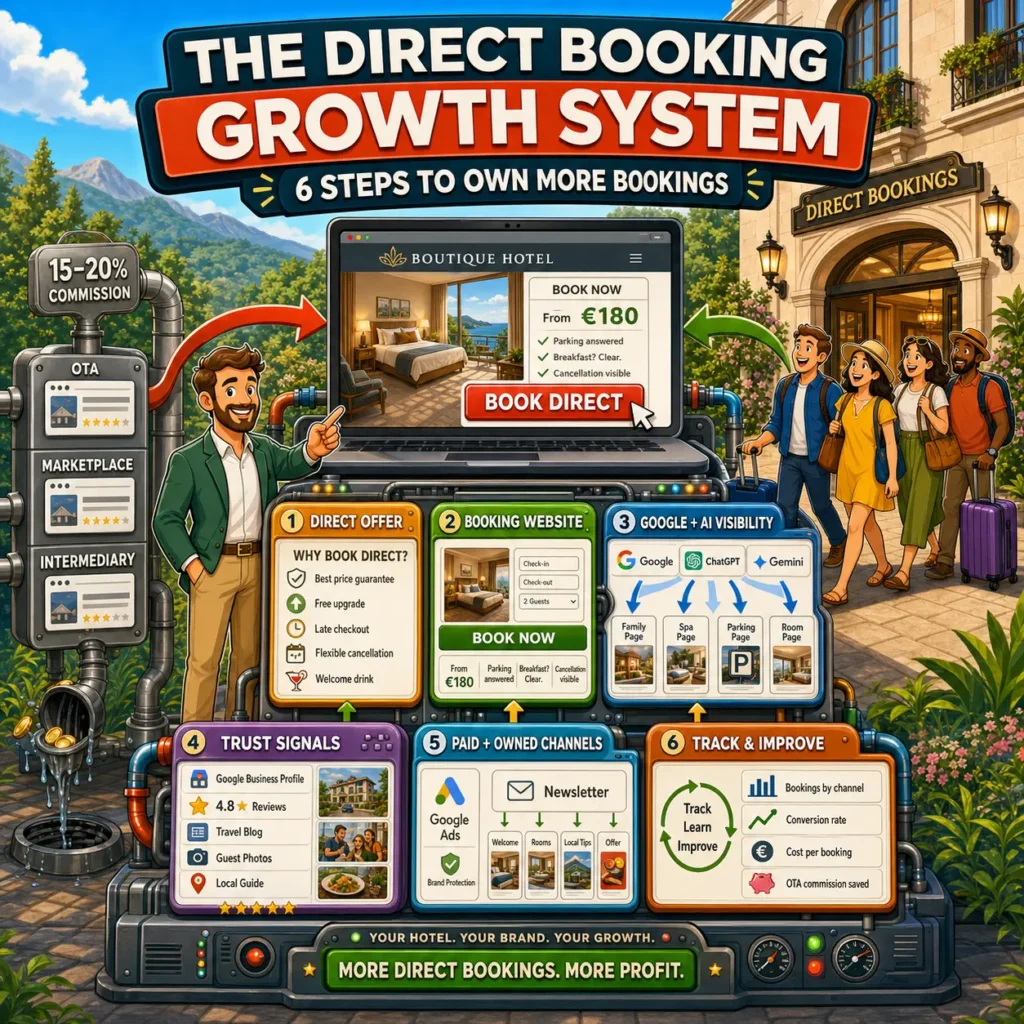
Chapter 3: The Direct Booking Growth System: A 6-Step Framework 🏗️
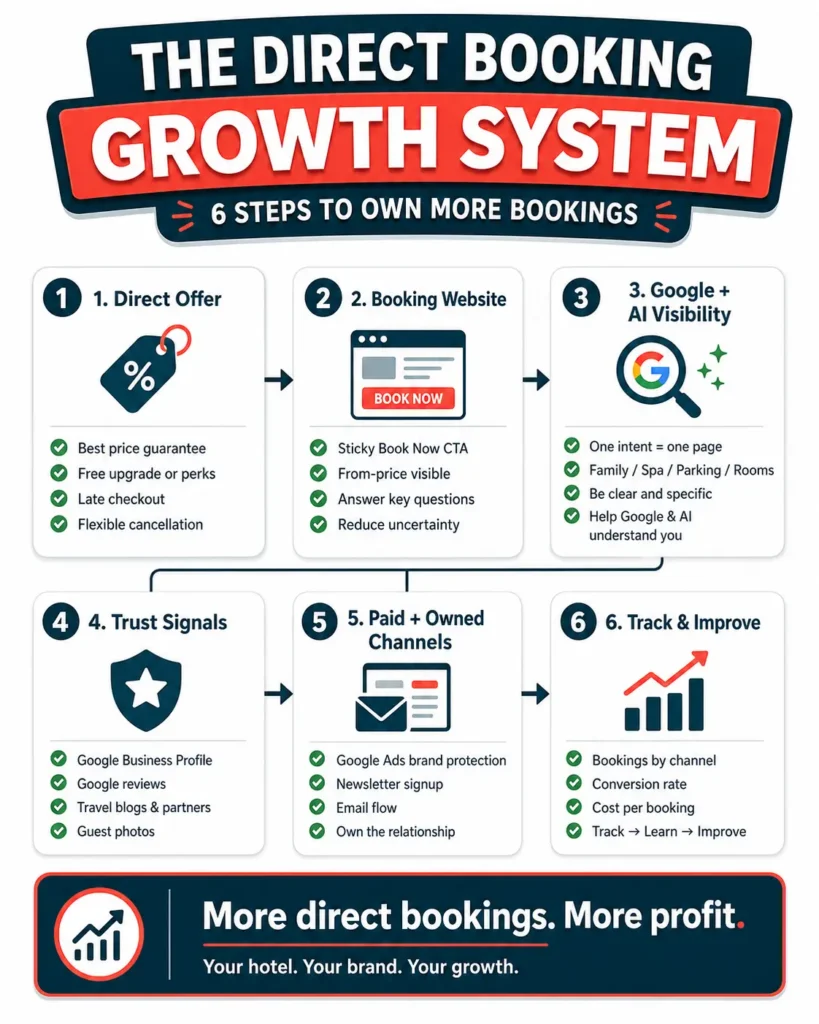
Before we dive into each step, here’s the big picture. Most hotels try steps 4 and 5 first, they run a few Google Ads, open an Instagram account, and wonder why it doesn’t move the needle. The real leverage is in steps 1,2 and 3. Everything else amplifies a strong foundation. Skip the foundation, and you’re pouring water into a leaky bucket.
Here are the five steps of the Direct Booking Growth System:
- Put a strong offer on your hotel website
- Build a conversion-ready website (your booking engine)
- Structure it for search and AI discovery
- Build supporting visibility signals (Google Business, reviews, partners)
- Add controlled traffic channels (Google Ads, Meta Ads, newsletter)
- Create a feedback and optimization loop
Done consistently, these five steps shift bookings away from Booking.com, Expedia, Airbnb, and Hotels.com and toward your own channel, step by step. Let’s go deep on each one.
Chapter 4: Deep Dive: Build Each Element of Your Direct Booking System
Now that we’ve looked at the full direct booking system, let’s break it down into the individual parts.
Because here’s the important thing: you don’t need to fix everything at once. A strong direct booking strategy is built step by step. First, you make your website the best place to book. Then you improve the booking experience. Then you make your hotel easier to find on Google, AI tools, and other channels. And finally, you track what works so you can keep improving.
Think of this chapter as your practical roadmap. Each step gives you one part of the system and one concrete action you can copy today. Then we’ll start where every direct booking strategy should start: your own website.
Step 1: Make Your Website the Best Place to Book 💳
Right now, a guest is comparing two options. Option A: Booking.com or Expedia → familiar, fast, loyalty points, flexible cancellation. Option B: your website. What does your website offer that the OTAs don’t?
If you don’t have a clear answer, that’s your first homework assignment. The good news: you have an enormous advantage that Booking.com can never replicate. You control the offer. You can create incentives that are only available when someone books directly with you. Here are some examples that work:
- Better price guarantee – “Book direct and get our lowest rate. If you find it cheaper elsewhere, we’ll match it and give you a 5% discount.” This also gives you a brilliant signal when a platform is undercutting your prices.
- Better room allocation – “Direct bookers get first choice of room and floor.”
- Free upgrade if available – No cost to you when occupancy allows, but enormously powerful for guests.
- Little extras – A welcome drink, late checkout, a local guide, breakfast included. These feel huge to the guest and often cost you very little.
- Flexible cancellation – If your OTA listing has strict policies, offer more flexibility direct.
A hotel that does this beautifully is Hotel Stadthalle Vienna. They clearly communicate why booking directly with them is better, right on their homepage. You could make this even stronger by adding a price-match guarantee with a commission-based refund. It’s a powerful trust signal.
⚠️ Important: Check your OTA agreements before advertising lower public rates. Many OTA contracts include rate parity clauses that restrict you from publicly offering a lower price on your own website. If that applies to you, no problem → pivot to value-added perks instead of a lower room price. A free breakfast, late checkout, a welcome drink, a room upgrade if available, or more flexible cancellation are all highly attractive to guests and don’t trigger rate parity issues. A guest will often choose the option with more value, not just the lowest price.
Also, think about your returning guests. These are your warmest leads. Contact past guests directly and offer them a loyalty rate or exclusive perk for booking direct on their next stay. No commission. No middleman.
👉 Copy this today: Add a “Why Book Direct?” box to your homepage and booking page. List 3–5 specific benefits. Make it visual. Make it hard to miss.
Step 2: Turn Your Website Into a Booking Engine, Not a Brochure 🖥️
There is a fundamental difference between a brochure website and a booking engine website. A brochure says “here’s how beautiful our hotel is.” A booking engine answers every question a guest has and makes it frictionless to book.
Most hotel websites are beautiful brochures. They have stunning photos. They have a “Welcome to our hotel” intro. But they don’t answer the questions guests actually have: “Is there parking?” “What’s included in the breakfast?” “Is this room good for two adults and a toddler?” “What’s the cancellation policy if I need to change plans?”
Here’s the rule I live by: every unanswered question is a lost booking. A guest who can’t find the answer doesn’t necessarily call you to ask. They close the tab and book somewhere else.
The three elements every high-converting hotel website must have are:
- An always-visible booking CTA – A sticky “Book Now” button that stays on screen as the guest scrolls. Never more than one click away from starting a booking.
- Price transparency – Show a starting price. “From €180 per night.” Guests who see a price are more likely to continue into the booking engine than guests who see nothing and assume it’s expensive.
- Zero uncertainty content – Answer every question that could possibly prevent a booking. Check-in times, parking, pet policy, accessibility, what’s near the hotel, what’s included. All of it.
For your homepage and room pages specifically, I’ve written dedicated guides you can follow:
👉 Copy this today: Open your website on your phone. Can you find the “Book Now” button without scrolling? Can you see a price? Can you find the cancellation policy in under 30 seconds? If not, fix those three things first.
Step 3: Make Your Website Visible on Google and AI Search 🔎
Here’s a mindset shift that changes everything: you don’t rank as a hotel. You rank for specific problems.
When someone searches Google, they’re not typing “find me a hotel.” They’re typing things like:
- “hotel with rooftop near Vienna city center”
- “quiet boutique hotel for couples Vienna”
- “family hotel near Prater with parking”
- “hotel good for remote work Vienna”
Each of these is a specific search intent. And each one deserves its own dedicated page on your website that directly answers that search. This is the same strategy OTAs use with their thousands of pages and you can do it too, at a smaller scale, for your specific positioning.
I analyzed over 1,000 hotel search results in a case study, and the pattern was clear: hotels that rank on Google are the ones that have clearly communicated what they are, who they’re for, and where they’re located. I’ve done this in multiple places, with consistent language. Not once. Consistently, across their homepage, room pages, location page, and supporting content.
This same logic now applies to AI search tools like ChatGPT, Gemini, and Perplexity. These tools don’t guess what your hotel is like. They summarize what you clearly communicate. If your website is vague, AI tools will skip you. If it’s specific and well-structured, AI tools will recommend you.
There’s one key rule to understand about AI discovery: AI tools need repeated, consistent signals across multiple sources. If your website calls you a “quiet boutique hotel,” your reviews mention “peaceful atmosphere,” your Google Business photos show a cozy breakfast setup, and travel blogs describe your Spittelberg location → AI has high confidence recommending you for exactly those searches. The more consistently all your sources reinforce the same story, the more trust AI places in your positioning. It’s not enough to say it once. You need to say it everywhere and have others confirm it.
A great example: when I asked ChatGPT to recommend a quiet boutique hotel with a good breakfast, it recommended a Vienna hotel that clearly positions itself exactly that way on their website and whose guest reviews consistently confirm it. AI doesn’t guess. It summarizes what you clearly communicate.
Start with your positioning (what makes your hotel unique and who it’s for), then structure your website to make that clear to both humans and search engines. I’ve written a full guide on both:
- How to position your hotel for Google and AI
- How to structure your hotel website for maximum visibility
👉 Copy this today: Write down five specific things guests love about your hotel. Then check if those exact things are written clearly on your website. If not, add them.
Step 4: Build Supporting Visibility Signals 📣
Set Up and Optimize Your Google Business Profile
If you haven’t set this up yet, stop reading and do it now. Google Business Profile is one of the most powerful free tools available to any hotel. When guests search for hotels in your area, Google shows a “local pack” → a map with listings. Hotels with strong Business Profiles show up there. Hotels without them don’t.
What makes a strong profile? Keep it fully up to date with your address, phone, website, and hours. Add rich photos of your interior, exterior, rooms, breakfast, and staff. Photos are one of the biggest trust factors in local search. Fill in the Q&A section, which is an underused but powerful SEO and AI signal. And critically: make sure your category is set correctly (Hotel, Boutique Hotel, etc.).
Having a Business Profile also means you start collecting Google reviews, which brings us to the next point.
Collect Reviews Outside of OTAs 🌟
Right now, if a guest wants to read reviews about your hotel, they probably go to Booking.com, Expedia, or TripAdvisor. That’s a problem, because it sends them into the OTA ecosystem where they’ll also see your competitors. Google reviews break that pattern.
When you have strong Google reviews, potential guests can see social proof without ever visiting an OTA. Encourage every guest to leave a Google review after their stay. Send a follow-up email with a direct link. It takes ten seconds and makes a huge difference.
One more tip: when you reply to reviews, use natural language that reinforces your positioning. If someone says “the room was so peaceful,” reply with something like “We’re so glad you enjoyed the quiet atmosphere, that’s something we really pride ourselves on here.” You’re using reviews as an SEO and AI signal, not just a customer service moment.
Partner with Travel Blogs and Tourism Websites 📰
Here’s a channel most hotels completely ignore: travel bloggers and tourism websites that already rank on Google. When someone searches “best boutique hotels in Vienna,” they often click a travel blog, not a hotel website. Getting featured in those articles gives you what I call borrowed visibility.
An example: The Travel Tortoise’s guide to boutique hotels in Vienna appears prominently in Google results. Being listed there gives you credibility, trust, and a new discovery channel.
How do you get listed? Reach out to relevant bloggers and tourism sites. Offer them a small commission on every booking they drive. This way, you only pay when you get a result, just like an OTA but often at lower rates. Always make sure they include a direct link to your website, not just a mention. That link is important for both SEO and for giving guests a direct path to your booking engine.
For SEO and AI discovery (GEO), those inbound links also strengthen your website’s authority in the eyes of both Google and AI tools.
Optional: Shoot Some Videos 🎬
If you enjoy making content and want to learn a new skill, creating short videos about your hotel and the surrounding area can bring in organic discovery from people looking for travel inspiration. Post them on YouTube, your website, and wherever your guests spend time online.
The key is providing unique value. So, in addition to a hotel tour, create videos about genuine local tips, hidden gems nearby, and seasonal events. Think about what a guest would want to know before their trip, and create that content. Don’t force this if it’s not fun for you. But if it is, it’s a free channel with real long-term payoff.
Step 5: Add Paid and Owned Traffic Channels 💰
Use Google Ads — But Do This First
Most independent hotels either don’t use Google Ads at all, or they throw money at broad keywords like “Hotel Vienna” and wonder why it’s so expensive with zero return. Smart Google Ads for hotels is about being narrow, not broad.
Before you run any ads, get your positioning right (use the guide linked above). Then target keywords that match your specific positioning: “boutique hotel Spittelberg Vienna,” “quiet hotel with parking Vienna 1st district,” “romantic weekend Vienna adults only.” These are cheaper keywords with higher conversion intent.
But there’s one thing that is non-negotiable: bid on your own hotel name. Every day, OTAs are running ads on your hotel name. When someone searches “Hotel [Your Name],” they already want to book with you, but potentially Booking.com shows up above your own website. You pay commission on that booking. Bidding on your own name costs very little and protects the guests who are already yours.
If you’re new to Google Ads, Google offers free support to set up your first campaign. Use it.
👉 Copy this today: Go to Google and type your hotel name. Does Booking.com appear above your own website? If yes, set up a brand protection campaign this week.
Build a Newsletter Flow That Converts 📧
Not every guest is ready to book the first time they visit your website. A newsletter gives you a second chance without paying anyone a commission.
Add a newsletter signup to your website with a clear incentive. Something simple works well: “Subscribe and get a 5% discount on your first direct booking.” Or “Get our insider guide to [your city] + exclusive member rates.”
Then build an automated email sequence that goes out to every new subscriber over the next few weeks:
- Email 1: Welcome + what makes your hotel special (your USP in 3 sentences)
- Email 2: A closer look at your rooms and the experience
- Email 3: Local area tips — your favorite restaurants, hidden spots, seasonal events
- Email 4: A special offer or incentive to book
This sequence works while you sleep. Once it’s set up, every new subscriber goes through it automatically. And unlike OTA bookings, you now have a direct line to that potential guest.
Step 6: Track Everything and Improve What Works 📊
This is the step most hotels skip, and it’s the one that turns all of the above from “things I tried once” into a real competitive advantage.
The simple truth: most hotels don’t need more traffic. They need to know what already works. And the only way to know that is to track it.
Here’s a simple framework to start with:
- Discovery — How are people finding you?
- Which channels drive traffic to your website? (Organic search, Google Ads, travel blogs, direct?)
- What % of bookings come through each channel?
- Conversion — Are they booking?
- What is the conversion rate from website visitor to booking?
- Where are people dropping off? (Which pages have high exit rates?)
- Positioning — Are you attracting the right guests?
- Do the guests who book describe your hotel the way you position it?
- Are they happy with what they found?
- Channels — What’s your cost per booking on each channel?
- Google Ads cost per booking vs. OTA commission rate → which is cheaper?
Start with Google Analytics and Google Search Console. Both are free and take less than an hour to set up. Once you have data, you can make decisions based on evidence instead of gut feel. That’s when the flywheel really starts turning.
Want more practical ideas like this?
I share one actionable hotel growth idea every week – focused on SEO, AI, and direct bookings on Substack.
Chapter 5: Real-World Examples: Hotels Getting This Right ✅
Let me share five hotels from my research that I genuinely admire for executing this framework well.
Example 1: Showing Up in Google Local Results
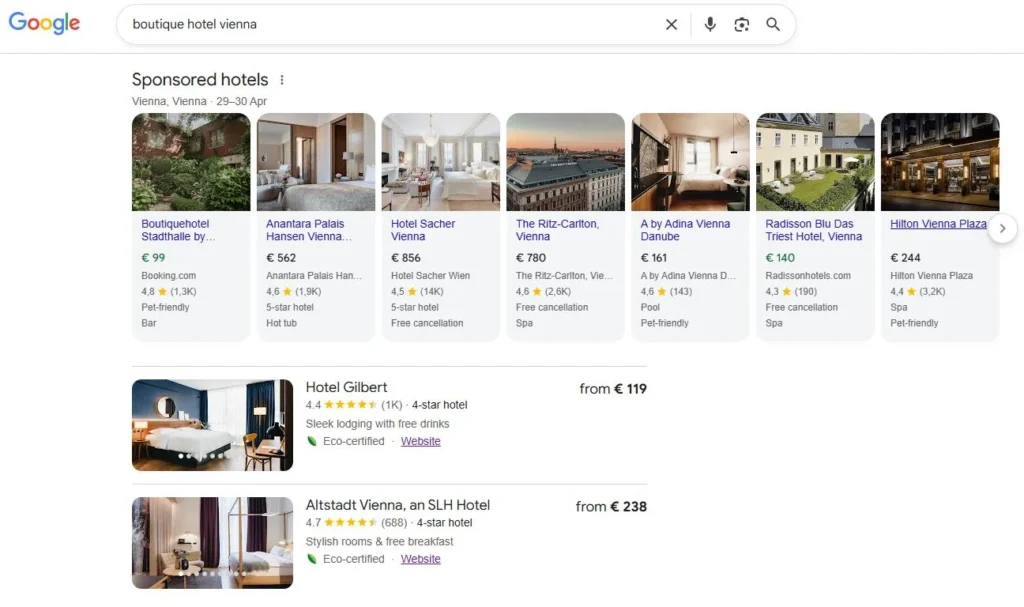
When you search for hotels in a specific Vienna neighborhood, you see a local map pack at the top of Google results. The hotels that appear there have done their homework: a complete and rich Google Business Profile, a strong review score, and consistent NAP (name, address, phone) information across the web. Some are also running Google Ads to guarantee their visibility. What you can copy: set up your Google Business Profile today, add 20+ photos, and actively collect Google reviews from every guest.
Example 2: Boutique Hotel SPIESS & SPIESS — A Hotel Recommended by ChatGPT 🤖
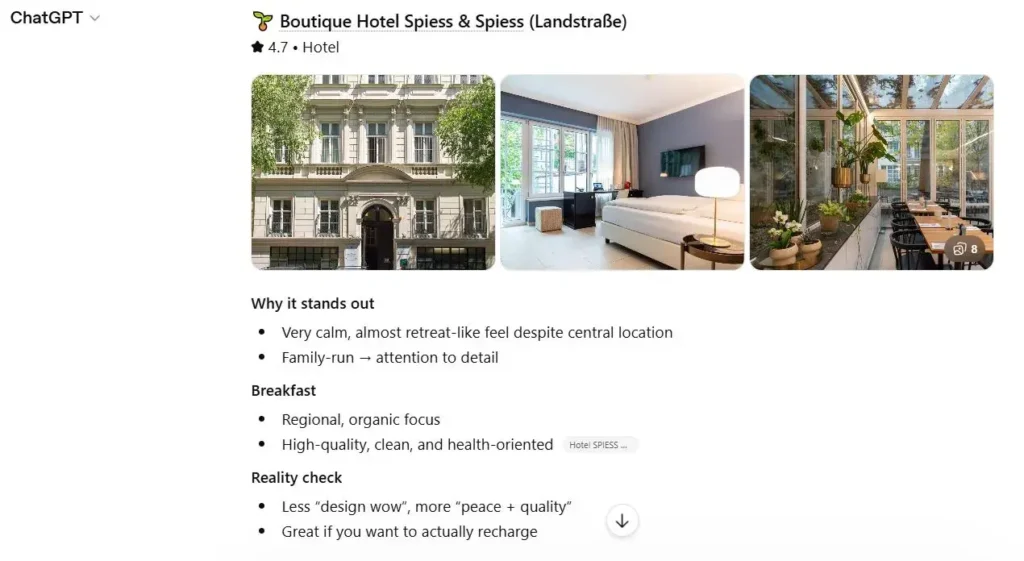
I tested this personally. I asked ChatGPT: “Can you recommend a quiet boutique hotel in Vienna with an excellent breakfast?” It recommended Boutique Hotel SPIESS & SPIESS to me. Why that one? Because their website clearly and repeatedly describes the hotel as quiet and boutique-style, and they have a dedicated section on their breakfast. Guest reviews across multiple platforms confirm it. ChatGPT summarized that consistent signal and served it up as a recommendation.
What to copy: Define your two or three strongest positioning claims. Make sure those exact qualities are mentioned on your homepage, your room pages, your about page, and reflected in your guest reviews. Then AI will find you and recommend you.
Example 3: Hotel Stadthalle — Direct Booking Done Right
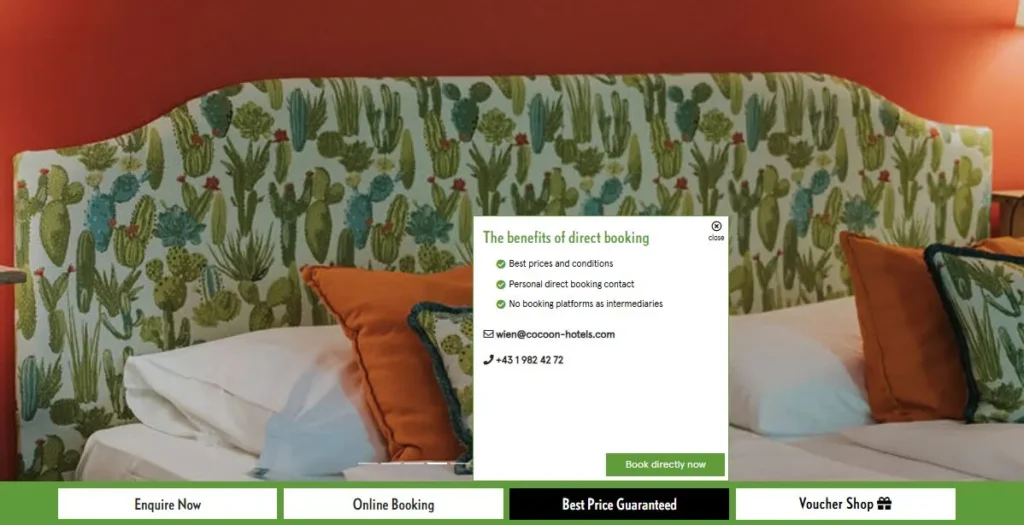
Hotel Stadthalle puts their direct booking benefits front and center. You see it immediately on their website: here’s why you should book with us directly, and here’s what you get. Clear, visual, compelling. You could take this further with a price-match guarantee: “If you find a cheaper rate for the same dates anywhere online, we’ll match it and give you an extra 5% off.” This protects your rate parity, builds trust, and gives you useful market intelligence when a platform is undercutting you.
What to copy: Create a “Why Book Direct?” section and put it on your homepage and booking page. Make it specific. Three to five concrete benefits, clearly written.
Example 4: The Travel Tortoise — Borrowed Visibility from a Travel Blog
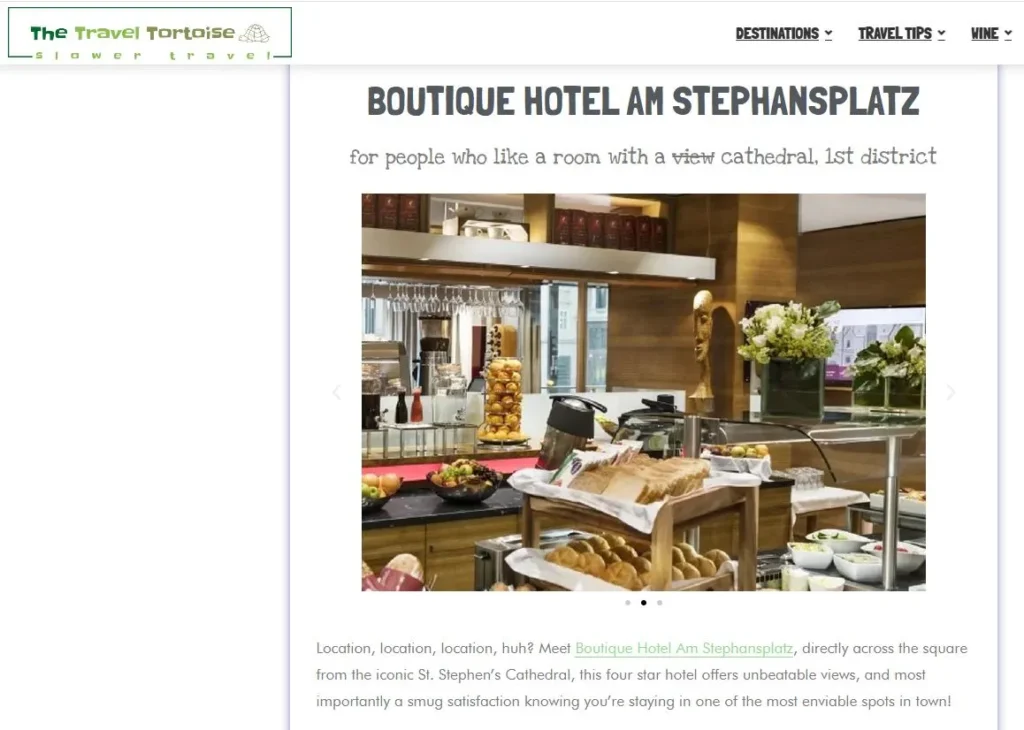
This article from The Travel Tortoise ranks on Google for “best boutique hotels in Vienna.” Someone searches that phrase, clicks the article, sees a curated list of hotels, and clicks through to one. Being on that list is a discovery channel that costs you nothing upfront (or a commission only when you get a booking). It also builds credibility — a third-party endorsement carries weight.
What to copy: Search for “best hotels in [your city]” and “top boutique hotels in [your area].” Find the blogs and guides that rank on page 1. Reach out to them. Offer a commission model or a one-time fee to be included. Always make sure they link to your website.
Example 5: Miiro Spittelberg — Winning Local Search with Content Strategy
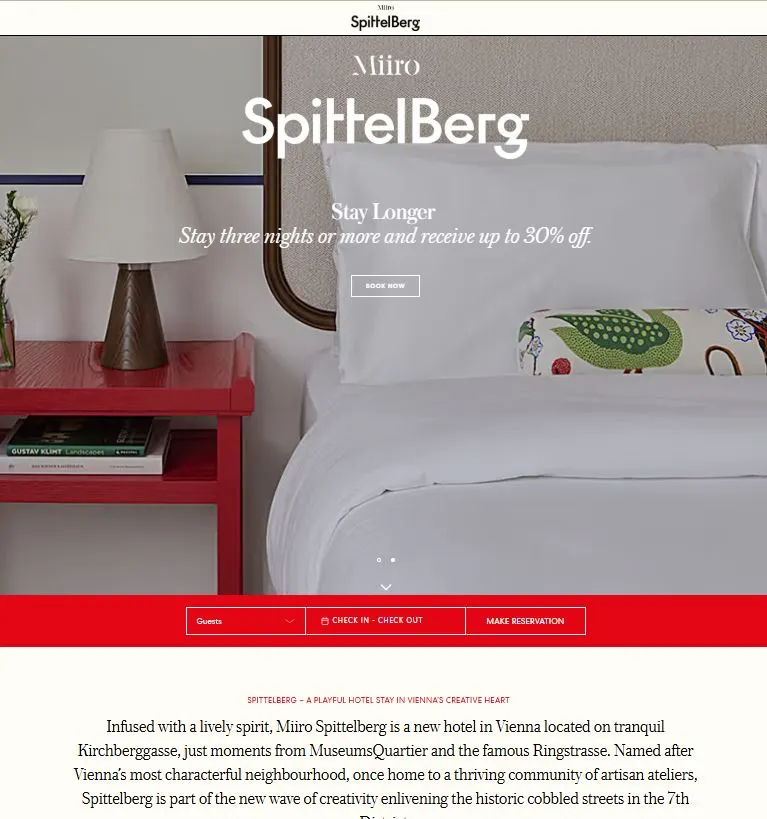
Miiro Spittelberg is a great case study in how to win local search even as a newer or rebranded property. They clearly position this hotel within its specific neighborhood – Spittelberg – across their homepage, room pages, and local content. They describe their rooms and restaurant in detail. They answer questions about what makes the location special. As a result, they rank for Spittelberg-related searches across multiple audiences, including for search categories where nearby competitors are simply not showing up.
What to copy: Identify your immediate neighborhood, nearby landmarks, and local attractions. Make sure those are mentioned naturally and frequently across your website content. Be the most informative resource about your local area for potential guests.
I break down real hotel strategies like this every week
Connect with me on LinkedIn for short, practical tips and ideas based on real examples.
Chapter 6: The Direct Booking Growth System: Your Quick-Start Checklist ✔️
Go through these in order. Each one you complete moves more bookings toward your own channel.
1. Discovery — Are people finding you?
☐ Do you have Google Analytics installed on your website?
☐ Is Google Search Console set up so you can see which searches bring people to your site?
☐ Do you know what % of bookings come from each channel (OTAs, direct, Google Ads, referrals)?
☐ If more than 50% come from OTAs, your priority is building direct discovery channels (continue in the checklist)
2. Conversion — Are visitors booking?
☐ Is there a sticky “Book Now” button visible at all times on your website?
☐ Does your website show a starting price?
☐ Are all the common guest questions answered on your website (e.g. how to get there, parking, breakfast, cancellation, accessibility)?
☐ Does your website work well on mobile (open it on your phone and try to book)?
☐ Does you offer popular payment methods? Do they work in the country of your guests?
3. Positioning — Do you clearly stand for something?
☐ Can you describe your hotel in one sentence that includes who it’s for and what makes it special?
☐ Is that description on your homepage, room pages, and Google Business Profile?
☐ Do your guest reviews use the same language you use to describe your hotel?
4. Channels — Are you using the right ones?
☐ Is your Google Business Profile complete with photos, categories, and Q&A?
☐ Are you actively collecting Google reviews from every guest?
☐ Are you bidding on your own hotel name in Google Ads?
☐ Do you have a newsletter with at least 3 automated emails for new subscribers?
☐ Have you reached out to any travel blogs or tourism websites about being featured?
5. Tracking — Are you learning and improving?
☐ Do you review your channel performance at least once a month?
☐ Do you know your cost per booking on each channel vs. OTA commission?
☐ Do you ask guests how they found you?
Your First 30 Days: A Week-by-Week Action Plan 🗓️
The checklist above tells you what to do. This plan tells you when. If you implement only this over the next month, you will already be ahead of the vast majority of independent hotels.
Week 1 — Fix Your Foundation
- Add a “Why Book Direct?” section to your homepage and booking page with 3–5 specific benefits
- Make sure your “Book Now” button is visible at all times (sticky or in the header)
- Add a starting price (“from €X per night”) somewhere visible on your homepage
- Check your website on mobile: is everything easy to find and click?
Week 2 — Build Your Discovery Base
- Set up or update your Google Business Profile: correct category, complete description, 20+ photos
- Set up Google Search Console (free, takes 30 minutes) so you can track which searches bring you traffic
- Start actively asking every guest to leave a Google review — set up a follow-up email with a direct review link
Week 3 — Start Your Traffic Channels
- Set up a brand-name Google Ads campaign for your hotel name (this is non-negotiable — stop OTAs from poaching your brand searches)
- Add a newsletter signup to your website with a simple incentive
- Write your first three automated emails for new subscribers and schedule them
Week 4 — Build Your Visibility Network
- Search for “best hotels in [your area]” and identify 5 travel blogs or tourism websites that rank on page 1
- Send personalized outreach to 2–3 of them proposing a commission or feature arrangement
- Review your Google Analytics or channel manager data: where are your bookings actually coming from?
By the end of day 30, you’ll have a stronger website, active discovery signals, brand protection on Google, and a newsletter system running. All will be working for you 24 hours a day, without paying a cent in commission. 🎯
Chapter 7: Connect to the Bigger Strategy: The Direct Booking Flywheel 🔄
Here’s how I want you to think about all of this. Not as a list of tasks, but as a flywheel that builds momentum over time.
Discovery → Booking → Great Experience → Review → More Discovery
Before anything else, let’s set a realistic target. A healthy direct booking strategy does not mean 100% direct bookings. That’s not realistic, and honestly not even desirable. OTAs will always serve a role in reaching new audiences. But for most independent hotels, moving from 20% direct bookings to 35–45% direct can already have a dramatic impact on annual profit. Every percentage point of shift means commission savings that go straight to your bottom line. That’s your benchmark. Not perfection, but having a meaningful, compounding progress.
It starts when a guest finds your hotel through Google, through AI, through a travel blog, through a friend’s recommendation. They visit your website, which is a true booking engine: clear, confident, and easy to use. They book directly. They arrive. You deliver exactly what you promised (or better). They leave a Google review. That review strengthens your positioning for the next guest who searches the same thing. The flywheel turns.
This is why I believe so strongly that your hotel’s discovery and customer acquisition should not live on rented land. It should belong to you. OTAs are a tool, not a strategy. The goal is not to eliminate Booking.com, Expedia, or Hotels.com from your channel mix. The goal is to make them a supporting channel instead of your dominant one. When you own the relationship, you own the growth and you compete on experience rather than price.
Having a lower variable marketing cost per booking also means you can invest more in the thing that drives the whole flywheel: the experience. Better experiences drive better reviews. Better reviews drive better discovery. You don’t need to compete on price. You compete on value, and you can afford to deliver it.
This is the cycle I want you to build: consistently fill your hotel with guests, give them more than they expected, and watch the system compound over time. It works. I’ve seen it happen with hotels that started with almost no direct traffic, and within 12 months were generating a meaningful share of their bookings from their own channel.
You can do this. The tools exist, the strategy is clear, and the guests are already searching for exactly what you offer. Let’s make sure they find you. 💪
Chapter 8: Your Next Steps: Where to Start on patricklindbichler.com 🔗
All the tools, guides, and resources you need to implement this system are here:
Start with your website foundation:
- How to build a hotel homepage that converts
- How to write room descriptions that drive direct bookings
Then make your website discoverable:
Conclusion: How to reduce dependency on Booking.com
Reducing your dependency on Booking.com is not a battle you fight overnight. But it is absolutely a battle you can win one step at a time.
The hotels that succeed at this share a common mindset: they treat their website as their most important sales channel, not an afterthought. They invest in being found through search, through AI, through travel blogs and reviews. They make booking directly clearly better than booking through an OTA. And they track what works so they can do more of it.
You already have the most important ingredient: a real hotel, with a real story, and real guests who chose you. Now let’s make sure the next round of guests can find you without giving 15–20% to Booking.com, Expedia, or Hotels.com.
If you have questions about any of the steps above, want to discuss your specific situation, or just want to talk hotel strategy. Reach out directly through patricklindbichler.com. I’d love to help. 🙌
If you found this helpful and want more ideas like this:
👉 Follow me on Substack for deep-dive guides on hotel SEO, AI, and direct bookings
👉 Connect on LinkedIn for shorter insights and real-world examples
FAQs on How Hotels Reduce Dependency on Booking.com
1. How long does it take to see results from improving my direct booking strategy?
The honest answer: it depends on where you start. Quick wins, such as adding a “Why Book Direct?” section, setting up a Google Business Profile, or launching brand protection ads, can show results within weeks. SEO improvements typically take 3–6 months to show meaningful movement in rankings. Newsletter flows start compounding as your subscriber list grows. Think of this as a 12-month project, not a 12-day fix. The hotels that commit to it consistently see the most dramatic shifts in their booking mix.
2. Is it worth competing with OTAs on Google Ads?
Competing with OTAs on broad keywords like “Hotel Vienna” is indeed very expensive and rarely worth it for independent hotels. But that’s not the right game to play. The smart approach is bidding on niche, positioning-specific keywords (“romantic boutique hotel Vienna 1st district”) and, most importantly, bidding on your own hotel name. Brand keyword campaigns cost very little and protect you from OTAs poaching guests who were already looking specifically for you.
3. What should I prioritize first if I have limited time?
In this order: (1) Make sure your website answers every guest question and has a clear, visible booking CTA. (2) Set up Google Business Profile with rich photos and start collecting Google reviews. (3) Add a newsletter opt-in with a simple incentive. (4) Bid on your hotel name in Google Ads. Those four steps alone can meaningfully shift your booking mix, and most can be done within a few weeks.
4. How do I get travel blogs to feature my hotel?
Start by identifying which blogs and articles rank on Google for searches relevant to your area (e.g., “best boutique hotels in [your city]”). Then reach out with a clear, personalized message — introduce your hotel, explain why it’s a great fit for their audience, and propose either a commission arrangement (e.g., 10–15% per referred booking tracked via a unique link) or a one-time feature fee. Most bloggers are receptive, especially if the commission model means they only earn when they deliver results. Always insist on a direct link to your website — not just to your OTA listing.
5. Can this strategy work for hotel chains, not just independent hotels?
Absolutely. In fact, hotel chains often have a significant advantage here — more content, more budget, more data, and an existing brand that guests already search for. The same principles apply: clear positioning per property, location-specific pages, Google Business Profiles for each hotel, and a direct booking incentive that makes the brand’s own website the best place to book. For chains, the big additional opportunity is building a loyalty program or newsletter that brings guests back across all properties — turning one-time visitors into brand advocates.
6. Can I offer a cheaper price on my own website than on Booking.com?
It depends on your OTA agreements and local rules. Many hotels should be careful with public lower rates. A safer approach is to offer value-added direct booking benefits such as late checkout, breakfast, upgrades, welcome gifts, or more flexible cancellation.
The Prompt used To Create this article
I want to be transparent on how this article was written, so below you will find the prompt to create this article. Of course, I asked for adjustments afterwards, but here is the initial input:
Check the prompt
Can you create a compelling blog article for my website, www.patricklindbichler.com? I will first give you a full outline of my draft for the article, so you have the full context. Then we will create each section together step-by-step. So, no need to start writing, just give me feedback on the ideas of the draft and where you would see good additions or improvements.
I want to make the articles a bit longer, so people can find clear information. The article should be clear and easy to understand, especially for people who are new to the topic. It should be written in good American English, using not too complicated words so that even non-native English speakers can follow along easily. Avoid too long sentence structures and avoid sentence structure with a -. The tone should be motivational like Alex Hormozi, that when you put in the effort, you will get ahead of OTAs and other hotels. Feel free to use examples from my experience as proof points and explain them in a clear and compelling way.
I am typically a positive and humorous person, so the writing style can be upbeat with a few lighthearted jokes here and there—just nothing offensive. The article should be motivating, practical, engaging, fun to read, and educational. Please follow the structure outlined below, and feel free to expand on the points with additional context to ensure that each paragraph presents clear arguments.
Introduce hooks throughout the artice so people stay engaged.
Structure of the article:
- Introduction or The Problem (Hook): Start with a paragraph that summarizes the topic and grabs attention. You can make a strong statement or ask a thought-provoking question that will be answered later in the article. Make sure people are hooked.
- Key Highlights (3-5 bullet points): Include a few short bullet points summarizing the key takeaways of the article. Each point should be 1-2 sentences long.
- Main Content: Break the main part of the text into several text parts, each with a heading optimized for SEO and AI search. Each text part can have 1-3 paragraphs with 5-20 sentences each, depending on how much content is needed to explain the point clearly and bring the argument across. The paragraphs should be easy to read and compelling. Here is a structure for the main content:
- Explain Why the Problem Exists
- The Framework / Solution
- Deep Dive into Each Element
- Practical Examples
- Quick Checklist
- Connect to the Bigger Strategy
- Internal Links (Very Important)
- Headlines: Please formulate the headlines and include important keywords for SEO.
- Conclusion: Wrap up the article by summarizing the main points and inviting readers to reach out if they have any questions or want to learn more.
- FAQs: Include 5 frequently asked questions about the topic, with clear answers that add value to the reader.
Take this article as a rolemodel for structure: https://patricklindbichler.com/hotel-website-positioning-for-seo-ai/
Formatting:
- Use bold for key points,
- Add emojis throughout (but no more than 50 total) to make the article more visually appealing.
- Please make the article clear, but still deliver ideas to the point. Feel free to ask me if you need more input or add information and context where you feel it’s necessary to convey a message or provide more clarity.
Goals:
- Please optimise the article for SEO. Give recommendations for search terms to include and integrate them into the titles of the paragraphs and the beginning of the article
- Please make the article engaging so people are intrigued to read, but also enjoy reading.
- What readers learn in the article, should be easy to apply for them because everything is explained clearly and has examples
Overall Strategic Improvements for the draft I’m sending you:
Here are the biggest upgrades I’d push you to implement:
- Add more “mental models”
People remember:
- Booking engine vs brochure
- Owned vs rented customer
- One intent = one page
- Add more “copy this” moments
Every section should feel like:
👉 “I can do this today”
Please use the following input to create the article:
Title: How Hotels Can Reduce Dependency on Booking.com
- The Problem (Hook)
When you found this article, you probably own a hotel or a holiday apartment and most of your online bookings are coming from OTAs like Booking.com, Expedia etc.
That’s not necessarily bad, because it means you built an OTA channel successfully. You attract guests and your hotel is booked. That’s a good starting position. What you want to do is to reduce your marketing spent aka pay less commission.
So let’s focus on increasing the share of your own online channels. There is a number of ways to ensure that your hotel website gets discovered and booked, if you take the right steps. We’ll build your website in a way, so it gets discovered on Google and AI, add low cost channels to get even more traffic on your website. They key is that your website becomes a booking engine.
This is what we’ll do in this article.
Add: Make the cost of the problem more tangible
- 👉 Add a simple mental math example:
- “If you pay 15–20% commission on Booking.com, every €1,000 booking costs you €150–€200.”
- “If 70% of your bookings come from OTAs → you’re giving away a large part of your profit.”
- 👉 Add a contrast:
- OTA booking = rented customer
- Direct booking = owned customer
- 👉 Add a “hidden downside”:
- You don’t own the relationship
- You can’t easily re-market to guests
- You compete on price instead of experience
- 👉 Add a short “aha moment”:
- “Most hotels don’t have a traffic problem. They have a conversion + discovery structure problem.”
(This aligns perfectly with your playbook)
- “Most hotels don’t have a traffic problem. They have a conversion + discovery structure problem.”
- Explain Why the Problem Exists
The challenge seems big: You have on the one hand the big OTAs like Booking.com, Expedia and co who appear everywhere on Google and AI. Plus guests naturally search there. They have huge budgets and it seems incredibly difficult to compete.
On the other hand, you have little support. There are either expensive agencies or confusing website builders, none of them really show you how to build a hotel website, that actually drives bookings and revenue, and not just looks good. And there is all this other advice like do Social Media, work with Influencers, … which complicate things further.
What you end up with is a nice website, potentially an Instagram account that requires a lot of effort, but still, most bookings are coming from Booking.com.
Now I’ll share steps with you, on how you can attract bookings outside of OTAs. Besides point 10, I sorted them by importance. Point 10 then brings them all together.
Add 3–4 clear root causes:
- OTAs win on intent matching
- They have pages for every combination (location + feature + audience)
- Hotels usually have 5–10 pages → OTAs have thousands
- Hotel websites are built like brochures
- (You already mention it → strengthen it with examples)
- “Nice images, but no answers”
- No clear positioning
- “If you try to be everything → you rank for nothing”
- No dedicated pages for search intents
- Key concept from your playbook:
- 👉 “One search intent = one page”
- No feedback loop
- Hotels don’t track:
- where guests come from
- why they booked
- why they didn’t
- Hotels don’t track:
👉 This section should make the reader think:
“Okay, this is not random. There is a system behind it.”
- The Framework / Solution
To reduce your dependency on OTAs, invest in the following steps:
- Make your website the best alternative to book your hotel online
- Position your website for discovery on search engines and AI
- Add supporting content (Google MyBusiness, Reviews, Social Media) to get discovered
- Add supporting channels (Google Ads, Meta Ads, Newsletter) to get discovered and reactivate previous guests
- Track your channels and constantly improve
By doing those 5 steps consistently, you can constantly increase the share of people booking through your website and decrease the dependency on Booking.com, Expedia and co. In the next chapter we go into further detail how this can look like.
Add: Name your framework (important for memorability)
👉 Example:
“The Direct Booking Growth System”
Then slightly tighten the steps:
- Build a conversion-ready website (booking engine)
- Structure it for search & AI discovery
- Build supporting visibility signals
- Add controlled traffic channels
- Create a feedback + optimization loop
Add one key line:
👉 “Most hotels try step 3–4 first. The real leverage is in step 1–2.”
- Deep Dive into Each Element
Make your website the better alternative
- Have the best offer on your website – Booking.com has attractive deals and Genius points, but you can make booking on your website more attractive. Offer special rates, extra services, little bonuses, … Just some things that makes booking on your website more appealing for guests. Also approach recurring guests and offer benefits if they contact you directly for their next booking
- Add: “Why should I not book on Booking.com?” section
- 👉 Suggest hotels explicitly answer this on their website:
- Better price guarantee
- Better room selection
- Extra perks
- Flexible cancellation
- Add: “Direct booking triggers” (super powerful)
- “Only available when booking directly”
- “Best room allocation”
- “Free upgrade if available”
- Turn your website into a booking engine – This is the key. I have written a lot of guides on how to turn your website into a booking engine and how guests actually book. Start with the guides on how to set up your homepage and room pages, as those are the key conversion elements. Make sure you always have buttons visible for people to book and provide all the answers to potential questions.
- Add: 3 must-have elements
- Always visible booking CTA (sticky button)
- Price transparency (“from €180 per night”)
- Zero uncertainty content
- 👉 Reinforce your core belief:
- “Every unanswered question = a lost booking.”
- Make your website visible on search engines (Google, Bing, etc.) and AI (ChatGPT, Gemini, Perplexitiy, …). Also here I’ve written some guides. Start with how people search and how to structure your website. I’ll also show you a trick on how to imporve the performance of your website with the help of AI in chapter 4.
- Add: One very clear mental model
- 👉 “You don’t rank as a hotel. You rank for specific problems.”
- Examples:
- “hotel with parking”
- “hotel near museum”
- “quiet hotel for couples”
- Add: AI angle (important differentiation)
- AI tools recommend:
- clear positioning
- consistent signals
- supporting reviews
- 👉 Add line:
- “AI doesn’t guess. It summarizes what you clearly communicate.”
Add supporting content (Google MyBusiness, Reviews, Social Media)
- Create a Google MyBusiness profile – Yes this is key in the discovery of your hotel. Google and the AI Mode reference often hotel in the local section. Make sure your profile is up-to-date and rich in content. There’ll be a guide on this website at some point.
- Add:
- Categories matter
- Photos = huge ranking factor
- Q&A section → underrated SEO/AI signal
- Collect reviews outside of OTAs – Collect reviews on Google for instance, so potential guests don’t necessarily need to check booking.com to see reviews about your hotel
- Add:
- Use keywords in replies:
- “We’re glad you enjoyed your quiet room”
- Reviews reinforce positioning
- Partner with Blogs and Tourism – Ask websites that appear in search to feature you, maybe you can offer them a small commission on every booking. This might cost you something, but probably less than paying an OTA.
- Add:
- “They rank → you get borrowed visibility”
- Think of them as “SEO partners”
- Shoot some videos – Only if you have fun with it and want to learn the skill of video shooting and editing, then shoot some videos about your hotel and the area. Put them on your YouTube and your Website, potentially other social platforms, so people looking for some inspiration for your area might come across them. Think of how you can provide some unique value to them
Add supporting channels (Google Ads, Meta Ads, Newsletter)
- Use Google Ads – I see hotels barely using this, but compared to commissions, this could be a low-budget way to attract customers. The key is to set the keywords as narrow as possible. Don’t go for Hotel + YOUR LOCATION, this will be very expensive. Go for something that fits the position of your hotels and is more niche and target. Read my positioning article first and then position your website clearly. If you are new, Google offers support in setting up ads. What you for sure should do is bid on your own brand (=hotel name). Those people already want to book with you, so get them on your website.
- Add:
- “Brand protection is non-negotiable”
- You compete with OTAs on your own name
- Send newsletters – Some guests are not ready to book, when they visit your website. Give them the option to subscribe to your newsletter with an incentive (e.g. get 5% discount when subscribing). Prepare 5 emails that you send to every guest over the next weeks so you are top of their mind when booking.
- Improve clarity:
- Add example flow:
- Email 1: Welcome + USP
- Email 2: Rooms & experience
- Email 3: Area tips
- Email 4: Offer / incentive
- 👉 Make it feel actionable.
Track your channels
- Last and very important – Track how guests discovered and booked with you. This way you get an overview which channels work for you, what it costs you to maintain them and then you can learn and improve plus focus on what works
- Add: Simple KPI framework
- Track:
- Traffic source
- Conversion rate per channel
- Cost per booking
- 👉 Add insight:
- “Most hotels don’t need more traffic. They need to know what already works.”
- Practical Examples
Example of Local Results on Google
Those hotels set up a clear Google Business Profile and therefore they show up on top of the local searches. In the first row you see hotels that use Google Ads to be shown, the 2 below Hotel Gilbert and Altstadt Vienna are recommended to me. That doesn’t mean they are recommended to everyone, because the search is personalised. But when you have a business profile, you have the chance to show up. When you use Google Ads, you increase the likelihood. What definitely supports is to have alot of reviews and a good rating.
Example of a hotel recommended by ChatGPT
In this example you see a hotel that is recommended to me by ChatGPT when I asked for a quiet boutique hotel with good breakfast. Why did ChatGPT recommend this to me? Because they clearly position themselves on their website as quiet boutique hotel and they have a dedicated section on their breakfast. What is more, reviews from guests confirm this.
Example of a hotel clearly showing the advantages of booking directly
https://www.hotelstadthalle.at/index-en.html
This hotel shows clearly the benefits of booking directly with them. You could make this offer even stronger by adding special services if you book directly on the website or by adding a guarantee like if you see a cheaper rate for your period somewhere else, we refund you the difference plus give you a 5% additional discount (this way you also collect feedback if a platform undercuts your prices)
Example of a travel blog appearing on Google
Here is an example of a travel blog that showed up for me on Google, which gives an overview of the best boutique hotels in Vienna. Getting listed in the examples they provide, gives you additional credibility, trust and an additional chance to get found. Make sure they link to your website and ideally negotiate good conditions. My preference is to give them a commission on every booking, so you only pay when you deliver. If you anyways have a budget, then it might make sense to do one payment to be mentioned in the article. Important for SEO and GEO: Always have them put a link to your website.
Example of a hotel getting discovered
https://www.miirohotels.com/spittelberg
I have picked an example of this small hotel chain because they positioned this hotel very well in a local environment. The Miirro Spittelberg was rebuild and even rebranded, still with a clear content strategy they show up for searches including their local area called Spittelberg. The location is mentioned in various spots on their website, plus they describe what they offer in a lot of detail. You can find a lot of information on their rooms and their restaurant. So even though they don’t have a lot of facilities, they manage to show up on search engines and AI for searches related to Spittelberg for different audiences. Even for features they don’t even offer, just because other hotels in the area are missing out.
Add after each example: “What to copy”
👉 Keep it consistent:
- What they did
- Why it works
- What you should do
- Quick Checklist
Go through this checklist to unleash potential step-by-step
- Do you know how guests discover you?
- Do you have a general overview how guests actually find and book?
- Can you give a % share to each channel
- If not, your first step is to implement tracking to see how you attract guests. (e.g. add Google Analytics, see if your channel manager has analytics, ask your guests for feedback, …)
- Do you know the share of each channel?
- Now that you know how guests find you, check which channel brings you bookings
- If more than 50% come through OTAs, start working on other channels. If it’s more than 30%, there is still a chance to optimise for other channels until OTAs become a supporting channel
- Do guests find your website?
- Check how many people find your website?
- How many of those book?
- Tip: Implement Google search console
- If the share is below 10%, invest in website visibility
- Do you use Google Ads
- Do you have a newsletter flow of minimum 3 emails after people subscribe
- …
Add grouping:
- Discovery
- Do people find you?
- On which channels?
- Conversion
- Do they book?
- Where do they drop off?
- Positioning
- Do you clearly stand for something?
- Channels
- Which channels drive bookings?
👉 This makes it feel like a tool, not just questions.
- Connect to the Bigger Strategy
My strong opinion is, that the discovery of your hotel should not just rely on OTAs, but it should belong to you. This is why I support hotel to build their website as their main customer acquisition channel. This is the channel you have in your own hands, and if done properly you have mechanisms from search engines and AI that brings you customers. For free. When you run ads, you can get more customers at potentially efficient rates. Having less variable marketing costs on every booking on average, enables you to provide better experiences, invest in your hotel and offering and ensure a better experience for guests.
So I want you to build a cycle, where you constantly fill your hotel with guests, that get what they expected or even better. This in turn will result in longterm growth for your hotel.
To me it starts at the core of turning your website into a booking engine, that also works efficiently for discovery. Then you do your homework with a Google Business Profile and finding partners like tourism boards and travel blogs, that can bring you additional bookings.
Introduce the “Direct Booking Flywheel”
- Discovery → Booking → Experience → Review → More discovery
👉 This connects everything emotionally + strategically.
Also aligns with your other article’s logic
- Internal Links (Very Important)
I support hotels first and foremost to turn your website in a direct booking engine. Tools, articles, newsletters and further reads you can find here: https://patricklindbichler.com/hotels/
What I recommend first is to turn your website into a booking engine:
- Build a strong homepage: https://patricklindbichler.com/structure-a-hotel-homepage/
- Invest into room pages: https://patricklindbichler.com/hotel-room-descriptions/
Then a clear positioning and structure of your website helps you get found on Google and AI like ChatGPT:
- Positon your hotel clearly: https://patricklindbichler.com/hotel-website-positioning-for-seo-ai/
And structure your website: https://patricklindbichler.com/hotel-website-structure/
Have a question or want to share what’s working for your hotel? Drop a comment or reach out directly — I’d love to hear from you. 😊
If you’re a hotel owner and tired of being invisible for the searches that matter, click below and see how I can help you turn your website into a clear, high-converting booking engine.