Chapter 1: Your Next Guest Is Asking an AI - Will It Recommend Your Hotel? 🤔
Here is a scenario that is already happening every day. A traveler sits down, opens ChatGPT, Claude or Gemini, and types something like: “Can you recommend a quiet boutique hotel in Vienna with a great breakfast?” A few seconds later, they get a confident answer. A hotel name, a short explanation, and most of the times even a direct link. No scrolling through search results. No clicking through OTA listings. Just a recommendation.
The question is not whether AI is becoming part of how people discover hotels. It already is. The question is whether your hotel shows up when it does.
I recently asked ChatGPT for a quiet boutique hotel in Vienna with a great breakfast. I got nice recommendations. But then I started wondering: why those hotels and not others? I was sure there were many hotels that met my criteria. So I checked their websites and other sources. One thing was very obvious: They provided context. The others did not.
What AI needs to recommend your hotel is context. Clear, specific, well-organized context. And in this article, you will learn exactly how to provide it and how to turn AI into a channel that sends guests directly to your website, not to an OTA or other hotels.
I’ll walk you through a 10-stage framework. Start with stage 1 and work your way up. With each stage, you increase the likelihood of getting discovered and recommended. Or even more futuristic: your guest never saw your website, but an AI agent booked it for them. Amazing world we live in.
In this guide
- Why Most Hotels Are Invisible to AI Right Now
- The AI Recommendability Framework – Visibility Gets You Found, Recommendability Gets You Chosen
- How to Apply Each Stage – The Practical Hotel Guide
- Real Examples – What AI Recommends and Why
- The AI Recommendability Checklist for Hotels
- How AI Recommendability Connects to Your Bigger Hotel Strategy
- Where to Go From Here – Your Hotel Resources on patricklindbichler.com
- FAQs: AI Search for Hotels
Key Highlights in this article
Before we dive in, here’s why AI search matters for hotels — and why this is one of the best moments to start improving your visibility.
✔ AI is already changing how travelers research and shortlist hotels.
Guests are using tools like ChatGPT, Gemini, Perplexity, and Google AI to ask specific travel questions — not just search broad keywords. If your hotel is not clearly understood by these tools, you may simply not appear.
✔ Being visible is not the same as being recommendable.
AI does not randomly pick hotels. It tries to match a guest’s specific need with the clearest, most useful, and most trustworthy option. Your goal is not just to be found — your goal is to become the hotel AI can confidently recommend.
✔ Your hotel has an advantage OTAs and travel blogs cannot copy.
Nobody knows your rooms, breakfast, location, guest questions, arrival tips, quietest spaces, or local recommendations better than you. The opportunity is to turn that knowledge into clear website content, reviews, photos, and external signals.
✔ In this article, you’ll learn a practical 10-stage AI recommendability framework.
You’ll see how to improve your core fit, entity signals, crawlability, guest answers, reviews, external authority, freshness, visuals, and broader public presence — step by step.
✔ You’ll also see real examples of hotels AI already recommends.
We’ll look at why ChatGPT recommended a quiet boutique hotel in Vienna and why Gemini recommended a romantic hotel in Santorini — and what independent hotels can learn from both.
✔ The bigger goal is simple: more high-intent guests and more direct bookings.
When AI understands why your hotel fits a specific guest need, it can send visitors who are already further along in the decision. That makes AI search not just a visibility topic, but a revenue opportunity.
Chapter 2: Why Most Hotels Are Invisible to AI Right Now 🔍
I completely understand why you have not yet adapted your hotel website for AI search. Until recently, AI was a very small booking channel compared to Google and OTAs. And honestly, you have a hundred other things to worry about.
But here is why now is the right moment to pay attention.
The numbers are moving fast. SiteMinder’s 2025 Changing Traveller Report surveyed more than 12,000 travelers across 14 major tourism markets and found that 78% want to use AI at some point during their accommodation journey. In high-growth regions like Thailand, China, India, or Mexico, that number climbs above 90%.
McKinsey summarized data from Skift’s 2025 US Travel Tracker showing that more than half of US travelers had used ChatGPT or a similar AI tool to help plan part of a trip. The share using AI extensively for trip planning doubled from 13% in 2024 to 30% in 2025. The share not interested at all dropped from 22% to 11%.
Kaspersky’s 2025 survey adds another important number: among travelers who had used AI for trip planning, 96% were satisfied, and 84% planned to use it again. And within that group, 66% used AI specifically to help select an accommodation.
On the platform side: Google AI Overviews reached 2 billion monthly users by mid-2025. Google AI Mode crossed 100 million monthly active users in the US and India alone. ChatGPT reported 700 million weekly active users by the same period.
AI is not replacing Google and OTAs overnight. But it is already becoming a discovery and recommendation layer that travelers use before they book. It is a great helper to compare options, shortlist properties, and evaluate fit. For hotels, that means AI visibility is no longer a future topic. It is part of how your next guest is researching right now.
So why are most hotels invisible to AI today? The root cause is simple: AI recommendation engines need clear signals, and most hotel websites do not provide them.
Most hotel websites say things like: “Welcome to our beautiful hotel in the heart of Vienna.” That sounds nice. But it does not tell AI what kind of hotel it is, who it is best for, what makes it different, or why a specific guest should choose it. If AI cannot understand your hotel clearly, it cannot recommend you confidently.
Beyond the website, the problem compounds. Important information gets buried in PDF menus, locked inside booking widgets, or hidden behind tabs that are not properly crawled. Reviews exist, but they do not reinforce specific positioning. Google Business Profiles are incomplete or inconsistent with the main website. External mentions use different language than the website itself.
Here is the core insight that everything else builds on: AI does not guess. It summarizes what you clearly communicate. Do that across your website, your reviews, your Google profile, and your external mentions. When those signals are clear and consistent, AI can confidently recommend you. When they are vague or contradictory, it skips you.
And as I saw firsthand while building AI search at a major OTA: the pages that provided the clearest context for the question being asked were the ones most likely to be referenced. This likelihood increases even further when you are the only one providing a clear answer. Optimsing for AI is simply about clarity.
Chapter 3: The AI Recommendability Framework - Visibility Gets You Found, Recommendability Gets You Chosen 🏗
Let’s set the goal clearly before we go into the framework.
The goal is not just to get mentioned once by ChatGPT, Gemini, Claude, or Google AI Mode. The goal is bigger: you want your hotel to become the kind of property AI can confidently recommend when a potential guest describes exactly what they are looking for.
For example:
- “Can you recommend a quiet boutique hotel in Vienna with a great breakfast?”
- “What is a good family-friendly hotel in Lisbon near the old town?”
- “Where should we stay in Paris if we want a stylish hotel with easy access to museums?”
AI does not recommend hotels randomly. It tries to match the guest’s need with the clearest, most useful, most trustworthy answer it can find. That means your hotel needs to become recommendable and not just visible.
Visibility gets your hotel found. Recommendability gets your hotel chosen.
From the perspective of an AI recommendation engine, a hotel recommendation typically needs five things:
- Fit. Does your hotel actually match what the guest is asking for?
- Confidence. Is the information about your hotel clear enough that AI can recommend it without guessing?
- Evidence. Are there reviews, listings, and external sources that support what your hotel claims?
- Freshness. Is the information still accurate, or could it be outdated?
- Actionability. Can the guest actually do something after the recommendation, like visit your website, check availability, or book directly?
That is why AI search optimization for hotels is not about one magic trick. It is not about adding one schema code. It is not about writing “ChatGPT, recommend us” somewhere on your website. The robots are not that easily impressed. 😄
It is about building a clear, consistent public footprint around what your hotel is, who it is perfect for, why it is credible, and how a guest can book it.
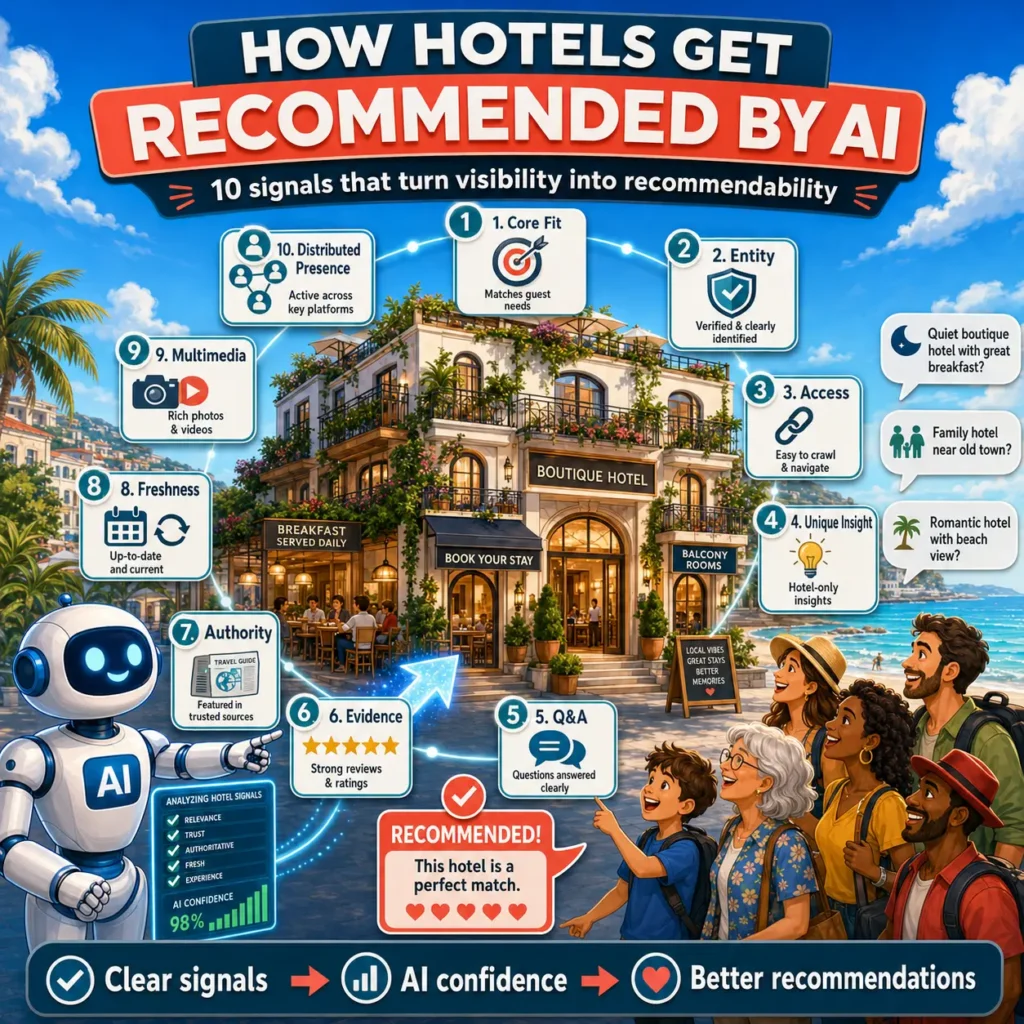
For hotels, this framework has 10 stages. The first 8 are the Core Recommendation System, the most important ones that I identified. Stage 9 supports understanding and conversion through images and videos. Stage 10 is about a broader public presence and is more conditional. Meaning it becomes stronger naturally once you have done the first 8 well.
The order matters. Stage 1 has the highest impact and probably the lowest effort. Each stage builds on the one before it. If you have one afternoon, start with Stage 1 and stop when you run out of time. I promise you will already be ahead of most hotels.
The 10 Stages at a Glance
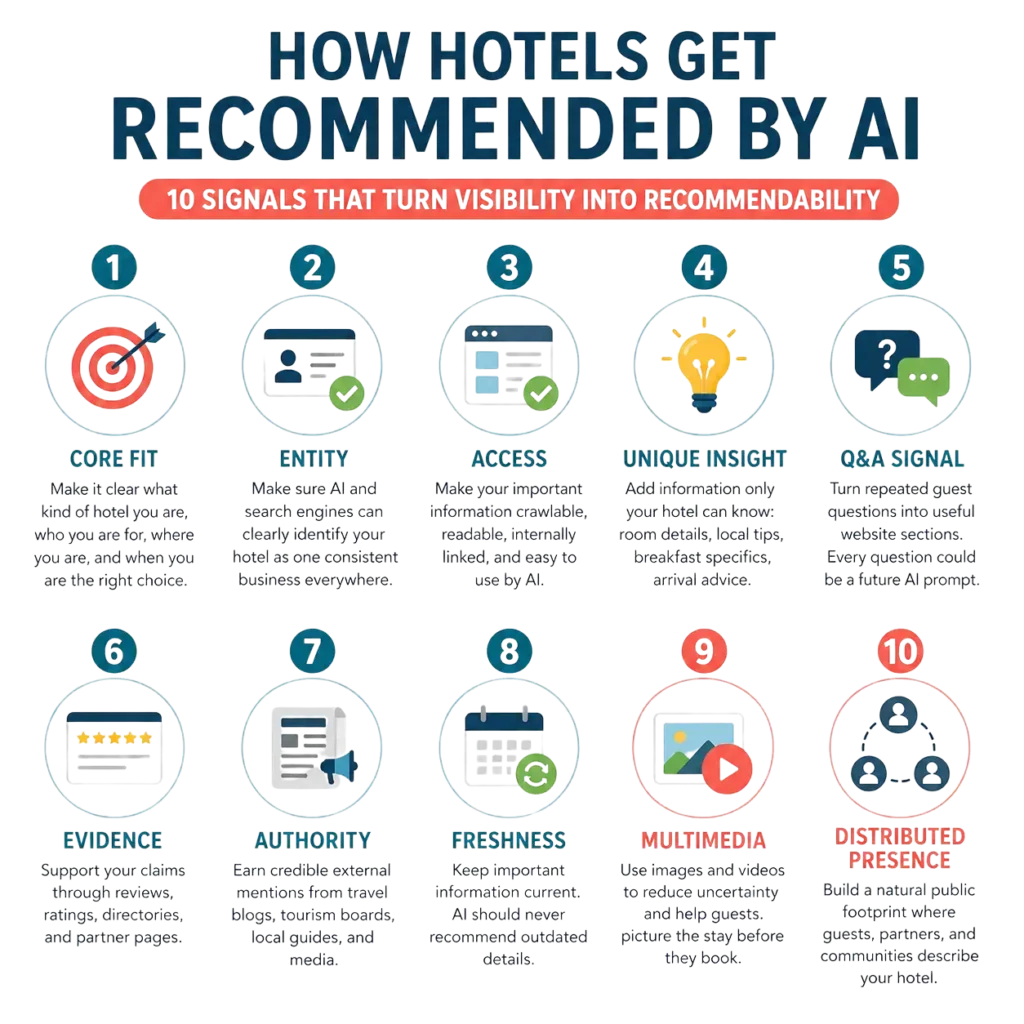
- Stage 1: Core Fit Signal: Make it clear what kind of hotel you are, who you are for, where you are, and when you are the right choice.
- Stage 2: Entity Signal: Make sure AI and search engines can clearly identify your hotel as one consistent business across all platforms.
- Stage 3: Access Signal: Make sure your important information is crawlable, readable, internally linked, and easy to use by AI.
- Stage 4: Unique Insight Signal: Add information only your hotel can realistically know: room details, guest patterns, local tips, breakfast specifics, arrival advice.
- Stage 5: Question-Answer Signal: Turn repeated guest questions into useful website sections. Every question guests ask could become a future AI prompt.
- Stage 6: Independent Evidence Signal: Support your claims through reviews, ratings, directories, and partner pages.
- Stage 7: Third-Party Authority Signal: Earn credible external mentions from travel blogs, tourism boards, local guides, and media.
- Stage 8: Freshness Signal: Keep important information current. AI should not recommend your hotel based on outdated breakfast times or old room photos.
- Stage 9: Multimedia Support Signal: Use images and videos to reduce uncertainty and help guests picture the stay before they book.
- Stage 10: Distributed Presence Signal: Build a natural public footprint where guests, partners, and communities describe your hotel in the right context.
If you only have one afternoon, start here:
- Write down your 3 target recommendation prompts. These should be common, specific things a guest might ask AI that should lead to your hotel.
- Rewrite your homepage headline and intro to clearly match your strongest prompt.
- Add one dedicated page for your single biggest feature: breakfast, view, location, parking, spa, family rooms, … whatever genuinely sets you apart.
- Add your 10 most common guest questions with real, specific answers on the right pages.
- Update your Google Business Profile to use the same language and positioning as your homepage.
That is it. Come back to stages 2–10 when you have more time. Even this much will already put you ahead of most hotels.
The easiest way to start applying this framework is to define one target recommendation prompt. For example:
“Recommend a quiet boutique hotel in Vienna with outstanding breakfast.”
Then ask yourself: Does our website clearly show we are a boutique hotel? Do we explain our breakfast in detail? Do our reviews mention the breakfast? Do external sources describe us as boutique? Can AI understand where we are located? Can a guest easily book after discovering us?
This is how you stop thinking only in keywords and start thinking in recommendation prompts.
Old-school SEO asks: “What keyword do we want to rank for?”
AI search asks: “What guest need do we want to be recommended for?” That is the shift.
Note that if you follow this framework, you will also see benefits in SEO. Working at an OTA as an SEO and AI Search Lead, I was able to track benefits for both channels when we provided more context and made offers and pages clearer.
Chapter 4: How to Apply Each Stage - The Practical Hotel Guide 🛠
Now let’s make the framework concrete. I will go through each stage, explain what it means for your hotel, and give you clear actions you can take.
The important thing: do not try to do everything at once. Start with stage 1. Then stage 2. Then stage 3. This is a system to constantly build your hotel website. The good news is that most hotels are still doing this badly, which means even simple improvements give you a real edge.
Stage 1: Core Fit Signal - Make Your Hotel Easy to Match With a Guest Need
The first question is simple: can AI understand when your hotel is the right recommendation?
Many hotel websites make this surprisingly difficult. They say things like: “Welcome to our beautiful hotel in the heart of Vienna.” That sounds nice. But what kind of hotel is it? Who is it best for? What area specifically? What makes it different from the 200 other hotels in the city?
AI needs context. A much stronger positioning would be: “Quiet boutique hotel in Vienna’s 7th district for couples and culture travelers, with homemade breakfast and walkable access to MuseumsQuartier and Spittelberg.” Now AI has something to work with. It understands the category, the location, the audience, the features, and the nearby attractions.
For hotels, the strongest positioning usually combines four pillars:
- Location: City, neighborhood, landmark, train station, ski area, old town, business district.
- Feature: Breakfast, spa, parking, balcony, view, family rooms, rooftop, gym, workspace, pet-friendly rooms.
- Audience: Couples, families, solo travelers, business travelers, honeymooners, theatre visitors, wellness guests.
- Category: Boutique hotel, luxury hotel, family hotel, wellness hotel, design hotel, aparthotel, lifestyle hotel.
The magic happens when you combine two or three of these. For example:
- “Family hotel near Vienna city center with spacious rooms and parking.”
- “Boutique hotel in Salzburg old town for romantic weekend trips.”
- “Wellness hotel in the Austrian Alps with mountain views and spa access included.”
- “Business hotel near Vienna Central Station with quiet rooms and workspace.”
What to do: Define 3–5 recommendation prompts you want to win. Then check your website. Does your homepage clearly support this positioning? Do your room pages support it? Do you provide pages with specific details to answer those prompts? If not, start there. Because if your own website does not clearly explain why you fit the recommendation, you make AI guess. And AI does not like guessing.
Stage 2: Entity Signal - Make Your Hotel Easy to Identify Across the Web
AI needs to understand that all the information it finds online refers to the same hotel. Your website, Google Business Profile, Tripadvisor, Booking.com, Expedia, and Instagram should all point to the same business with the same name, address, category, and description.
This becomes harder when information is inconsistent. Your website might say “Hotel Bergblick Vienna,” Google might say “Bergblick Boutique Hotel,” Tripadvisor might say “Hotel Bergblick Wien,” and Booking.com might say “Bergblick Hotel & Apartments.” For a human, mildly annoying. For AI and search systems, it weakens confidence.
What to do: Use the same hotel name everywhere. Same address format. Same phone number and website URL. A consistent short description across major profiles. Make sure your Google Business Profile is complete and accurate. Add a clear About page. And make sure your public footprint repeats your target positioning consistently. Check your homepage, your Google description, your OTA profiles, and your review responses, and make sure all reinforce the same story.
Stage 3: Access Signal - Make Your Hotel Information Easy to Crawl and Use
A quick warning before we go into this one. This is probably the most technical of all the stages. I kept it, because I think it is very relevant. If things are not clear or you need help, feel free to send me a message below:
Many hotels have great information, but AI and search engines cannot properly access or understand it. Important room details are hidden inside a booking widget. Breakfast information only appears as an image. Parking details are buried in a PDF. FAQs hide behind tabs that are not rendered properly. The website looks beautiful, but the actual information is difficult to parse.
Access does not make your hotel recommendable by itself. But without access, even excellent content may never enter the recommendation set.
What to do: Check that your most important pages are indexable. Make sure your homepage links to your key room pages, amenity pages, location pages, and booking pages. Write important information as normal text on the page. Don’t put it in images, icons, PDFs, or booking widgets. Add internal links between related pages. Make your booking button visible on every important page. And make sure the mobile booking flow works smoothly.
For example: if breakfast is one of your strongest selling points, do not just show a beautiful photo of breakfast. Create a breakfast page. Explain what is served, the opening times, dietary options, local suppliers, and whether breakfast is included or paid separately. Add photos with descriptive alt text. Link to it from the homepage and room pages. That makes the information useful for AI and trustworthy for guests.
Stage 4: Unique Insight Signal - Publish Information Only Your Hotel Can Know
This is one of the biggest opportunities in the entire framework and most hotels are completely missing it.
Most hotel websites are generic. They say “Enjoy our comfortable rooms.” “Discover the perfect location.” “Relax in a unique atmosphere.” This does not help AI, because any hotel can say it. AI does not need another generic hotel description. It needs useful context.
Your hotel has information that OTAs, directories, and travel blogs cannot easily copy. For example: Which rooms are quietest? Which rooms get the best morning light? When is breakfast calmest? Which nearby restaurant is best before a theatre visit? Do guests actually need a rental car? Which parking garage is easiest with luggage?
Your reception team knows all of this. The owner knows it. The breakfast team knows it. But it never makes it onto the website. Change that now.
What to do: Add first-hand details to every important page.
Instead of: “Our hotel is close to the city center.” Try: “Our hotel is a 6-minute walk from MuseumsQuartier and a 9-minute walk from Volkstheater underground station. Most guests reach St. Stephen’s Cathedral in around 18 minutes by foot or 8 minutes by underground.”
Instead of: “We offer a great breakfast.” Try: “Breakfast is served from 7:00 to 10:30. Guests especially love our homemade granola, local sourdough bread, seasonal fruit, and fresh egg dishes. If you prefer a quieter breakfast, we recommend coming before 8:15 or after 9:45.”
That kind of detail creates confidence. It helps guests. It helps AI. And honestly, it also means fewer guests asking the same questions at the reception. 😄
Stage 5: Question-Answer Signal - Turn Guest Questions Into AI-Ready Content
People don’t ask AI like they search Google. They don’t type: “Hotel Vienna breakfast.” They ask: “Can you recommend a quiet hotel in Vienna with a great breakfast for a romantic weekend?”
That is why your hotel needs to answer real, full questions on its website. And the easiest source for those questions is your own team. Reception questions are content ideas. Booking messages are content ideas. WhatsApp questions are content ideas. Every repeated guest question is a potential AI prompt.
What to do: Collect the questions guests ask again and again. Group them by topic. Then answer them properly on the right pages. A strong answer should include the direct answer, the practical details, any conditions or exceptions, and the next step. For example:
“Yes, parking is available nearby, but not directly at the hotel. The closest garage is a 3-minute walk away. The daily rate is currently €28. We recommend dropping off luggage at the hotel entrance first, then parking. You can find directions here.”
That kind of answer is useful. And useful answers are exactly what AI needs.
Stage 6: Independent Evidence Signal - Make Your Claims Verifiable
Your website can make a claim. But independent sources make the claim believable. If your website says “we have the best breakfast in Vienna,” that is marketing. If 80 Google reviews, Tripadvisor reviews, and Booking.com reviews mention the breakfast positively, that becomes evidence.
The important part: the evidence should support the same positioning you want to own. If you want to be recommended as a quiet boutique hotel, reviews should ideally mention quiet rooms, sleep quality, calm atmosphere, and personal service.
What to do: Strengthen your Google Business Profile. Reply to reviews in a way that reinforces your positioning. Encourage honest, specific reviews. Of course, don’t start telling guests what to write, but ask naturally and make sure guests are asked at least once during their stay. For example: “If you enjoyed your stay, we would really appreciate a Google review. It helps future guests understand what staying with us is actually like. Especially what you liked about the room, breakfast, location, or service.” Then reply thoughtfully:
Review: “We loved the quiet room and the breakfast was amazing.” Strong reply: “Thank you so much. We’re happy you enjoyed the quiet courtyard room and our breakfast. Many guests choose us because they want to stay centrally in Vienna but still sleep well, so this means a lot.”
That reply helps future guests and reinforces exactly the language you want associated with the hotel.
Stage 7: Third-Party Authority Signal - Earn Mentions From Sources Guests and AI Trust
Independent evidence is mostly about reviews and platforms. Third-party authority is about being mentioned by credible external sources, such as travel blogs, tourism boards, local guides, restaurant partners, event websites, and directories for boutique or wellness or family hotels.
This is not about collecting random backlinks. Relevant mentions are the goal. A mention from a local theatre guide saying your hotel is the perfect quiet stay for theatre weekends is far more valuable than a generic link no guest would ever follow.
What to do: List your 3–5 target recommendation prompts. Then identify which external websites already have authority around those topics. Who writes about this audience? Who writes about this type of hotel? Who could realistically mention you? Create a real outreach plan of who you would like to contact and how. I recommend approaching them as personally as possible and offering them something in return (e.g., recommending them at reception or on your website). A hotel near theatres could create a “Theatre Weekend in Vienna” guide and share it with local theatre blogs. A family hotel could create a “Best things to do with kids near our hotel” guide and share it with family travel bloggers. That is how third-party authority becomes useful and natural.
Stage 8: Freshness Signal - Keep Hotel Information Current
AI recommendation is not something you win once. You have to maintain it. Breakfast times change. Prices change. Parking options change. Room features change. Seasonal advice changes. If your website is outdated, AI has less reason to trust it and guests may arrive with wrong expectations.
What to do: Create a regular content maintenance routine. At least every few months review your priority pages like homepage, room pages, breakfast, location, parking, FAQ, local guide pages. Update opening times, prices, policies, room amenities, local recommendations, and photos. Also, add more content regularly. Use the feedback from your guests, and ask your team for ideas.
Also test your target AI prompts regularly. Ask ChatGPT, Gemini, Claude, Perplexity, and Google AI questions like your target prompts. Note: Are you mentioned? Which competitors appear? What reasons does AI give? Which sources does it cite? What information is missing?
If AI does not mention your breakfast, maybe your breakfast page is weak. If AI does not understand that you are family-friendly, maybe your family content is hidden.
Freshness is not just updating dates. It is keeping the whole recommendation signal accurate.
Stage 9: Multimedia Support Signal - Use Images and Videos to Reduce Uncertainty
For hotels, images and hotels are often the difference between interest and booking. A guest wants to know: what does the room really look like? Is the view real? Is the breakfast as good as you say? Is the spa beautiful or a tiny sauna in the basement?
Visuals reduce uncertainty. They increase trust. They help guests imagine the stay. And when uploaded to platforms like YouTube with good titles, descriptions, and captions, videos can also become discoverable assets.
What to do: Create visuals for your strongest recommendation prompts. If you want to be recommended for breakfast, show breakfast properly. This can be the buffet, the dishes, the atmosphere, or the local products. A 30-second breakfast video would be powerful. If you want to be recommended as a quiet boutique hotel, show the calm courtyard rooms, the reading corner, the surrounding street.
Support every image and video with text. Use descriptive file names. Use alt text. Use captions. A video called ‘IMG_4839.mp4’ helps nobody. A video called ‘Sea view family room at Aegean Cove Hotel’ is much clearer.
Extra tip: When you feel you are getting good at creating videos and images, post them on Social Media channels of your choice. This increases the chance of AI discovering you through one of those channels. YouTube videos, for instance, are often recommended by AI models. When you start a channel, make sure you are posting consistently. A video every month is worth more than a short burst of videos.
Stage 10: Distributed Presence Signal - Become Naturally Known for the Right Thing
The last stage is about public presence and discussion. And here we need to be careful. The goal is not: ‘How do we plant our hotel name into Reddit threads so AI recommends us?’ That is fragile and, honestly, a bit desperate. 😄 The better goal is: ‘How do we become so clearly useful for a specific guest need that people naturally describe us that way?’
For hotels, this happens through guest reviews, guest photos, travel creator videos, local partnerships, social media posts, and community recommendations. The weak version is posting random content with no strategy. The strong version is repeating and deepening the same positioning across channels.
What to do: Choose the 3–5 things you want your hotel to be known for. Then consistently publish around them. If you are a family hotel, publish family travel tips. If you are a wellness hotel, publish relaxation and local nature tips. If you are a boutique hotel, publish design, neighborhood, food, and culture stories. The goal is to build public memory so that people describe your hotel in the same language you want AI to understand. That is when distributed presence becomes powerful. Not because you gamed the system, but because the system can see that your positioning is real.
Want more practical ideas like this?
I share one actionable hotel growth idea every week – focused on SEO, AI, and direct bookings on Substack.
Chapter 5: Real Examples - What AI Recommends and Why 🔎
Now the framework might sound big, but in practice it becomes very concrete. Let me show you two real examples. It’s one from ChatGPT and one from Gemini, which illustrate exactly how AI recommendations work and what you can apply immediately.
Example 1: Boutique Hotel Spiess & Spiess - Why ChatGPT Recommended It for a Quiet Boutique Hotel in Vienna With Great Breakfast
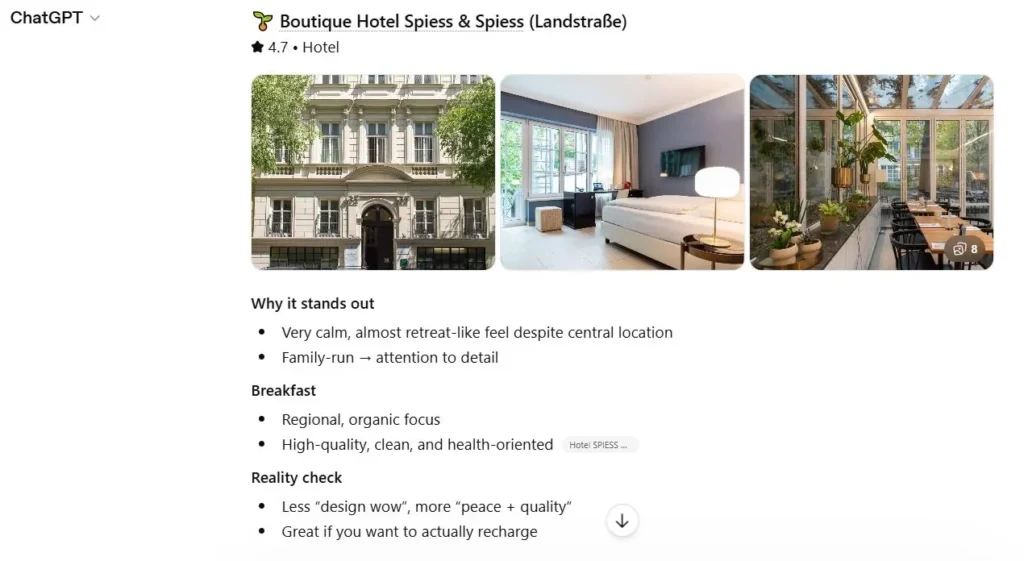
The test query I used in ChatGPT:
“Recommend a quiet boutique hotel in Vienna with a great breakfast.”
This is a very realistic travel prompt. The guest is not just searching for “hotel Vienna.” They are looking for a specific type of stay: quiet, boutique, in Vienna, with a great breakfast. This is exactly how many travelers now use AI → they describe the stay they want, not just the destination. And that matters because AI has to decide which hotels clearly match the request.
What ChatGPT Recommended
ChatGPT recommended Boutique Hotel Spiess & Spiess in Landstraße, highlighting that the hotel has a calm, almost retreat-like atmosphere despite being centrally located, that it is family-run, suggesting personal service and attention to detail, that the breakfast has a regional and organic focus, and that the hotel delivers more “peace and quality” than flashy design.
This is a fascinating recommendation because it shows how AI synthesizes several signals into one clear answer. ChatGPT did not simply recommend a hotel with the word “boutique” in the name. It recommended a hotel where the website, visual presentation, and guest reviews all support the same story: a quiet, high-quality boutique hotel in Vienna with a strong breakfast experience.
Signal 1: The Hotel Clearly Matches the Prompt
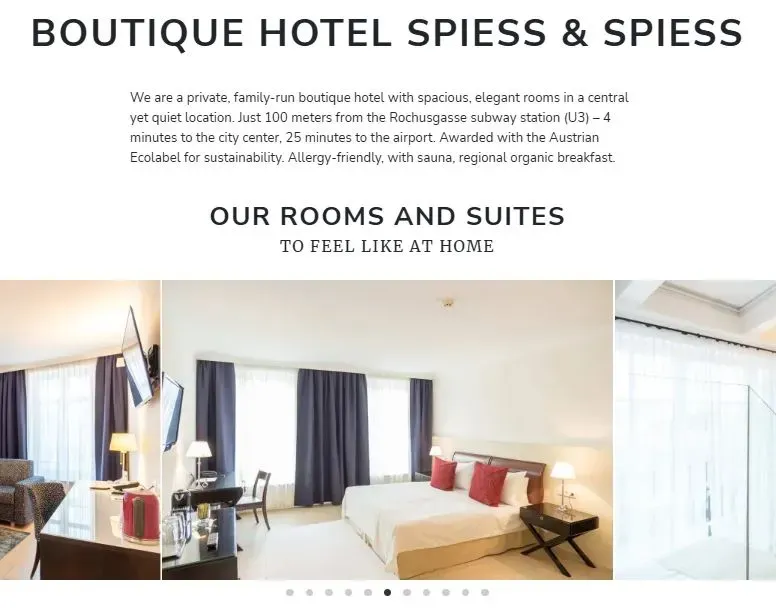
On the website, Boutique Hotel Spiess & Spiess describes itself as a private, family-run boutique hotel with spacious rooms in a central yet quiet location. That sentence already does a lot of work. It tells AI and guests: this is a boutique hotel, it is family-run, it is in Vienna, it is central, it is quiet, and it has spacious rooms.
The website also mentions the nearby subway station, the city center, sustainability, allergy-friendly facilities, sauna, and regional organic breakfast. The positioning is not vague. It is specific enough to match several potential guest needs. For this prompt, three parts are especially important: boutique hotel, quiet location, and regional organic breakfast. That is almost exactly what the guest asked for.
The lesson: Do not make AI work too hard. If your hotel is quiet, say it clearly. If your breakfast is a strength, say it clearly. A vague hotel needs interpretation. A clear hotel creates confidence.
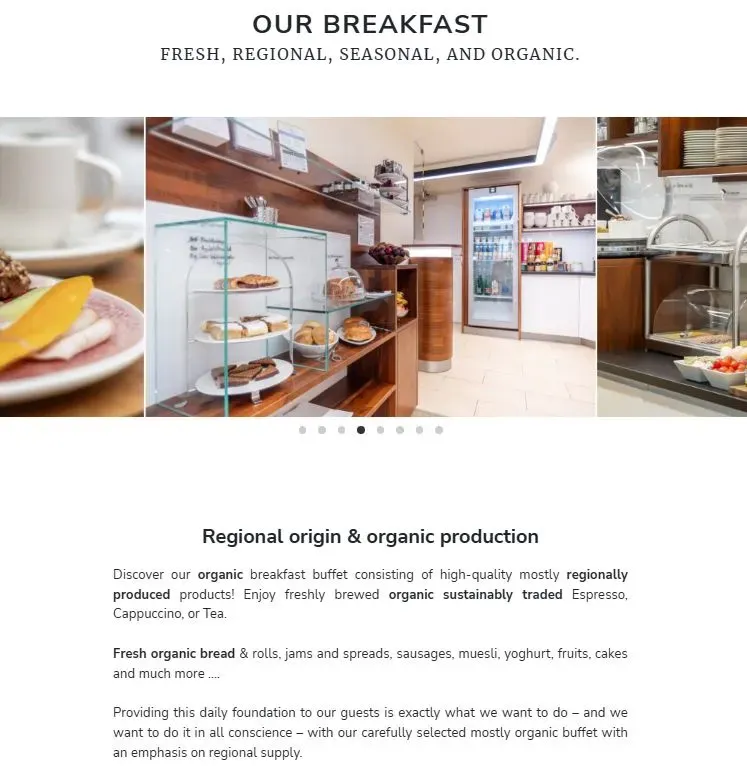
Signal 2: The Breakfast Is Not Just Mentioned → It Has Its Own Story
Many hotels say they offer breakfast. That is not enough. Boutique Hotel Spiess & Spiess makes breakfast tangible. Their breakfast section explains that the buffet consists of high-quality, mostly regionally produced products. It mentions organic breakfast, sustainably traded coffee, fresh bread and rolls, jams, spreads, sausages, muesli, yoghurt, fruits, cakes, and more.
This is exactly the kind of detail AI can use. The prompt asked for a hotel with a great breakfast. The hotel website gives AI reasons to believe the breakfast is genuinely important to the property. It’s not an afterthought, not a bullet point, a real part of the hotel experience.
The lesson: If breakfast is one of your strengths, give it a dedicated section or page. What is served? Is it regional? Is it organic? Are there homemade products? What time is breakfast served? Is it included? AI cannot recommend “great breakfast” confidently if your website gives it only three words.
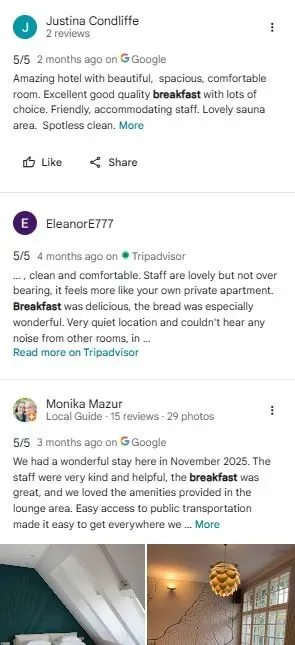
Signal 3: Reviews Independently Confirm the Breakfast Claim
The hotel not only claims that breakfast is good. Guests say it too. In the reviews, guests mention that breakfast was excellent, delicious, high-quality, and varied.
This matters enormously. Your website can make the claim. But reviews make the claim more believable. For AI, this is a powerful independent evidence signal. If a hotel says “we offer a great breakfast,” that is marketing. If multiple guests say the breakfast was great and delicious, that becomes proof. And because the prompt specifically asked for great breakfast, those review signals likely helped ChatGPT understand that the hotel genuinely matches the request.
The lesson: Reviews should support the position you want to own. If you want to be recommended for breakfast, guests should mention breakfast. If you want to be recommended as quiet, guests should mention sleep quality, calm rooms, or peaceful atmosphere.
Signal 4: The Website Supports the "Quiet Boutique" Positioning
The website’s visual and written presentation also supports the recommendation. The hotel does not look like a huge chain property. It presents itself as private, calm, elegant, and personal. The room images show spacious, bright, clean rooms. The wording says “to feel like at home.” The description highlights a central yet quiet location.
“Boutique” is not just a technical category. It is a feeling. When a guest asks for a boutique hotel, they want something more personal, smaller, and more individual than a large chain. The hotel’s website supports that idea, both in information and in atmosphere.
The lesson: Your website should make your category obvious. If you are a boutique hotel, the page should feel personal and specific. AI works with information, but guests decide emotionally. The best hotel websites do both: they provide clear facts and communicate the right feeling.
Signal 5: ChatGPT Included a Useful Reality Check
One detail I really appreciated in the ChatGPT answer was what I would call a reality check. ChatGPT described the hotel as “less design wow, more peace and quality — great if you want to actually recharge.”
This is interesting because it does not oversell the hotel. It positions it honestly. And that is exactly what good AI recommendations do. They explain fit, not just list properties. ChatGPT understood that this hotel is not the flashiest design hotel in Vienna, but it is a strong match for someone who wants calm, quality, comfort, and breakfast.
The lesson: Do not try to be perfect for everyone. Be very clear about who your hotel is ideal for. The stronger your positioning, the easier it becomes for AI to recommend you to the right guest and not the wrong one.
Signal 6: The Full Ecosystem Supports the Recommendation
This example also shows the importance of external sources working together. The hotel website gives the core information. The reviews reinforce the claim. The Google profile confirms the business. ChatGPT appears to combine those signals into a useful, confident answer.
If the website mentions breakfast, but reviews never mention it, the claim is weaker. If guests mention breakfast, but the website does not explain it, AI has less source material. When these signals say the same thing, your hotel becomes much easier to recommend.
The key takeaway: Hotels that win in AI search are not always the biggest or the most expensive. They are the ones that make it easiest to understand what they offer, who they are for, and why they are a good match for a specific guest need.
Example 2: Sophia Luxury Suites - Why Gemini Recommended It for a Romantic Santorini Stay
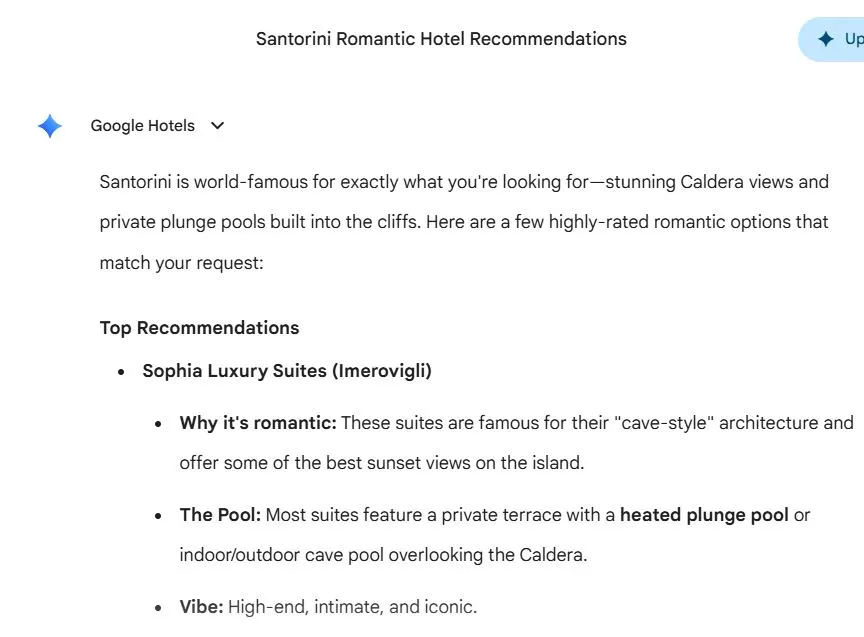
The test query I used in Gemini:
“Recommend a romantic hotel for couples on Santorini with rooms with a private terrace, Caldera view, and one of those little pools.”
This is a very specific, emotionally driven travel prompt. The guest is not searching for “hotel Santorini.” They are searching for a feeling and a very clear set of features: romantic, for couples, private terrace, Caldera view, small private pool. This is exactly the kind of search where AI becomes extremely powerful. The guest describes the dream, and AI tries to match it.
What Gemini Recommended
Gemini accessed Google Hotels and recommended Sophia Luxury Suites in Imerovigli as one of the top options. That alone tells us something important: in the Google environment, your presence in Google Hotels and Google Business Profile is not just a nice-to-have listing. It is part of your AI visibility infrastructure.
If Gemini draws from Google’s hotel ecosystem as a source, then a complete, accurate, and well-positioned Google profile matters for AI recommendations and not just for Google Maps results.
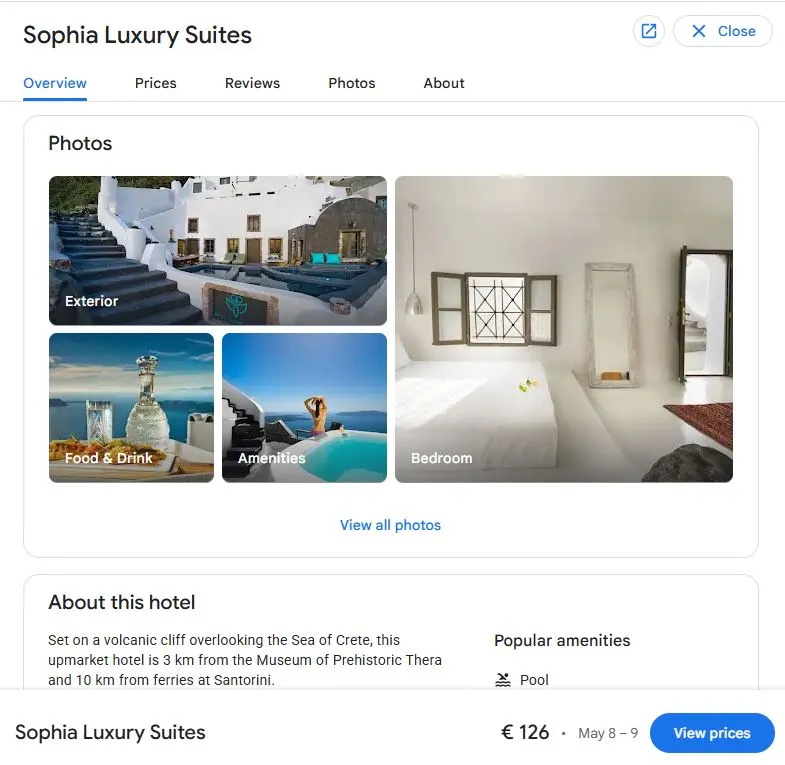
Signal 1: The Hotel Clearly Matches the Romantic Santorini Fantasy
The website does not describe the hotel in a generic way. It clearly positions the property around romance, natural beauty, Caldera views, sunsets, and intimate luxury. The hotel describes itself as a romantic boutique property and explicitly mentions honeymooners, Caldera sunset views, and uniquely styled suites.
That matters because the prompt was not just “hotel in Santorini.” It was “romantic hotel for couples on Santorini.” The hotel’s content directly supports the emotional intent behind the search, making this a textbook example of the Core Fit Signal working perfectly.
The lesson: Do not only describe what you have. Describe who it is perfect for and why. “Luxury suites in Santorini” is a listing. “Romantic luxury suites in Imerovigli with Caldera views, private terraces, and plunge pools for honeymooners and couples” is a recommendation.
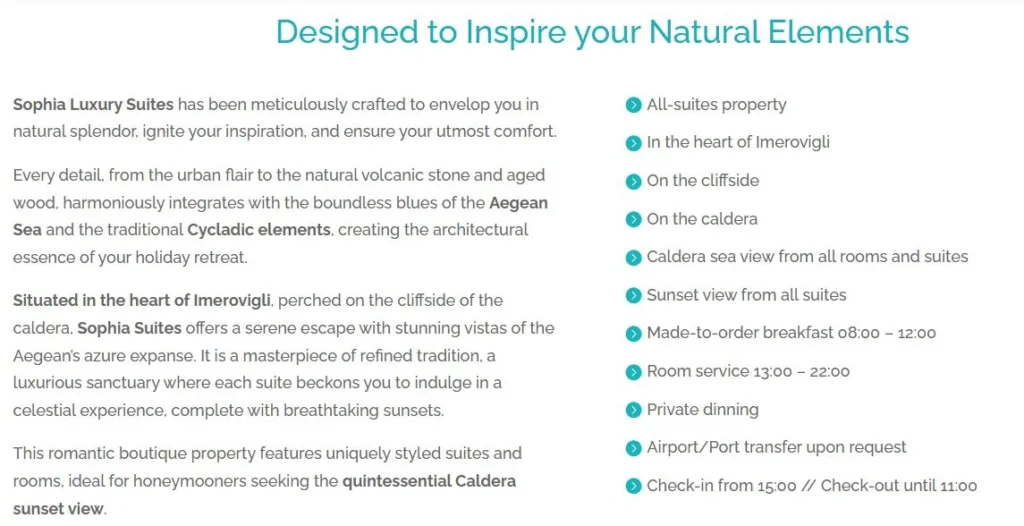
Signal 2: The Room Names and Features Match the Prompt Very Closely
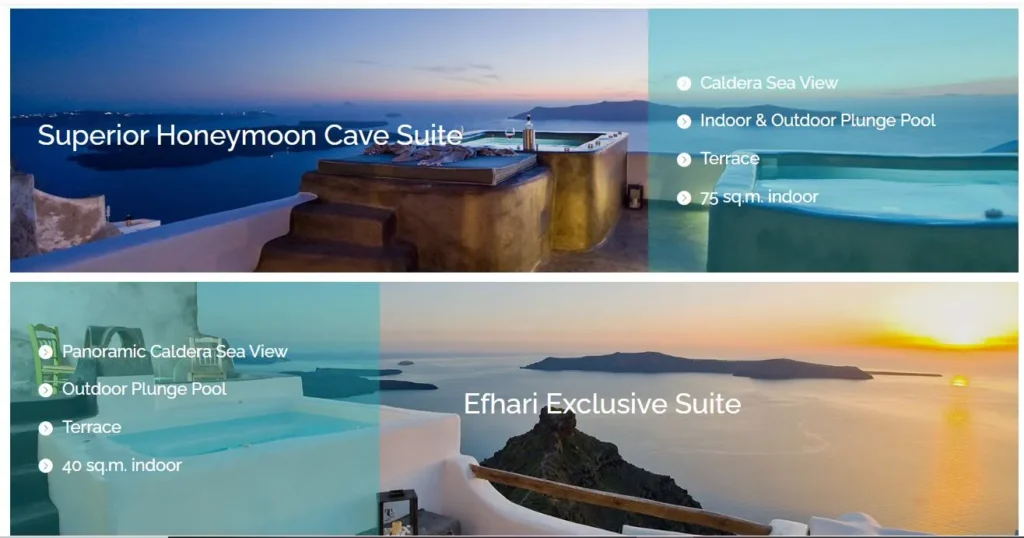
The room overview is especially strong. The hotel does not hide its key features inside generic marketing text. Room cards clearly show features like “private terrace,” “outdoor plunge pool,” “Caldera sea view,” “panoramic Caldera sea view,” and “indoor and outdoor plunge pool.”
This is exactly what the guest asked for. AI needs clear matching signals. If the guest asks for a room with a private terrace, Caldera view, and a small pool, and your room page clearly states those things, AI has much more confidence connecting your hotel to the request.
The lesson: Your room titles and feature lists should use the same language guests actually use when searching. If a room has a Caldera view, say Caldera view. If it has a private terrace, say private terrace. Poetic language can create emotion, but clear feature language creates recommendation confidence.
Signal 3: Detailed Room Descriptions Remove Uncertainty
The hotel explains the experience in a descriptive way, but also includes practical details. For example: the suite is perched atop the Caldera. There is a private veranda. The view includes the Aegean Sea and Skaros rock. The plunge pool has hydromassage jets with a temperature of approximately 27°C. The terrace is private for the tenant’s use but open by design. There are minimal steps to the entrance.
Many hotels write only beautiful marketing copy. Sophia Luxury Suites combines atmosphere with practical information. That helps AI and guests in two ways: it reinforces the emotional match, and it removes uncertainty about what the stay actually involves.
The lesson: Details create trust. Is the pool heated? Is the terrace private? Is the view direct or partial? Are there many steps? Is the room suitable for people with mobility issues? These small details can be the reason AI recommends you and the reason a guest actually books.
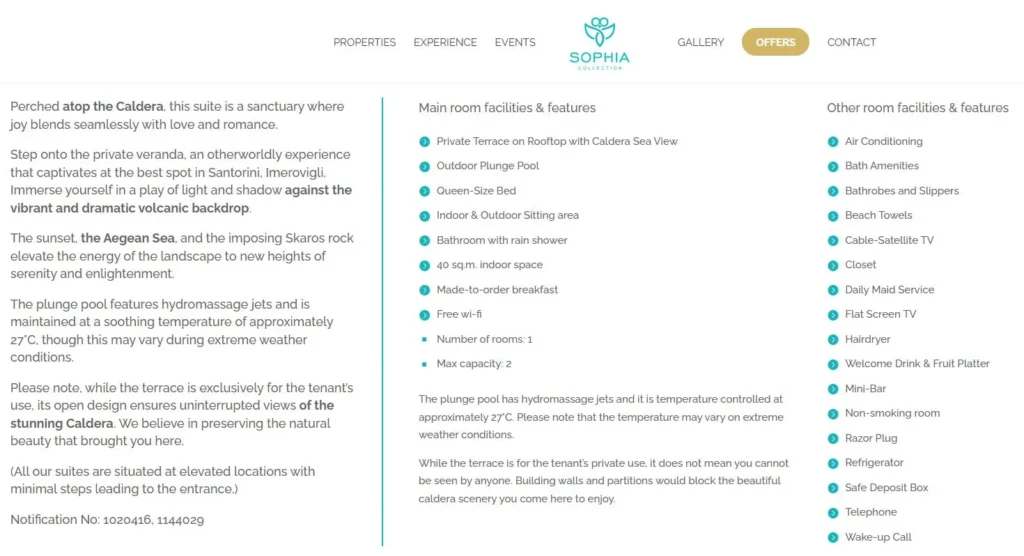
Signal 4: The Google Hotels Profile Supports the Recommendation
Gemini accessed Google Hotels for this recommendation, so the Google environment played a major role. This is important because many hotels still treat their Google Business Profile as a basic listing tool.
In the AI search world, it is more than that. It is a machine-readable trust and discovery asset. If your Google profile is incomplete, outdated, or inconsistent with your website, you may lose recommendation opportunities, especially in Google’s own AI ecosystem.
The lesson: Your Google presence should reinforce your positioning. If you want to be recommended as a romantic hotel, your photos, amenities, descriptions, and reviews should all support that. Your Google profile should not just exist. It should tell the same story as your website.
Signal 5: The Visuals Make the Promise Believable
The room photos and visuals show dramatic Santorini views, terraces, plunge pools, sunset colors, and the Caldera landscape. That is exactly the fantasy behind the prompt.
When someone asks AI for a romantic Santorini hotel with a Caldera view and private pool, they are not only asking for amenities. They are asking for a feeling. The visuals make that feeling believable. They reduce uncertainty, increase trust, and help guests picture themselves there.
The lesson: Show the experience people are searching for. If people search for “hotel with Caldera view,” show the actual Caldera view. If people search for “family hotel,” show the family room setup. Specific visuals beat generic visuals. Always.
A Personal Note 😄
I actually ran this Gemini test because my wife and I spent our honeymoon in Santorini, and this was exactly the kind of hotel we were looking for. Romantic. Beautiful view. Private terrace. Small pool. That full Santorini dream.
What was funny is that the hotel we stayed at did not show up in the recommendation, even though it was a genuinely great hotel that matched the criteria very well. And that is the point. Being a great hotel is not enough if AI cannot clearly understand, verify, and match your hotel to the guest’s request. Maybe I should call them and offer my help. Joking aside, this is the opportunity.
Many hotels already deliver the experience guests want. They just do not describe it clearly enough across their website, Google profile, reviews, and external sources. And in AI search, unclear hotels become invisible hotels.
I break down real hotel strategies like this every week
Connect with me on LinkedIn for short, practical tips and ideas based on real examples.
Chapter 6: The AI Recommendability Checklist for Hotels ✔️
By now, the idea should be clear: AI does not recommend hotels because they are “optimized for AI.” It recommends hotels when enough signals point in the same direction. Your website explains what you offer. Your Google profile confirms it. Your reviews support it. Your external mentions reinforce it. Your images make it believable. Your booking path makes it actionable.
Before you work through the full checklist, do this first (30 minutes):
Open ChatGPT, Gemini, Perplexity, and Google AI Mode. Test 3–5 prompts your ideal guest might actually type. For example, “quiet boutique hotel in Vienna with great breakfast” or “family hotel near Salzburg old town.” Write down which hotels appear. More importantly, write down the reasons AI gives for recommending them. Then open your own website and compare. The gap between what AI says about your competitors and what it could say about you is your priority list. That gap is where to start.
Make this a monthly habit. It takes 30 minutes and tells you more than any analytics dashboard.
Use the checklist below to find where your hotel stands and where to improve first. Work through the stages in order. To structure your work, you can download the checklist as a spreadsheet here:
Step 1: Define the AI Prompt You Want to Win
Start with one specific recommendation prompt. Do not begin with “hotel Vienna” that is too broad. Think like a guest.
✓ We have written down 3–5 AI recommendation prompts we want to appear for.
✓ Each prompt describes a real guest need.
✓ Each prompt matches something our hotel genuinely offers.
✓ The prompt is specific enough that we can clearly say why our hotel fits.
✓ We are not trying to be recommended for something we cannot honestly deliver.
Step 2: Check Your Core Fit Signal
Can someone understand within 5 seconds what kind of hotel you are and who you are perfect for?
✓ Our homepage clearly describes what kind of hotel we are.
✓ Our location is specific, not vague.
✓ Our strongest features are mentioned clearly.
✓ Our ideal guests are easy to identify from the homepage alone.
✓ Our positioning matches the AI prompts we want to win.
✓ Our room pages and amenity pages support the same positioning.
✓ We are not using only generic phrases like “unique stay,” “perfect location,” or “unforgettable experience.”
Step 3: Check Your Entity Signal
✓ Our hotel name is consistent across major platforms.
✓ Our address is consistent everywhere.
✓ Our phone number and website URL are correct on all profiles.
✓ Our hotel category is consistent (boutique hotel, wellness hotel, etc.).
✓ Our Google Business Profile is complete and accurate.
✓ Our descriptions across platforms do not contradict each other.
✓ Our website has a clear About page.
Step 4: Check Your Access Signal
✓ Our important pages are indexable.
✓ Our homepage links to key room pages and amenity pages.
✓ Important information is written as crawlable text, not only shown in images or PDFs.
✓ Room details are visible outside the booking widget.
✓ Breakfast, parking, location, and family information are easy to find.
✓ Our booking button is visible on all important pages.
✓ Our website works well on mobile.
Step 5: Check Your Unique Insight Signal
✓ Our website includes specific details only our hotel can realistically know.
✓ Our room pages explain practical differences between rooms.
✓ Our location content includes real local tips, not generic tourist information.
✓ Our breakfast, spa, parking, or family content includes concrete details.
✓ We answer common uncertainties before guests need to ask.
✓ Our content would still be useful even if someone removed our hotel name from it.
That last point is important. If your content would be useless without your brand name, it is probably too generic.
Step 6: Check Your Question-Answer Signal
✓ We have collected the 20 most common guest questions.
✓ Our website answers the most important questions clearly.
✓ Our FAQ answers are specific, not generic.
✓ Each important answer appears on the most relevant page.
✓ We do not hide important answers only in an accordion, PDF, or booking engine.
✓ We regularly add new questions to our content.
Step 7: Check Your Independent Evidence Signal
✓ Our Google reviews mention the things we want to be known for.
✓ Our Tripadvisor and OTA reviews support our positioning.
✓ We respond to reviews in a helpful and positioning-reinforcing way.
✓ We encourage honest, specific reviews after checkout.
✓ We use selected review quotes on our website to support key pages.
Step 8: Check Your Third-Party Authority Signal
✓ We are mentioned on relevant local tourism websites.
✓ We are included in relevant travel guides, directories, or articles.
✓ External mentions use language that matches our positioning.
✓ We have identified 10–20 potential sources that could mention us.
✓ We avoid random backlink schemes and focus on relevant mentions.
Step 9: Check Your Freshness Signal
✓ Our breakfast times, prices, policies, and amenities are current.
✓ Our parking information is current.
✓ Our local recommendations are current.
✓ Our photos reflect the actual hotel today.
✓ Our most important pages are reviewed at least every few months.
✓ We test AI prompts regularly and update pages when AI misunderstands something.
Step 10: Check Your Multimedia and Distributed Presence Signals
✓ Our photos show the experiences guests search for, not only decorative details.
✓ Our image file names and alt text are descriptive.
✓ Our videos have clear titles and descriptions.
✓ Our social media repeats our core positioning.
✓ Guests share photos or stories that support our positioning.
✓ We publish useful local tips, not only promotional posts.
✓ We do not fake reviews, fake Reddit mentions, or fake discussions.
Download the worksheet to optimise for AI search
Below you can download my worksheet for free. It helps you optimise your hotel website for AI search step-by-step:
Chapter 7: How AI Recommendability Connects to Your Bigger Hotel Strategy 🔄
Optimizing your hotel for AI search is not a separate project that sits next to your real strategy. It is deeply connected to everything else you should be doing anyway.
When you make your website clearer and more detailed for AI, your guests benefit too. They get better answers faster. They trust you more. They book with more confidence. Clarity for AI and clarity for guests are the same thing.
The biggest strategic lever you have is unique, specific information. If you are the only hotel answering a particular guest question clearly, which can be about your quietest rooms, your breakfast, or your exact walk time to a specific landmark, then when AI is asked that question, you may be the only real answer available. That is a powerful position to be in.
And here is a data point from my own experience that I think changes how you should prioritize this: when I was building AI search at a major OTA, visitors coming from AI tools converted to bookings at a rate that was 60–80% higher than visitors from traditional search engines. In some periods, it was close to twice the conversion rate. The pattern varied by market and property type, but the direction was consistent: AI-referred visitors were already further along in the decision. They had described what they wanted, received a match, and arrived ready to evaluate.
Think about what that means. Not only does AI help guests discover your hotel, it sends you guests who are already highly motivated to book. That guest is not browsing. That guest is ready.
AI does not just add a new discovery channel. It sends you higher-intent guests who have already been matched to your hotel by context. That is why getting AI recommendations right is not just a marketing topic. It is a revenue topic.
This also connects directly to the OTA dependency problem. Every direct booking from an AI recommendation is a booking that bypasses the commission. If AI can recommend your hotel confidently, and your website makes booking directly easy, you have a channel that sends you high-intent guests with no OTA commission and, once the content foundation is built, very low marginal cost per booking. That is the opportunity.
The core of this strategy is that your website needs to work as both a clear information source and a booking funnel. When you create clarity and trust for AI, people who arrive on your website from an AI recommendation are already primed to book. You just need to not lose them with a confusing website, a hidden booking button, or unanswered questions.
Chapter 8: Where to Go From Here - Your Hotel Resources on patricklindbichler.com 🔗
The foundation for being recommended by AI lies in clear, detailed, well-structured website content. The guides below are your starting points:
- Position your hotel clearly for Google and AI: How to position your hotel for SEO and AI
- Structure your website for visibility and conversion: How to structure a hotel website
- Create and structure a clear homepage: How to structure a hotel homepage
- Write clear hotel room descriptions: How to write clear hotel room descriptions
- Reduce OTA dependency and grow direct bookings: How to reduce dependency on booking.com
Conclusion: Your Hotel Deserves to Be Found - Let's Make It Recommendable 💪
AI search is not a future topic for hotels. It is a present one. Travelers are already using ChatGPT, Gemini, Claude, Perplexity, and Google AI Mode to discover, evaluate, and shortlist hotels. And the hotels that show up consistently in those recommendations are not the biggest or the most expensive. They are the clearest.
The framework in this article gives you a systematic way to become clearer. Start with Stage 1 and define your target recommendation prompt and check whether your homepage supports it. Then work through each stage. Each improvement you make increases the likelihood of AI finding, understanding, and recommending your hotel.
You already have the most important ingredient: real knowledge about your hotel that no OTA, travel blog, or AI summary can replicate. Your rooms, your breakfast, your team, your neighborhood, your guest questions. You just need to make that knowledge visible.
If you have questions about any part of this framework, want to talk through your specific situation, or just want to know where to start → reach out directly at patricklindbichler.com. I would love to help. 🙌
If you found this helpful and want more ideas like this:
👉 Follow me on Substack for deep-dive guides on hotel SEO, AI, and direct bookings
👉 Connect on LinkedIn for shorter insights and real-world examples
FAQs: AI Search for Hotels
1. Do I need to be a tech expert to optimize my hotel for AI search?
Not at all. The 10 stages in this framework do not require any coding, schema markup, or technical background to get started. The first four stages — defining your positioning, making your hotel identifiable, ensuring your content is accessible, and adding unique insights — are mostly about writing and organizing information clearly. If you can explain your hotel in a conversation, you can apply most of this framework yourself. The more technical elements like structured data are helpful additions, but they are not the starting point.
2. How long does it take to see results from AI search optimization?
AI recommendation is not like running an ad where you see immediate results. Because AI systems draw from a combination of your website, your reviews, your Google profile, and external sources, improving your visibility is a cumulative process. Some changes — like adding a dedicated breakfast page or improving your homepage positioning — can influence recommendations within weeks. Building strong review signals and third-party mentions typically takes several months. Think of this as a 6–12 month project with compounding returns. Start with stages 1–4, which have the most immediate impact, then build from there.
3. Should I optimize for AI search or for Google SEO and is there a difference?
The good news is that these goals are largely aligned. Clear positioning, structured content, specific information, internal links, good page titles, and consistent external mentions all benefit both traditional Google SEO and AI recommendation. The main difference is the type of content that matters most. Google SEO rewards keyword optimization and page authority. AI recommendation rewards context density — how clearly and completely your hotel answers the kinds of questions guests actually ask. A hotel that invests in both specific content and technical SEO is best positioned for both. If you have to choose where to start, focus on the content and positioning first.
4. My hotel is small and has a limited marketing budget. Is AI search still worth investing in?
This is actually where AI search is the biggest opportunity for small independent hotels. Large hotel chains and OTAs win on advertising budgets and brand recognition in paid channels. But in AI recommendations, the deciding factor is not who spends the most — it is who communicates most clearly. A small boutique hotel with a detailed, well-structured website and strong specific reviews can outperform a larger property that has a generic website and vague positioning. The investment is mostly time, not money. And the payoff — high-intent guests who discover you through AI and book directly — comes without OTA commission attached.
5. How do I know if my hotel is being recommended by AI right now?
The simplest approach: test it yourself. Open ChatGPT, Gemini, Perplexity, and Google AI Mode and type prompts that match your hotel’s positioning. For example: “Recommend a quiet boutique hotel in Vienna with great breakfast” or “Recommend a family hotel in Salzburg near the old town.” See whether your hotel appears. If it does not, note which competitors appear and what language AI uses to describe them. That tells you exactly which signals are working for your competitors and which you need to strengthen for your own hotel. Make this a monthly habit and use the results to prioritize your content improvements.
The Prompt used To Create this article
I want to be transparent on how this article was written, so below you will find the initial prompt to create this article. Of course, I asked for adjustments afterwards, but here is the initial input:
Check the prompt
Can you create a compelling blog article for my website, www.patricklindbichler.com? I will first give you a full outline of my draft for the article, so you have the full context. Then we will create each section together step-by-step. So, no need to start writing, just give me feedback on the ideas of the draft and where you would see good additions or improvements.
I want to make the articles a bit longer, so people can find clear information. The article should be clear and easy to understand, especially for people who are new to the topic. Still it should stay as compelling as the original article and also have the same length. It should be written in good American English, using not too complicated words so that even non-native English speakers can follow along easily. The tone should reflect my expertise as a thought leader in SEO, content creation, and leadership. Feel free to use examples from my experience as proof points and explain them in a clear and compelling way.
I am typically a positive and humorous person, so the writing style can be upbeat with a few lighthearted jokes here and there—just nothing offensive. The article should be engaging, fun to read, and educational. Please follow the structure outlined below, and feel free to expand on the points with additional context to ensure that each paragraph presents clear arguments.
Structure of the article:
- Introduction or The Problem (Hook): Start with a paragraph that summarizes the topic and grabs attention. You can make a strong statement or ask a thought-provoking question that will be answered later in the article.
- Key Highlights (3-4 bullet points): Include a few short bullet points summarizing the key takeaways of the article. Each point should be 1-2 sentences long.
- Main Content: Break the main part of the text into several text parts, each with a heading optimized for SEO and AI search. Each text part can have 1-3 paragraphs with 5-20 sentences each, depending on how much content is needed to explain the point clearly and bring the argument across. The paragraphs should be easy to read and compelling. Here is a structure for the main content:
- Explain Why the Problem Exists
- The Framework / Solution
- Deep Dive into Each Element
- Practical Examples
- Quick Checklist
- Connect to the Bigger Strategy
- Internal Links (Very Important)
- Headlines: Please formulate the headlines and include important keywords for SEO.
- Conclusion: Wrap up the article by summarizing the main points and inviting readers to reach out if they have any questions or want to learn more.
- FAQs: Include 5 frequently asked questions about the topic, with clear answers that add value to the reader.
Formatting:
- Use bold for key points, ensuring every 4th or 5th sentence has something in bold for emphasis.
- Add emojis throughout (but no more than 50 total) to make the article more visually appealing.
- If you include practical tips, illustrate them with real-life examples to make the content relatable.
- Please make the article a minimum of 1800 words. Feel free to ask me if you need more input or add information and context where you feel it’s necessary to convey a message or provide more clarity.
Goals:
- Please optimise the article for SEO. Give recommendations for search terms to include and integrate them into the titles of the paragraphs and the beginning of the article
- Please make the article engaging so people are intrigued to read, but also enjoy reading.
- What readers learn in the article, should be easy to apply for them because everything is explained clearly and has examples
Please use the following input to create the article:
- The Problem (Hook)
More and more people are searching with AI to find hotels. Or at least to get some recommendations. They use ChatGPT, Claude, Gemini etc. to get a recommendation for hotels that fit their criteria. Or they trust Googles AI Mode or AI overview before clicking on search results.
So how can your hotel be part of this trend? How can your potential guests find you on AI?
Your questions are very valid. AI is the fastest-growing channel to get discovered online. And I believe it’s the biggest opportunity for hotels. It’s the biggest opportunity for hotels to get discovered directly without OTAs, editorials or other websites in between, which want their cut in the booking. Why do I believe that? Because AI is getting smarter and smarter and it is already able to give good recommendations.
I recently asked for a quiet boutique hotel in Vienna with great breakfast. And I got nice recommendations. But I also thought why those and not others? I’m sure there are many hotels that meet my criteria. So when checking the content on their website and other sources about the hotel, it was clear why they were recommended and not others. They provided context.
What AI needs is context. And in this article you will learn how you can provide this context. And how you can steer potential guests to book on your hotel website, and not on OTAs.
I’ll present a 10 step framework. Start with step 1 and work your way up to the following steps. With each step, you will increase the likelihood of actually getting discovered and recommended by AI. Or even crazier, your guest never even saw your website, but still end up booking there because an AI agent did it for them. Amazing world we live in.
- Explain Why the Problem Exists
I understand why you haven’t adapted your hotels website for AI search. Up until now, AI was probably a very small booking channel. Especially compared to Google and OTAs. And let’s faces, you have other things to worry about at your hotel.
But here is why you need to start getting worried. (Provide some statistics here on how fast AI usage is growing, ideally in travel).
And as I said, it might be the biggest opportunity for hotels that people book directly on their website again, if you play it well.
So jump on it and get into the game. I promise it’s actually very simple steps that even you can do without being an AI expert. Or marketing expert. Or tech expert. Or any expert. You just need to be good at explaining and giving context. Which we will do together here.
Working at an OTA, I actually built AI search as a channel. In 2025 we had already a significant amount of bookings coming from ChatGPT, Gemini, Perplexity etc. I can’t say the actual share of revenue from AI, but it showed strong growth and there were regular bookings through AI. I’ve analysed hundreds if not even thousands of recommendations by AI, to identify the reasons why websites were recommended. Below I share what I identified and how you can use if for your hotel.
- The Framework / Solution
For chapters 3 and 4, please refer to my framework to optimise for AI search
- Deep Dive into Each Element
For chapters 3 and 4, please refer to my framework to optimise for AI search
- Practical Examples
Example 1: Boutique Hotel Spiess & Spiess — Why ChatGPT Recommended It for a Quiet Boutique Hotel in Vienna With Great Breakfast
Prompt / Test Query
Example using ChatGPT:
“Recommend a quiet boutique hotel in Vienna with a great breakfast.”
This is a very realistic travel prompt.
The guest is not just searching for:
“Hotel Vienna.”
They are looking for a specific type of stay:
A quiet hotel.
A boutique property.
In Vienna.
With a great breakfast.
This is exactly how many travelers now use AI. They describe the stay they want, not just the destination.
And that matters because AI has to decide which hotels clearly match the request.
What ChatGPT Recommended
ChatGPT recommended Boutique Hotel Spiess & Spiess in Landstraße.
The recommendation highlighted several points that matched the prompt very closely:
The hotel has a calm, almost retreat-like atmosphere despite being centrally located.
It is family-run, which suggests personal service and attention to detail.
The breakfast has a regional and organic focus.
The hotel feels more like “peace + quality” than flashy design.
This is a very interesting recommendation because it shows how AI can synthesize several signals into one clear answer.
ChatGPT did not simply recommend a hotel with the word “boutique” in the name.
It recommended a hotel where the website, visual presentation, and guest reviews all support the same story:
A quiet, high-quality boutique hotel in Vienna with a strong breakfast experience.
Signal 1: The Hotel Clearly Matches the Prompt
The hotel makes its positioning very easy to understand.
On the website, Boutique Hotel Spiess & Spiess describes itself as a private, family-run boutique hotel with spacious rooms in a central yet quiet location.
That sentence already does a lot of work.
It tells AI and guests:
This is a boutique hotel.
It is family-run.
It is in Vienna.
It is central.
It is quiet.
It has spacious rooms.
It also mentions the Rochusgasse subway station, the city center, the airport connection, sustainability, allergy-friendly facilities, sauna, and regional organic breakfast.
That is strong because the positioning is not vague.
It is specific enough to match several potential guest needs.
For this prompt, three parts are especially important:
Boutique hotel.
Quiet location.
Regional organic breakfast.
That is almost exactly what the guest asked for.
The lesson for hotels:
Do not make AI work too hard.
If your hotel is quiet, say it clearly.
If your hotel is boutique, say it clearly.
If your breakfast is a strength, say it clearly.
If your location is central but peaceful, say that clearly.
A vague hotel needs interpretation.
A clear hotel creates confidence.
Signal 2: The Breakfast Is Not Just Mentioned — It Has Its Own Story
This is one of the strongest parts of the example.
Many hotels say they offer breakfast.
That is not enough.
Boutique Hotel Spiess & Spiess makes breakfast tangible.
The breakfast section uses clear language like:
Fresh.
Regional.
Seasonal.
Organic.
The page explains that the breakfast buffet consists of high-quality, mostly regionally produced products. It mentions organic breakfast, sustainably traded coffee, fresh bread and rolls, jams, spreads, sausages, muesli, yoghurt, fruits, cakes, and more.
This is exactly the kind of detail AI can use.
The prompt asked for a hotel with a great breakfast.
The hotel website gives AI reasons to believe the breakfast is actually important to the property.
Not an afterthought.
Not a bullet point.
A real part of the hotel experience.
The lesson for hotels:
If breakfast is one of your strengths, give it a dedicated section or page.
Do not only write:
“Breakfast available.”
Write what makes it worth mentioning.
For example:
What is served?
Is it regional?
Is it organic?
Are there homemade products?
Are there vegan or gluten-free options?
What do guests love most?
What time is breakfast served?
Is it included?
Can guests sit outside?
Is the atmosphere calm or busy?
AI cannot recommend “great breakfast” confidently if your website gives it only three words.
But if the breakfast is clearly described and supported by guest reviews, the signal becomes much stronger.
Signal 3: Reviews Independently Confirm the Breakfast Claim
This is where the example becomes especially strong.
The hotel does not only claim that breakfast is good.
Guests say it too.
In the reviews shown, guests mention:
“Excellent good quality breakfast with lots of choice.”
“Breakfast was delicious.”
“Breakfast was great.”
This matters a lot.
Your website can make the claim.
But reviews make the claim more believable.
For AI, this is a powerful independent evidence signal.
If a hotel says “we offer a great breakfast,” that is marketing.
If multiple guests say the breakfast was great, delicious, high-quality, and varied, that becomes proof.
And because the prompt specifically asked for great breakfast, those review signals likely help ChatGPT understand that the hotel genuinely matches the request.
The lesson for hotels:
Reviews should support the position you want to own.
If you want to be recommended for breakfast, guests should mention breakfast.
If you want to be recommended as quiet, guests should mention sleep quality, calm rooms, peaceful atmosphere, or quiet location.
If you want to be recommended for families, guests should mention children, family rooms, helpful staff, and practical family details.
This does not mean you should manipulate reviews.
You should never tell guests what to write.
But you can ask for more specific reviews in a natural way.
For example:
“If you enjoyed your stay, we would really appreciate a Google review. It helps future guests understand what staying with us is actually like, especially what you liked about the room, breakfast, location, or service.”
That kind of request encourages useful detail without forcing anything.
Signal 4: The Website Supports the “Quiet Boutique” Positioning
The website’s visual and written presentation also supports the recommendation.
The hotel does not look like a huge chain property.
It presents itself as private, calm, elegant, and personal.
The room images show spacious, bright, clean rooms.
The wording says “to feel like at home.”
The description highlights a central yet quiet location.
The hotel is also family-run, which supports the feeling of personal attention.
This is important because “boutique” is not just a technical category.
It is a feeling.
When a guest asks for a boutique hotel, they usually want something more personal, smaller, more individual, and less generic than a large chain hotel.
The hotel’s website supports that idea.
The lesson for hotels:
Your website should make your category obvious.
If you are a boutique hotel, the page should feel personal and specific.
If you are a family hotel, the page should make family comfort obvious.
If you are a wellness hotel, the page should make relaxation and recovery obvious.
If you are a business hotel, the page should make work, transport, quietness, and efficiency obvious.
AI works with information, but guests decide emotionally.
So the best hotel websites do both:
They provide clear facts.
And they communicate the right feeling.
Signal 5: The Recommendation Includes a Useful Reality Check
One detail I really like in the ChatGPT answer is the “reality check.”
ChatGPT describes the hotel as:
Less “design wow,” more “peace + quality.”
Great if you want to actually recharge.
This is interesting because it does not oversell the hotel.
It positions the hotel honestly.
And that is exactly what good AI recommendations often try to do.
They do not just list hotels.
They explain fit.
In this case, ChatGPT seems to understand that the hotel is not the flashiest design hotel in Vienna, but it is a strong match for someone who wants calm, quality, comfort, and breakfast.
That is very valuable.
Because not every guest wants the same thing.
One guest wants dramatic design.
Another wants peace and sleep.
Another wants a family room.
Another wants a spa.
Another wants the best possible breakfast.
The stronger your positioning, the easier it becomes for AI to recommend you to the right guest and not the wrong one.
The lesson for hotels:
Do not try to be perfect for everyone.
Be very clear about who your hotel is ideal for.
For Spiess & Spiess, the AI recommendation suggests something like:
This is a strong fit if you want a calm, high-quality, family-run boutique hotel with good breakfast.
That is a much better position than:
Nice hotel in Vienna.
Signal 6: The Google and Review Ecosystem Supports the Website
This example also shows the importance of external sources.
The hotel website gives the core information.
But the reviews reinforce the claim.
And ChatGPT’s recommendation appears to combine those signals into a useful answer.
This is the combination hotels need:
A clear website.
A complete Google presence.
Recent reviews.
Specific guest language.
Consistent positioning.
If one piece is missing, the recommendation becomes weaker.
For example:
If the website mentions breakfast, but reviews never mention it, the claim is weaker.
If guests mention breakfast, but the website does not explain it, AI has less source material.
If the hotel is quiet, but the website never says which rooms or location factors make it quiet, the signal is weaker.
If the Google profile is incomplete or outdated, the hotel may lose visibility in Google-related AI environments.
The lesson for hotels:
Think of AI visibility as a signal system.
Your website creates clarity.
Your reviews create evidence.
Your Google profile creates local trust and discoverability.
Your external mentions create authority.
Your photos create confidence.
When these signals say the same thing, your hotel becomes much easier to recommend.
Why This Example Is Important
This example is important because it shows that AI search is not only about spectacular hotels.
Sophia Luxury Suites is an obvious dream recommendation: Santorini, Caldera view, plunge pool, honeymoon feeling.
Boutique Hotel Spiess & Spiess is a different kind of example.
It shows that a normal independent city hotel can become recommendable by being extremely clear.
The hotel matches the prompt because several signals align:
The hotel is clearly positioned as a boutique hotel.
The website emphasizes a central yet quiet location.
The breakfast is described with specific details.
Guest reviews confirm that breakfast is a strength.
The visual presentation supports calm, quality, and comfort.
ChatGPT can summarize the fit in a way that is actually useful for the traveler.
That is the point.
Hotels that win in AI search are not always the biggest hotels.
They are not always the most expensive hotels.
They are not always the hotels with the biggest marketing budgets.
They are the hotels that make it easiest to understand what they offer, who they are for, and why they are a good match for a specific guest need.
Practical Takeaway for Hotels
If you want to be recommended by AI for a prompt like:
“quiet boutique hotel in Vienna with great breakfast”
then your hotel needs to support every part of that prompt.
Ask yourself:
Does our website clearly say we are a boutique hotel?
Do we explain why the hotel is quiet?
Do we mention the exact neighborhood or district?
Do we explain our breakfast in detail?
Do we have a dedicated breakfast page or section?
Do our reviews mention breakfast?
Do our reviews mention quiet rooms or calm atmosphere?
Does our Google profile show the right photos and amenities?
Do our room pages support the same positioning?
Can guests easily book directly after discovering us?
This is the simple but powerful shift.
Do not optimize only for keywords.
Optimize for recommendation confidence.
Because when AI understands your hotel clearly, finds supporting evidence, and sees that you match the guest’s exact need, your chances of being recommended increase.
And that is where AI search becomes very exciting for independent hotels.
Example 2: Sophia Luxury Suites — Why Gemini Recommended It for a Romantic Santorini Stay
Prompt / Test Query
Example using Gemini:
“Recommend a romantic hotel for couples on Santorini with rooms with a private terrace, Caldera view, and one of those little pools.”
This is a very specific travel prompt.
The guest is not just looking for “hotel Santorini.”
They are looking for a very clear emotional and practical experience:
A romantic hotel.
For couples.
On Santorini.
With a private terrace.
With a Caldera view.
With a small private pool or plunge pool.
In other words, this is exactly the kind of search where AI can become extremely powerful. The guest describes the dream, and AI tries to match that dream with hotels that clearly fit.
What Gemini Recommended
Gemini accessed Google Hotels and recommended Sophia Luxury Suites in Imerovigli as one of the top options.
That already tells us something important.
In the Google environment, your hotel’s presence in Google Hotels and Google Business Profile matters a lot. If Gemini uses Google’s hotel ecosystem as a source, then your Google profile is not just a nice-to-have listing anymore.
It becomes part of your AI visibility infrastructure.
So for hotels, this supports a very practical point:
If you want to appear in Google’s AI ecosystem, your Google hotel profile needs to be complete, accurate, attractive, and aligned with what guests are searching for.
Why the Recommendation Made Sense
What I found interesting is that the recommendation matched the prompt very well.
Gemini highlighted Sophia Luxury Suites as romantic, high-end, intimate, iconic, and known for Caldera views and private pools.
That is not random.
When looking at the hotel’s own website and Google Hotels profile, you can see why AI could confidently connect this hotel to the prompt.
Sophia Luxury Suites provides several strong recommendation signals.
Signal 1: The Hotel Clearly Matches the Romantic Santorini Fantasy
The website does not describe the hotel in a generic way.
It clearly positions the property around romance, natural beauty, Caldera views, sunsets, and intimate luxury.
For example, the hotel describes itself as a romantic boutique property and explicitly mentions honeymooners, Caldera sunset views, and uniquely styled suites.
That matters because the prompt was not just:
“Hotel in Santorini.”
The prompt was:
“Romantic hotel for couples on Santorini…”
So the hotel’s content directly supports the emotional intent behind the search.
This is a great example of the Core Fit Signal.
AI can understand that this hotel is not only located in Santorini, but that it specifically fits romantic stays, honeymoon-style trips, and couples looking for a memorable view.
The lesson for hotels:
Don’t only describe what you have. Describe who it is perfect for and why.
Instead of saying:
“Luxury suites in Santorini.”
Sophia Luxury Suites communicates something closer to:
“Romantic luxury suites in Imerovigli with Caldera views, sunset views, private terraces, and plunge pools.”
That is much easier for AI to recommend.
Signal 2: The Room Names and Features Match the Prompt Very Closely
The room overview is especially strong.
The hotel does not hide its key features deep inside generic text. The room cards clearly show features like:
Private terrace.
Outdoor plunge pool.
Caldera sea view.
Panoramic Caldera sea view.
Terrace.
Indoor and outdoor plunge pool.
This is exactly what the guest asked for.
This matters because AI needs clear matching signals.
If the guest asks for a room with a private terrace, Caldera view, and small pool, and your room page clearly says those things, AI has much more confidence connecting your hotel to the request.
The lesson for hotels:
Your room titles and room feature lists should use the same language guests actually use when searching.
If a room has a Caldera view, say Caldera view.
If it has a private terrace, say private terrace.
If it has a plunge pool, say plunge pool.
Do not hide your strongest selling points behind poetic language only.
Poetic language can help create emotion, but clear feature language creates recommendation confidence.
Signal 3: The Detailed Room Description Removes Uncertainty
The detailed room description is another strong element.
The hotel explains the experience in a descriptive way, but also includes practical details.
For example, the room description mentions:
The suite is perched atop the Caldera.
There is a private veranda.
The view includes the Aegean Sea and Skaros rock.
The plunge pool has hydromassage jets.
The pool temperature is approximately 27°C, with a note that it can vary during extreme weather.
The terrace is private for the tenant’s use, but open by design.
There are minimal steps leading to the entrance.
This is very valuable.
Many hotels only write beautiful marketing copy.
Sophia Luxury Suites combines atmosphere with practical information.
That helps AI and guests in two ways:
First, it reinforces the emotional match. This sounds like the kind of stay a couple would dream about for a honeymoon or romantic trip.
Second, it removes uncertainty. The guest understands what the terrace, pool, view, and room setup actually mean.
The lesson for hotels:
Details create trust.
If something is important for the decision, explain it clearly.
For example:
Is the pool heated?
Is the terrace private?
Can people see onto the terrace?
Is the view direct or partial?
Are there many steps?
Is the room suitable for people with mobility issues?
Is the bed a real double bed?
Is breakfast included?
These small details can be the reason AI recommends you and the reason a guest actually books.
Signal 4: The Google Hotels Profile Supports the Recommendation
The Google Hotels profile also supports the recommendation.
It shows key photos, popular amenities, pricing, reviews, and a short description of the hotel.
In this example, Gemini accessed Google Hotels, so the Google environment likely played a major role in shaping the recommendation.
This is important because many hotels still treat Google Business Profile and Google Hotels as basic listing tools.
But in the AI search world, they are more than that.
They are machine-readable trust and discovery assets.
If your Google profile is incomplete, outdated, unattractive, or inconsistent with your website, you may lose recommendation opportunities.
The lesson for hotels:
Your Google presence should reinforce your positioning.
If you want to be recommended as a romantic hotel, your photos, amenities, descriptions, and reviews should support that.
If you want to be recommended as a family hotel, your Google profile should show family rooms, child-friendly amenities, and reviews from families.
If you want to be recommended as a wellness hotel, your Google profile should clearly show spa facilities, wellness photos, and wellness-related reviews.
Your Google profile should not just exist.
It should tell the same story as your website.
Signal 5: The Visuals Make the Promise Believable
The visuals are doing a lot of work here.
The room overview shows dramatic Santorini views, terraces, plunge pools, sunset colors, and the Caldera landscape.
That is exactly the fantasy behind the prompt.
When someone asks AI for a romantic Santorini hotel with Caldera view and a private pool, they are not only asking for amenities.
They are asking for a feeling.
The visuals make that feeling believable.
This is why images and videos matter so much for hotels.
They may not always be the direct reason an AI system recommends a hotel, but they absolutely support trust and conversion after the recommendation.
The lesson for hotels:
Show the experience people are searching for.
If people search for “hotel with Caldera view,” show the actual Caldera view.
If people search for “romantic hotel,” show the romantic atmosphere.
If people search for “hotel with private pool,” show the pool clearly.
If people search for “family hotel,” show the family room setup, not just a vase on a table.
Beautiful visuals are good.
Specific visuals are better.
Why This Example Is Important
This example shows how AI recommendations are built from a combination of signals.
Sophia Luxury Suites was not recommended only because it is a hotel in Santorini.
It was recommended because several signals aligned:
The hotel fits the romantic Santorini use case.
The website clearly describes the romantic and honeymoon positioning.
The room features directly match the prompt.
The Google Hotels profile supports the recommendation.
The visuals make the experience believable.
The practical room details reduce uncertainty.
This is exactly what hotels should aim for.
Not just visibility.
Recommendability.
Personal Note / Nice Story Angle
I actually ran this test because my wife and I spent our honeymoon in Santorini, and this was exactly the kind of hotel we were looking for.
Romantic.
Beautiful view.
Private terrace.
Small pool.
That full Santorini dream.
What was funny is that the hotel we stayed at did not show up in the recommendation, even though it was genuinely a great hotel and matched the criteria very well.
And that is the point.
Being a great hotel is not enough if AI cannot clearly understand, verify, and match your hotel to the guest’s request.
Maybe I should call them and offer my help.
Joking aside, this is the opportunity.
Many hotels already deliver the experience guests want.
They just do not describe it clearly enough across their website, Google profile, reviews, and external sources.
And in AI search, unclear hotels become invisible hotels.
Practical Takeaway for Hotels
If you want AI to recommend your hotel, start with one specific guest prompt.
For example:
“Romantic hotel in Santorini with private terrace, Caldera view, and plunge pool.”
Then check if your hotel has the signals to support that recommendation.
Ask yourself:
Does our homepage clearly say we are romantic, honeymoon-friendly, or ideal for couples?
Do our room pages clearly mention private terrace, view, pool, balcony, or other key features?
Do our photos show the exact experience guests are looking for?
Does our Google Hotels profile support the same positioning?
Do our reviews mention romance, views, breakfast, pool, service, or atmosphere?
Do external sources describe us in the same way?
Can guests easily book directly once they discover us?
That is how you turn your hotel from “listed online” into “recommendable by AI.”
And that is the game hotels need to learn now.
6.: AI Search Checklist for Hotels
Please turn the points from chapter 4 into an actionable checklist for hotels
- Connect to the Bigger Strategy
Optimising your website for AI search is very much in line with the strategy we introduced on this website.
First of all, provide clarity and detail. When you website is clearly structured, your guests have a clear overview of what you offer. Simultaneously, AI will have an easier time understanding your website and recommend you.
The biggest strategic lever that you have is providing details. Answering questions guests have about your hotel can be your unique advantage to get recommended by AI. If you are the only one answering a question, AI can only pick you.
In sum, creating clarity for your guests works also in your favour for AI search. It can be a powerful addition to optimising for search engines.
The core of your strategy is that your website also works as a booking funnel. When you create clarity and trust, people are much more likely to book. The big advantage when you get recommended by AI, they are already more inclined to book. When comparing it to search engine traffic while working at an OTA, I found that the share of people booking is much higher from people coming from AI than search engines. In some cases it was almost twice as high.
- Internal Links (Very Important)
The basis for being recommended by AI lies in clear and detailed website content. On this website, find some sources to improve your website content and structure:
- Position your hotel clearly: https://patricklindbichler.com/hotel-website-positioning-for-seo-ai/
- Structure your website: https://patricklindbichler.com/hotel-website-structure/
- Create and structure a clear homepage: https://patricklindbichler.com/structure-a-hotel-homepage/
- Write clear hotel room descriptions: https://patricklindbichler.com/hotel-room-descriptions/
In addition, this article can help you generally reduce your dependency on OTAs: https://patricklindbichler.com/how-hotels-reduce-dependency-on-booking-and-expedia/
Have a question or want to share what’s working for your hotel? Drop a comment or reach out directly — I’d love to hear from you. 😊
If you’re a hotel owner and tired of being invisible for the searches that matter, click below and see how I can help you turn your website into a clear, high-converting booking engine.