
Chapter 1: You Have a Neighbourhood Page, But It Isn't Doing Anything For You
So you have a neighbourhood page on your hotel website already, or you’re thinking about adding one. Good instinct. The problem is, in my research going through more than 300 hotel websites, most of them right here in Vienna, I found that almost none of these pages are actually doing what they should.
Here’s what I see, hotel after hotel:
- A short paragraph about being “centrally located, close to major attractions”
- A generic list of the same five landmarks every guidebook already covers
- No mention of the actual neighbourhood name, just the city
- Nothing a guest couldn’t find faster on Google Maps or a tourism board’s website
- No sign that anyone who actually works at the hotel wrote it
None of this makes the page harmful exactly. It’s just invisible. Google has nothing specific to rank it for, AI tools have nothing unique to cite when someone asks for a recommendation, and guests who land on it learn nothing they didn’t already know.
Now imagine a different version of that page. One that shows up when someone asks ChatGPT or Gemini for a hotel recommendation near a specific street or landmark. One that guests actually read before they book, because it tells them things a tourism board never would, and convinces them your hotel is the right base for the trip they’re picturing. One that keeps working quietly for you long after you published it, simply because no other website can copy it.
That’s the gap I want to close in this article.
If I were writing a neighbourhood page for your hotel, here’s what I wouldn’t do. I wouldn’t write another “top 10 things to do” list. There are already thousands of those out there, written by people with far more time and budget for it than you have. What I’d do instead is write it specifically for your guests, and connect it clearly back to your hotel. That alone makes it different from almost everything else out there, because a tourism board or travel blogger simply can’t do that part.
Here’s the framework I’d use to build it. I call it LOCAL.
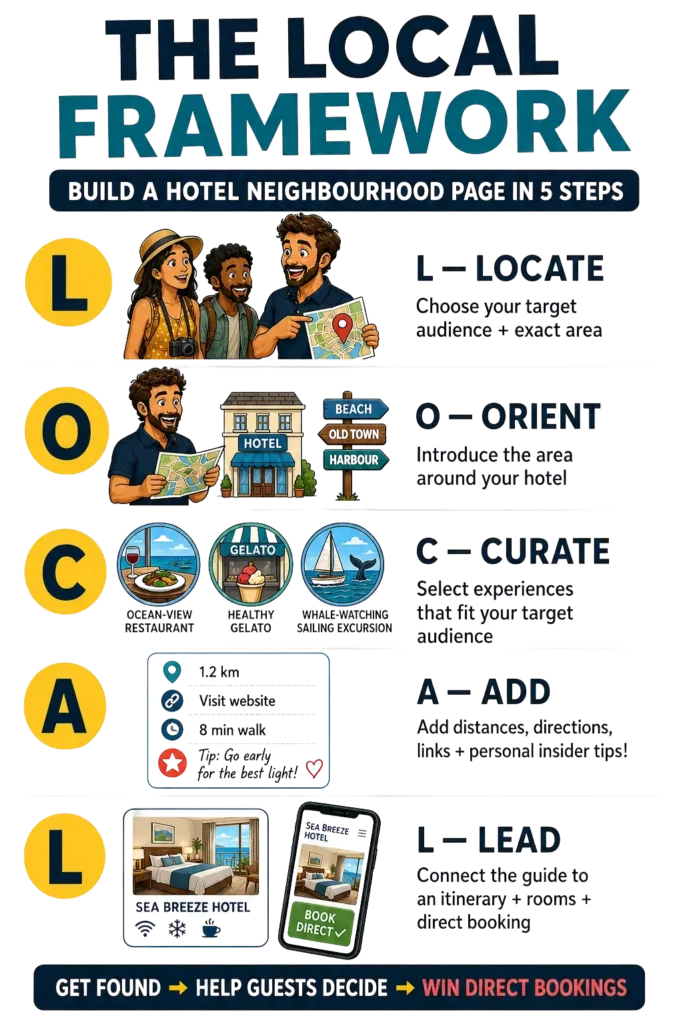
The LOCAL Framework: Locate your guest and neighbourhood, Orient them from your hotel, Curate the right recommendations, Add actionable local detail, and Lead them toward the stay.
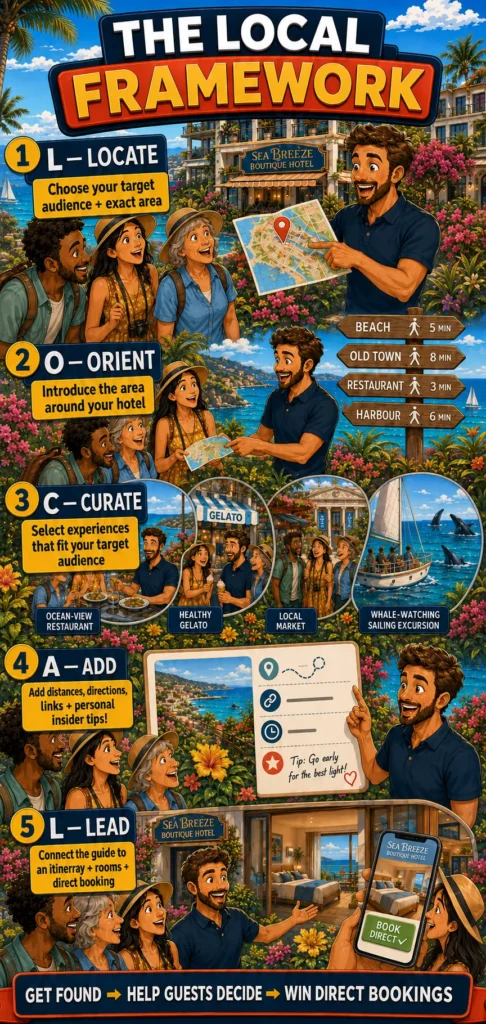
In this guide
- Why most hotel neighbourhood pages never get found
- The LOCAL Framework: how I’d build a neighbourhood page guests and AI actually trust
- Deep dive: building every part of your neighbourhood page
- Practical examples from real hotel neighbourhood pages
- Neighbourhood page checklist: is your page ready?
- How this connects to your bigger direct booking strategy
- Further reads to grow your hotel’s visibility
- FAQs on hotel neighbourhood pages
Key Highlights in this article
✔ A neighbourhood page isn’t a destination guide, it’s a decision page. Its only job is to help the right guest decide the area fits them, and that your hotel is the right base for it.
✔ Generic local content doesn’t get found. Travel blogs and tourism boards already own the vague version of your neighbourhood. Being specific about your area, your guests and your own recommendations is what gets you found instead.
✔ Start with one strong page, not five thin ones. I’d only split a neighbourhood page into several once the guest, the recommendations or the offer genuinely differ.
✔ The LOCAL Framework is how I’d build it: Locate your guest and neighbourhood, Orient them from your hotel, Curate the right recommendations, Add actionable local detail, and Lead them toward the stay.
✔ Try the free Hotel Neighbourhood Page Builder. I built a Custom GPT that walks you through the whole LOCAL Framework and turns your team’s local knowledge into a publishable page. It’s free to use, more on it in Chapter 6.
Chapter 2: Why Most Hotel Neighbourhood Pages Never Get Found
Before I worked in search, I worked hotel reception in Vienna for a few years. If there’s one question I answered more than any other, it wasn’t “do you have a room available.” It was some version of “what should we do today.” Where to eat, where the tourists don’t go, whether the walk to wherever is actually worth it. I gave some version of that answer probably five times a day, and I gave it away for free at the desk.
That’s exactly the knowledge most hotel neighbourhood pages are missing.
There’s a structural reason for that, and it comes down to competition. Travel blogs and tourism boards write about your neighbourhood too, and they know there’s a lot of search volume in it, so they’ve been chasing it for years with real budgets and real teams behind them. Every other hotel nearby is writing about the same streets and the same five landmarks as well. If your page looks like theirs, it’s fighting for exactly the same sliver of attention, and losing, simply because there are more of them and they’ve been at it longer.
What I’ve noticed, going through hundreds of these pages, is that hotels tend to create a version of the same neighbourhood page everyone else already has. And a page like that doesn’t get any attention, from guests or from Google.
So what actually gets a page to show up on Google and AI tools? It needs to offer something unique, something with real value that only your hotel can provide. If I were writing this page for your hotel, I’d target it specifically at your guests and tie it directly back to your hotel, your rooms, your team, your recommendations. That’s what makes it genuinely different from a destination guide. It stops being about the neighbourhood in general, and starts being about the neighbourhood through your hotel’s eyes.
That’s the idea underneath the whole framework below.
Chapter 3: The LOCAL Framework for Hotel Neighbourhood Pages
A hotel neighbourhood page really only has one job: help the right guest understand what your neighbourhood is like, and why your hotel is a good place to experience it from. Everything below serves that job, and I’d build it around a framework I call LOCAL, mostly because that’s exactly what these pages are usually missing: something genuinely local.
Here it is at a glance.
Step | What It Does | Guest’s Question |
L — Locate | Define your guest and your exact neighbourhood | “Is this written for someone like me, and where exactly is this?” |
O — Orient | Set the scene from the hotel’s point of view | “What’s this area actually like, and where does the hotel sit in it?” |
C — Curate | Select recommendations that fit your guest | “What’s genuinely worth my time here?” |
A — Add | Give practical, first-hand detail for each recommendation | “How do I actually get there, and why should I trust this?” |
L — Lead | Turn the page into a reason to stay and book | “Now what, and where do I book?” |
That’s the framework in five steps. In Chapter 4, I’ll go through each one properly, with the practical tips and small checklists I’d actually use if I were building this page for your hotel.
The LOCAL Framework at a glance. Locate your guest and neighbourhood, Orient them from your hotel, Curate the right recommendations, Add actionable local detail, and Lead them toward booking.
The Basic Plays. What Also Needs to Be in Place
This page won’t work in isolation. It needs a website Google and AI can actually read, and a homepage that gives guests context before they land here. If those aren’t solid yet, I’d start there:
SEO and AI search visibility. If search engines and AI tools can’t understand your hotel or your website structure, a great neighbourhood page still won’t get found. → SEO for hotel websites → AI search optimisation for hotels
A homepage that gives context. Guests who land on your neighbourhood page from Google or an AI answer often don’t know your hotel yet. Your homepage still needs to do its job. → How to structure a hotel homepage
One more thing before we get into it. What I keep seeing across the hotels that actually get picked up by Google and AI tools is real, first-hand detail, the kind only someone working at the hotel could know. I call that the Unique Insight Signal in my AI search framework, and it’s worth keeping in mind for every step below. If a sentence on your page could just as easily sit on a tourism board’s website, it’s probably worth rewriting.
Chapter 4: Deep Dive - How I'd Build Every Part of Your Neighbourhood Page
L — Locate the Guest and the Place
Start with who you're writing for
Before you write a single word, decide who this page is for. Different guests want completely different recommendations, and a page trying to speak to everyone usually ends up speaking to no one.
Practically, I’d start by looking at your guest stats. What’s the biggest group of guests staying at your hotel? What’s the second biggest? Keep working down the list until you have a real picture, not a guess.
That current mix is a good starting point, but I wouldn’t stop there. It’s shaped partly by whichever channel brought those guests in, often an OTA, and not necessarily by who your hotel is actually best suited for. So I’d also look at your reviews and guest feedback for what people mention unprompted, the questions your reception team gets asked most, search demand for your area, and honestly, the guests you’d like to attract more of, not only the ones you currently get.
Beyond the usual couples, families and business travellers, here are more ways to think about your audience:
- By trip type: couples, singles, families, groups of friends, business travellers with some leisure time
- By life stage: young travellers, older guests, Gen Z, millennials, families with very young kids or with teens
- By interest: art lovers, adventurers, wellness travellers, foodies, culture and architecture fans
- By practical need: car-free travellers, guests with limited mobility, pet owners
- By occasion: honeymoon, anniversary, a concert or match weekend, a seasonal trip
It could be that you only need one neighbourhood page that speaks to all of your guests. But sometimes it’s worth splitting into a few, so you can speak to different audiences more clearly. If I were deciding, I’d only split once the search need is genuinely different, the recommendations actually change, and there’s enough original content to justify a page of its own, something like “[Neighbourhood] for Couples.” Otherwise, a single page with clearly labelled sections or itineraries for different guests does the job just as well, without spreading your best content too thin.
Then define your exact neighbourhood
The second half of Locate is about place, not people, and specificity matters just as much here.
Take a hotel in Santorini as an example. There are already plenty of guides to Santorini itself, but a hotel there could write about the actual neighbourhood it sits in, Oia, say, or Imerovigli, which is a far less contested topic. The same logic works anywhere. Write about the whole city, and you’re competing with every guidebook and tourism board that exists. Write about your specific street or neighbourhood, and there’s a lot less competition, and a lot more relevance for the guest who’s actually staying there.
In my research, mentioning specific locations, not just the city name, was one of the clearest factors separating hotels that showed up on Google and AI from ones that didn’t. So I’d make sure to name the specific neighbourhood both in your title and throughout the text. Don’t overdo it, you don’t need to spam it into every sentence, but say it clearly and say it more than once.
It also helps to think in layers: your exact neighbourhood or street, the nearby landmarks guests will recognise, and the wider destination they actually searched for. And be honest about trade-offs. A neighbourhood that’s quiet at night, has limited parking, or is a bit of a walk from the main sights isn’t something to hide, it’s useful information, and it filters in the guests who will actually be happy there.
O — Orient Them From the Hotel
I’d write this section last, once the rest of the page exists, because that way you can actually reference the tips and recommendations you’ve already written instead of guessing what might be in there. Keep it short, a few sentences that teaser three to five highlights from the page and describe the neighbourhood itself: what it feels like, who tends to enjoy it, where your hotel sits within it, and why it’s a genuinely useful base for exploring it.
Guests, and AI tools reading the page, should get the shape of the neighbourhood and your hotel’s place in it before they’ve scrolled past this first section.
C — Curate the Right Recommendations
Pick categories that actually fit your neighbourhood, not a template
Structure the rest of the page around categories, and list three to five examples in each. Beyond the obvious ones, here’s a fuller menu to pick from:
- Top highlights, the must-sees every traveller expects
- Personal recommendations from you or your team
- Restaurants, with breakfast, lunch and dinner options, and local dishes worth trying
- Coffee, breakfast spots and bakeries
- Bars and nightlife
- Attractions suited to your specific target audience
- Tours and activity providers
- Parks, walks and outdoor spots
- Shopping and local markets
- Family-friendly places
- Rainy-day ideas
- Free or low-cost experiences
- Day trips
Don’t include all of them. Pick four to seven that genuinely fit your neighbourhood and your primary guest, and write a short intro for each category, a few sentences on what to pay attention to or what makes that category special in your specific area. This is a good place for a bit of personality too. I’m from Vienna, so obviously I’d write about my favourite Schnitzel place.
Personal recommendations deserve their own category, and it’s the one that makes the page genuinely yours. Put things here that you or your team would actually recommend, not what a guidebook says you should recommend.
There are almost always tour and activity providers in your area, and I’d recommend entering into some partnerships and mentioning your partners here. It’s a genuinely good way to make some extra revenue, and it gives guests a shortcut to something you already trust. Just be upfront where it’s a partnership. A page where every single “personal recommendation” turns out to be a paid partner starts to feel less trustworthy, both to guests and to AI tools trying to work out how reliable your content actually is.
A — Add Actionable Local Detail
Write each recommendation the same way
For every place you recommend, I’d stick to the same structure. What it is, briefly. Why you recommend it, either your own reasoning or genuine feedback from guests who loved it, both work better than a vague adjective. At least one image. And a few practical details, without creating a lot of ongoing maintenance work for yourself: a link to the place’s website if it has one, and how to get there from your hotel specifically, walking minutes, which tram or bus, or whether you can arrange a transfer. This is one of the details that makes the page unmistakably yours. I’d avoid listing exact opening hours if they tend to change, just point to the link instead, or give an approximate window.
Then, the personal note. This might be the single most powerful part of the whole page. Something like “visit in the morning to avoid the crowds,” or “the light at sunset here is truly spectacular,” or “order the tiramisu, they use an ingredient you won’t have tasted before.” Or go further and mention something only a local would know: “Johnny took over the place three years ago, and he’s one of the warmest guys you’ll meet.” That’s the sentence a tourism board could never write, because they don’t actually know Johnny.
To see the difference this makes, compare these two:
Generic: St Stephen’s Cathedral is one of Vienna’s most famous attractions and is worth visiting.
Useful: St Stephen’s Cathedral is a great first stop if it’s your first time in Vienna. From our hotel it’s about a 12-minute walk, or two stops on the tram. Our team recommends arriving before 9am if you want the square to yourself before the tour groups arrive. Check current visiting and tower-access times on the cathedral’s official site.
Same landmark, completely different value to the guest reading it, and to whatever AI tool might be citing it.
Prove it's actually first-hand, and keep it fresh
One thing that’s easy to skip: give the page a named author, ideally someone on your team, not just “the hotel.” Add a “last updated” note, and mention where recommendations came from, repeated guest feedback is a good source. I’d also put this page on a seasonal or quarterly review, because a fantastic recommendation for a restaurant that closed down six months ago does the opposite of what you want. Freshness and a real name behind the page both strengthen the Unique Insight Signal I mentioned earlier, and both are things AI tools increasingly weigh when deciding what to recommend.
L — Lead Them Toward the Stay
Consider an itinerary
An itinerary isn’t a must, but it’s often a nice addition at the end of the page. Think about how long your guests typically stay. If it’s three days, propose an idea for what a three-day itinerary in the neighbourhood could look like. It’s also one of the harder things for a tourism board or blog to copy, simply because it’s built around an actual stay at your hotel, not a generic visit to the city.
Don't forget the booking option
Keep in mind that people might land on this page without knowing your hotel at all, because they came from Google or an AI answer, not your homepage. So I’d give a short intro to the hotel somewhere on the page, and link clearly to where guests can book a room. Always think about directing people back toward booking, even on a page that’s mostly about the neighbourhood.
If you want that transition to feel less abrupt, build toward it gradually. Something like: explore the rooms, see why the hotel is a good base for this itinerary, check availability, book directly. Mention the hotel early, and save the stronger prompt for later in the page.
Add FAQs
If your guests commonly ask questions about the neighbourhood, I’d put the most common ones here. Things like whether the area is good for first-time visitors, whether you need a car, or how far it actually is to the main sights. Just make sure they’re genuine questions guests ask, not ones invented to fit in a keyword.
Want more practical hotel website ideas in your inbox?
In my newsletter, I share clear, actionable ideas for hotel owners and marketers who want more guests to find, trust, and book their hotel directly.
Chapter 5: Real Examples of the LOCAL Framework in Action
Theory is easier to use once you’ve seen it working, or not quite working, on a real hotel website. Here are five neighbourhood pages, each one showing a different step of the LOCAL Framework particularly well, and each one with something I’d still improve.
Example 1 - Locate: Ovolo Central's guide to Queen's Road, Hong Kong
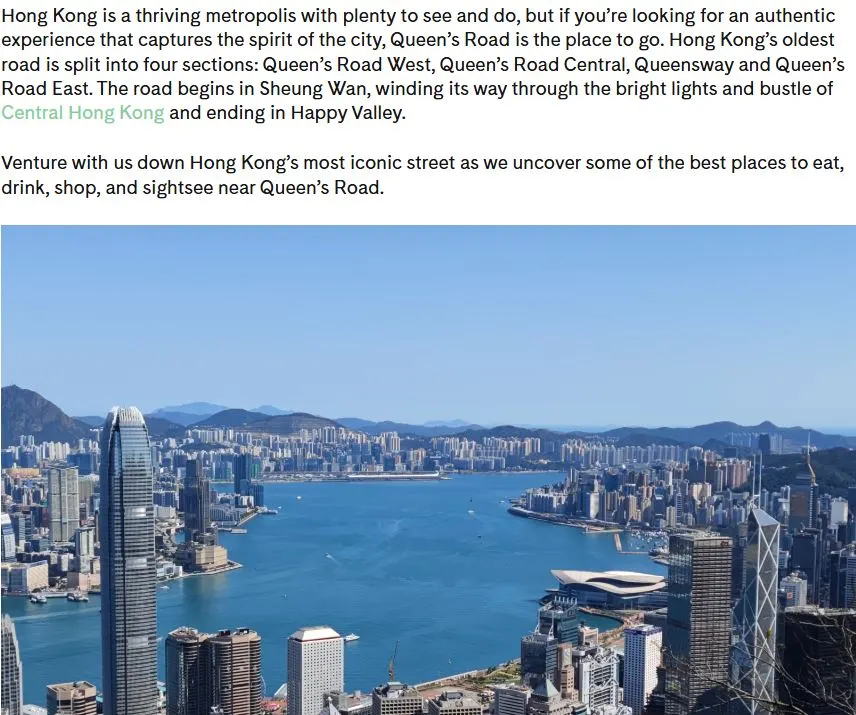
Ovolo Central didn’t write another “things to do in Hong Kong” post. Their guide to Queen’s Road walks through the actual street the hotel sits on, explains that it runs through four distinct sections, and places the hotel right at the crossroads of SoHo and Lan Kwai Fong.
What works:
- The specific street is in the title and the opening paragraph, not buried in the text
- Readers get real geographical orientation, Sheung Wan, Central, Happy Valley, before a single recommendation shows up
- It mixes different kinds of experiences along the street: shopping, nightlife, architecture, a historic temple
- The hotel only appears at the very end, as the answer to “where should I stay near all this”
The takeaway: don’t describe the whole destination. Define the exact street or area around your hotel, and explain how it connects to places guests already recognise.
What I’d change: the individual recommendations stay fairly general, a paragraph about a shopping mall, a paragraph about a temple. Adding walking times from the hotel and a genuine team recommendation or two would make it feel more like Ovolo’s page and less like something any travel blog could have written.
Example 2 - Orient: Treehouse Hotel's Marylebone guide, London
Treehouse London’s neighbourhood guide opens by describing Marylebone as village-like and lived-in, then places the hotel clearly within it before getting into recommendations.
What works:
- Guests understand the character of the area before anything else
- The exact neighbourhood is named prominently, not just “London”
- The hotel is positioned as the starting point for everything that follows
- Recommendations are grouped into categories, nature, shopping, culture, rather than one long list
The takeaway: before you list a single attraction, help guests picture what the neighbourhood actually feels like, and where your hotel sits inside it.
What I’d change: the guide wanders. It includes Battersea Park, which is a proper trip away from Marylebone, not a neighbourhood stop, and some of what’s covered could sit on any London tourism site. Staying closer to Marylebone itself, with hotel-specific distances and a personal tip or two, would make it considerably stronger. It’s a good example of solid orientation, and a good example of scope creep, at the same time.
Example 3 - Curate: Ace Hotel Sydney's Surry Hills guide
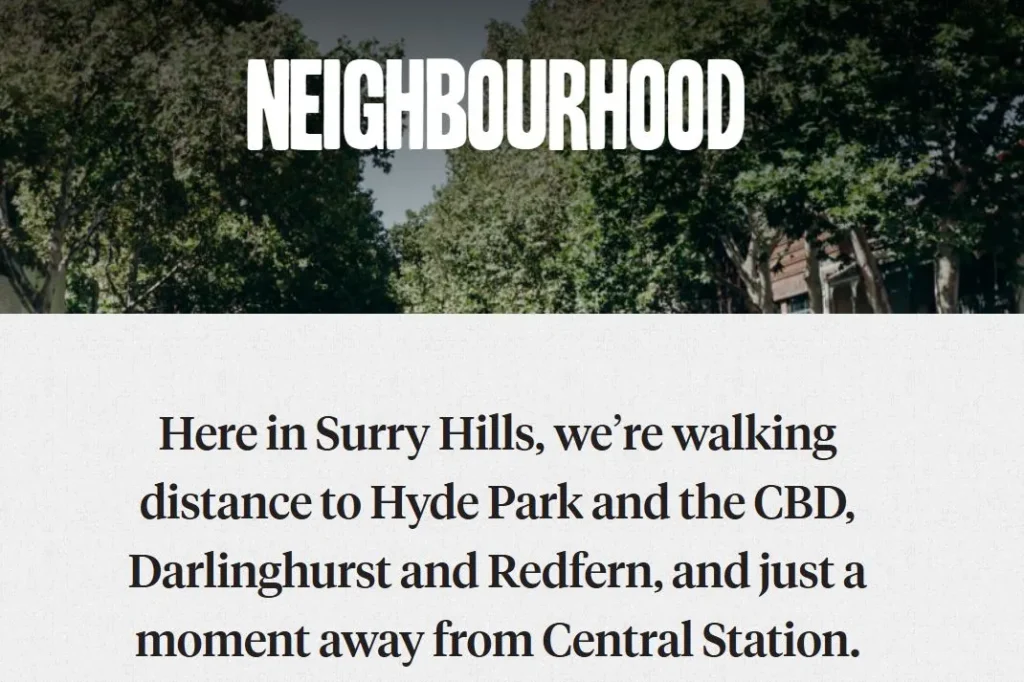
Ace Hotel Sydney’s neighbourhood guide names Surry Hills immediately and explains how it relates to Hyde Park, the CBD, Darlinghurst and Redfern.
What works:
- Guests can browse recommendations by what they actually want: dining, culture, shopping, events
- Individual entries include an address, contact details and a short write-up in Ace’s own voice
- A few entries mention hotel-specific context, like how far something is on foot
The takeaway: curate by what different guests want to experience. Don’t just dump everything into one giant “things to do” list.
What I’d change: there’s simply a lot on the page, and it can get overwhelming. Naming a few genuine team favourites, and adding walking distances from the hotel consistently rather than occasionally, would turn it from a directory into more of a decision page.
Example 4 - Add: The LINE LA's 24-hour Koreatown guide

The LINE LA didn’t hand this to a copywriter or credit it to “the hotel.” Their 24-hour guide is written entirely from the perspective of Luisa Maier, a Sommer Swim ambassador, guiding readers through her own curated day and using the hotel as her base.
What works:
- Every recommendation carries her name, not a generic staff byline, with exact times, addresses and specific dish call-outs throughout
- Genuine insider detail: an off-menu pasta at one restaurant worth asking for, plus a heads-up that reservations there are essential
- Recommendations go right down to the dish, marinated short ribs and kimchi fried rice at the Korean BBQ spot, not just “great Korean food”
- It’s honest about distance too, flagging when a coffee spot is a 15-minute drive outside Koreatown rather than pretending everything is next door
The takeaway: the more specific and personal the voice behind a recommendation, the more it reads like something only your hotel could produce. A named guide who tells you exactly what to order beats a paragraph that just calls somewhere “popular.”
What I’d change: because it’s built as one continuous 24-hour itinerary, it’s less browsable than a page organised by category. If you already know you want dinner ideas, you have to scroll through the whole day to find them. Splitting personal picks like this into both an itinerary and standalone category sections would let guests use it either way.
Example 5 - Lead: Ellerman House's Discovery curated journey, Cape Town
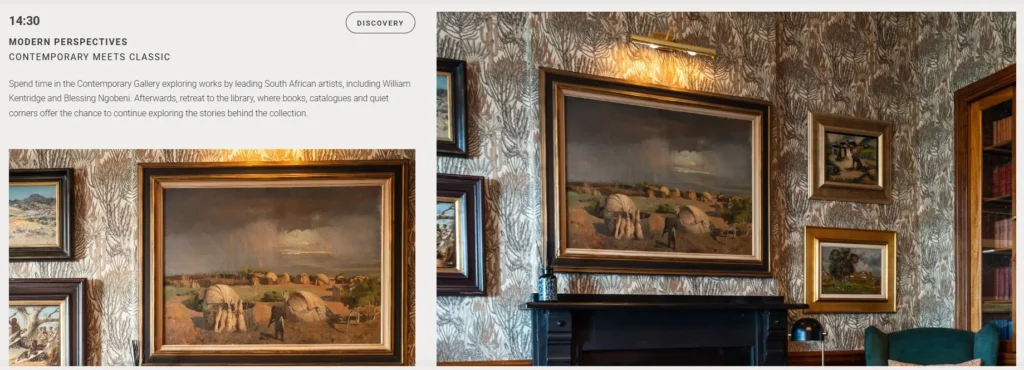
Ellerman House built their curated journeys around exactly this idea, turning a full day into a reason to book rather than a list of things guests might just as easily find on their own.
What works:
- It’s a genuine hour-by-hour day, breakfast at 08:30 through to dinner at 19:00, built entirely around the property’s own art collection, wine gallery and restaurants
- Every stop is specific, not “enjoy a wine tasting” but a guided tasting through the house’s own wine gallery, with real detail on what that includes
- It closes with a clear, low-pressure next step: speak to the reservations team, save the itinerary, or share it with someone else planning a trip
- Guests can browse other journeys built around different interests, art, wine, cuisine, stillness, so the format works for more than one type of guest
The takeaway: an itinerary earns its place on a website once it stops being “things you could do” and turns into a specific day you can picture yourself living, then closes with an easy way to act on it.
What I’d change: this journey stays entirely on the property, it never actually sends guests out into Bantry Bay itself. That’s a smart way to showcase what’s exclusive to the hotel, but a version of this same format built around the neighbourhood outside the door, mixing local restaurants and viewpoints in with the house’s own experiences, would do double duty: sell the stay, and get the hotel found for the area around it too. For a journey outside the property, check example 4 of The LINE LA.
Want more hotel website ideas and examples like this?
I regularly share practical thoughts on hotel SEO, AI search, direct bookings, website clarity, and how independent hotels can become easier to find and book directly.
Chapter 6: Try the Hotel Neighbourhood Page Builder, Free
A generic checklist for this article would tell you to check off “audience defined” or “categories chosen.” Useful, but not particularly exciting, and honestly, not enough on its own to actually get a page like this written.
So instead of a checklist, I built a tool. It’s called the Hotel Neighbourhood Page Builder, a free Custom GPT that walks you through the whole LOCAL Framework and turns your team’s local knowledge into an actual publishable page. All you need is a ChatGPT account, no sign up, no cost.
The idea behind it is simple. You bring the knowledge nobody else has, your team’s actual recommendations, the walking routes you’d tell a friend, the honest pros and cons of your neighbourhood. The GPT brings the research, official names, addresses, distances, links to check current details, and turns all of it into a structured draft you can publish.
Here’s roughly how the division of work looks:
Your hotel provides | The GPT researches and creates |
Who you want to attract | Likely audience needs and any missing categories |
Your personal recommendations | Official names, addresses and websites |
Why you recommend each place | Walking, transit or driving estimates |
Insider tips | Links to check current opening times and details |
Guest feedback and common questions | A structured first draft of the page |
Honest local pros and cons | An SEO title, description and internal link suggestions |
The hotel stays responsible for the part that actually makes the page different from everyone else’s, the genuine local knowledge. If you let it pick all the restaurants and attractions itself, you’re right back where you started, with another generic guide.
Here’s how it actually works, once you open it:
- It gets to know your hotel. Website, address, neighbourhood, main guest groups, and it reviews what’s already on your site first, so you’re not starting from a blank page.
- It interviews you, in small batches. Not a 30-question form, just a few simple prompts at a time. Which three places does your team recommend most. Where would you send a couple for a memorable evening. Which popular attraction actually needs an insider tip to enjoy properly.
- It flags the gaps. If your restaurant and culture recommendations are strong but there’s nothing for a rainy day or for families, it tells you, and keeps its own suggestions clearly separate from yours until you approve them.
- It researches the practical details. Distance from your hotel, how to get there, who each place suits, and the source it used, so nothing goes out of date the moment you publish it.
- It writes the full page. Title, meta description, orientation intro, categories, an itinerary, contextual booking links, genuine FAQs, and a “written with, last updated” line.
- It checks its own work against the LOCAL Framework before calling the draft done, Locate, Orient, Curate, Add, Lead, and flags anything still missing.
This is a first version, and I’d genuinely like to hear how it goes for you. If a recommendation feels generic, a question feels clunky, or it misses something your hotel needed, just tell me. I’m actively improving it based on what real hotels run into, not what I assumed they would.
Generally, my recommendation is to rewrite the output. Take it as a structure, but give it your personal voice and tone.
Chapter 7: How This Connects to Your Bigger Direct Booking Strategy
A neighbourhood page sits right alongside your other core pages, your homepage, your room overview, your room details. It works as a discovery page too. Someone planning a trip to your area, searching for recommendations, might land here before they’ve ever heard of your hotel. If they genuinely like what you’ve recommended, they already have your hotel in mind, without you spending a cent on ads.
It also gives Google and AI tools a lot more context about where your hotel actually is and what guests can do nearby. That context increases your odds of showing up in the searches that matter. If you describe the beaches near your hotel, a sailing trip your guests can book, and a restaurant with ocean views and private tables, an AI tool putting together a recommendation for someone chasing exactly that kind of trip has a real reason to mention you.
Beyond visibility, a good neighbourhood page becomes a decision page in its own right. When a guest can picture what staying at your hotel and exploring your neighbourhood would actually feel like, they’re simply more convinced, and more likely to book.
So this is a page that can genuinely add value to both discovery and booking. It works best alongside the basics I mentioned in Chapter 3, a website Google and AI can actually read, and a homepage that gives guests context the moment they arrive.
Chapter 8: Go Deeper, Related Reads 🔗
Once your neighbourhood page is live, the rest of your website’s visibility and booking system needs to hold up its end too. These articles cover the pieces that connect directly to what you just read:
On using your neighbourhood as a booking strategy, not just content → How Boutique Hotels Get More Direct Bookings: 8 Strategies That Work. Strategy 6 goes deeper into using your location as a direct booking advantage, beyond just the neighbourhood page itself.
On getting your hotel recommended by AI tools → Hotel AI Search Optimisation. The Unique Insight Signal I mentioned in Chapter 3 is explained in full here, along with the rest of what makes AI tools trust and cite a hotel.
On how guests actually search before they book → How Guests Actually Search for Hotels. Useful if you want to understand the kind of specific, location-based searches your neighbourhood page should be targeting.
On where this page fits into your overall website → How to Structure a Hotel Website, so your neighbourhood page links properly into the rest of your site instead of sitting there as an island.
On writing the kind of specific, sensory detail that makes a recommendation card work → How to Write Hotel Room Descriptions That Drive Direct Bookings. The same principles apply almost directly to writing your neighbourhood recommendations.
Conclusion: Your Neighbourhood Becomes a Reason to Book, Not Just a Page
Most hotel neighbourhood pages are invisible because they’re trying to do a job that’s already taken. Google, AI tools and guests don’t need another generic list of attractions, that job belongs to tourism boards and travel blogs, and they’re better resourced for it than you are.
What they don’t have is your hotel’s actual knowledge. The restaurant your team would send a friend to. The walk from your front door that takes twelve minutes, not “a short stroll.” The honest note about which beach suits families and which one is better for a quiet sunset. That’s the part nobody can copy, and it’s exactly what the LOCAL Framework is built to get out of your head and onto the page.
Start with Locate, decide who you’re writing for and exactly where you are. Build from there. You don’t need every category, every recommendation, or a five-page series covering every guest type on day one. One well-built page, written honestly and tied clearly back to your hotel, will do more for your visibility and your bookings than ten generic ones ever could.
Want to know if your neighbourhood page is actually working?
I offer a free Hotel Website Check where I look at your website, including pages like this one, and show you specific opportunities you might be missing.
If you found this article helpful and want more ideas like this:
👉 Follow me on Substack for deep-dive guides on hotel SEO, AI, and direct bookings
👉 Connect on LinkedIn for shorter insights and real-world examples
Want to improve more than just this one page?
This guide focuses on one specific part of your hotel website. But direct booking growth usually comes from improving the full system: your positioning, homepage, room pages, feature pages, Google visibility, AI search readiness, and booking journey.
FAQs on Hotel Neighbourhood Pages
1. How long should a hotel neighbourhood page be?
There’s no fixed word count. What matters more is whether every section earns its place. A page with four well-developed categories and genuine recommendation cards will outperform a 3,000-word page padded out with generic descriptions. If you’re covering four to seven categories properly, you’ll likely land somewhere between 1,500 and 2,500 words naturally.
2. Should I create a separate neighbourhood page for every audience I serve?
Not at first. Start with one strong page for your primary guest. Only split it into separate pages once the search need, the recommendations, or the offer for that audience is genuinely different, and you have enough original content to support a page of its own.
3. Do I need professional photos for every recommendation?
No, but I’d aim for at least one image per recommendation, and it doesn’t need to be professionally shot. A genuine photo from your team, taken on a phone at the actual restaurant or viewpoint, often feels more authentic than a stock image anyway. Still, put good-quality images; the appearance needs to be professional.
4. How often should I update my neighbourhood page?
I’d put it on a seasonal or at least quarterly review. Recommending a restaurant that closed six months ago undoes a lot of the trust you’re trying to build, both with guests and with AI tools that increasingly weigh how current your content is.
5. Will a neighbourhood page actually help me get recommended by AI tools like ChatGPT?
It can, but only if it’s specific. Generic descriptions of your city give AI tools nothing unique to cite. A page with named streets, hotel-specific directions and first-hand recommendations from your team gives them something no other website has, which is exactly what tends to get picked up.
The Prompt used To Create this article
I want to be transparent on how this article was written, so below you will find the prompt to create this article. Of course, I made and asked for adjustments afterwards, but here is the initial input:
Check the prompt
Can you create a compelling blog article for my website, www.patricklindbichler.com? I will first give you a full outline of my draft for the article, so you have the full context. Then we will create each section together step-by-step. So, no need to start writing, just give me feedback on the ideas of the draft and where you would see good additions or improvements.
I want to make the articles a bit longer, so people can find clear information. The article should be clear and easy to understand, especially for people who are new to the topic. Still it should stay as compelling as the original article and also have the same length. It should be written in good American English, using not too complicated words so that even non-native English speakers can follow along easily. The tone should reflect my expertise as a thought leader in SEO, content creation, and leadership. Feel free to use examples from my experience as proof points and explain them in a clear and compelling way.
I am typically a positive and humorous person, so the writing style can be upbeat with a few lighthearted jokes here and there—just nothing offensive. The article should be engaging, fun to read, and educational. Please follow the structure outlined below, and feel free to expand on the points with additional context to ensure that each paragraph presents clear arguments.
Structure of the article:
- Introduction or The Problem (Hook): Start with a paragraph that summarizes the topic and grabs attention. You can make a strong statement or ask a thought-provoking question that will be answered later in the article.
- Key Highlights (3-4 bullet points): Include a few short bullet points summarizing the key takeaways of the article. Each point should be 1-2 sentences long.
- Main Content: Break the main part of the text into several text parts, each with a heading optimized for SEO and AI search. Each text part can have 1-3 paragraphs with 5-20 sentences each, depending on how much content is needed to explain the point clearly and bring the argument across. The paragraphs should be easy to read and compelling. Here is a structure for the main content:
- Explain Why the Problem Exists
- The Framework / Solution
- Deep Dive into Each Element
- Practical Examples
- Quick Checklist
- Connect to the Bigger Strategy
- Internal Links (Very Important)
- Headlines: Please formulate the headlines and include important keywords for SEO.
- Conclusion: Wrap up the article by summarizing the main points and inviting readers to reach out if they have any questions or want to learn more.
- FAQs: Include 5 frequently asked questions about the topic, with clear answers that add value to the reader.
Formatting:
- Use bold for key points, ensuring every 4th or 5th sentence has something in bold for emphasis.
- Add emojis throughout (but no more than 50 total) to make the article more visually appealing.
- If you include practical tips, illustrate them with real-life examples to make the content relatable.
- Please make the article a minimum of 1800 words. Feel free to ask me if you need more input or add information and context where you feel it’s necessary to convey a message or provide more clarity.
Goals:
- Please optimise the article for SEO. Give recommendations for search terms to include and integrate them into the titles of the paragraphs and the beginning of the article
- Please make the article engaging so people are intrigued to read, but also enjoy reading.
- What readers learn in the article, should be easy to apply for them because everything is explained clearly and has examples
Please use the following input to create the article:
- The Problem (Hook)
According to my research, there is one page that is particularly impactful for SEO and AI search:
- The neighbourhood page
Why? The hotels that were ranking on Google and got recommended by AI provided very specific context about their location, plus of course mentioned it specifically.
A great neighbourhood page can provide the context of where your hotel is located, what your guests experience in the area and why your hotel is a great choice for a visit of the neighbourhood.
- Explain Why the Problem Exists
At the same time, I’ve seen it rarely that hotels really provide value in a neighbourhood page.
What you need to consider is, that there is a lot of competition. There are travel blogs, tourism boards, other hotels etc. describing a location to travelers. Because they know that there is a lot of volume.
What I’ve often seen is that hotels create similar neighbourhood pages to all the others out there. And they don’t get any attention.
So what do you need to do, so that your page shows up on Google and AI tools? It needs to provide unique insights and value. If I’d write a neighbourhood page for your hotel, I’d target it towards your guests and connect it to your hotel. This way you make it automatically very unique and specific, plus you attract an audience that is very likely to book your hotel.
In the next steps I’ll provide a framework on how to do that.
- The Framework / Solution
@Claude: Introduce the framework of chapter 4 in a clear and precise way
- Deep Dive into Each Element
Audience
Before I’d create a neighbourhood page, I’d define a target audience, because for different audiences, different recommendations would apply. I’d split them based on the experience they want to have. It could be that you would just need one neighbourhood page, that applies to all your guests, but sometimes it’s worth splitting them to speak to different audiences clearly.
Practically I’d approach this by looking at your guest stats and checking: What is the biggest group of guests at your hotel? What is the second biggest group of guests at your hotel? And so on.
Potential audiences are: Couples, Singles, Families, Groups of friends, sometimes business travelers when they have some leisure time, young, older people, Gen Z, Millennials, Families with very young kids/teens/…
But it can also be like art lovers, adventurers, wellness people, …
@Claude can you check for more potential audiences?
With this in mind, you can actually create several variations of your neighbourhood page, with suitable recommendations for each audience.
Location
Another thing to clarify is to specifically define the area you describe. To increase the value of your page for SEO and AI search, I recommend to describe your specific neighbourhood. Take for instance a hotel in Santorini. There might be plenty of guides on Santorini, but maybe for their guests they could create a page for the specific location of the hotel, which might be Oia for instance. Also works if the hotel is in Imerovigli and to describe this neighbourhood.
In my study of hotels appearing on Google and AI. Mentioning specific locations was one of the key factors for hotels showing up. So I find it very important to mention the specific locations in the title and text. Of course don’t spam the text with it, but name it.
Intro
At the top of the page, write a short introduction. My recommendation is to write it at the end, because this way you can reference the tips you are giving. This can be a short text that teasers 3-5 highlights from the page and describes the neighbourhood of the hotel.
Category
To structure your page, I’d think of categories. And then for each category, list 3-5 examples. Here are my suggestions for categories:
- Top Highlights: What are the must sees that every traveler visits in the area. They should never miss on such a page, otherwise people don’t feel they are complete
- Personal recommendations: This is a really powerful category and it makes your neighbourhood guide truly unique. Put here things that you or your team would personally recommend
- Restaurants: People got to eat, so propose them with some options for breakfast, lunch and dinner. This section gets better when you keep your target audience in mind. Plus also think of your guests wanting to try local experiences and dishes. I’m from Vienna, so obviously I’d write about my favourite Schnitzel place.
- Attractions: Those can vary a lot depending on the location you are. Think of the things your target audience typically does
- Tours: There are always tours and activity providers in almost every area. I recommend to enter some partnerships and mention your partners here. It’s a good way to make some extra revenue.
@Claude what would you add to the list?
For each category, write a short intro to provide some context e.g. what to pay attention to for restaurants or the top highlights. Something that is generally applicable to your neighbourhood and feels like a specific insight.
Content of each recommendation
Okay now we have established the structure, what should be actually written for each recommendation. Since you already have quite a list and variety of recommendations. Here I see many hotel write something generic or copy from other websites. I’d rather taylor the information for your guest. They are the target audience of this page. So here is what I’d write:
- What it is: Briefly explain the place
- Why they should visit the place: Here I have 2 powerful angles, one why you recommend going there, or why other guests loved going there (use feedback from other guests). And write about. This makes it very authentic why you recommend the place.
- Images: Put some images of the place (at least one)
- Practical information. Add a few practical infos, but don’t create too much maintenance work for you e.g.
- Link to the website of the place (if available)
- How to get there from the hotel → very important, mention specifics how to get there from your hotel like walking times in minutes, which public transport to take or how to drive there from the hotel or if you can arrange a transfer. This makes the section very specific and unique to your hotel, which is what you want to achieve
- Don’t put opening times if they constantly change, say they can check it through the link or put approximate hours
- Personal note: This is one of the most powerful ideas. Writing a personal note so guests have the feeling they are getting insider information. This can be things like “visit it in the morning to avoid crowds”, “the light at sunset is truly spectacular” or “order their Tiramisu, they use a special ingredient you have not tasted before”. Plus you can mention something only locals know, like “Johnny took over the place 3 years ago and he is the warmest guy you can imagine”
Itinerary
Not a must, but sometimes a nice idea is to put an itinerary at the end e.g. if guests stay 3 days at your hotel, what would you propose as an idea for an itinerary.
Booking option
Keep in mind that people might land on this page without even knowing your hotel, because the came directly from Google or somewhere else and not your homepage. So provide an intro to your hotel on this page and link to options where they can book a room. Always think of directing people to booking.
FAQs
If your guests commonly ask questions about your neighbourhood, put the most common ones in this section.
- Practical Examples
1. Locate: Ovolo Central’s Queen’s Road guide, Hong Kong
Ovolo does not create another broad “Things to do in Hong Kong” article. It focuses on Queen’s Road, explains that it consists of four sections, and positions it in relation to Sheung Wan, Central and Happy Valley.
What fits your framework:
- The specific street appears in the title and introduction.
- The guide gives readers geographical orientation before introducing places.
- It covers different experiences along the street: shopping, nightlife, architecture, culture and the waterfront.
- The final section introduces Ovolo Central as a place to stay near Queen’s Road.
- It ends with a direct booking option.
The strongest takeaway:
Don’t describe only the destination. Define the exact area surrounding the hotel and explain how it connects to places guests recognise.
What I would improve:
The individual recommendations remain relatively general. Ovolo could strengthen the page with walking times from the hotel, team recommendations and more specific advice about who should visit each place.
2. Orient: Treehouse Hotel’s Marylebone guide, London
The Treehouse Hotel neighbourhood guide starts by describing Marylebone as village-like, stylish and lived-in. It then shows the hotel’s address and explains its relationship to parks, major sights and business districts.
What fits your framework:
- The introduction communicates what the area feels like.
- It identifies the exact neighbourhood prominently.
- The hotel is shown as the starting point.
- Recommendations are organised into nature, activities, family, shopping, culture and wellness.
- The page provides a location map and directions.
The strongest takeaway:
Before listing attractions, help guests picture the character of the neighbourhood and understand where the hotel sits within it.
What I would improve:
Some recommendations extend well beyond Marylebone, including Battersea Park. Many descriptions could also appear on any London travel website. Distances, hotel-specific directions and personal tips would make the page considerably stronger.
This makes it a useful example of both good orientation and possible scope creep.
3. Curate: Ace Hotel Sydney’s Surry Hills guide
Ace Hotel Sydney immediately names Surry Hills and explains its relationship to Hyde Park, the CBD, Darlinghurst, Redfern and Central Station.
Its recommendation system is especially effective. Visitors can filter places by:
- Activities
- Attractions
- Kid-friendly options
- Museums and galleries
- Ocean and city pools
- Restaurants and bars
- Shops
The individual entries frequently include an address, Google Maps link, official website, contact details and a short explanation written in Ace’s recognisable voice. Some also provide useful hotel context, such as “a short walk from the hotel” or “the closest pool to the hotel.”
The strongest takeaway:
Curate recommendations according to what different guests want to experience—not merely under one enormous “Things to do” list.
What I would improve:
There are so many recommendations that the page can become overwhelming. Ace could make it more decision-oriented by identifying team favourites, adding distances from the hotel and explaining which guests each place suits.
4. Add: Ellerman House’s concierge guide, Cape Town
Ellerman House’s summer guide to Cape Town is technically a journal article rather than its main neighbourhood page, but it may be the strongest example of your “personal note” idea.
The advice comes from Head Concierge Yassir Ebrahim, whose experience and credentials are introduced before the recommendations. He then distinguishes between different needs:
- Clifton 4th for scenery
- Camps Bay for families
- Beta Beach for quieter sunset picnics
- Muizenberg for gentler waves and surf lessons
- Lion’s Head for a more strenuous hike
- Kirstenbosch for easier, shaded walking
He adds practical advice about heat, water, accredited guides, restaurant reservations and transfers. The recommendations also repeatedly connect back to Ellerman House through its terrace, pool, restaurant and concierge service.
The strongest takeaway:
The most valuable local content does not just explain what exists. It tells particular guests which option suits them and what the hotel team has learned from experience.
What I would improve:
The guide could be easier to scan with clearer headings or recommendation cards. It also covers Cape Town broadly rather than focusing tightly on Bantry Bay.
5. Lead: The LINE LA’s 24-hour Koreatown guide
The LINE LA’s 24-hour Los Angeles guide turns local recommendations into an actual stay.
The itinerary:
- Begins with waking up at the LINE LA.
- Moves through coffee, hiking, lunch and shopping.
- Returns to the hotel for pool time.
- Recommends dinner and Korean BBQ.
- Ends with nightlife and a nightcap back at the hotel.
- Suggests a beach extension for a longer stay.
It includes exact times, addresses, approximate travel times, dish recommendations, an off-menu tip and warnings when reservations are essential.
The strongest takeaway:
An itinerary can make the hotel part of the experience instead of placing a booking button underneath an unrelated list of attractions.
This is probably your strongest example for the final L—Lead them towards the stay.
What I would improve:
Some stops are well beyond Koreatown, so it is closer to a Los Angeles itinerary than a pure neighbourhood guide. It could also explain more clearly which type of guest the itinerary was created for.
- Quick Checklist
CustomGPT: https://chatgpt.com/g/g-6a6f450597b88191acd34ca727034c96-hotel-neighbourhood-page-builder
- Connect to the Bigger Strategy
It’s one of the key pages next to the core pages (homepage, room overview, room details). It can be a discovery page if potential guests are planning a trip in your area and looking for recommendations. If they genuinely like your recommendations, they have your hotel at least in mind. In addition, it provides a lot of context for search engines and AI about the location of your hotel and what guests can do. This increases the chances of showing up on relevant searches. E.g. if you describe the nearby beaches of your hotel, plus a sailing trip your guests can organise as well as restaurants with ocean view and private tables, then AI might recommend your hotel to guests looking for that type of experience.
What is more, a neighbourhood page can become a decision page. When guests can picture the stay at your hotel and what they’ll experience, they might become more convinced and actually book.
So it’s a page that can add a lot of value to your hotel website discovery and booking strategy. Alongside other measures which are introduced in the link section below.
- Internal Links (Very Important)
Find 5 articles on patricklindbichler.com that could fit well as further reads with links here. It should have a short explanation for the reader also why this article might be a logical continuation of reading on my website.
Have a question or want to share what’s working for your hotel? Drop a comment or reach out directly — I’d love to hear from you. 😊
If you’re a hotel owner and tired of being invisible for the searches that matter, click below and see how I can help you turn your website into a clear, high-converting booking engine.