
Chapter 1: The Problem - Couples Want You, But Can't Find You
There is one audience that is probably the most appealing for a boutique hotel: couples. They dream of small, characterful hotels. They book romantic weekends, anniversaries, honeymoons and the occasional just-because escape. They are exactly the guest a boutique hotel is built for.
So why are so many of them still booking on Booking.com or Expedia instead of your website?
In my research on Vienna hotels, only 2% addressed couples specifically, in a genuinely dedicated way. Not “romantic stay” in a sentence somewhere on the homepage, an actual, built-out case for why a couple should choose that hotel.
Guests increasingly search with specific, detailed intent, and Google and AI tools are getting better at matching that intent to specific content. When a hotel website doesn’t address couples directly, Google and AI tools default to what does, mostly OTAs, who can filter and tag every property by guest type even if the hotel itself never said a word about it.
This article is the deep-dive on one specific part of that fix: what your website needs to say, show and offer to get couples to find you, choose you and book directly. Not your social media, not your ads, your website and the content on it.
Imagine the alternative for a moment. A couple searches “boutique hotel for couples in [your city].” Your hotel shows up, not the generic city hotel three streets over. They land on a page that already answers their questions: which room, what view, what’s included for an anniversary. They book directly, because there was simply no reason not to.
Here is exactly how big that gap really is, and what the few hotels who already close it are doing differently. It’s getting romantic sometimes.
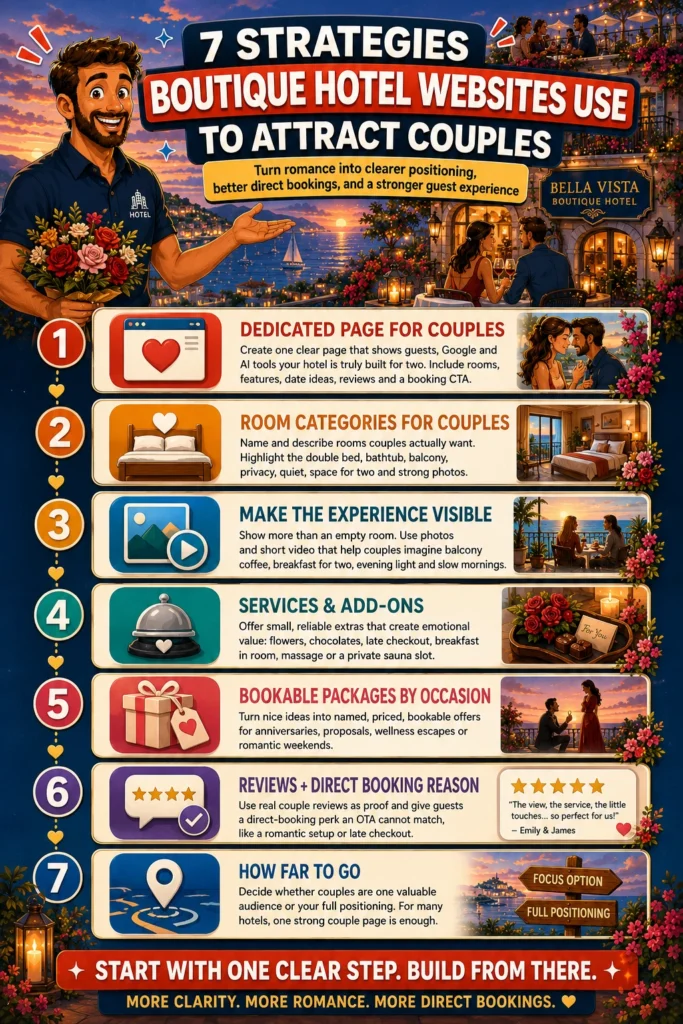
In this guide
- Why couples are an underused opportunity in hotel website content
- The 7-strategy framework for a couples-ready hotel website
- Deep dive into each strategy with a clear action step and a minimum viable version
- Real examples from hotels that do this well
- A quick check for your own website
- How to measure whether it’s working
- How this connects to your bigger direct booking strategy
- FAQs on attracting couples to your boutique hotel
Key Highlights in this article
✔ A dedicated couples page is the single highest-leverage move, but it only works if it answers real questions, not just claims to be “romantic.”
✔ Couples are not one audience. A honeymoon, an anniversary and a proposal are three different searches with three different intents. You don’t need a page for each, but you do need to know which one you’re actually writing for.
✔ You’ll leave this article with 7 standalone strategies, each with a clear action step and a minimum viable version, so you can pick what fits your hotel and start this week.
✔ Small, well-named touches outperform vague luxury. A named package with a clear price beats “we offer romantic experiences” every time, for guests, for Google and for AI tools.
Want to know where your hotel website is losing direct bookings?
Before investing in a bigger website project, start with a free Hotel Website Check.
I’ll show you 3 specific direct booking leaks your hotel can fix within one week. You will know what to improve first and whether a deeper website upgrade makes sense.
Chapter 2: Why Couples Are an Underused Opportunity on Hotel Websites
The 2% figure from the introduction is just the headline. The fuller study and methodology live on my Case Studies page; here is the relevant slice for this article, and what it actually means for where couples are finding hotels right now.
Across 101 Vienna hotel websites, here is how much couple-related content actually existed:
| Website content checked | Hotels with content | Share of 101 hotels |
|---|---|---|
| Couples content | 2 | 2.0% |
| Romantic content | 2 | 2.0% |
| Anniversary content | 3 | 3.0% |
| Any of the three | 5 | 5.0% |
Five hotels, out of 101, in a city that markets itself heavily on romance, music and culture. That is the entire visible supply.
Now look at who actually shows up in the search results couples use to find a hotel:
| Search group | Top-10 results checked | OTA results | Hotel chain results | Independent hotel results |
|---|---|---|---|---|
| “For couples” searches | 57 | 39 (68.4%) | 9 (15.8%) | 5 (8.8%) |
| Couples + romantic + anniversary searches | 177 | 109 (61.6%) | 38 (21.5%) | 21 (11.9%) |
For the exact “hotel for couples” searches, independent hotels captured under 9% of the visible results. OTAs took more than two-thirds. That is the gap this article is about closing.
Here is the part worth paying attention to, with an honest caveat attached. Hotels with couple-related content (couples, romantic or anniversary content, combined) were about 12.8 times more likely to appear in the top 10 results for couple-related searches than hotels without any: 40.0% versus 3.1%. That is a meaningful signal, though it comes from a small sample and it is directional, not proof that content alone causes the ranking. For “couples” content on its own, the sample is too thin to draw a real conclusion: only two hotels had it, neither showed up in the tracked results, while one hotel with no identifiable couple content at all did.
The honest takeaway is this: the data does not prove that one couples page guarantees a ranking. What it shows clearly is that almost nobody is even trying, and the few hotels who do show up tend to be specific about it rather than generic. You will see exactly what that looks like in the four real examples in Chapter 5.
Chapter 3: The Framework - 7 Strategies for a Couples-Ready Website
The gap above is really an opportunity. With so little real competition from other independent hotels, a well-built couples page does not need to be perfect to stand out, it just needs to exist and be specific. The seven strategies below are how you build that.
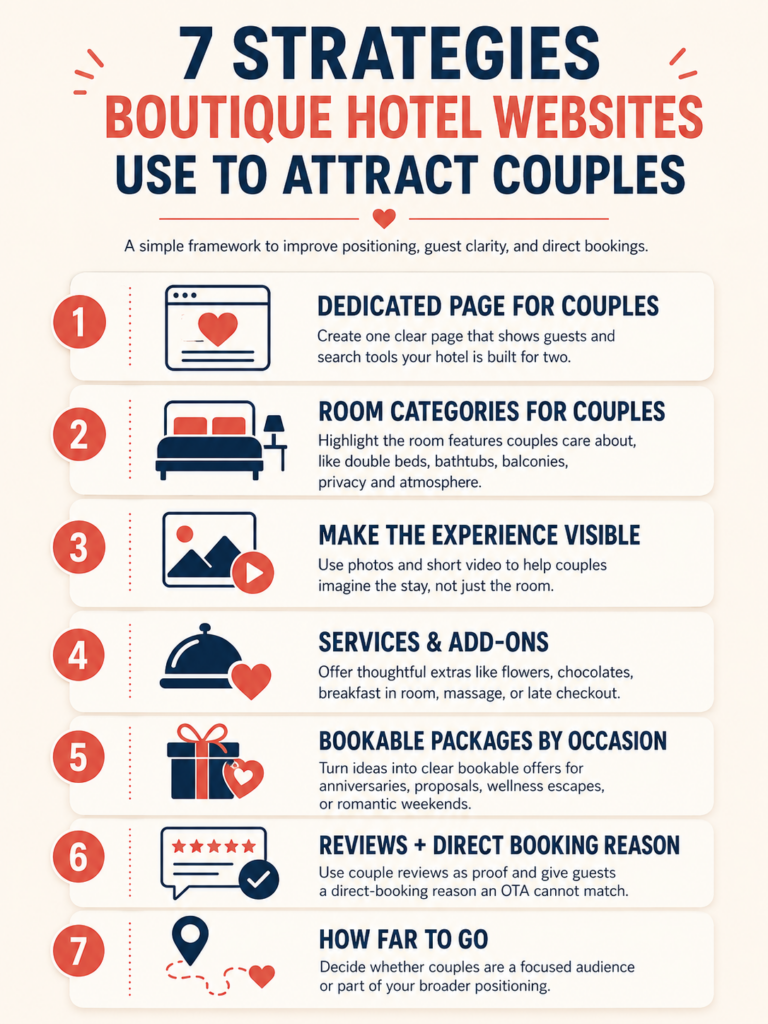
Here is the framework at a glance. Each strategy addresses one part of what a couple needs to see before they book directly.
| Strategy | What it does |
|---|---|
| 1. Dedicated Page for Couples | Tells guests, Google and AI tools this hotel is genuinely built for two |
| 2. Room Categories for Couples | Turns a generic double into a room couples actively choose by name |
| 3. Visible Couple Experience | Photos and video that let a couple picture themselves there |
| 4. Services & Add-Ons | Small touches that create outsized emotional and review value |
| 5. Bookable Packages by Occasion | Turns “we should do something nice” into a named, priced, bookable thing |
| 6. Reviews & Direct Booking Reason | Independent proof, plus a reason not to book on Booking.com |
| 7. How Far to Go | Decide if couples are a feature of your hotel or the whole positioning |
You do not need all seven before you see results. Strategy 1 alone, done properly, changes what Google and AI tools understand about your hotel. Here is each one in detail, with the practical specifics to build it.
Chapter 4: Deep Dive into the 7 Strategies
Each of the seven strategies below stands on its own. You do not need to follow them in order, and you do not need all seven to see results. Pick the one or two that fit your hotel, your team’s time this month, and what your guests already tell you matters, then come back for the rest when you’re ready.
Strategy 1: Create a Dedicated Page for Couples
This is the foundation strategy, and the one I would recommend almost every boutique hotel start with. It turns a vague claim like “perfect for couples” into a clear search and booking asset, the kind of page a guest, Google or an AI tool can actually point to as evidence.
Start by being honest about which kind of couple you are writing for, a romantic weekend, an anniversary, a honeymoon, a proposal, a babymoon, a theatre weekend or just a relaxed city break, since they do not all want the same trip. Then build the page around real specifics: which rooms suit couples, what services exist for two, a short note on romantic spots nearby, and reviews from other couples.
Here is a page structure you can copy directly:
- Hero: “Boutique Hotel for Couples in [City]”
- Best rooms for couples
- Couple-friendly features
- Romantic services and add-ons
- Nearby date ideas
- Couple packages
- Reviews from couples
- FAQ
- CTA: “Check Availability” or “Plan Your Stay”
Make the language concrete, not just warm. Instead of “we are perfect for couples,” write something like: “Choose our Courtyard Double Room if you want a quieter stay, or our Balcony Room if you want morning coffee outside.” That is the kind of sentence a couple can actually act on.
Action step: Build the page using the structure above, with a clear, specific URL like /boutique-hotel-couples-[city], and link to it from your homepage.
Minimum viable version: Don’t build the full page yet. Add one paragraph to your homepage or About page naming the room you’d actually recommend to a couple and why, with a link to that room’s page.
Strategy 2: Design Room Categories for Couples
This strategy stands on its own. You do not need a dedicated couples page first, a hotel can simply create or rename a room category specifically for couples, for example “Double Room for Couples” or “Romantic Balcony Room,” and give it its own dedicated room page, the same way you would for any other room category.
For the general structure of a strong room page, photos, layout, amenities, booking button, see my article on how to write hotel room descriptions. What matters specifically for this strategy is which details you choose to highlight, the ones that actually matter to a couple, not a full rewrite of how you write room pages in general.
Run a quick couple-room audit on each of your existing room categories. Check whether it has:
☐ A real double bed ☐ A bathtub or large shower ☐ A balcony or view ☐ A quiet location ☐ Warm lighting ☐ Enough space for two ☐ A seating area ☐ Privacy ☐ Amenities for both guests (a large mirror, a hairdryer, products that suit different needs) ☐ A late checkout option ☐ Strong, specific photos
Action step: Pick your strongest couple room, give it its own clearly named page, and write the description around the details above instead of just size and price. You can do this even if the official category name in your booking engine stays the same for now.
Minimum viable version: Rename one existing room category on its own page this week. Weak: “Superior Room.” Better: “Quiet Double Room with Bathtub for Two.”
Strategy 3: Make the Couple Experience Visible
This strategy is purely about what your photos and video actually show, independent of how you have named your rooms or built any page. Couples should not have to imagine the stay from an empty bed photo alone.
Two types of images do this job, and you need both. First, clear, accurate photos of the hotel and the room itself, so a couple knows exactly what they are booking, the real bed, the real bathroom, the real view. Second, photos and short video that capture moments and settings, the kind of scene that lets a couple imagine themselves there, not just see the furniture.
A short shot list for the second type:
- Two coffees on the balcony
- Breakfast table for two
- A couple entering the room
- Bathtub or shower detail
- Evening lighting in the room
- Flowers or a small occasion setup
- A couple walking nearby
- A restaurant or bar recommendation
- A slow breakfast moment
- Late checkout, relaxed morning feel
Action step: Audit your current room and couples-page photography. If everything is an accurate but empty room shot, you already have the first type covered, plan one modest shoot to add the second. Do not fake the romance with cliché roses scattered everywhere, the goal is to show the stay as a real experience for two people, not a staged photo of one.
Minimum viable version: If a full shoot is not realistic this month, take five usable phone photos of one room set up for two (coffee on the table, a robe laid out, evening lighting) and add them alongside your existing accurate room photos.
Strategy 4: Offer Couple-Specific Services and Add-Ons
This strategy is about giving couples something concrete to look forward to, beyond a nice room. Small services create disproportionate emotional value for couples, but only the ones you can actually deliver, every single time.
Split your add-ons into three tiers:
- Simple: flowers, a handwritten note, chocolates, an alcohol-free sparkling drink, late checkout
- Experience: breakfast in the room, a private sauna slot, a massage, a picnic basket, a dinner reservation
- Special occasion: an anniversary setup, proposal support, a birthday surprise, a honeymoon welcome
One rule worth following strictly: only offer what you can deliver reliably. A bad romantic surprise is worse than no romantic surprise at all, it is very efficient at ruining the mood.
Action step: Build a small “Make Your Stay Special” section with 3 bookable options, not a long, vague list nobody reads.
Minimum viable version: Pick one Simple add-on (a welcome drink or late checkout) and add a single line offering it on your booking confirmation email and one room page. No new page required.
Strategy 5: Build Bookable Packages for Couple Occasions
This strategy turns individual nice touches into a single bookable product. A package turns “we should do something nice for couples” into a named, priced, bookable thing a couple can choose with one click, instead of assembling the right add-ons themselves. Different occasions want different trips, and one generic “romance package” rarely fits an anniversary, a honeymoon and a proposal equally well.
Use this template for each one:
- Name
- Who it’s for
- What’s included
- Best room type
- Price or starting price
- Available days
- How to book
- Optional upgrades
- Cancellation terms
- One review or quote from a similar stay
A few names to start from: Anniversary Weekend for Two, Romantic City Break, Theatre Weekend for Couples, Wellness Stay for Two, Proposal Stay Package, Slow Sunday Escape.
One reality check before you publish any package: confirm it is actually bookable in your booking engine in one or two clicks, not “email us to book this.” A beautifully named package that requires an email round-trip quietly reintroduces the exact friction guests are trying to avoid. If your booking engine cannot handle a package directly, that is the same handoff problem I cover in the booking funnel article, worth fixing there first.
Action step: Start with one package based on existing demand. If your reviews already mention anniversaries often, build the anniversary package first. If guests keep asking about wellness, start there instead.
Minimum viable version: Take your single best Simple add-on from Strategy 4, give it a name and a price, and offer it as a clickable extra on one room page.
Strategy 6: Use Couples' Reviews as Proof, and Give Them a Reason to Book Direct
This strategy works whether or not you have a dedicated page or package yet. It is about using your own guests’ words as proof, and giving them one concrete reason to book on your website instead of an OTA. This is the same review principle from Strategy 8 in my direct bookings article, applied specifically here: independent proof, paired with a reason not to book elsewhere.
Split it into two actions.
Review mining: search your existing reviews for phrases like “anniversary,” “romantic,” “quiet room,” “beautiful bathtub,” “perfect for couples,” “great breakfast,” “helped with our proposal,” or “lovely weekend.” Place the strongest ones next to the relevant page or package, not buried in a generic testimonials carousel.
Direct booking perk: give couples something an OTA genuinely cannot offer: priority room preference, late checkout, a romantic setup request, a welcome treat, a free local couple itinerary, or easier planning for a special occasion. As I like to put it: book direct if you want the most personal version of your stay.
Action step: Read your last twenty reviews for couple-specific language, place the best ones strategically, and add one direct-booking-only perk that fits a romantic stay.
Minimum viable version: This week, pull the three best couple-related lines from your existing reviews and place them on your homepage or your best couple room page. Nothing else needs to change yet.
Strategy 7: Decide How Far to Go - One Page or Full Positioning
This one is less an action and more a decision, and it is worth making honestly before you invest heavily in any of the strategies above. Not every boutique hotel should turn its entire identity into “the couples hotel.” For most, a strong dedicated page is enough. Going further, positioning the whole hotel around couples, only makes sense if it genuinely fits.
Go all-in on couples if:
- Couples already make up a meaningful share of your bookings
- Your reviews already mention romantic stays
- Your rooms genuinely fit couples
- Your location supports couple activities
- Your team can reliably deliver special requests
- It does not risk alienating a more important guest segment
Stick to a dedicated page if:
- Couples are one of several important audiences for you
- You only have a few rooms or services genuinely suited to them
- Your homepage needs to stay broader for other guest types
- You also strongly serve families, business travellers or groups
Action step: Before rewriting your homepage, check your reviews, booking notes and the questions guests actually ask. If couples already show up there naturally, the positioning may already exist, your website just has not caught up yet.
Minimum viable version: Don’t change anything on the website yet. Spend ten minutes checking your last 20 bookings and reviews for how often couples already show up, that tells you whether this strategy is worth pursuing further.
Want more practical hotel website ideas in your inbox?
In my newsletter, I share clear, actionable ideas for hotel owners and marketers who want more guests to find, trust, and book their hotel directly.
Chapter 5: Practical Examples
Reading about these strategies is one thing. Seeing how real hotels, from a Caribbean cliffside resort to a small city-centre boutique hotel, put them into practice is another.
Example 1 - Jade Mountain, Saint Lucia
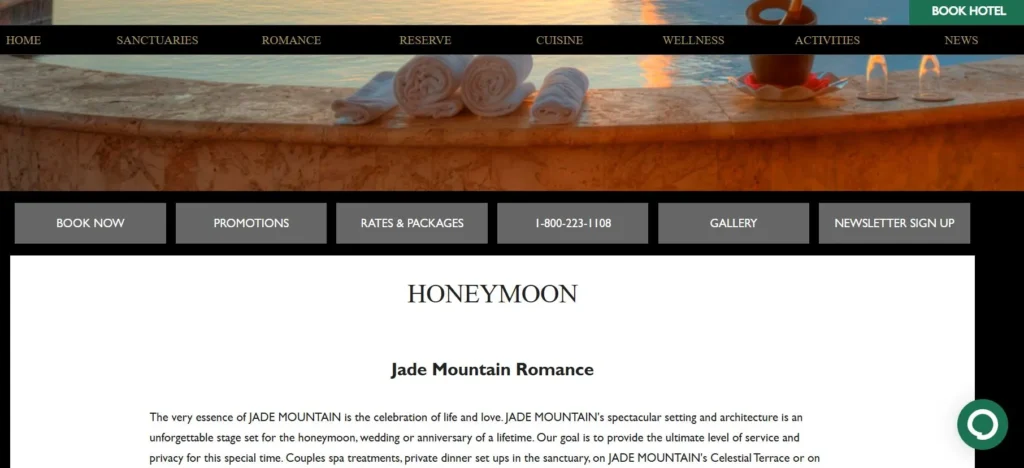
Website: Jade Mountain
Jade Mountain does not have one “couples” page. It has an entire Romance section in its main navigation, split into Weddings, Honeymoons, Anniversaries, Vow Renewal and Gifts. Each occasion gets its own dedicated content rather than sharing a single page.
Take away: a single page is the right starting point for most boutique hotels, but if couples genuinely make up a large share of your guests, splitting by occasion the way Jade Mountain does can help, since a honeymoon search and an anniversary search are not the same search.
Example 2 - Secret Bay, Dominica
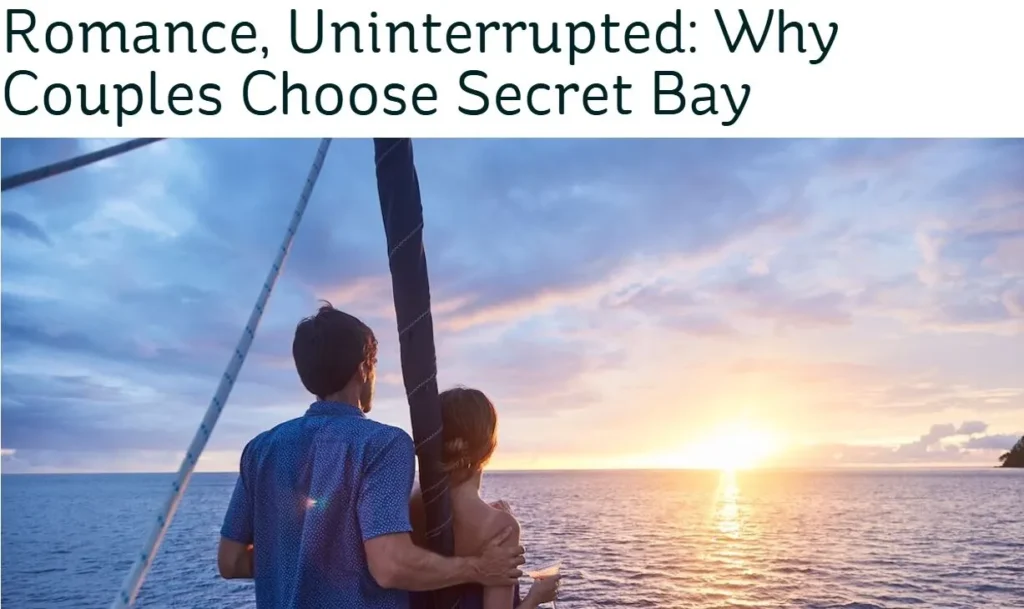
Website: Secret Bay
Secret Bay’s couples page does not claim to be romantic. It describes the actual experience: slow mornings, breakfast served on a private deck, no fixed schedule, days that stretch. The resort’s 27 private villas include a distinct “Honeymoon Villas” category, and five separately named packages built around different couple occasions, from a more adventurous getaway to a quieter, wellness-focused one. Notably, Secret Bay still offers separate villas for families and friends, proving a strong couples identity does not require shutting other guests out.
Take away: describe the feeling instead of the adjective. “Romantic” is a claim. “Mornings begin slowly, breakfast on your own deck” is proof a couple can picture.
Example 3 - Boutiquehotel Staats, Haarlem
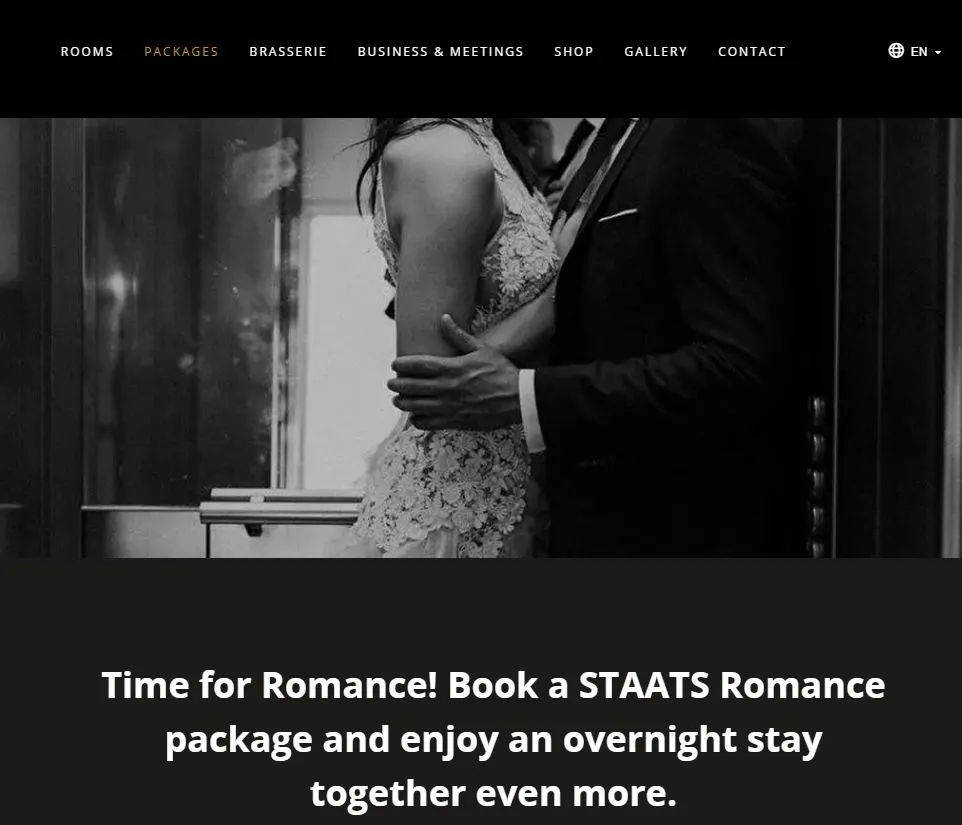
Website: Boutiquehotel Staats
This city-centre boutique hotel offers a simple Romance add-on available on any room category for a modest surcharge: a small bottle of prosecco waiting in the room and rose petals on the bed, with optional extras available locally if a guest wants more.
Take away: you do not need a private island to do this. A small, clearly named, clearly priced add-on is often enough for a city boutique hotel to give couples a reason to book that specific room, on that specific website. One caveat worth flagging: Staats currently books this add-on by email rather than inside the booking engine itself, exactly the kind of friction Strategy 5 above warns against. The idea is excellent, the booking path is the part worth upgrading.
Example 4 - Post Ranch Inn, Big Sur
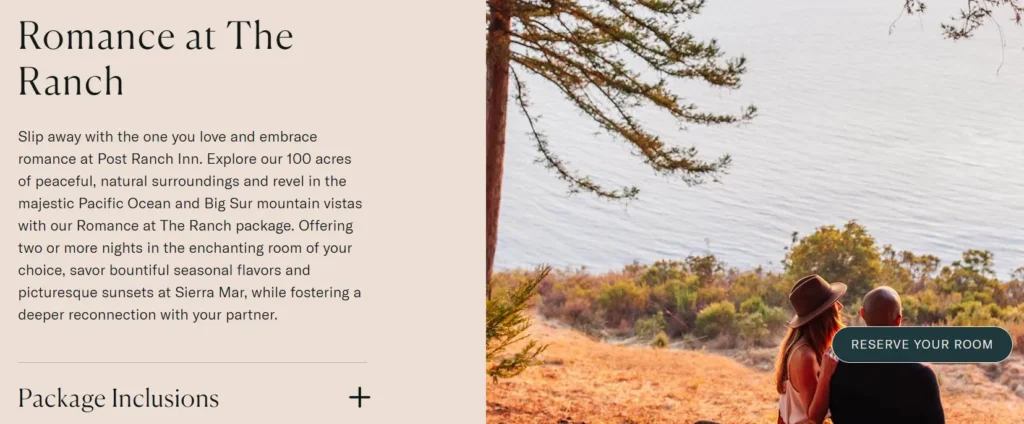
Website: Post Ranch Inn
Post Ranch Inn runs four distinct, named packages built around different couple occasions: a general Romance package (multi-night stay, dinner for two, champagne on arrival), a Honeymoon package with extra nights and touches, a Babymoon package for expecting or new parents (built around rest and sleep, not adventure), and two tiers of Proposal package with a private cliffside setting and a photographer included.
Take away: not every couple wants the same trip. Segmenting packages by occasion lets each one speak precisely to what that couple is actually there for, which is also exactly the kind of specific, long-tail search (“babymoon package hotel,” “hotel proposal package”) that AI tools and Google reward.
Between these four examples, you have seen all seven strategies in action at very different price points and scales. Time to check where your own website stands.
Want more hotel website ideas and examples like this?
I regularly share practical thoughts on hotel SEO, AI search, direct bookings, website clarity, and how independent hotels can become easier to find and book directly.
Chapter 6: Quick Check - Is Your Website Ready for Couples?
You’ll find an interactive check right below this section. Go through it honestly, the same way you would size up your hotel through a guest’s eyes. It will show you which of the 7 strategies above your website already covers well, and which one is your fastest next win.
Which couples strategy should your hotel build first?
Answer two questions for each strategy: does your website already cover it, and how well does the strategy fit your actual hotel? The result shows your strongest next opportunities to attract couples and win more direct bookings.
Tip: Be honest. A strategy only works if the website says it clearly and the hotel can genuinely deliver it.
Once you know where you stand, here is how to check over time whether it’s actually working.
Bonus Chapter: Measurement - How to Know Whether It's Working
Publishing the page is the start, not the finish. Here is how to check, in the weeks after you publish, whether any of this is actually moving the needle.
Branded and “couples” impressions in Search Console: track impressions for combinations like “[hotel name] couples,” “boutique hotel couples [city],” or “[hotel name] anniversary.” A new, specific page typically needs six to twelve weeks to show movement here, so check monthly rather than daily. If you create a dedicated page for couples, you can track it’s performance individually on Google Search Console. Just filter for the URL of the page. Learn how to set up Google Search Console here.
Booking-engine clicks from the couples page specifically: if your analytics can isolate it, track how many visitors click through from the couples page, or a couple-named room page, into your booking engine. This tells you whether the page is doing its actual job, not just attracting visits.
The 30-second AI test: before you publish, ask ChatGPT, Gemini and Perplexity to “recommend a boutique hotel for couples in [your city]” and note whether, and how, you’re mentioned. Ask the same question again six to eight weeks after publishing. AI tools lag behind fresh content the same way Google does, so don’t expect a change in week one, but a page that didn’t exist before now has a real chance of being the answer.
None of these need a dashboard or a developer. A spreadsheet with three rows and a five-minute monthly check is enough to know if a strategy is working, or if it’s time to try a different one from Chapter 4.
Once you have a way to track progress, here is how this single page fits into your bigger direct booking strategy.
Chapter 7: Connect This to Your Bigger Direct Booking Strategy
The broader strategy behind this article is simple: find a clear positioning for your hotel and attract specific audiences instead of everyone at once. The goal is to position your website for SEO and AI search so it can become your main booking channel and you can rely less on OTAs. Targeting a specific audience, like couples, is one of the most effective ways to do that, which is exactly what I cover in How Boutique Hotels Get More Direct Bookings.
The logic is the same flywheel from that article. A guest searches something specific. Your website, not an OTA listing, answers it precisely. They book directly because the page already removed their doubts. They arrive, the stay matches what the page promised, and they leave a review that helps the next couple find you the same way.
One quick note before moving on: the goal of the couples page itself is not to rank for every “romantic hotel” search out there. It is to be the clear answer for the couples who are already a strong match for your hotel, the kind who actually book once they find you.
If you want to go deeper on any single piece of this, here is where to look next.
Chapter 8: Go Deeper with Related Articles 🔗
On how guests search, so you write the right content: → How Guests Actually Search for Hotels → AI Search for Hotels
On where this page fits in your site structure: → How to Structure a Hotel Homepage → Hotel Website Structure
On turning this into bookings, not just visits: → Hotel Room Descriptions That Drive Direct Bookings → How Hotels Reduce Dependency on Booking.com and Expedia
The bigger picture this article fits into: → How Boutique Hotels Get More Direct Bookings: 8 Strategies That Work
Conclusion: Couples Are Already Looking For You
Most boutique hotels are not losing couples to Booking.com because of price. They are losing them because nothing on the website actually says “this is for you,” in a way specific enough for a guest, Google or an AI tool to believe it.
You do not need all seven strategies on day one. Start with the dedicated page. Make it specific, not just warm. Add one named package built around the occasion you already see most. Then build from there.
Couples are already searching for exactly what your hotel offers. The only question is whether your website is the answer they find, or whether Booking.com gets there first.
If you found this helpful and want more ideas like this:
👉 Follow me on Substack for deep-dive guides on hotel SEO, AI, and direct bookings
👉 Connect on LinkedIn for shorter insights and real-world examples
Want to improve more than just this one page?
This guide focuses on one specific part of your hotel website. But direct booking growth usually comes from improving the full system: your positioning, homepage, room pages, feature pages, Google visibility, AI search readiness, and booking journey.
FAQs on the Hotel Booking Funnel
1. What's the single highest-impact thing a boutique hotel can do to attract couples online?
Build one dedicated, specific page for couples, and name at least one room category around what it actually offers them. Together, these two changes do more for visibility and conversion than any amount of generic “romantic” language scattered across your homepage.
2. Do I need a separate page for every couple occasion, like honeymoons, anniversaries and proposals?
No, not at first. Start with one combined couples page that’s honest about the occasions you serve well. Only split into separate occasion pages, the way Jade Mountain does, once couples make up enough of your bookings to justify the extra content and the upkeep that comes with it.
3. What's a low-cost couples package I could launch this week?
Pick two or three items from the “simple” add-on tier in Chapter 4, like a small welcome treat and a late checkout, give the bundle a name and a clear price, and make it bookable from the room page. It doesn’t need to be elaborate to give a couple a reason to book directly instead of comparing prices on Booking.com.
4. How is this different from just calling my hotel "romantic" on the homepage?
A claim like “romantic” tells a guest nothing concrete. Naming the actual room feature, the view, or the specific touch you offer gives a guest something to picture, and gives Google and AI tools something specific to match a search against.
5. Will a dedicated couples page hurt my visibility for other types of guests, like families or business travellers?
No. A couples page adds content, it doesn’t replace anything else on your site. Your homepage and other guest-type pages keep doing their job exactly as before. The couples page simply gives you a precise answer for searches you currently lose to OTAs almost entirely, and the guests who find it that way are already a strong match for your hotel, which is exactly why a page like this tends to convert well even though it’s built for a smaller, specific audience.
Have a question or want to share what’s working for your hotel? Drop a comment or reach out directly — I’d love to hear from you. 😊
If you’re a hotel owner and tired of being invisible for the searches that matter, click below and see how I can help you turn your website into a clear, high-converting booking engine.